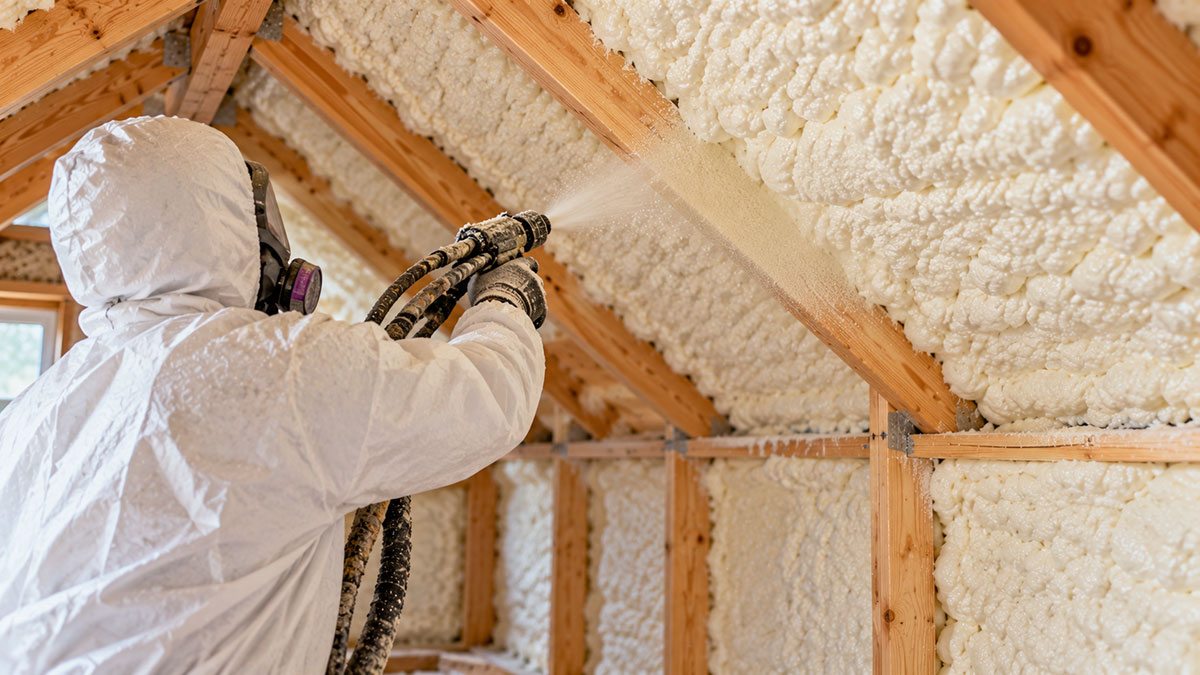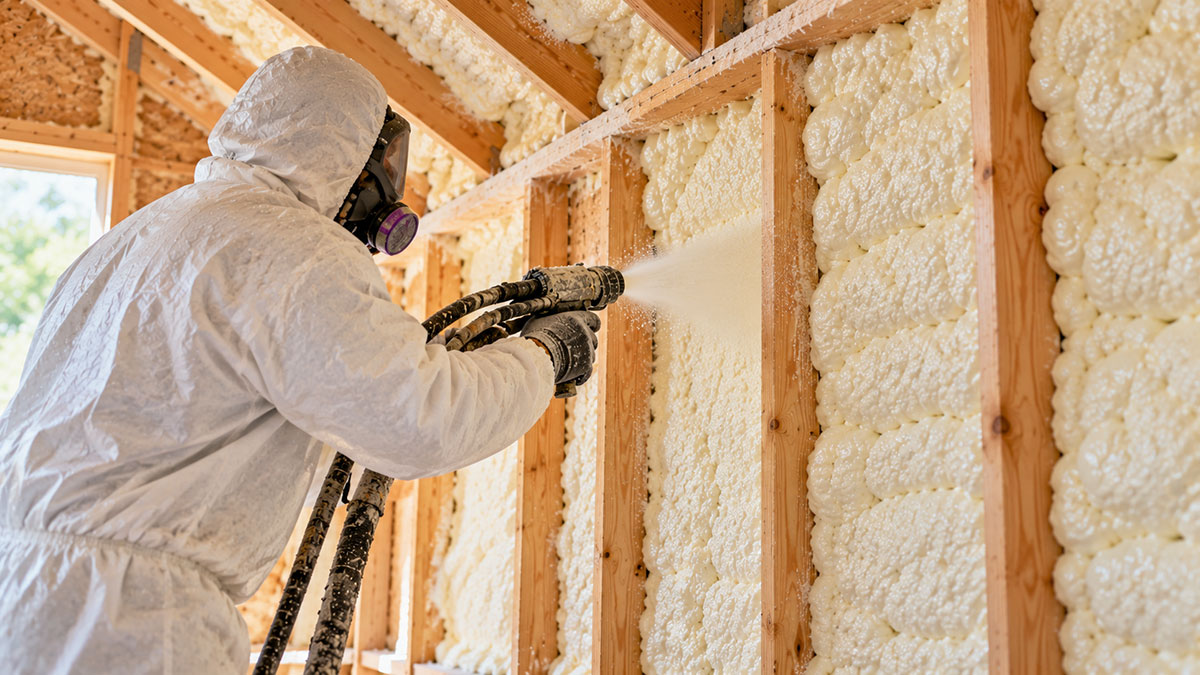
Huntsman Building Solutions sells Icynene as two separate foam families. The open-cell side is a no-mix platform, and the closed-cell side is blown with HFO. Contractors specify the line for attics, wall cavities, crawl spaces and roof decks, and they usually compare it with fiberglass and cellulose insulation on installed r-value per inch, not on sticker price alone.
Icynene Ultra 50’s evaluation report (ESR-5497, issued May 2024 and revised November 2024) documents single-pass application up to the product’s full rated thickness. Closed-cell lines such as Icynene HFO Max can’t do that, since each pass there caps at 6.5 inches.
What Is Icynene Spray Foam Insulation?

Huntsman Building Solutions makes Icynene as a line of spray polyurethane foam products for homes and commercial buildings.
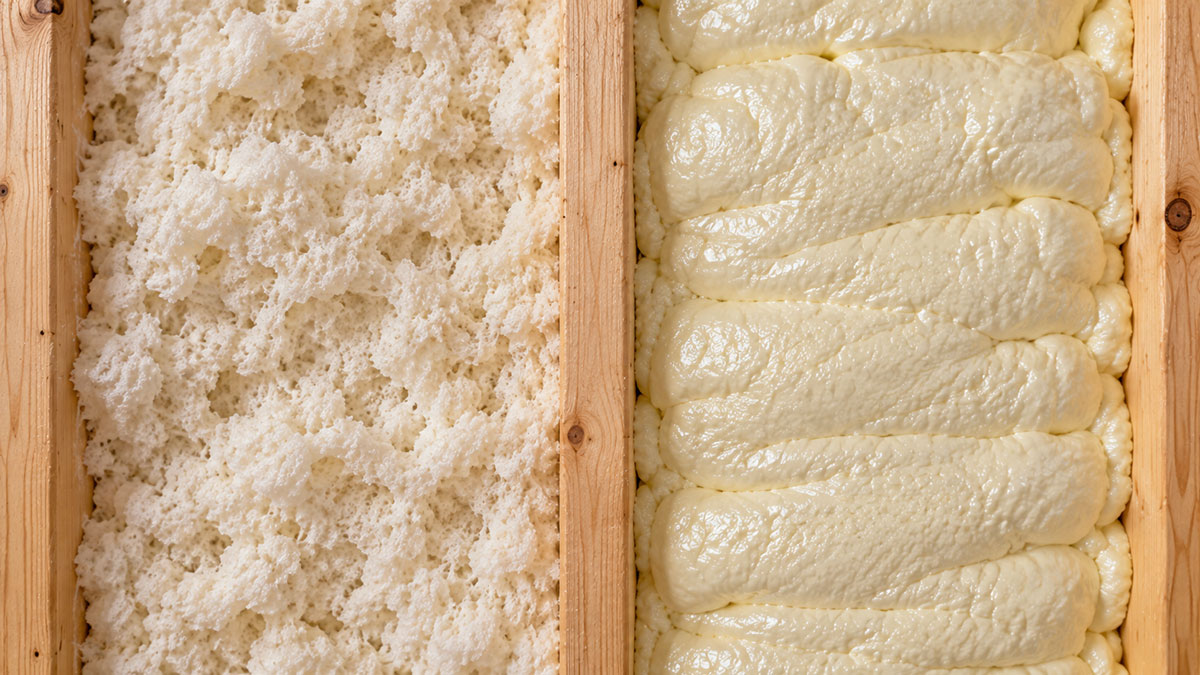
Some of them are open-cell, which means lighter and more flexible foam. The rest are closed-cell, which is denser and adds structural rigidity.
Where Icynene stands out in the wider spray foam insulation category is the no-mix open-cell systems. The resin doesn’t need mixing before you spray it, though the foam still goes on as a two-component, 1-to-1 by volume product.
Both families close gaps and cracks across the building envelope in a single pass. That’s the basis for Icynene’s air sealing claims.
What Is the Difference Between Open-Cell and Closed-Cell Icynene Foam?
Density, r-value per inch and moisture handling are where the two types part ways.
Closed-cell foam runs roughly three to four times denser than open-cell foam, and that extra density is what pushes its r-value per inch higher.
| Attribute | Open-cell Icynene | Closed-cell Icynene |
|---|---|---|
| Density | About 0.5 to 0.75 lb per cubic foot | About 2 lb per cubic foot |
| R-value per inch | Roughly 3.7 to 4.0 | Roughly 6.0 to 7.4 for HFO-blown products (water-blown ProSeal Eco is about 4.9) |
| Vapor status | Vapor permeable, not a retarder | Recognized vapor retarder at rated thickness |
| Structural role | None, soft and flexible | Adds racking shear strength |
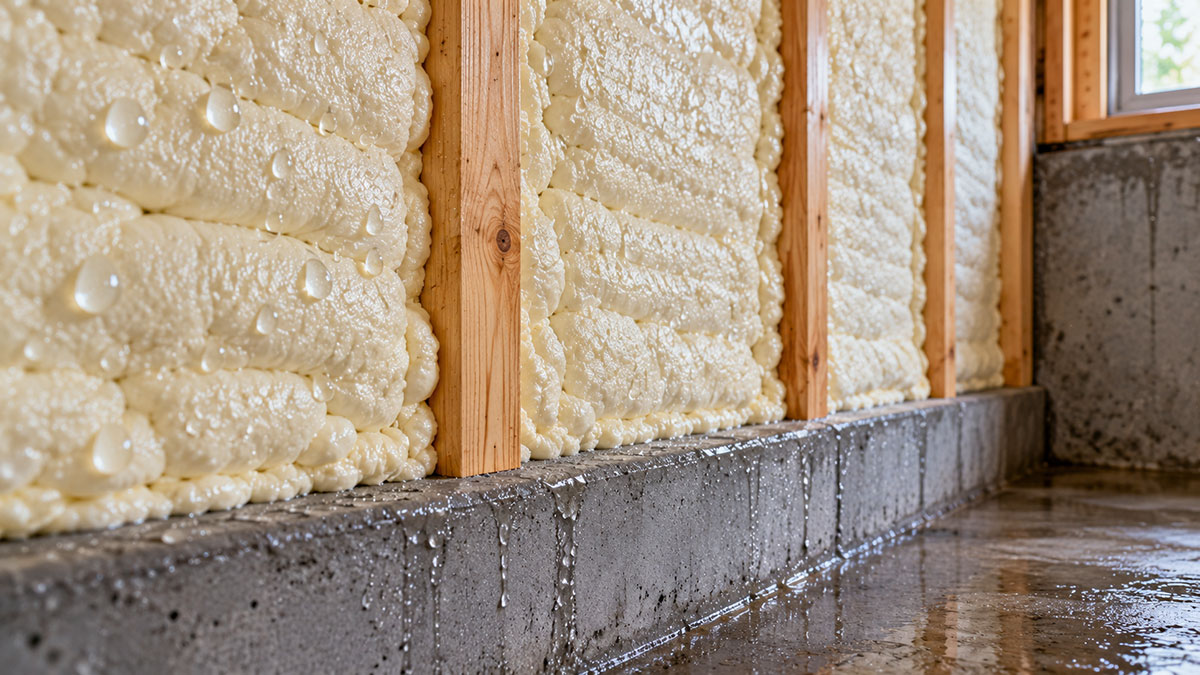
Each cell in closed-cell foam is fully sealed shut, and that structure gives Icynene’s closed-cell products their water resistance.
The rigid layer also works as continuous insulation across studs and framing. It cuts thermal bridging, which open-cell foam can’t really do by itself.
Top Icynene Open-Cell Spray Foam Products

The open-cell lineup starts at a no-mix flagship and ends at a system made just for attics and crawl spaces. Each one fits a slightly different job, from vaulted ceilings to unvented attics.
Icynene Prime NM
Prime NM is the current no-mix, open-cell flagship from Huntsman Building Solutions. It was engineered for sprayability and flexible application.
It meets AC377 Appendix U (the alternate test path for unvented attics) and the 2024 IRC and IBC building codes. You can spray pass on pass with minimal wait between lifts, and the wide operating window means fewer delays from ambient conditions, which large jobs appreciate.
The downside is that open-cell chemistry still needs added vapor management in cold climates.
Icynene Classic 45
Classic 45 is a low-density, 100 percent water-blown open-cell foam. Huntsman Building Solutions states it can go into unvented attics without an ignition barrier or coating, and its aged r-value is 3.7 per inch.
It’s the product the current Icynene Series lineup lists for this role. The earlier Icynene Classic Max no longer shows up in that list.
The yield is high and the density is low. Crews install it in attics and crawl spaces without an ignition barrier where the evaluation report allows it. Occupied spaces still need a code-required thermal barrier over it.
Icynene Xpress 55
Built specifically for unvented attics and crawl spaces.
Xpress 55 is a low-density open-cell system that meets Appendix X requirements and skips the ignition barrier when the space serves utilities only. It also bonds well between spray passes.
Don’t plan on it for general wall cavities. That’s not what it’s for.
Icynene High-R 80
High-R 80 is the open-cell option with the highest per-inch r-value in the family.
At 0.75 lb density it gets air barrier properties that the lighter open-cell foams don’t have on their own. You need fewer inches to reach a target r-value, but it costs more per board foot than standard open-cell foam.
Icynene Ultra 50
Ultra 50 is pitched as an easy-to-spray, industry-leading open-cell option for routine wall and attic work.
Spray behavior is predictable at standard cavity depths, which is most of its appeal. Per-inch r-value trails High-R and the closed-cell lines.
Top Icynene Closed-Cell Spray Foam Products
Closed-cell products are meant for exterior-exposed and below-grade applications, where moisture and structural load matter. Every product here carries a recognized vapor retarder rating at its tested thickness.
Icynene HFO Max
HFO Max is the flagship closed-cell system, an HFO-blown product for commercial and residential builds.
It sprays in passes from 1 to 6.5 inches thick, and the foam’s core temperature has to drop below 100°F before the next pass goes on.
One product covers air barrier and recognized vapor retarder duty. The HFO blowing agent also lowers the environmental footprint compared with legacy chemistries. Material costs more per board foot than any open-cell option in the lineup, which is the trade.
Icynene HFO 200
Built as a continuous insulation layer across roof decks and walls.
Icynene markets HFO 200 as one of the more thermally efficient closed-cell products in the line, with an aged r-value of 7.4 per inch. Moisture vapor permeability is low, and it adds shear and racking strength to framed walls. Commercial and residential jobs both work.
Icynene ProSeal
ProSeal is for crews that want a high-yield closed-cell product that still meets current code across climate zones. Huntsman Building Solutions now files it under legacy closed-cell products.
The all-season formulation is rated to spray down to 23 degrees Fahrenheit, so crews can keep working later into the season. The higher yield also cuts material waste on large jobs.
Icynene ProSeal Eco
ProSeal Eco is the medium-density closed-cell product, built on a 100 percent water-blown formulation. That’s the same base chemistry as Icynene’s original open-cell line.
Nothing gets added as a blowing agent beyond water, so it suits projects aiming for a lower blowing-agent footprint. What you give up is r-value. At about R-4.9 per inch it sits well below the HFO-blown closed-cell products.
What R-Value Do Icynene Spray Foam Products Deliver?

Open-cell products land in the R-3.7 to R-4.0 per inch range, and the HFO-blown closed-cell line reaches roughly R-6.0 to R-7.4 per inch.
For code compliance, the number that counts is the aged r-value rating. The figure measured right after spraying doesn’t.
Aged r-value by product, from Huntsman Building Solutions 2024 data:
- Icynene HFO Max, closed-cell: R-7.4 per inch
- Icynene High-R 80, open-cell: R-4.0 per inch
- Icynene Ultra 50, open-cell: R-3.81 per inch
- Icynene OC No-Mix, open-cell: R-3.9 per inch, or R-3.7 per inch at 4 inches or greater
- Icynene Classic 75, open-cell: rated to reach R-20 in walls and roof decks
Wall and roof deck assemblies rarely land on one clean per-inch number, since the thickness actually sprayed drives the final assembly rating.
What Code Compliance and Fire-Test Certifications Do Icynene Products Carry?
Both open-cell and closed-cell products carry ICC-ES evaluation reports built around AC377, and they also go through fire and emissions testing under ASTM and GREENGUARD standards.
Huntsman Building Solutions documents these separately for each product line. There’s no blanket rating.
ICC-ES AC377 Appendix U and Appendix X
ICC-ES issues the evaluation reports that let code officials approve Icynene products for specific uses.
HFO Max is documented under evaluation report ESR-5496, reissued in May 2025 and listed as subject to renewal in May 2026, so check the ICC-ES site for the current version. The report’s Seal and Insulate with ENERGY STAR supplement also covers thermal resistance and surface-burning characteristics under that program.
Appendix U gives an alternate fire-test path for foam installed in unvented attics with a downward opening. Appendix X governs attic and crawl space installations, including when you’re allowed to skip an ignition barrier.
ASTM E84 and NFPA Fire Ratings
HFO Max tests at a flame spread index of 25 or less under ASTM E84 (at up to 4 inches). That sits at the top of the Class A range, which tops out at 25.
The number sits alongside NFPA 285 and NFPA 286 assembly testing. Those cover how exterior walls and room corners perform in a full-scale fire, not in a small sample.
Builders pulling permits in jurisdictions with strict fire codes lean on this documented fire rating to avoid a rejected inspection.
Blowing Agent Transition to HFO Technology
Icynene’s original open-cell products used a 100 percent water-blown process. The closed-cell HFO line has moved away from older high-GWP blowing agents.
Legacy agents carried a global warming potential roughly a thousand times higher than carbon dioxide, and the newer closed-cell products use hydrofluoroolefin technology to cut that footprint sharply.
Several Icynene products, including ProSeal and Classic Max, have earned GREENGUARD Gold certification, which caps allowable VOC emissions for indoor air quality. Check the certification listing for the specific product before specifying it.
How Much Does Icynene Spray Foam Insulation Cost?
Open-cell Icynene runs roughly $1.50 to $3.50 per square foot installed, and closed-cell Icynene runs roughly $3.00 to $5.00 per square foot installed.
Those ranges track general spray foam pricing reported by HomeGuide, and they include both material and labor.
| Foam type | Installed cost | Typical r-value per inch (general spray foam) |
|---|---|---|
| Open-cell | $1.50 to $3.50 per sq ft | 3.5 to 3.7 |
| Closed-cell | $3.00 to $5.00 per sq ft | 5 to 7 |
Job size and how accessible the space is push the price around, and so does the thickness needed to hit a target r-value. Trimming around studs adds more.
Contractors typically set a minimum job fee, so a small crawl space or a single wall cavity often costs more per square foot than a full attic.
Installers certified under Spray Polyurethane Foam Alliance guidelines often charge more. They also cut the odds of a callback for shrinkage or gaps.
A general spray foam cost breakdown is useful context here, since Icynene pricing tracks close to the category average rather than sitting far above or below it.
Fiberglass insulation remains the cheaper baseline for a straight material-cost comparison. It doesn’t seal air the way Icynene’s foam does in one pass, though.
How Does Icynene Compare to Other Spray Foam Brands?

Icynene sits inside a Huntsman Building Solutions portfolio that also owns Demilec and Lapolla, so several products marketed as competitors share the same parent company.
BASF Walltite and Carlisle SealTite come from independent manufacturers. Both companies also sell open-cell foam.
| Brand | Parent company | Cell types offered | Key certification |
|---|---|---|---|
| Icynene | Huntsman Building Solutions | Open-cell and closed-cell | AC377 Appendix U and X |
| Demilec Heatlok | Huntsman Building Solutions | Open-cell and closed-cell | AC377 Appendix X, ESR-4073 |
| Lapolla Foam-Lok | Huntsman Building Solutions | Open-cell and closed-cell | Product-specific ICC-ES reports, such as ESR-2629 for Foam-Lok FL2000 |
| BASF Walltite | BASF Corporation | Open-cell (Enertite) and closed-cell (Walltite) | ESR-2642 (Walltite LWP, Max and One) |
| Carlisle SealTite | Carlisle Companies | Open-cell and closed-cell | Product-specific evaluation reports |
Demilec Heatlok HFO products and Icynene HFO products are both HFO-blown lines from the same manufacturer, so their chemistry is closely related.
In practice, the gap between Icynene and its Huntsman siblings usually comes down to regional distributor relationships and installer training. Formulation quality isn’t really the difference.
BASF Walltite is the most direct outside comparison. Its code compliance rests on its own evaluation report, ESR-2642, and NFPA 285 assemblies, independent of Huntsman’s evaluation reports.
When Does Icynene Spray Foam Not Apply?
Icynene isn’t approved for direct contact with rain or standing water, and it doesn’t go inside electrical outlet and junction boxes.
Huntsman Building Solutions’ own evaluation reports spell out several other hard limits, and a crew should read them before showing up with a rig.
Per the ICC-ES evaluation reports for Huntsman Building Solutions:
- Wood substrate moisture content must stay under 19 percent before spraying
- Icynene HFO Max must be applied when the ambient and substrate temperature is between 10°F and 120°F
- No Icynene product is rated for sustained service above 180°F
Substrates covered in frost, ice, loose scale, rust, oil or grease get skipped, or cleaned and re-checked. Nobody sprays over them.
Once cured, Icynene doesn’t come back out easily. That permanence is worth weighing before you fill a cavity that might get reconfigured later.
A crew planning demolition or a future retrofit should look into how to remove spray foam insulation before committing to a full cavity fill.
Open flame is outside what any spray foam is built to handle. Whether spray foam insulation is flammable comes down to the product’s tested rating, so read that document before specifying it near a heat source.
Is Icynene Spray Foam Safe for Indoor Air Quality?
The foam releases volatile organic compounds while it cures, then stops once the polyurethane reaction finishes.
Safety mostly comes down to timing. Stay out of the space long enough for that reaction to complete.
VOC Emissions and Curing Time
Spray polyurethane foam forms when methylene diphenyl diisocyanate, known as MDI, reacts with a polyol blend under heat from the spray rig. The reaction produces the strong odor during and right after application.
Huntsman Building Solutions recommends a 24-hour re-occupancy time for homeowners and building occupants when appropriate ventilation is used. Re-entry periods for workers vary by product and ventilation rate, following EPA and American Chemistry Council ventilation guidance.
Only contractors authorized by Huntsman Building Solutions are permitted to handle and apply the A-side and B-side components, since both carry documented health risks before they cure.
GREENGUARD Gold and Reoccupancy Guidance
GREENGUARD Gold testing runs foam samples through a small-chamber emissions method closely related to California’s CDPH Standard Method for indoor air contaminants.
The protocol measures what actually off-gasses from a cured sample, not just what goes into the mix at the nozzle. Chamber testing tracks emissions over an extended post-cure window, and the results feed into both GREENGUARD Gold certification and California’s Section 01350 compliance path.
Good ventilation during and after spraying shortens the practical wait beyond the manufacturer’s minimum. It’s the main factor in how soon a space is genuinely safe once the spray foam insulation has cured.
How Is Icynene Spray Foam Insulation Installed?

The install follows a sequence built around temperature control. Spraying material into a cavity is only part of it, and skipping a step in the sequence causes most of the callbacks contractors deal with.
- Check substrate moisture, temperature, and cleanliness against the product’s evaluation report limits
- Warm up the proportioner and hose heaters to the manufacturer’s setpoint temperatures
- Run an off-target test spray to confirm pressure and temperature before touching the actual cavity
- Spray in controlled passes within the product’s minimum and maximum thickness per pass, respecting the wait time between lifts
- Trim open-cell foam flush with the studs once it has set
- Hold re-entry until the manufacturer’s cure window has passed
- Confirm the finished air seal performs as designed
That last step usually means a blower door test, which measures air leakage directly instead of relying on a visual check.
Huntsman Building Solutions advises against flash-coating a cold substrate with heated chemical. If the substrate is too cold, warm it with an indirect-fired heater or wait for a warmer day.
The rig itself needs to be fully warmed before the first pass, or the foam risks running, sagging or drooping off the substrate.
Common Installation Mistakes and Fixes
Most callbacks trace back to a small handful of avoidable mistakes.
Spraying over a damp substrate is the classic one, and it leads to poor adhesion and eventual delamination. The fix is to test wood moisture content (19 percent maximum) before the crew even unloads the rig.
Water on the substrate from rain, fog or condensation reacts with the isocyanate and hurts adhesion and foam properties.
Passes sprayed too thick can char the foam and, in extreme cases, start a fire. Passes that are too thin in cold conditions form poor cell structure.
Using an installer who isn’t authorized by Huntsman Building Solutions can void both the warranty and the ICC-ES compliance basis.
FAQ on Top Icynene Spray Foam Insulation Products
What Does No-Mix Mean for Icynene Application?
No-mix refers to Icynene’s newer open-cell platform, including Prime NM and OC No-Mix, where the resin does not need to be mixed before spraying. Crews still spray two components at a 1-to-1 ratio, but the single-phase resin removes a prep step that older open-cell systems required on site.
Is Icynene the Same as Generic Polyurethane Spray Foam?
No. Icynene is a branded polyurethane spray foam line manufactured by Huntsman Building Solutions, with product-specific ICC-ES evaluation reports and AC377 testing. Unbranded or uncertified foam may lack that documentation, in which case code officials cannot verify its r-value, density, or fire performance claims.
How Does Icynene Foam Create an Air and Vapor Seal?
Icynene expands after spraying, filling gaps and cavity irregularities that batt insulation cannot reach. Open-cell foam blocks airflow while staying vapor permeable. Closed-cell foam blocks airflow and acts as a vapor retarder, since its cell structure resists moisture diffusion.
What Warranty Coverage Do Icynene Products Carry?
Huntsman Building Solutions backs qualifying installations with a Limited Lifetime warranty, contingent on using an authorized contractor and following the published application guide. Coverage typically addresses material defects and adhesion failure, not damage from renovations, roof leaks, or moisture intrusion.
How Does Icynene Compare to Fiberglass or Cellulose Insulation?
Fiberglass and cellulose rely on trapped air pockets and settle or sag over years, losing r-value. Icynene stays dimensionally stable once cured and seals air gaps directly, so it needs less added air sealing work than loose-fill alternatives during installation.
Who Is Qualified to Install Icynene Foam, and Does That Affect the Warranty?
Under the ICC-ES evaluation reports, Icynene products must be applied by contractors authorized by Huntsman Building Solutions. Unauthorized installation puts the job outside the evaluation report’s tested compliance basis and can void the Limited Lifetime warranty.
Which Top Icynene Spray Foam Insulation Products Should You Choose First?
Pick the cell type before anything else. That one choice locks in the r-value range, the vapor retarder status and the price bracket for the rest of the job.
After that, match density to the substrate and climate exposure, then confirm the r-value target against local code minimums. Price the job by board foot, not by square foot alone.
Going with a no-mix open-cell product for install speed means giving up the racking strength a closed-cell system adds to the same wall assembly.
A home energy audit is the logical next check before you finalize the spec. It measures actual air leakage and heat loss, which catalog r-value can’t tell you.