Knowing how to remove attic insulation mostly comes down to what you do before any of it comes out. You need to know what the material is and whether it’s carrying asbestos, mold, or rodent waste. After that comes a fairly boring question, which is whether it needs to go at all. Plenty of old insulation falls short of current R-value targets and still isn’t dangerous.
Vermiculite is the one that changes the plan. Loose pebbles in a pre-1990 attic get treated as a possible asbestos hazard until someone tests them, and a homeowner holding a rental vacuum has no business guessing.
If it turns out to be Zonolite-brand vermiculite, homeowners can recover up to 55% of abatement costs through the Zonolite Attic Insulation Trust, which W.R. Grace funded as part of a 2014 bankruptcy settlement.
What Is Attic Insulation Removal?

Somebody has to get the old material out of the attic floor or rafters before anything else happens up there, and that’s really all removal is. Batts come out by hand. Loose-fill usually goes through a vacuum system.
Homeowners do it when the insulation is damaged or contaminated, or when it’s simply outdated, and it usually comes right before an inspection, a repair, or an upgrade.
It sits under general home insulation maintenance more than it counts as a stand-alone repair, since the attic floor is usually where a house loses the most heat.
If you understand how insulation works, it’s easier to see why worn material has to come out first. The trapped air pockets in old batts collapse over time and stop resisting heat flow the way they used to.
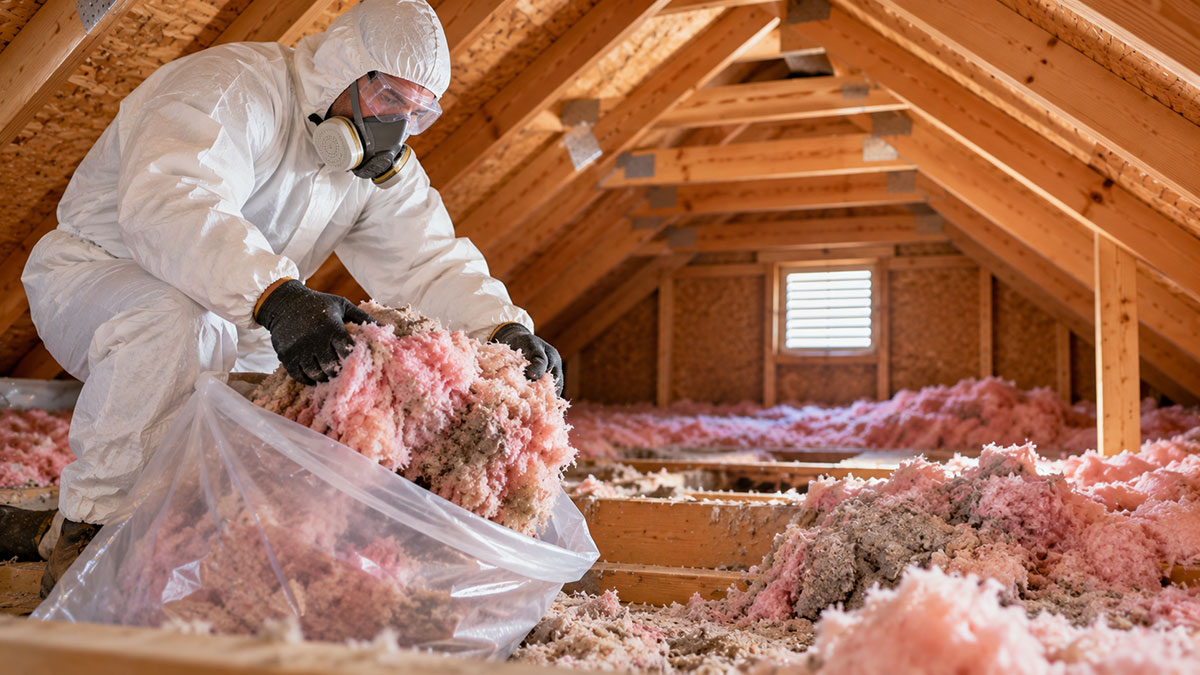
On a typical job that means vacuum extraction for loose-fill such as blown-in cellulose or fiberglass, usually with a HEPA-filtered insulation removal vacuum, and hand removal and bagging for batts or rolls. Once the material is out, the exposed rafters and ceiling joists get inspected, and the waste is sealed and labeled before disposal.
Attic insulation removal cost and timing depend heavily on which of these steps a given job actually needs.
What Types of Attic Insulation Can Be Removed?

Every material behaves a little differently once a crew starts pulling it out. A quick look at the range of attic insulation types explains why identification always comes before a removal plan.
Fiberglass, cellulose, vermiculite, spray foam, and mineral wool cover most of what shows up in a U.S. attic, regardless of the home’s age.
| Material | Common Form | Typical Age Found | Removal Note |
|---|---|---|---|
| Fiberglass | Batt or loose-fill | 1950s to present | Removed by hand or vacuum |
| Cellulose | Blown-in | 1970s to present | Vacuum removal standard |
| Vermiculite | Poured, loose pebbles | 1940s to 1990 | Treated as a possible asbestos hazard |
| Spray foam | Rigid, adhered layer | 2000s to present | Scraped off by hand |
| Mineral wool | Batt or loose-fill | 1930s to present | Dense, removed by hand |
Cellulose and fiberglass both come as loose-fill insulation, and so does vermiculite, which is the one you actually worry about. From the attic hatch you often can’t tell them apart, so treat vermiculite with extra caution until it’s identified.
Signs Your Attic Insulation Needs to Be Removed

Usually something up there gives it away before anyone books a job.
- Matted, flattened, or visibly thin material
- A musty or sour smell drifting down from the attic hatch
- Rodent droppings, nesting material, or chewed batts
- Heating or cooling bills that keep climbing for no obvious reason
- Depth that no longer meets current R-value targets
Flat, matted batts are usually insulation compression. Years of foot traffic and stored boxes squash the loft out of the product, and it stops performing anywhere near its rating.
ENERGY STAR and the Department of Energy recommend an attic R-value of roughly R-30 to R-60 depending on climate zone, and colder regions land at R-49 or higher.
So a jump in the energy bill is more than an annoyance. EPA’s ENERGY STAR program estimates that homeowners save an average of 15% on heating and cooling costs by air sealing and adding insulation in attics, floors over crawl spaces, and basements.
Hazards Commonly Found in Old Attic Insulation

Old attic insulation can hide more than dust.
Pre-1990 vermiculite insulation, often sold under the Zonolite brand, is presumed contaminated with asbestos unless it has been tested. Most of it traces back to a single mine in Libby, Montana.
Mold and rodents are the other usual suspects. A roof leak or poor attic ventilation turns damp insulation into a mold source that spreads before anyone notices, and droppings, urine, and nesting material carry pathogens. That makes removing insulation with rodent damage a health issue rather than a plain cleanup chore.
Then there’s knob-and-tube wiring buried under the insulation, which changes how, and whether, the material can be disturbed safely.
Vermiculite can look similar to other loose-fill products at a glance, and knowing how to tell the difference between cellulose and asbestos insulation saves a costly guessing game.
EPA added the Libby Asbestos Site in Montana, which includes the former mine tied to most Zonolite-brand vermiculite, to the Superfund National Priorities List in 2002, a marker that still shapes how contractors treat any vermiculite found today.
None of this rules out removal by itself. It does change who should be doing the work.
When Attic Insulation Should Not Be Removed by a Homeowner
Not every attic job belongs to a DIYer, and a few situations rule out self-removal entirely.
Untested vermiculite goes to a licensed asbestos abatement contractor, not a rental vacuum. Active mold is similar once it’s past about 10 square feet of visible growth (roughly a 3-foot by 3-foot patch), because that calls for a remediation specialist before any insulation work starts.
Exposed knob-and-tube wiring under load is a fire risk if you disturb it without an electrician present. That one is never a weekend project.
The last case runs the other way. If the insulation is dry, intact, and at proper depth, pulling it out just to start fresh wastes money and adds nothing.
The first three cases hand the job to a specialist, and the fourth means there may be no job to do. A short inspection settles which category a given attic falls into before any bags or vacuums come out.
DIY vs. Professional Attic Insulation Removal
Once hazards are ruled out, the decision comes down to time, tools, and how much dust you’re willing to live with.
Doing it yourself costs less, mostly equipment rental and disposal bags, and it suits small attics with easy access and clean material. It also takes a full day or more for an average-size attic. The protective gear isn’t optional either, and that means PPE that meets OSHA’s respiratory protection standard, typically a NIOSH-rated N95 respirator, plus disposable coveralls.
A professional crew is faster, usually finished in a single day even with a larger attic. They bring HEPA-filtered vacuums, Tyvek coveralls, and sealed containment to control dust, and they handle licensed disposal with documented containment practices. The price is higher upfront, though removal is often bundled with reinsulation.
For a small, clean attic I’d do it myself. For anything bigger, or anything I couldn’t identify, I’d pay someone.
Anyone planning to handle fiberglass batts directly should look into whether fiberglass insulation is genuinely safe without full protective gear, since skin contact alone causes noticeable irritation for most people.
How Much Does Attic Insulation Removal Cost, and How Long Does It Take?
Clean, non-hazardous attic insulation removal runs on a fairly narrow national range.
Most jobs land at $1 to $2 per square foot, which matches the typical cost per square foot for insulation removal work nationwide (Angi, 2026). A full removal-and-reinsulation project comes to around $3,000 on average (Angi, 2026), and an insulation removal vacuum rental runs $200 to $350 per day (HomeGuide, 2026).
A standard attic usually takes a few hours to a full day, depending on square footage and whether the material is hand-removed or vacuumed out.
Bigger attics, spray foam material, or any hazard flag push those numbers well beyond this baseline range.
Removal Method by Insulation Type
The material you identified earlier decides how a crew approaches removal.
Compare spray foam or cellulose insulation and you can see how much the method depends on the material. Cellulose goes out through a vacuum hose. Foam has to be scraped off the framing by hand.
| Material | Removal Method | Relative Difficulty | Special Note |
|---|---|---|---|
| Fiberglass batt | Hand removal, rolled and bagged | Moderate | Fibers irritate skin on contact |
| Blown-in cellulose | Vacuum extraction | Fast | Heavier by volume than fiberglass |
| Vermiculite | Vacuum or hand, after clearance | Specialist only | Treated as an asbestos risk |
| Spray foam | Manual scraping | Slow | Bonds directly to framing |
| Mineral wool | Hand removal | Moderate | Dense and heavy per bag |
Cellulose blown into an attic reaches roughly R-3.2 to R-3.8 per inch, against R-2.2 to R-2.7 per inch for blown fiberglass (U.S. Department of Energy, Building America), which is part of why cellulose loads out heavier per bag despite similar depth.
Removing spray foam alone runs $1.50 to $3 per square foot because of the manual scraping involved (AtticInsulationPlus, 2026), above the $1 to $2 range for most clean removal jobs.
Spray foam brands like Icynene rate their open-cell product around R-3.7 per inch, and none of that bonded foam comes off in one piece the way batts do.
Anyone tackling a foam attic directly should look closer at how to remove spray foam insulation before starting, since the scraping technique differs completely from vacuum work.
Safety Equipment Needed Before You Start

Gear has to be on hand before the hatch opens, not halfway through the job.
Start with a NIOSH-rated N95 or higher, fitted properly, which means a clean-shaven face where the seal sits. Disposable coveralls and gloves keep fibers off skin, and the eyewear should seal against the face.
Loose-fill material calls for a HEPA-filtered insulation removal vacuum. Heavy-duty bags and plastic sheeting for the access path are the basics for containment, and tape comes in handy for sealing the hatch between passes.
NIOSH rates a certified N95 filter at capturing at least 95% of airborne particles, which is the baseline most attic jobs are built around.
M and similar manufacturers sell disposable N95 respirators rated for exactly this kind of dust exposure.
None of this gear replaces the hazard check from earlier in the project. It only covers jobs already confirmed safe for a homeowner to handle without a licensed contractor.
Step-by-Step Process to Remove Attic Insulation

A removal job runs in a fixed order, whether it’s a weekend DIY project or a professional crew.
With insulation vacuum removal, loose-fill material gets pulled through a long hose straight into a collection bag staged outside the house.
- Empty the attic floor of stored items and seal the room below with plastic sheeting.
- Put on the respirator, coveralls, and eye protection before opening the hatch.
- Vacuum loose-fill material section by section, or roll and bag batts by hand.
- Close each bag immediately instead of leaving loose material exposed mid-job.
- Check the empty attic, including rafters, joists, and any newly exposed damage, before calling the job done.
Contractors often run equipment from suppliers like Intec, which has manufactured insulation blowing equipment since 1977 and now builds removal vacuums under its VORTEC line.
Batts still get rolled and cut to length by hand, and knowing how to cut fiberglass insulation cleanly keeps loose fibers from shredding into the air.
Common Mistakes That Ruin a DIY Removal Job

Most failed attempts trace back to the same handful of errors.
The most common one is skipping respiratory protection because the job looks quick at first glance. After that, people run the vacuum hose too far from the collection bags, which clogs the line, or they disturb suspected vermiculite before it has actually been tested. Some leave bagged material sitting in the attic overnight instead of hauling it out.
Any one of these turns a same-day project into a multi-day cleanup.
How to Dispose of Removed Attic Insulation
Disposal rules split sharply depending on what actually came out of the attic.
Standard, non-hazardous material is simple. Sealed contractor bags go into regular household waste in most municipalities, though bulk loads sometimes need a licensed hauler and landfill acceptance rules vary by county.
Hazardous or asbestos-contaminated material is a different matter.
- It cannot go into standard household trash or a construction dumpster
- It has to be wetted and sealed in leak-tight containers, typically 6-mil polyethylene bags, per EPA’s Asbestos NESHAP (the federal rule exempts most single-family homes, but state and local rules still apply)
- It goes only to a landfill specifically permitted to accept asbestos waste
Mixing hazardous and non-hazardous bags in the same load creates real legal exposure for whoever hauls it away.
Preparing the Attic Before New Insulation Goes In

An empty attic floor is the best inspection window a homeowner gets, and Department of Energy building research shows ducts running through attics or crawl spaces lose 25% to 40% of the heating or cooling energy that passes through them.
That number alone justifies checking supply and return ducts before anything new goes down.
Before covering anything back up, air sealing gaps around penetrations and top plates, and around the attic hatch, stops conditioned air from leaking out the same way it did before.
- Repair or reroute any damaged ductwork that’s now visible
- Bring in an electrician for exposed knob-and-tube wiring before it gets buried again
- Reinstall soffit vent baffles so attic ventilation stays clear
- Confirm the floor is dry and free of debris
Companies like Aeroseal have built entire duct-sealing processes around this exact kind of exposed-duct opportunity.
After that, the process to install insulation in attic spaces can begin without fighting old, damaged material underneath.
FAQ on How To Remove Attic Insulation
Is Attic Insulation Removal the Same as an Attic Cleanout?
No. An attic cleanout clears out debris and boxes, and sometimes pests, without touching the insulation. Attic insulation removal strips out the material itself (fiberglass, cellulose, vermiculite and so on) ahead of decontamination or reinstallation. The two jobs sometimes overlap.
Do You Need a Permit to Remove Attic Insulation?
Most jurisdictions don’t require a permit for straightforward removal. Work that touches wiring or adds spray foam can trigger local permit rules, and licensed asbestos abatement often comes with notification requirements of its own. Checking with the building department first avoids a stop-work order mid-project.
Can Old Attic Insulation Be Reused, Donated, or Recycled?
Dry, undamaged fiberglass batts can sometimes go back into use elsewhere in the same house. Cellulose and vermiculite generally can’t once they’re contaminated or compacted. Recycling programs for insulation remain rare, and most removed material ends up bagged for landfill disposal.
Where Does Attic Insulation Removal Break Down?
The job goes wrong when a homeowner treats every attic the same way. Material, hazard status, and square footage each change the correct approach.
Spray foam removal runs roughly 50% more than a clean blown-in extraction job on the same square footage, and that gap widens once contamination enters the picture.
Doing it yourself saves money but puts hazard identification on you. A missed vermiculite test shifts legal and health risk onto the person holding the vacuum hose.
There’s more on how to improve home insulation once the attic floor is cleared and ready for reinstallation.