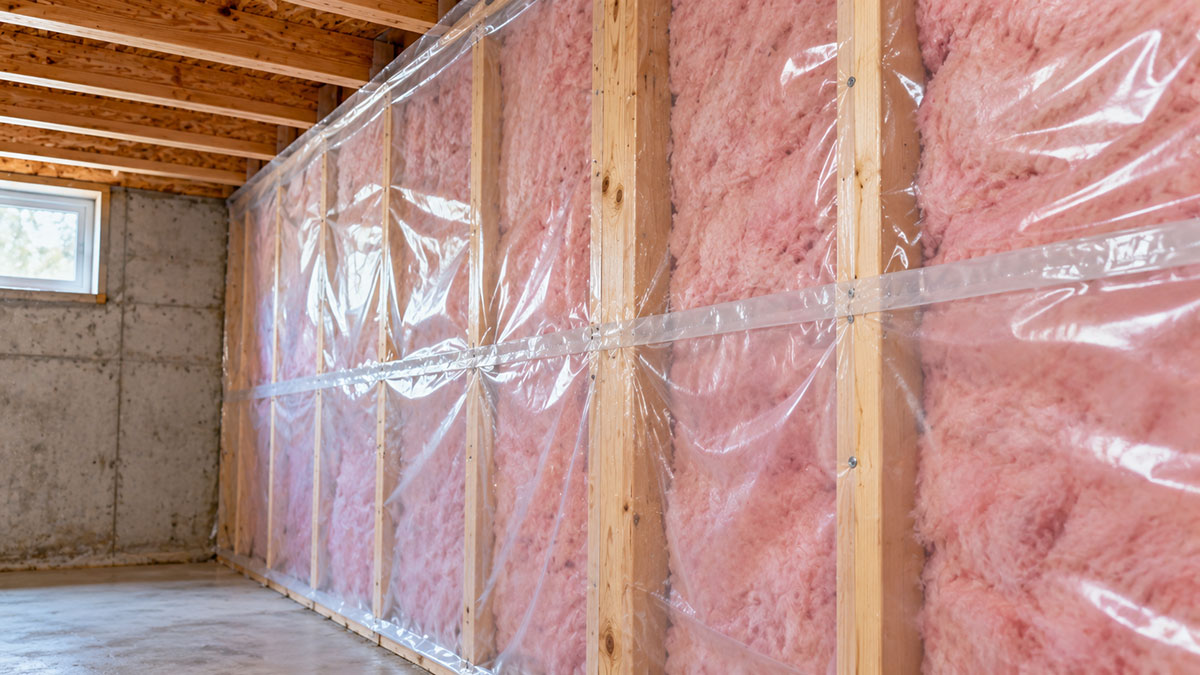
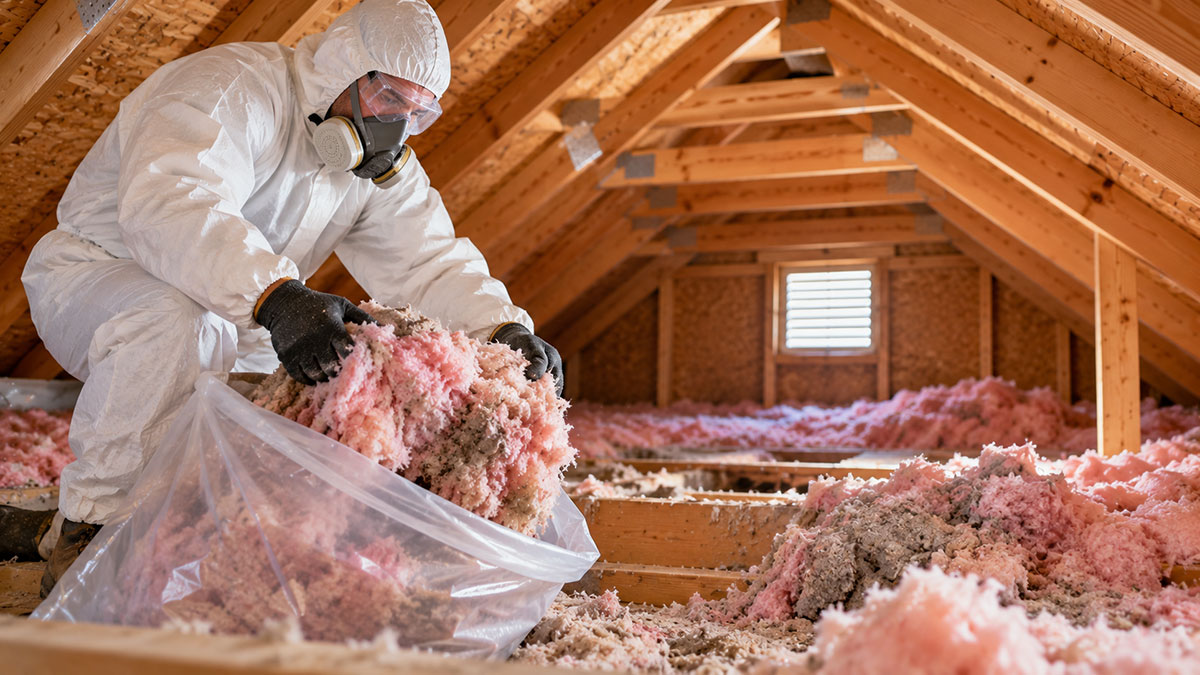
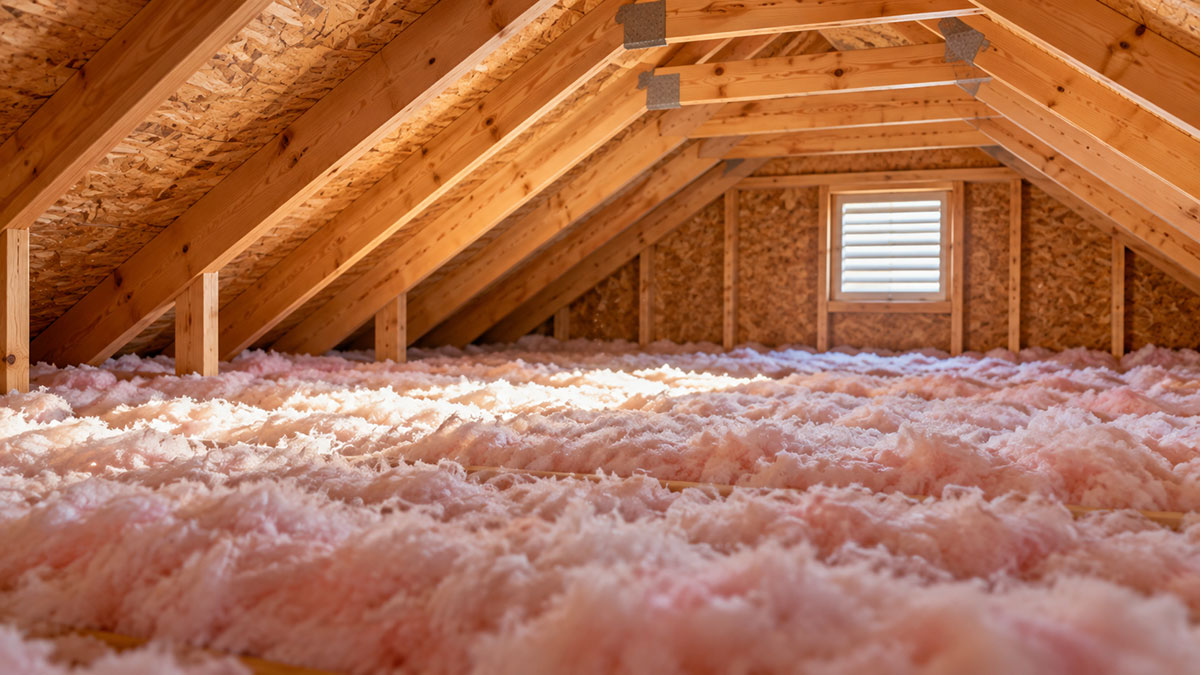
Tyvek is not a vapor barrier. It’s a spunbonded olefin water-resistive barrier, which means it blocks liquid water and air but stays open to water vapor.
DuPont makes it to go over exterior wall sheathing, under siding, brick or stucco. Building codes measure it on the same perm scale used for polyethylene sheeting and kraft facing, and that’s where the difference shows up.
DuPont’s technical data sheet lists Tyvek HomeWrap’s water vapor transmission at 56 perms under ASTM E96-05 Method A testing. The International Residential Code sets the ceiling for a Class III vapor retarder at 10 perms, so Tyvek sits more than five times past it.
What Is Tyvek?

The material starts as high-density polyethylene fibers. DuPont spins them into a continuous web and bonds it with heat instead of weaving it, so the sheet is non-woven.
That process leaves a random pattern of microscopic pores, smaller than a drop of liquid water and larger than a molecule of water vapor.
Liquid water stays out of the sheathing and air movement through the wall gets resisted, while vapor can still diffuse through in either direction. As a wall component it’s a water-resistive barrier installed over the sheathing. It isn’t insulation, and it doesn’t replace any part of a home’s insulation system.
DuPont introduced Tyvek HomeWrap as a synthetic alternative to asphalt felt and building paper, both of which sag and lose strength once wet. Tyvek keeps its shape wet or dry. And like other spunbonded wraps on the market, Typar included, it won’t rot or feed mold growth the way older felt products can.
What Is a Vapor Barrier?
The cutoff for a true vapor barrier is 0.1 perm or less, low enough to stop nearly all diffusion of water vapor through the material.
Vapor retarder is the broader term. It covers anything that slows vapor movement, whether or not it stops it completely.
Building scientist Joseph Lstiburek, working with Building Science Corporation, proposed splitting vapor retarders into permeability classes in a 2004 ASHRAE Journal paper. That framework became the basis for how the International Residential Code classifies them today.
Sheet polyethylene and unperforated foil are Class I, at 0.1 perm or less. Kraft-faced batts fall in Class II (above 0.1 up to 1.0 perm). Latex or enamel paint counts as Class III, which covers everything above 1.0 up to 10 perm.
In residential walls, a Class II retarder often arrives already built into the insulation. Manufacturers bond a kraft or foil facing to one side of a batt so it works as vapor barrier insulation, and the retarder and the cavity fill come as one product.
Plenty of products get sold loosely as a vapor barrier without actually meeting the 0.1 perm ceiling. Most of the confusion around the term starts there.
Is Tyvek a Vapor Barrier or a Vapor Retarder?

Neither one, really.
Tyvek doesn’t meet the definition of a vapor retarder in any of the classes above. Its perm rating sits well over the Class III ceiling of 10 perms, which puts it in a separate category that building scientists call vapor open or vapor permeable.
Class I stops at 0.1 perm and Class II at 1.0. Class III tops out at 10. Tyvek HomeWrap comes in at roughly 56 perms, so it’s past every one of them.
The gap is on purpose and not a manufacturing shortfall. A wall needs to dry out somewhere, and a wrap that lets vapor pass keeps the sheathing from holding moisture behind it.
Tyvek does work as an air barrier, though, which is classified separately from vapor control. DuPont’s technical data sheet puts its air penetration resistance at under 0.004 cfm per square foot at 1.57 psf, tested to ASTM E2178, meeting the Type I rating defined in ASTM E1677.
What Is Tyvek’s Perm Rating?
Every perm number on a data sheet comes from ASTM E96, which measures how much water vapor passes through a material over a 24 hour period. Higher means more vapor gets through, lower means less.
The test has a dry cup version (Method A) and a wet cup version (Method B). They load the sample under different humidity conditions, so the same material gives slightly different numbers depending on which one was run.
DuPont’s technical data sheet for Tyvek HomeWrap lists 56 perms for Method A and 54 perms for Method B, both under ASTM E96-05.
Either figure leaves Tyvek more than five times past the Class III ceiling of 10 perms. That breathability is the reason it works as a drying layer instead of a sealed one.
What Vapor Retarder Class Does Tyvek Meet Under the IRC?
None of them.
The International Residential Code only assigns Class I, II or III to materials tested at 10 perms or below, and Tyvek’s rating puts it outside that range entirely. It also isn’t what the code calls a responsive vapor retarder. That category is reserved for materials whose permeance changes with humidity, and Tyvek stays vapor open no matter what the moisture conditions are.
This matters most in climate zones 5, 6, 7, 8 and Marine 4, where the 2021 IRC requires a Class I or Class II retarder on the interior side of frame walls. Tyvek on the exterior doesn’t satisfy that. It sits outside the sheathing and its rating is nowhere near Class I or II.
Basement walls and any wall section below grade are exempt from the interior retarder rule regardless of what wrap is used outside.
Where the code does call for an interior retarder, that layer has to come from somewhere else. Kraft-faced batts and sheet polyethylene both work. So does vapor retarder paint, depending on the class you need.
How Does Tyvek Compare to True Vapor Barriers?
Putting Tyvek next to materials that do meet the retarder classes shows how big the gap is.
| Material | Perm Rating | Retarder Class | Typical Placement |
|---|---|---|---|
| Tyvek HomeWrap | ~56 | None, vapor open | Over sheathing, under cladding |
| Polyethylene sheet, 4 mil | ~0.08 | Class I | Interior side, cold climates |
| Kraft-faced fiberglass batt | ~1.0 | Class II | Cavity insulation facing |
| Foil-faced rigid foam board | ~0.05 | Class I | Exterior continuous insulation |
Those figures come from the Insulation Institute’s materials table, which is built from ASHRAE Handbook of Fundamentals data.
Polyethylene sheeting gets its Class I rating because the plastic film has almost no pore structure at all, unlike the porous facings used on fiberglass insulation.
Foil-faced rigid board works the same way. The metal layer blocks vapor almost completely, which is why rigid foam board insulation with a foil face counts as a Class I material when it goes on as exterior continuous insulation.
Kraft-faced batts land in the middle. They’re permeable enough to allow some drying and restrictive enough to qualify as Class II.
Which Tyvek Product Fits Which Wall Assembly?
The lineup differs in surface texture and basis weight, and vapor permeance moves around too, from roughly 23 perms for CommercialWrap up to 56 perms for HomeWrap under Method A testing.
Tyvek HomeWrap
HomeWrap is the standard residential product, a flat non-woven sheet meant for siding installed directly over it. It suits vinyl and wood siding on a typical single-family build, and fiber cement too.
The surface is flat, so there’s no built-in drainage gap behind denser claddings. For a lot of houses that’s fine. Behind anything that holds water against the wall, I’d look at the next product down instead.
Tyvek DrainWrap
DrainWrap adds vertical grooves to the surface, which leaves a small gap behind the cladding for bulk water to drain down and out. It passes ICC-ES AC24 Section 6.11 drainage testing.
It’s the better match for manufactured siding and for lap siding that tends to hold moisture against the wrap. HomeWrap depends on the cladding to shed water, so DrainWrap is the one that gives water a dedicated path.
Tyvek CommercialWrap
Heavier build, with a higher basis weight and more tear resistance than HomeWrap. It’s aimed at taller elevations and larger door and window openings, so you’ll mostly see it on multifamily and commercial low-rise projects where there’s more wind load and the wrap stays exposed longer during construction.
It carries the same Type I air barrier rating as HomeWrap under ASTM E1677, just built for a rougher job site.
Tyvek StuccoWrap
A corrugated surface sets StuccoWrap apart. It holds the stucco lath slightly off the wrap instead of pressing it flat, so the stucco can cure and dry from behind and not trap moisture between two dense layers.
It’s meant for direct-applied and traditional three-coat stucco systems. Skip it where the cladding already has its own drainage plane, since the corrugation would add a gap you don’t need twice.
Where Does Tyvek Go in a Wall Assembly?
Over the structural sheathing (plywood or OSB) and under the cladding.
That position doesn’t move. Every other layer gets built around it. Working from the inside out, you have framing and cavity insulation, then structural sheathing, then the Tyvek, and finally the cladding, whether that’s siding, brick veneer or stucco.
Rigid foam shifts that order a bit, and builders are split on where it goes relative to the wrap. Some keep Tyvek directly on the sheathing and add the rigid insulation outside it, with a second layer of flashing. Others put the foam on the sheathing first and run Tyvek over the foam itself, taping seams right to the foam surface.
Both approaches show up on current job sites. The choice usually comes down to how the foam manufacturer’s flashing details are written.
Below-grade walls follow a different set of rules, since bulk water and hydrostatic pressure act differently underground. That deserves its own breakdown, so see the guide on insulating basement walls for that case.
Does Tyvek Perform the Same in Every Climate Zone?

No. Tyvek’s own perm rating never changes, but how the wall around it needs to be built does.
The International Residential Code sets different rules for which vapor retarder class is allowed on the interior side, and those rules shift by climate zone.
Cold climates
Zones 5 through 8 and Marine 4 carry the strictest interior retarder rule.
Winter heating drives warm, moist interior air toward the colder sheathing. That vapor has to be stopped before it reaches a cold surface where it can condense, so in these zones Tyvek needs a partner on the inside. Kraft-faced batts or sheet polyethylene will do it, or any other qualifying interior retarder. Tyvek alone won’t.
Mixed-humid climates
Zones 1 and 2 don’t permit a Class I or Class II interior retarder at all. Only Class III materials, like latex paint, are allowed.
Zones 3 and 4, except Marine 4, permit Class II and Class III retarders but rule out Class I.
| Climate Zone | Class I | Class II | Class III |
|---|---|---|---|
| 1, 2 | Not permitted | Not permitted | Permitted |
| 3, 4 (except Marine 4) | Not permitted | Permitted | Permitted |
These figures come from the Insulation Institute’s summary of current IRC provisions.
A wall in these zones has to dry in both directions across the seasons, which is why a low-perm Class I retarder is off the table here.
Hot-humid climates
Air conditioning flips the moisture drive the other way. Cooled interior air keeps wall surfaces cold relative to the hot, humid exterior, so vapor gets pushed inward instead of outward.
Put a low-perm vapor barrier on the interior side in this climate and it can trap that inward-moving moisture against the drywall, which is a mistake that’s easy to make and slow to notice.
The Insulation Institute recommends placing any vapor retarder on the exterior side of the wall in very warm, humid climates, if one is used at all.
How Is Tyvek Installed Correctly?

Installation order and overlap direction matter more than the material itself for keeping a wall dry. DuPont gives the same sequence for every Tyvek product line.
- Start at the bottom of the wall and work up, keeping each roll plumb.
- Overlap horizontal courses by at least 6 inches, shingle-style, so the upper layer sheds water over the lower one.
- Overlap vertical seams by 6 to 12 inches.
- Fasten to the studs with cap nails or cap staples, spaced no closer than 6 inches and no farther than 18 inches apart, per DuPont’s installation guidelines.
- Extend the bottom edge at least 2 inches over the sill plate, or to the base of the foundation on a slab.
- Integrate window and door flashing as you reach each opening, shingling the wrap over the flashing rather than under it.
Seams get taped after the wrap is up, not before. Taping every vertical and horizontal seam is what finishes Tyvek’s air sealing role, instead of leaving it partial.
The most common shortcut is skipping the horizontal tape. It still passes a casual site walkthrough, since the shingle lap alone stops most bulk water, but it leaves the air barrier incomplete.
When Does Tyvek Fail as a Moisture Control Layer?
Tyvek fails the way most water-resistive barriers fail, through installation gaps and not through the material breaking down under normal exposure.
Installation errors
Reversed lap direction is the most damaging mistake.
Every course has to shingle downward and outward, upper layer over lower layer, so gravity carries water past each seam instead of into it. Flip that order and water rides into the seam instead of over it.
Grooved products like DrainWrap depend on direction by design, so installing one upside down or sideways blocks the drainage channel instead of using it.
You won’t spot either error on a walkthrough. Years later they show up as rot behind the cladding.
Incompatible assembly pairing
Tyvek on its own doesn’t cause condensation, but the assembly around it can.
Too little exterior insulation over Tyvek in a cold climate leaves the sheathing behind it cold enough for interior moisture to condense on contact. Thicker continuous insulation fixes that. Swapping the wrap doesn’t, since the wrap’s own perm rating was never the variable causing the problem.
Physical degradation
DuPont’s technical data sheets cap ultraviolet exposure at 120 days for HomeWrap, and DrainWrap and StuccoWrap share that limit before cladding needs to go on. CommercialWrap gets a longer 270-day allowance.
Past that window, UV breaks down the fiber structure, and both tear strength and water resistance drop. Delayed framing and weather holds are the usual reasons a wrap sits exposed that long, and phased construction schedules can do it too.
Do You Need an Additional Vapor Retarder Alongside Tyvek?

In climate zones 5 through 8 and Marine 4, yes.
The IRC requires a Class I or Class II retarder on the interior side of the wall in those zones, and Tyvek’s own perm rating doesn’t satisfy either class.
In zones 1 through 4, except Marine 4, the code doesn’t require one at all, and skipping it often lets the wall dry faster in both directions.
Adding continuous exterior insulation changes the math. Enough foam over the sheathing keeps it warm enough that a less restrictive interior retarder becomes acceptable.
| Climate Zone | Min R-Value, 2×4 Wall | Min R-Value, 2×6 Wall |
|---|---|---|
| Zone 3 | R-2 | R-2 |
| Zones 4, 5, 6 | R-3 | R-5 |
| Zone 7 | R-5 | R-7.5 |
| Zone 8 | R-7.5 | R-10 |
Those thresholds, reported by the Insulation Institute from the 2021 IRC, apply to continuous insulation and unlock a Class II responsive retarder in place of the stricter Class I requirement.
The R-value here belongs to the exterior foam layer, not to Tyvek, which carries no thermal resistance rating of its own. Anyone unfamiliar with how that number works can check the breakdown of R-value before pricing out foam thickness.
Where an interior retarder is required, installing it correctly follows its own sequence, separate from the exterior wrap steps above.
Local code amendments can tighten these baseline IRC numbers. Checking with the local building department before framing is the last step, and it isn’t optional.
FAQ on Is Tyvek A Vapor Barrier
Is Tyvek waterproof?
Not in the sense of a sealed membrane.
Tyvek blocks liquid water at the surface through its microporous structure, but water vapor still diffuses through. DuPont markets it as water-resistant, and the distinction matters, since true waterproofing would also trap interior moisture inside the wall.
How does water vapor move through the Tyvek membrane?

By diffusion, through millions of microscopic pores that form when the spunbonded fibers bond into a non-woven sheet.
The pores are too small for liquid droplets but large enough for individual vapor molecules, so humidity and pressure gradients pull vapor through in either direction.
Does Tyvek also function as an air barrier?
Yes. DuPont’s own testing rates Tyvek HomeWrap as a Type I air barrier under ASTM E1677, which stops drafts through the wall assembly independent of its vapor performance.
Air barrier and vapor barrier are separate classifications, and Tyvek qualifies for one and not the other.
Is Tyvek code-compliant as a stand-alone air barrier for energy code purposes?
The IECC requires a continuous air barrier for the whole building, verified through a blower door test, and not certification of a single product.
Tyvek’s rating supports that requirement, but compliance gets confirmed at the assembly level once seams, penetrations and transitions are sealed.
Can Tyvek be used in a basement or below-grade wall?
DuPont’s own guidance limits Tyvek to above-grade vertical wall surfaces.
Below-grade walls face hydrostatic pressure from soil moisture that a vapor-permeable wrap isn’t built to resist, so basement walls call for a dedicated waterproofing membrane instead.
How do you properly seal Tyvek seams and penetrations?
DuPont specifies its own Tyvek Tape, applied to every vertical and horizontal seam and to window and door flashing transitions.
Skipping tape at penetrations is the gap inspectors find most often, since the wrap alone can’t bridge a fastener hole or a cut edge.
What Should You Prioritize First When Tyvek Is Not the Vapor Barrier?
Tyvek does its water-resistive and air barrier job correctly only when the interior vapor retarder decision gets made as a separate step. That decision rests on the climate zone’s class requirements and not on Tyvek’s own vapor-open rating.
The order matters here. Confirm the climate zone and the retarder class it requires first. Then size any continuous exterior insulation against the R-value threshold for that zone, and pick an interior retarder that satisfies the class without going past it.
DuPont caps Tyvek’s maximum in-service temperature at 180 degrees Fahrenheit, which is worth checking behind dark-colored siding or masonry veneer that radiates stored heat back onto the wrap.
Once that sequence is settled, the remaining decision sits inside the wall cavity itself, where spray foam or cellulose insulation determines whether the assembly gains a second layer of vapor control.