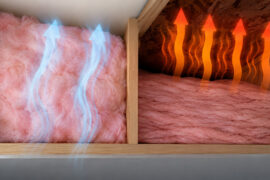
Glass gets melted down and spun into fibers thinner than a human hair, then matted into something that looks a lot like wool. The fibers themselves are ordinary glass. What does the insulating work is the air caught in the gaps between them, held still enough that heat struggles to move through.
North American manufacturers make it for houses and commercial buildings, where it goes up against cellulose, spray foam, and mineral wool on price and thermal resistance. The recycled content is higher than most people assume. NAIMA’s Insulation Institute reports that U.S. facilities used more than 2.4 billion pounds of recycled glass to produce fiberglass and mineral wool insulation in 2025.
What Is Fiberglass Insulation?
Manufacturers spin molten glass into fine fibers, press the result into a wool-like mat, then cut it into batts or chop it for blowing. The product is a synthetic thermal insulating material, and the pockets of trapped air between fibers are what slow heat moving through walls, attics, and floors.
It sits at the center of most residential home insulation projects in North America, alongside cellulose, mineral wool, and spray foam.
- Spun glass fiber, not woven cloth and not plastic foam
- Sold as batts, rolls, loose-fill, and rigid board
- Rated by R-value. Thickness on its own tells you very little
Fiberglass and mineral wool together account for insulation in roughly 70 percent of U.S. homes, according to NAIMA’s Insulation Institute.
That number says less about raw performance than about price, availability at every lumberyard in the country, and the fact that both drop into a standard 2×4 or 2×6 wall cavity without anyone having to think about it.
Fiberglass is one entry in a longer list of types of insulation materials, and it earned its market position long before spray foam or advanced foam boards existed as mainstream options.
What Is Fiberglass Insulation Made Of?
Silica sand forms the base glass. Recycled cullet from bottles and industrial scrap goes into the same batch, a binder resin cures the loose fibers into a stable mat, and a small amount of dust suppressant oil keeps airborne particles down.
The mix runs through a furnace at extreme heat, then gets thrown out through tiny openings on a spinning head. Same basic mechanics as a cotton candy machine, at several hundred degrees more.
- Silica sand, the base glass-forming material
- Recycled glass cullet, sourced from bottles and industrial scrap
- Binder resin, which is what turns a pile of fibers into something you can pick up
- Dust suppressant oil, applied in a small amount
Owens Corning’s PINK fiberglass insulation contains between 53 and 73 percent recycled content depending on the specific product, and the company used 1.4 billion pounds of recycled glass in its manufacturing in 2022 (Owens Corning, 2023).
Knauf Insulation uses a bio-based binder it markets as ECOSE Technology in place of older formaldehyde resins, a shift several major manufacturers have made over the past decade.
Formaldehyde-free binders now show up on spec sheets as a selling point rather than a footnote, since indoor air quality has become a bigger part of how buyers compare products.
What Forms Does Fiberglass Insulation Come In?
Batts and rolls cover most wall and attic work. Loose-fill fills what batts cannot reach, rigid board turns up on basement walls and duct exteriors, and duct wrap stays in its own narrow lane. Cavity shape decides the choice more often than performance does.
| Form | Typical Use | Installation Method |
|---|---|---|
| Batts and rolls | Walls, attic floors, floor joists | Friction-fit or stapled |
| Loose-fill | Attics, irregular cavities | Blown with a machine |
| Rigid board | Basement walls, ducts | Cut and fastened |
| Duct wrap | HVAC ductwork | Wrapped and taped |
Batts and Rolls
Batts arrive pre-cut to standard stud and joist spacing. Rolls are the same material shipped as one continuous length, which you cut on site, and they earn their keep on long attic-floor runs where pre-cut lengths would just create more seams.
Under ASTM classification, this is technically called batt insulation when supplied in blanket form, whether it arrives faced or unfaced.
Owens Corning’s EcoTouch line, for example, publishes an ASTM C665 Type and Class rating for every batt width it sells.
- Widths of 15 and 23 inches, matched to framing
- R-13, R-19, R-21, R-30 and R-38 cover nearly all residential work
Loose-Fill
Loose-fill fiberglass ships in bags and gets blown into place with a pneumatic machine.
- Fills irregular attic spaces and tight corners batts cannot reach
- Works well for retrofits over existing insulation
Depth matters more than most installers admit, since loose-fill insulation settles after installation and loses some of its rated depth over the following months.
Johns Manville sells a version called Spider specifically for blowing fiberglass into finished wall cavities, a niche batts cannot fill without opening the wall.
Rigid Board
Rigid fiberglass board holds its shape under moderate pressure. Batts do not. Anything leaning against a batt compresses it, and compression is the whole problem.
Basement walls and duct exteriors are where the board earns its price, which runs higher per square foot than batts. It also needs no additional vapor retarder in most basement applications, so part of that premium comes back.
Faced Versus Unfaced
Faced batts come with a kraft or foil vapor retarder already attached, and the facing doubles as a visual cue during install, since you know which side goes toward the warm room without thinking about it.
Unfaced is what you want for a retrofit layer over existing insulation. It also pairs with a separate vapor barrier where local code calls for one.
Kraft facing is combustible on its own and typically needs to stay covered by drywall once installed, while some foil facings can be left exposed in specific assemblies.
How Does Fiberglass Insulation Work?
Still air conducts heat poorly. Millions of tiny gaps between glass fibers hold air still, and the more of it a material holds in place, the slower heat moves across.
Glass itself has fairly high thermal conductivity, but spun into fine fibers with air pockets between them, the assembly behaves nothing like a solid pane of glass.
- Fiber diameter and density, both set during manufacturing
- Installed thickness, which determines total R-value
- Compression, which reduces the air gap and lowers performance
- Gaps and voids left during installation, which let heat bypass the material entirely
None of this addresses the wood or metal studs running through a wall, since framing conducts heat faster than the insulation packed around it.
That gap in performance is called thermal bridging, and it is one reason continuous exterior insulation has become more common in newer builds.
Fiberglass batts also cut sound transmission through interior partitions, a secondary function Owens Corning markets separately through its Sound Attenuation Batt line.
What R-Value Does Fiberglass Insulation Have?
Standard fiberglass batts deliver roughly R-13 to R-38 depending on thickness, while high-density batts and loose-fill reach higher totals in the same cavity depth.
R-value measures resistance to conductive heat flow, and it is the number printed on every bag and batt wrapper for exactly that reason.
- Owens Corning EcoTouch batts reach R-13 at 3.5 inches thick and R-38 at 12 inches thick (Owens Corning product documentation)
- ENERGY STAR, jointly run by the Department of Energy and the EPA, recommends R-30 attic insulation in the mildest U.S. climate zone and up to R-60 in zones 7 and 8 (ENERGY STAR)
- Floor insulation recommendations from the same program run from R-13 in zone 1 up to R-38 in the coldest zones (ENERGY STAR)
R-Value by Product Type
Standard batts and loose-fill fiberglass land in a similar general range per inch of thickness, though the exact figure varies by manufacturer and product line.
Density is the lever that moves it. High-density batts pack more fiber into the same cavity depth, which pushes R-value per inch higher without adding a single millimeter of thickness.
Compressing a batt into a shallower space than it was designed for reduces the trapped air volume, and that kind of insulation compression drops the delivered R-value below the printed rating.
R-Value by Climate Zone
R-value targets shift with location, not with a single national standard.
The R-value a home needs in Miami is not the R-value a home needs in Minneapolis, and code minimums reflect that gap directly.
| Zone Example | Attic Target | Floor Target |
|---|---|---|
| Zone 1 (Miami) | R-30 | R-13 |
| Zone 3 (Atlanta) | R-49 | R-19 |
| Zones 7-8 (Fairbanks) | R-60 | R-38 |
Is Fiberglass Insulation Fire Resistant?
Unfaced fiberglass is classified as noncombustible and carries a Class A fire rating under ASTM E84, according to NAIMA’s Insulation Institute. Glass fiber does not burn. It is the same base material as a window pane.
- Flame spread index of 25 or less, required for Class A
- Smoke development index of 450 or less under the same standard
- Unfaced fiberglass typically scores under 50 on smoke development, well inside that limit
- Melting point of roughly 1,000 degrees Fahrenheit, far above typical residential fire temperatures
A Class A label alone does not tell the whole story, since combustible materials can earn the same label if their smoke output stays under the code threshold.
Unfaced fiberglass also passes ASTM E136, a separate test that confirms a material is genuinely noncombustible rather than merely low on the E84 flame spread scale.
Whether fiberglass batts can catch fire comes up constantly in homeowner forums, and the short answer is that the glass fiber resists ignition even though facing materials like kraft paper can burn.
Kraft-faced batts generally need to stay covered by drywall once installed, which keeps the combustible facing away from an open flame source.
CertainTeed publishes an ignition-temperature comparison chart across insulation materials for exactly this reason, since a Class A rating by itself does not capture every fire-relevant property.
Spray foam, by comparison, is combustible on its own and depends on chemical fire retardants to hit the same insulation fire rating class that fiberglass reaches without any additive.
Does Fiberglass Insulation Resist Moisture?
Glass fiber itself does not absorb water, since glass is not an organic material and has nothing for moisture to soak into.
The batt or roll built around those fibers can still trap water that reaches it from a roof leak, condensation, or a flooded crawl space.
People tend to blur two separate properties here. Fiberglass scores low on water absorption, because the glass repels moisture. It scores worse on moisture retention, because a soaked batt takes a long time to dry out.
Owens Corning’s Pure Safety fiberglass batts carry an ASTM C1338 mold and mildew resistance rating on the published product specifications, a certification most standard batts also meet.
That rating covers surface mold growth on the material itself, not what happens to studs and subfloor sitting next to a soaked batt for weeks.
Pairing fiberglass with a properly installed vapor barrier stops most of the moisture problem before it starts, particularly in crawl spaces and basements.
Closed-cell spray foam behaves differently here. Its cell structure blocks bulk water on contact instead of merely resisting mold afterward, which is the defining trait of closed-cell insulation as a category.
Is Fiberglass Insulation Safe to Handle?

Once it is installed and enclosed behind drywall, fiberglass is safe. Handling it bare-handed is a different experience, and it will irritate skin, eyes, and airways.
The International Agency for Research on Cancer reclassified glass wool insulation from a possible carcinogen to a substance not classifiable as to human carcinogenicity in October 2001 (IARC, 2001).
The U.S. National Toxicology Program went further in 2011, removing biosoluble glass wool used in home and building insulation from its list of substances reasonably anticipated to be human carcinogens (NTP, 2011).
- Long sleeves and pants, to keep loose fibers off skin
- Safety goggles, since airborne fibers irritate eyes on contact
- A NIOSH-rated dust mask or respirator during cutting or blowing
- Gloves, because bare-hand contact is where most of the itching starts
The industry’s voluntary workplace exposure limit sits at 1.0 fiber per cubic centimeter of air, a standard OSHA agreed to in 1999 after negotiating exposure controls directly with NAIMA.
Whether fiberglass insulation is safe for a household with asthma or allergies is a different question from whether it is safe to handle during installation, and the two get confused constantly in online debates.
Once enclosed behind drywall or sheathing, airborne fiber exposure effectively stops, since loose fibers no longer have a path into the living space.
How Much Does Fiberglass Insulation Cost?

Fiberglass batt and roll insulation runs $0.30 to $1.50 per square foot installed, according to HomeAdvisor’s 2025 cost data.
A typical single-family batt job runs $1,000 to $2,400 total, materials and labor combined (HomeAdvisor, 2025).
- Target R-value, since higher ratings need thicker or denser material
- Faced product, which costs slightly more than unfaced
- Access, because cramped attics and finished walls add labor hours
- Region, where labor rates swing the total far more than material does
Blown-in fiberglass runs $0.45 to $1.10 per square foot for material alone, before labor (homegnome, 2025).
A single roll of R-13 kraft-faced fiberglass covering about 106 square feet retails for roughly $98 at Lowe’s, a rough material baseline before markup and labor.
Working out the true cost per square foot for insulation means adding labor, old material disposal, and any air sealing done at the same time, not just the price on the bag.
Some states and utilities offer a weatherization rebate that offsets part of the material or labor cost, though eligibility rules vary by location.
Fiberglass Insulation Versus Cellulose, Spray Foam, and Mineral Wool

Fiberglass costs less per square foot than the other three main options, and it gives up some R-value per inch and essentially all air-sealing ability to get there.
Homeowners comparing spray foam or cellulose insulation against fiberglass usually decide based on budget and cavity depth rather than any single clear winner.
| Material | R-Value Per Inch | Material Cost | Air Sealing |
|---|---|---|---|
| Fiberglass | 2.2 to 4.3 | $0.45 to $1.10 per sq ft | No |
| Cellulose | 3.2 to 3.8 | $0.60 to $2.80 per sq ft | Partial |
| Mineral wool | 3.0 to 4.2 | $1.30 to $2.20 per sq ft | No |
| Closed-cell spray foam | 5 to 7 | $1.60 to $4.60 per board foot | Yes |
Material cost figures above come from homegnome’s 2025 insulation pricing survey, gathered across large and small U.S. markets.
Fiberglass Versus Cellulose
Cellulose packs denser, so it slows air movement better than a batt does, and it carries a higher R-value per inch while being made mostly from recycled paper.
Fiberglass costs less. It also does not settle as badly in vertical wall cavities, and it dries faster once something gets it wet.
GreenFiber is one of the largest cellulose insulation brands competing directly against fiberglass batts in the retrofit market.
Fiberglass Versus Spray Foam
Spray foam wins on air sealing, since it expands to fill gaps that batts and loose-fill both leave behind.
Fiberglass keeps the upfront cost down, stays realistic as a DIY job, and has no cure time holding up the drywall crew.
Closed-cell spray foam reaches roughly R-5 to R-7 per inch compared to fiberglass batts at R-2.2 to R-4.3 per inch (homegnome, 2025).
That performance gap costs money. Closed-cell spray foam runs $1.60 to $4.60 per board foot, several times the material cost of blown-in fiberglass.
Fiberglass Versus Mineral Wool
Mineral wool and fiberglass share a similar installation method, since both come as batts sized to standard framing.
- Mineral wool: higher fire resistance, denser, costs more per square foot
- Fiberglass: lighter, easier to cut, lower material cost
Rock wool insulation resists fire at a higher temperature than fiberglass and holds its shape better under compression.
ROCKWOOL, the company that popularized stone wool batts in North America under its Comfortbatt line, markets that fire performance directly against fiberglass in its product literature.
How Is Fiberglass Insulation Installed?
Batts get friction-fit or stapled into open cavities. Loose-fill goes in through a hose connected to a machine.
RESNET grades every installation on a Grade I through Grade III scale, and Grade I is the only grade that delivers the full rated R-value (NAIMA’s Insulation Institute).
Installing Batts and Rolls
- Measure the cavity and cut the batt slightly oversized
- Split the batt around wires and outlet boxes instead of compressing it flat
- Press the batt into place so it contacts the surface on all sides
- Staple the facing flange to the framing, or friction-fit unfaced batts
- Trim any overhang flush with the framing face
Grade I allows only occasional very small gaps, plus compression or incomplete fill of 2 percent or less of the area, per RESNET criteria published through NAIMA’s Insulation Institute.
Skipping air sealing before the batt goes in is the single most common mistake, since a batt does nothing to stop air leaking around it.
Installing Blown-In Loose-Fill
Blown-in makes sense in attics with irregular framing, in low-clearance spaces, and on retrofits where opening a finished wall is off the table.
A pneumatic blower agitates and feeds the material through a hose at a calibrated rate, matched to the coverage chart printed on the bag.
Installing fiberglass insulation this way still requires depth markers in the attic, so the installer and any later inspector can confirm the fill reached the target thickness.
Underfilling near the eaves is common, since low headroom makes it tempting to rush the edges where the roofline meets the attic floor.
When Fiberglass Insulation Does Not Work
Fiberglass stops earning its rated R-value the moment it gets compressed, soaked, or installed with gaps beyond what a Grade I inspection allows.
None of these failure points are unique to fiberglass, but the material is more sensitive to some of them than cellulose or spray foam.
- Irregular cavities with pipes, wiring, or diagonal bracing that batts cannot wrap around cleanly
- Flood-prone crawl spaces and basements, where a soaked batt holds water and dries slowly
- Attic eaves and low-clearance edges, where installers routinely underfill because of headroom
- High-heat zones near flues, chimneys, and recessed light housings that require rated clearance instead of direct contact
Squeezing a batt into a wall cavity built for a thinner product is compressed insulation in practice, and it delivers less R-value than the number printed on the wrapper.
Loose-fill has its own failure mode. Insulation settlement lowers the installed depth over time, which is why codes require installers to record the initial fill height on a certificate left in the attic.
None of this makes fiberglass a poor choice.
It means installation quality and site conditions decide the outcome more than the specification sheet does.
FAQ on What Is Fiberglass Insulation
Is Fiberglass Insulation the Same as Mineral Wool?
No. Fiberglass insulation is spun from molten glass, while mineral wool comes from basalt rock or furnace slag.
Both trap air in fiber form, but mineral wool resists fire at a higher temperature and holds its shape better under compression.
How Long Does Fiberglass Insulation Last?
Fiberglass does not rot, and mold will not feed on it, so it degrades mainly through moisture, compression, or pest damage rather than age.
CertainTeed backs its fiberglass building insulation with a lifetime limited warranty against manufacturing defects for the original homeowner.
Do You Need a Vapor Barrier With Fiberglass Insulation?
It depends on climate and wall assembly, not on the insulation itself.
Cold climates generally need vapor barrier insulation on the winter-warm side of the wall, while mixed and humid climates often skip it or use a smart membrane instead.
Can You Install Fiberglass Insulation Yourself?
Batts and rolls are DIY-friendly for accessible attics, since no special equipment is required beyond basic PPE.
Blown-in loose-fill needs a rented blower, and tight or finished spaces are usually better left to a professional.
How Do You Remove Old Fiberglass Insulation?
Removal starts with PPE and sealing off the work area.
Batts get bagged by hand, while loose-fill is pulled out using insulation vacuum removal equipment.
Contaminated material, from rodents or water damage, gets bagged and discarded rather than reused.
What Should You Weigh Before Choosing Fiberglass Insulation?
Fiberglass earns its place when the budget favors low material cost over maximum air sealing. It loses that place the moment a cavity turns out to be irregular, wet, or built for a thinner product than the batt supplies.
A Grade I installation, the RESNET standard allowing only 2 percent gap or compression, is what actually delivers the R-49 to R-60 attic target that ENERGY STAR recommends in colder zones. Below that grade, code-level and installed R-value stop matching.
Batts trade air-sealing performance for a lower price tag, and that gap only closes when a separate air sealing pass happens before the batt goes in. Skipping that pass is the difference between the R-value on the wrapper and the R-value the wall actually delivers.
A broader look at how to improve home insulation turns that step into a full project checklist.