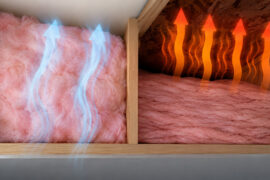
Precut panels that wedge into stud and joist bays. R-13 through R-38, faced and unfaced, and the installation mistakes that quietly eat your rated performance.
A batt is a precut panel of insulation, dimensioned to sit inside a stud, joist, or rafter cavity and hold itself there by friction. No hopper, no hose, no spray rig. You cut it with a utility knife against a straightedge, push it into the bay, and move on to the next one.
NAIMA, the trade association representing fiberglass and mineral wool producers, sets the manufacturing standards the category follows. R-value, tested under ASTM C518, is the metric installers and buyers measure it against.
NAIMA’s 2026 recycled-materials survey found U.S. manufacturers used more than 2.4 billion pounds of recycled glass in 2025 alone to produce fiberglass batt and related insulation.
What Is Batt Insulation?

Panels come off the production line already dimensioned. That is the whole idea behind the product. Widths match standard framing spacing, so the panel wedges between studs, joists, and rafters with nothing holding it but pressure against the framing members on either side.
It belongs to the broader category of types of insulation materials used across residential and light commercial construction.
Batt insulation arrives already sized, which is the detail that separates it from loose-fill and spray foam. Those two conform to whatever cavity they land in. A batt shows up pre-cut to a stud or joist bay, and your job is to make the bay and the batt agree with each other.
You will find it in the usual places:
- Wall cavities between studs
- Attic floors between ceiling joists
- Floor cavities between floor joists
- Rim joists at the foundation line
Batts are sold as separate cut lengths, not continuous rolls, which is what distinguishes a batt from a blanket insulation product on a spec sheet.
What Is Batt Insulation Made Of?

Spun mineral or plant fiber, held together with a binder, then cut to width. That covers every batt on the shelf.
Fiberglass gets spun from molten glass and silica sand. Mineral wool comes from basalt rock or recycled slag, and depending on the brand it gets sold as rock wool or stone wool. Natural fiber batts use cotton, denim, or sheep’s wool, and they occupy a small corner of the market that mostly serves people who react badly to fiberglass.
Owens Corning, Johns Manville, CertainTeed, and Knauf Insulation produce most of the fiberglass insulation sold in North America.
ROCKWOOL is the reference name in rock wool insulation, spun from the same basalt used in stone wool board products.
Bonded Logic manufactures a cotton and denim batt under the UltraTouch name, marketed as a formaldehyde-free option for allergy-sensitive installs.
Standard fiberglass batts test at R-3.0 to R-3.7 per inch, while mineral wool batts test higher, at R-3.8 to R-4.3 per inch, both measured under ASTM C518 heat flow meter testing.
| Material | Pros | Cons |
|---|---|---|
| Fiberglass | Lowest cost, widely stocked | Lower fire threshold, can irritate skin |
| Mineral wool | Higher R-value per inch, noncombustible | Heavier, costs more per batt |
| Cotton or wool | No fiberglass itch, recycled content | Higher price, fewer stocking dealers |
Fiberglass stays the volume leader on cost per square foot. Mineral wool wins out where fire performance or sound control matters more than price, and honestly, once you have handled both, the mineral wool is nicer to work with. It cuts clean and holds its shape in the bay. It also costs real money, which is why most houses get fiberglass.
Batt Insulation Sizes and Standard Dimensions
Widths are fixed to match on-center framing spacing, so a precut panel drops into a stud bay with a friction fit and no trimming.
Most residential framing runs on 16 inch or 24 inch centers. Batt widths get cut slightly narrower than that spacing on purpose, which is why a 15 inch batt belongs in a 16 inch bay.
| R-value | Thickness | Width Options |
|---|---|---|
| R-13 | 3.5 inch | 15 inch, 23 inch |
| R-19 | 6.25 to 6.5 inch | 15 inch, 23 inch |
| R-21 | 5.5 inch | 15 inch, 23 inch |
| R-30 | 9.5 to 10 inch | 16 inch, 24 inch |
| R-38 | 12 to 12.25 inch | 16 inch, 24 inch |
Where Different Batt Sizes Are Used
Walls take R-11 to R-21 batts, sized to whether the framing is 2×4 or 2×6. Attic work jumps up to R-30 through R-49, limited by how deep the ceiling joists actually run. Floors and rim joists usually land somewhere in the R-19 to R-25 range.
A batt cut for a 2×6 wall will not perform at its rated R-value if forced into a 2×4 cavity. The extra material has nowhere to go but compressed against itself.
What Is the Difference Between Faced and Unfaced Batt Insulation?
Faced batt has a sheet material bonded to one side, usually kraft paper or foil, and that sheet works as a vapor retarder.
Unfaced batt has no attached sheet. It relies on a separate vapor barrier, or on nothing at all, depending on how the rest of the assembly is built.
Kraft facing is the common one, a paper-based retarder with flanges you staple to the framing. Foil facing blocks more and adds a radiant barrier function in certain assemblies. Unfaced batt goes in where a separate barrier handles vapor, or where local code prohibits adding a retarder at all.
CertainTeed and Knauf both sell the same R-value batt in faced and unfaced versions. The facing choice does not change thermal performance on its own, it changes moisture handling.
Building codes in some regions restrict where a kraft or foil facing can sit within the wall assembly, since trapping moisture on the wrong side of the cavity causes condensation.
How Does Batt Insulation’s R-Value Work?
R-value measures resistance to heat flow through a material, and it comes from a standardized ASTM C518 heat flow meter test run at a 75 degree Fahrenheit mean temperature.
The denser and thicker the fiber mat, the more it slows conductive and convective heat transfer between the warm and cold sides of the cavity.
Federal regulation sets a tolerance on how far actual performance can drop below the labeled number.
Under the FTC R-Value Rule (16 CFR 460.8), manufacturers cannot sell batt insulation with a tested R-value more than 10 percent below what is printed on the label. The Federal Trade Commission’s 2005 amendment to the rule left that 10 percent figure itself unchanged; it clarified that the tolerance applies to manufacturers and the manufacturing process, not to installers, new home sellers, or retailers who rely on a manufacturer’s data.
Readers who want a wider look at how this metric applies across insulation types can check the dedicated R-value guide.
Why Compressing Batt Insulation Lowers Its R-Value
Compression is the most common way an installed batt underperforms its rating.
Force a 3.5 inch R-13 batt into a 3 inch cavity and the fibers pack tighter. Tighter fibers trap less still air, and still air is the actual insulating mechanism at work here. The fiber is just scaffolding.
The result is a lower effective R-value than the label promises, even though the batt material itself has not changed.
The dedicated guide on insulation compression covers how much performance typically gets lost at different compression ratios.
Overstuffing a cavity to squeeze in more insulation is one of the most common mistakes on residential jobs. It does the opposite of what the installer intended.
How Does Batt Insulation Control Moisture and Vapor?
Batt insulation itself does not stop moisture. The facing and the surrounding wall assembly do that work.
Vapor moves through a wall when warm, moist air meets a cold surface, and the facing decides how much of that vapor gets through before it condenses.
Kraft facing slows vapor without stopping it, which is why the industry calls it a retarder and not a barrier. Foil is the aggressive option. It blocks vapor almost entirely, so it belongs only on the warm-in-winter side of the assembly. Unfaced batt hands the whole job to a separate sheet, commonly polyethylene, installed as the actual vapor barrier.
Placing a vapor retarder on the wrong side of the cavity traps moisture inside the wall instead of letting it dry toward the exterior.
Building Science Corporation, the research firm behind much of the modern guidance on wall assemblies, and building scientist Joseph Lstiburek have both published extensively on getting this layering right by climate zone.
Get the facing orientation wrong and condensation forms inside the cavity. That is the leading cause of mold in batt-insulated walls, not the insulation material itself.
Fire Performance and Safety Ratings of Batt Insulation
Building codes cap the flame spread index of insulation and its facing at 25, with a smoke-developed index no higher than 450, when tested under ASTM E84.
That standard governs the facing, not just the fiber, which is why a kraft-faced batt needs its own test result separate from the raw fiberglass or mineral wool underneath.
ASTM C665 sets the material specification mineral fiber batt has to meet before it even reaches the E84 flame test, covering density, corrosivity, and fiber diameter.
Underwriters Laboratories certifies many of the facings sold on the market. A UL listing on the product label is the fastest way to confirm compliance without pulling the full ASTM report.
Mineral wool is noncombustible and holds its structure above 2,000 degrees Fahrenheit. Fiberglass is noncombustible too, but that word covers a lot of ground. Its glass fibers begin to soften and melt in roughly the 1,000 to 1,800 degree Fahrenheit range, depending on the glass formulation, so the material does not burn but it does surrender its shape long before stone wool does. Figures for mineral wool are consistent with manufacturer data and trade publications such as Insulation Outlook, the National Insulation Association’s magazine.
ROCKWOOL markets its stone wool batts around this exact property, since Class A fire performance is a selling point in multifamily and commercial specs where fiberglass alone will not satisfy the assembly rating.
The dedicated page on insulation fire rating breaks down how these classifications translate into actual assembly ratings like one-hour or two-hour walls.
What R-Value Do You Need for Your Climate Zone?
Required R-value depends on where the house sits, not on one national number.
The Department of Energy splits the country into climate zones, and energy star insulation guidance sets retrofit targets for each one.
Recommended R-values for retrofitting an uninsulated wood-frame home, per ENERGY STAR:
- Zone 1, southern Florida and the Gulf Coast: R-30 attic, R-13 floor
- Zone 3, much of the mid-South: R-49 attic, R-19 floor
- Zone 4A and 4B, mixed-humid and mixed-dry regions: R-60 attic, R-19 floor
- Zones 5, 6, and 4C, the upper Midwest and Northeast: R-60 attic, R-30 floor
- Zones 7 and 8, far northern Minnesota and Alaska: R-60 attic, R-38 floor
Wall guidance works differently, since it ties to a retrofit method rather than a flat target.
Under the 2021 IECC provisions ENERGY STAR references, an uninsulated 2×4 wall in Zones 4 through 8 gets R5 to R10 of insulative sheathing added beneath new siding, layered over whatever batt fills the cavity.
Code minimums often sit below these retrofit numbers, since code sets a floor for new construction while ENERGY STAR targets the most cost-effective level for an existing house.
A batt rated for R-19 will not satisfy an R-30 attic target by itself. In colder zones, installers commonly add a second layer running perpendicular to the joists to close the gap.
Batt Insulation vs Other Insulation Types
Every insulation product on the market is trying to do the same thing to the same cavity, which is slow heat moving through it. What separates them is R-value per inch, how the material gets into the cavity, and where each one physically cannot go.
| Type | R-value per inch | Install method | Best fit |
|---|---|---|---|
| Batt insulation | R-3.0 to R-4.3 | Friction fit, precut panels | Open stud, joist, rafter bays |
| Loose-fill insulation | R-2.2 to R-2.7 | Blown into the cavity | Attics, finished walls |
| Spray foam insulation | R-3.6 to R-7.0 | Sprayed, expands in place | Irregular or hard-to-reach cavities |
| Rigid foam board | R-4.0 to R-6.5 | Cut and fastened panels | Exterior sheathing, basement walls |
DOE insulation guidance and manufacturer data sheets tested under ASTM C518 back these per-inch ranges across all four product types.
Loose-fill insulation is the retrofit answer. It goes through a two inch hole into a finished wall, no drywall removal, which is a trick a rigid panel will never pull off.
With spray foam insulation you are really buying air sealing. It bonds to the framing and closes the gaps a precut batt leaves behind at every edge and penetration. Icynene, now part of Huntsman Building Solutions, was one of the first brands to popularize open-cell spray foam as a batt alternative in finished remodels.
Batt still wins on straightforward cost and speed in open, accessible framing, which describes most new residential construction before drywall goes up.
How Much Does Batt Insulation Cost?
Fiberglass batt and roll insulation runs $0.30 to $1.50 per square foot installed, or roughly $1,000 to $2,400 for a typical residential job, according to HomeAdvisor’s 2026 pricing data.
Mineral wool batt costs more per square foot, landing between $1.40 and $4.00 per Angi’s 2026 cost breakdown, since the raw material runs heavier and denser than fiberglass.
Four things move that number. Material type sets the baseline, with fiberglass cheapest and cotton or wool at the top. Target R-value adds thickness and therefore material. Facing adds a small premium over unfaced. And access matters more than people expect, because open new-construction framing is fast work while a retrofit behind existing drywall is not.
The dedicated cost per square foot for insulation page breaks down that full pricing picture and compares batt against every other insulation type on the market.
How Is Batt Insulation Installed?

Correct installation comes down to fit, not force. A batt that fills its cavity completely, without gaps or compression, delivers its full rated R-value.
The Insulation Institute, NAIMA’s residential guidance arm, publishes the RESNET Grade 1 standard most installers work toward.
- Measure the cavity and cut the batt roughly half an inch longer than the opening for a snug fit
- Cut around outlets, wiring, and plumbing instead of compressing the batt behind them
- Split thick batts to wrap conduit and pipes rather than notching a single layer
- Set the batt so it touches the cavity on all six sides, front to back and edge to edge
- Staple facing flanges to the face of the stud, not the side, to avoid a compressed edge
- Seal penetrations and the top and bottom plates before the drywall goes up
That perimeter sealing step is air sealing, and it matters as much as the batt itself for stopping conditioned air loss.
The fiberglass installation walkthrough covers this same sequence in more detail, with photos of correct and incorrect fits.
Installer Safety and Handling Fiberglass Batt
Fiberglass fibers cause temporary skin and throat irritation during handling, not a long-term health hazard when basic precautions are followed.
OSHA sets the permissible exposure limit for fiberglass at 5 mg per cubic meter for respirable dust and 15 mg per cubic meter for total dust over an 8-hour workday.
Long sleeves and gloves, safety glasses, and an N95 while you are cutting. That is the whole list, and the sleeves are the part people skip and regret around hour three.
NAIMA and OSHA established a voluntary program in 1999 that pushes manufacturers toward an even tighter exposure target of 1 fiber per cubic centimeter.
When Does Batt Insulation Fail or Stop Performing?
Batt insulation underperforms far more often from bad installation than from the material itself failing.
The usual trouble spots:
- Irregular framing, meaning bay windows, cathedral ceilings, and angled rafters where a rectangular panel cannot friction-fit cleanly
- Cramped cavities packed with wiring, plumbing, or blocking, where installers compress the batt instead of cutting around obstructions
- Knee walls and rim joists, where gaps at the edges let conditioned air bypass the insulation entirely
- Wet or previously flooded cavities, where a soaked batt loses loft and stays compressed even after it dries
Oak Ridge National Laboratory research found that fiberglass batts installed in real buildings reached only 60 to 70 percent of their rated R-value, with the shortfall coming from gaps, compression, and convective air loops inside the cavity.
Spray foam does not share this particular failure mode, since it bonds directly to the framing and fills voids a precut panel cannot reach.
A blower door test is the standard way to confirm whether a house is actually losing conditioned air through gaps like these.
Where the test flags a cold spot, a thermal imaging camera shows installers exactly which cavity has the missing or compressed batt.
None of this is a batt problem in the sense of a defective product. It is a fit problem, and it is fixable by removing and re-cutting the section rather than replacing the whole cavity.
FAQ on Batt Insulation
Is Batt Insulation the Same as Blanket or Roll Insulation?
Batt and blanket insulation are nearly identical; the difference is packaging. Batts cut to fixed lengths for a stud or joist bay, while roll insulation ships as a continuous run, unrolled and trimmed on site for long attic or floor runs.
Does Batt Insulation Work for Soundproofing?
Mineral wool batt absorbs sound well above fiberglass, since its denser fiber structure dampens airborne noise between floors and walls. Fiberglass batt still cuts noise transfer versus an empty stud cavity, just less than mineral wool or a dedicated acoustic batt product.
How Long Does Batt Insulation Last?
Fiberglass and mineral wool batt do not expire; both hold their R-value for the life of the building when kept dry and uncompressed. Failure comes from moisture, pest damage, or a renovation disturbing the cavity, not from the fiber material aging on its own.
Can You Install Batt Insulation Yourself, or Do You Need a Professional?
Open, accessible framing in new construction is a reasonable DIY job with basic tools and a dust mask. Finished walls and tight crawl spaces, or any job needing a RESNET Grade 1 inspection, are better left to a licensed insulation contractor.
What Should You Fix First
Performance problems trace back to installation quality before they trace back to material choice. Closing gaps and compression in the cavity comes before swapping fiberglass for mineral wool or chasing a higher R-value on the label.
RESNET’s installation grading treats Grade 3 workmanship as zero R-value across 5 percent of the insulated surface, the threshold where fixing installation quality stops being optional and becomes the entire performance question.
Start with gaps, voids, and compression in the existing cavity. Then check that the facing and vapor control actually match your climate zone. Total R-value against attic, wall, and floor targets comes last, after the first two are sorted.
Resetting a poorly fitted batt costs more upfront than layering a second batt on top, but a second layer over trapped gaps only doubles the material without closing the air pathway underneath.
The deeper walkthrough on installing insulation in an attic covers that same fix-first sequence room by room.