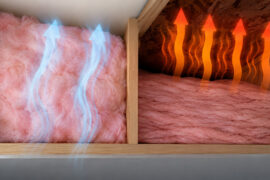
A building that uses 90% less energy for heating and cooling sounds impossible. It’s not.
That’s exactly what passive house insulation delivers when installed correctly.
Developed by the Passive House Institute in Germany, this approach to thermal envelope design has certified over 65,000 buildings worldwide since 1991.
The secret isn’t exotic materials. It’s obsessive attention to continuity, airtightness, and thermal bridge elimination.
This guide covers R-value requirements by climate zone, material options from mineral wool to vacuum insulation panels, installation methods that actually achieve certification, and real costs with payback timelines.
Whether you’re building new or planning a deep energy retrofit, understanding passive house insulation standards changes how you think about building performance.
What is Passive House Insulation

Passive house insulation is a high-performance thermal barrier system designed to meet Passivhaus certification standards developed by the Passive House Institute in Darmstadt, Germany.
These systems achieve wall R-values between R-40 and R-60, roof values from R-50 to R-90, and create a continuous thermal envelope around the entire building structure.
The standard was pioneered by Wolfgang Feist in 1991 and has since become the global benchmark for superinsulated building design.
Buildings meeting this standard use 80-90% less energy for heating and cooling compared to conventional construction.
The annual heating demand cannot exceed 15 kWh per square meter, which is roughly equivalent to 1.5 liters of heating oil per square meter annually.
How Does Passive House Insulation Differ from Standard Insulation
Standard home insulation meets minimum building code requirements. Passive house insulation exceeds those minimums by a factor of two or more.
The key differences come down to four factors:
- Thickness: Passive house walls require 200-300mm of insulation versus 100-150mm for code-minimum builds
- Continuity: Zero gaps allowed in the thermal envelope; standard construction tolerates minor breaks
- Airtightness: 0.6 ACH50 maximum versus 3-5 ACH50 for typical new construction
- Thermal bridge elimination: Every junction, corner, and penetration must be detailed to prevent heat loss
Understanding how insulation works at the molecular level explains why these differences matter so much for energy performance.
The U-value for passive house walls typically falls below 0.15 W/m2K, compared to 0.25-0.30 W/m2K for standard construction.
This means heat escapes three times slower through passive house assemblies.
What R-Value Does Passive House Insulation Require
The R-value requirements for passive house certification vary by climate zone, building geometry, and component type.
PHIUS (Passive House Institute US) and the European PHI use different calculation methods, but both demand exceptional thermal resistance.
Wall Insulation R-Values
Above-grade walls need R-40 to R-60 in cold climates (DOE zones 5-7). Milder regions can achieve certification with R-30 to R-40 when combined with high-performance windows and excellent airtightness.
Roof and Ceiling Insulation R-Values
Roof assemblies require R-50 to R-90 depending on climate. Cathedral ceilings and flat roofs need careful detailing to achieve these values without creating moisture problems.
Slab and Foundation Insulation R-Values
Sub-slab insulation starts at R-30 minimum. When insulating basement walls in passive house projects, continuous exterior insulation from footing to roof is standard practice.
Underfloor insulation connects directly to the wall system, eliminating thermal bridges at the critical wall-to-floor junction.
What Types of Insulation Materials Meet Passive House Standards
Multiple types of insulation materials can achieve passive house performance when installed correctly and at sufficient thickness.
The choice depends on application, budget, fire requirements, and environmental priorities.
Mineral Wool Insulation
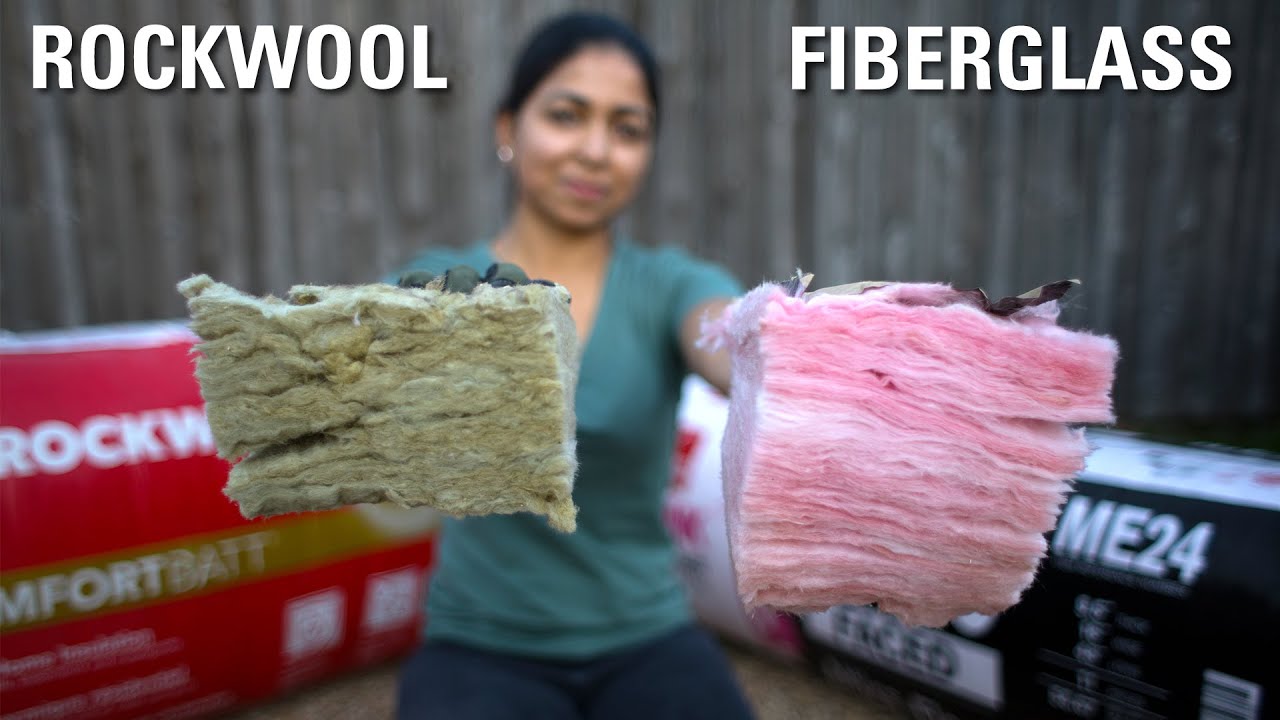
Rock wool insulation from manufacturers like ROCKWOOL and Knauf Insulation offers thermal conductivity around 0.035-0.040 W/mK. It handles moisture well, resists fire without chemical treatments, and allows vapor diffusion through wall assemblies.
Cellulose Insulation
Cellulose insulation achieves R-3.5 to R-3.8 per inch when dense-packed to 3.5 pounds per cubic foot. Lower embodied carbon than foam products; made from recycled newspaper with borate fire treatment.
Rigid Foam Board Insulation

Rigid foam board insulation includes EPS, XPS, and polyisocyanurate options. Polyiso delivers R-6 per inch but loses performance in cold temperatures. XPS maintains R-5 per inch regardless of temperature.
Kingspan and BASF manufacture high-performance rigid boards specifically designed for continuous external wall insulation systems.
Spray Foam Insulation
Closed-cell spray foam provides R-6.5 per inch plus serves as both insulation and air barrier. Open-cell spray foam insulation offers R-3.7 per inch at lower cost.
When comparing spray foam or cellulose insulation for passive house projects, consider that spray foam simplifies air sealing while cellulose has lower environmental impact.
Vacuum Insulation Panels
VIPs achieve R-25 to R-50 per inch, making them ideal where space is limited. High cost restricts use to specific applications like retrofit insulation projects where wall thickness cannot increase.
Aerogel insulation offers similar thin-profile performance at R-10 per inch with better durability than vacuum panels.
What is Thermal Bridge Free Design in Passive House Insulation
Thermal bridge free design eliminates weak spots where heat bypasses the insulation layer.
Understanding thermal bridging is critical because even small breaks in insulation continuity can increase heat loss by 20-30%.
Common thermal bridges in conventional construction include:
- Steel studs and lintels penetrating exterior walls
- Concrete balcony slabs extending through the building envelope
- Window and door frames without thermal breaks
- Foundation-to-wall connections
- Roof-to-wall junctions
Passive house certification requires psi-values below 0.01 W/mK for all linear thermal bridges.
The PHPP software from Passive House Institute calculates thermal bridge impacts and verifies compliance.
Achieving thermal bridge free construction often requires specialized products: insulated concrete forms, thermally broken window frames, and proprietary connection details from manufacturers like Schoeck.
A thermal imaging camera scan after construction reveals any thermal bridges that escaped detection during design review.
How is Passive House Insulation Installed
Installation quality determines whether a building achieves certification. Poor workmanship negates the benefits of home insulation, regardless of material choice.
Certified Passivhaus Designers and Consultants oversee installation to ensure compliance with PHPP calculations.
Continuous Insulation Layer Installation
Wall systems use either exterior continuous insulation over structural framing or double-stud walls filled with dense pack insulation.
Roof assemblies require uninterrupted coverage from ridge to eave, with special attention at penetrations for vents and skylights.
Foundation connections demand insulation continuity from below-slab through wall assembly to roof, creating the complete thermal envelope.
Air Barrier Integration
The 0.6 ACH50 airtightness requirement demands meticulous sealing at every joint, penetration, and transition.
Pro Clima, Siga, and other manufacturers produce specialized tapes and membranes for passive house air barriers.
A blower door test verifies airtightness before drywall installation, allowing corrections while assemblies remain accessible.
The vapor barrier location depends on climate: interior side in cold climates, exterior side in hot-humid regions, or smart vapor retarders like Intello membrane that adapt to conditions.
What Does Passive House Insulation Cost
Passive house insulation adds 5-15% to total construction costs compared to code-minimum builds.
The cost per square foot for insulation in passive house projects ranges from $8-25, depending on materials and regional labor rates.
Cost breakdown by component:
- Wall insulation: $4-10 per square foot of wall area
- Roof insulation: $3-8 per square foot of roof area
- Foundation insulation: $2-6 per square foot of slab
- Air sealing and tapes: $1-3 per square foot of envelope
- High-performance windows: 2-3x cost of standard windows
The ROI on insulation for passive house projects typically reaches 8-12% annually through energy savings.
Most homeowners see a payback period for insulation upgrades between 7-15 years, shorter in regions with high energy costs.
A weatherization rebate from utility companies and insulation tax credits from federal programs reduce upfront costs by 10-30%.
NYSERDA offers up to $4,500 per unit for passive house certified multifamily projects.
What Climate-Specific Requirements Affect Passive House Insulation
PHIUS developed climate-specific targets that adjust insulation requirements based on local heating and cooling degree days.
The European PHI standard uses a single global target, which critics argue makes certification unnecessarily difficult in extreme climates.
Cold Climate Insulation Requirements
DOE Climate Zones 5-7 demand the highest R-values: R-60+ walls, R-80+ roofs, R-40+ foundations.
Thermal mass inside the insulation layer helps moderate temperature swings during cold snaps.
Triple-glazed windows with U-factors below 0.14 are standard; some projects use quadruple glazing.
Hot Climate Insulation Requirements
Cooling-dominated climates prioritize solar heat gain control over raw R-value.
Reflective insulation and cool roof coatings reduce radiant heat transfer through roof assemblies.
Window solar heat gain coefficients below 0.25 on east and west facades prevent overheating; exterior shading devices block direct sun.
What Certification Standards Govern Passive House Insulation
Two primary organizations certify passive house projects: the German Passive House Institute (PHI) and the American PHIUS.
Passive House Institute Requirements
PHI certification requires annual heating demand under 15 kWh/m2, airtightness at 0.6 ACH50, and primary energy under 120 kWh/m2.
The PHPP software performs all energy modeling calculations; no alternative tools accepted.
Certified components from the PHI database simplify compliance documentation.
PHIUS Requirements
PHIUS 2021 standards use climate-specific targets calculated through WUFI Passive software.
PHIUS CORE certification covers energy efficiency; PHIUS ZERO adds net-zero energy requirements achievable with on-site renewables.
LEED certification for insulation projects can complement passive house certification, earning additional points for exceeding ASHRAE 90.1 requirements.
California’s Title 24 energy code aligns with some passive house principles but falls short of full certification requirements.
What are Common Passive House Insulation Installation Mistakes
Even experienced contractors make errors that compromise passive house performance.
A home energy audit after construction often reveals problems invisible during installation.
Most common failures:
- Thermal bridges at window installations: Frames not aligned with insulation layer; missing insulated sills
- Air barrier discontinuities: Unsealed penetrations for electrical, plumbing, HVAC; tape failures at membrane joints
- Insulation compression: Batts stuffed into cavities lose R-value; wiring and pipes compress insulation behind them
- Vapor barrier placement errors: Wrong side of assembly creates condensation risk and potential mold growth
- Missing insulation at complex junctions: Dormers, cantilevers, and bump-outs often have gaps
Batt insulation requires precise cutting around obstacles; gaps as small as 2% of cavity area reduce effective R-value by 25%.
Loose-fill insulation avoids compression issues but can settle over time if not installed at proper density.
Quality assurance testing during construction, not just at completion, catches problems while they can still be fixed without major demolition.
The insulation fire rating must meet local code requirements, which sometimes conflicts with optimal thermal performance; mineral wool solves this in most applications.
FAQ on What Is Passive House Insulation
What makes passive house insulation different from regular insulation?
Passive house insulation requires continuous coverage with zero gaps, R-values 2-3 times higher than building code minimums, and airtightness below 0.6 ACH50. Standard insulation meets code but allows thermal bridges and air leakage that passive house standards eliminate.
How thick do passive house walls need to be?
Wall assemblies typically range from 12-18 inches thick to accommodate R-40 to R-60 insulation. Double-stud walls or exterior continuous insulation systems achieve these depths. Climate zone and chosen materials determine exact thickness requirements.
Can I use fiberglass insulation in a passive house?
Fiberglass insulation can work in passive house projects when installed perfectly without compression or gaps. Most certified projects prefer mineral wool, cellulose, or rigid foam because they’re more forgiving during installation and provide better air sealing.
Is passive house insulation fireproof?
Not all passive house insulation is fireproof. Mineral wool resists fire naturally. Foam products require protective barriers. Cellulose contains borate fire retardants. Wondering if home insulation is flammable? It depends entirely on material choice.
What is the lifespan of passive house insulation?
Properly installed passive house insulation lasts 50-100 years. Mineral wool and rigid foam maintain R-value indefinitely. Cellulose may experience minor insulation settlement over decades but remains effective when installed at correct density.
Do passive houses need heating systems?
Most passive houses need minimal supplemental heating, typically 10-15% of conventional homes. The heat recovery ventilator (HRV) or energy recovery ventilator (ERV) provides fresh air while recapturing 80-90% of heat that would otherwise escape.
Can existing homes achieve passive house insulation levels?
Yes, through EnerPHit certification designed for retrofits. Improving home insulation to passive house standards in existing buildings typically involves exterior insulation wraps, window replacements, and meticulous air sealing throughout the envelope.
What natural insulation options meet passive house standards?
Sheep’s wool insulation achieves R-3.5 to R-3.8 per inch with excellent moisture management. Cork, wood fiber, and hemp insulation also meet passive house requirements when installed at sufficient thickness. All require careful detailing.
How do I verify my passive house insulation is working correctly?
Blower door testing confirms airtightness at 0.6 ACH50 or below. Thermal imaging reveals hidden gaps and thermal bridges. PHPP software calculations must match actual performance. Third-party certification from PHI or PHIUS validates compliance.
Are there government incentives for passive house insulation?
Federal tax credits, state rebates, and utility incentives reduce costs by 10-30%. Some homeowners qualify for free home insulation through weatherization assistance programs. NYSERDA, Energy Trust of Oregon, and similar programs offer passive house specific incentives.
Conclusion
Passive house insulation represents the highest standard in energy efficient building design available today.
The combination of high R-value insulation, thermal bridge free design, and mechanical ventilation with heat recovery creates buildings that maintain comfortable indoor air quality while using minimal energy.
Whether pursuing PHIUS or PHI certification, the principles remain consistent: continuous insulation coverage, exceptional airtightness, and quality-controlled installation.
The upfront investment pays back through dramatically reduced space heating demand and lower utility bills for decades.
As energy codes tighten and climate concerns grow, passive house insulation standards increasingly influence mainstream construction practices.
Buildings constructed to these specifications today will outperform code-minimum structures for their entire lifespan, typically 50-100 years of superior comfort and efficiency.