Summarize this article with:
Sheep’s wool insulation is a natural fiber insulation made from raw sheep fleece processed into batts, rolls, or loose-fill products for building applications.
The wool comes from annual shearing, mostly sourced from British wool, New Zealand wool, and Merino sheep breeds.
Manufacturers like Havelock Wool, Thermafleece, and Isolena process the fibers using mechanical bonding or 5-20% recycled polyester adhesive.
Unlike synthetic options in the different types of insulation materials category, wool insulation requires minimal energy to produce and biodegrades completely at end of life.
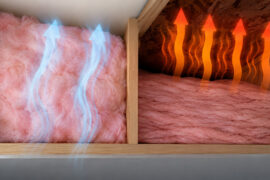
The keratin protein structure of wool fibers creates millions of tiny air pockets that trap heat and regulate moisture naturally.
How is Sheep’s Wool Insulation Made
Production starts with shearing sheep twice yearly.
The raw fleece goes through a scouring process using soda and curd soap to remove lanolin content, dirt, and residues.
After washing, the clean wool enters carding machines that align and separate the fibers into consistent webs.
Borax treatment follows for most manufacturers, adding fire resistance and pest protection at roughly 4% dry weight.
Some brands like Isolena use Ionic Protect technology instead, a plasma-ion treatment that permanently modifies the wool fiber structure without chemicals.
The processed fibers then get:
- Needle-punched into dense batts
- Rolled into blanket insulation strips
- Formed into loose wool knops for blown-in applications
Final products receive quality certifications including European Technical Approval, natureplus quality seal, and ASTM testing for thermal and fire performance.
What R-Value Does Sheep’s Wool Insulation Provide
Sheep wool insulation delivers an R-value between 3.5 and 4.3 per inch of thickness.
Wool batts typically measure R-3.6 per inch while loose-fill wool products reach approximately R-4.3 per inch.
This thermal resistance rating sits 0.3 to 0.6 points higher than fiberglass insulation, cellulose insulation, and mineral wool alternatives.
Standard product offerings include R-13 and R-19 configurations for wall and ceiling applications.
The thermal conductivity (lambda value) ranges from 0.033 to 0.038 W/mK, meeting requirements for most building codes including ASTM C518 testing standards.
Cold climates may require doubled-up batts or increased wall depth to achieve higher total R-values.
What Are the Thermal Properties of Wool Insulation
The crimped wool fibers create natural loft, trapping air in millions of microscopic pockets.
These air pockets form the actual insulating barrier since still air conducts heat poorly.
Each fiber acts like a coiled spring, maintaining consistent wool density measurement even under pressure.
Understanding how insulation works helps explain why wool performs well across varying conditions.
The U-value calculation for wool assemblies shows stable performance even when humidity increases, unlike synthetic materials that lose effectiveness when damp.
Key thermal characteristics:
- Stable heat transfer resistance across humidity levels
- Active temperature regulation through moisture phase changes
- Reduced thermal bridging when properly installed between studs
- Compression resistance maintains air pocket structure long-term
Wool actually releases small amounts of heat when absorbing moisture, raising surrounding temperature by up to 45 degrees Fahrenheit during absorption cycles.
How Does Sheep’s Wool Insulation Manage Moisture
Wool fibers are hygroscopic, absorbing and releasing water vapor naturally without feeling wet.
The fiber structure has a hydrophobic exterior that repels liquid water while the hydrophilic interior absorbs vapor.
This dual nature allows wool to hold up to 33-35% of its weight in moisture while maintaining insulation performance.
A proper vapor barrier setup with wool differs from synthetic installations because the material actively manages humidity rather than blocking it entirely.
When indoor humidity rises, wool absorbs excess moisture from the air and stores it within the fiber cortex.
During dry periods, that stored moisture releases back into the environment through evaporation.
This moisture regulation cycle:
- Prevents condensation on cold surfaces
- Protects surrounding timber framing from rot
- Reduces mold and mildew risk since keratin protein resists fungal growth
- Maintains stable indoor climate without mechanical dehumidification
The vapor permeability rating sits at a mu-value of 1, meaning wool allows moisture to pass through freely rather than trapping it inside wall cavities.
Where Can Sheep’s Wool Insulation Be Installed
Wool insulation works in most residential and commercial building applications where home insulation fits between framing members.
Attic and Loft Insulation
Attics account for up to 35% of heat loss in buildings.
Install wool rolls between and over ceiling joists at minimum 160mm thickness; 200mm recommended for optimal performance.
Wall Cavity Insulation
Premium rolls or batts fit between timber frame studs using friction-fit installation methods.
Cavity wall insulation with wool requires 80-100mm thickness for interior partitions.
Roof and Rafter Insulation
Staple wool rolls between rafters for cathedral ceilings, dormer bungalows, and attic conversions.
Leave 25-50mm ventilation gap if no breathable membrane exists; 200mm total thickness meets most building regulations.
Floor Insulation
Underfloor insulation with wool batts fits between suspended timber floor joists.
Combine with acoustic underlay for sound transmission reduction between floors.
Pipe and Tank Insulation
Wool rope products wrap around pipe insulation applications and water tanks in unheated spaces.
What Forms Does Sheep’s Wool Insulation Come In
Wool batts measure 50-100mm thick, with standard widths of 400mm (16 inches) and 600mm (24 inches) matching typical stud spacing.
Roll lengths range from 4000mm to 7200mm depending on manufacturer.
Batt insulation products from brands like Black Mountain Insulation and Oregon Shepherd come pre-cut for wall cavities.
Loose-fill insulation uses wool knops, small balls of tangled fiber designed for blown-in applications.
DIY installation works with a standard garden vacuum blower and 3-inch hose; professionals use commercial blowing equipment.
Wool ropes fill gaps in log homes and around window frames.
How Do You Install Sheep’s Wool Insulation
No protective equipment needed. No gloves, masks, or safety glasses required unlike fiberglass alternatives.
Cut batts slightly larger than the cavity space, roughly 10mm oversize for a snug friction fit.
Use a sharp knife or compress between two boards for clean cuts.
Installation steps:
- Clean cavity spaces and check for woodworm, dry rot, or exposed wiring
- Start at the furthest point from access and work backward
- Press insulation gently into place without compressing the fibers
- Butt roll ends tightly together at joints
- Run wiring under insulation, never through it
- Leave 50mm gap at eaves for ventilation
Pair with breathable airtight membranes for best performance; proper air sealing prevents drafts that reduce effectiveness.
A blower door test confirms installation quality.
What Are the Fire Safety Properties of Wool Insulation
Wool ignites at approximately 560-580 degrees Celsius, far higher than most building materials.
The 14% nitrogen content means wool cannot sustain a flame without external oxygen supply.
Wool is self-extinguishing; remove the heat source and it stops burning immediately.
Products meet Class A insulation fire rating under ASTM E84 testing without toxic flame retardant additives.
When wool burns, it chars and swells rather than melting or dripping like synthetic insulation, creating a protective barrier.
Asking is home insulation flammable matters when comparing materials; wool ranks among the safest options available.
How Does Sheep’s Wool Insulation Affect Indoor Air Quality
Keratin protein in wool fibers actively absorbs formaldehyde and other volatile organic compounds from indoor air.
The amino acid side chains bind pollutants permanently through chemical reaction, not just temporary adsorption.
Research from the German Wool Research Institute confirms wool removes harmful gases including nitrogen oxide and sulfur dioxide.
Install wool closer to interior spaces for maximum air purification effect; partition walls and suspended ceilings work best.
Unlike synthetic materials that off-gas chemicals, wool releases no harmful substances into living spaces.
What Sound Insulation Does Sheep’s Wool Provide
Wool achieves a noise reduction coefficient between 0.90 and 1.15, outperforming most plastic insulation materials.
The dense, irregular fiber structure absorbs up to 55% of sound energy passing through it.
Helical molecular structure reduces airborne sound, surface noise, and sound transmission between rooms.
Viscoelastic properties convert sound energy into small amounts of heat.
Ideal for bedrooms, home offices, music rooms, and multi-family buildings requiring soundproof insulation between units.
How Long Does Sheep’s Wool Insulation Last
Wool insulation lasts approximately 60 years or the entire life of the building.
Each fiber withstands over 20,000 compression cycles without permanent deformation.
Unlike fiberglass that compacts over time, wool maintains dimensional stability and loft indefinitely.
No insulation settlement issues; the spring-like fiber structure rebounds after compression.
Glass fiber may need topping up after 10 years while wool keeps performing.
How Much Does Sheep’s Wool Insulation Cost
Expect to pay $18-25 per square meter at 100mm thickness for 100% pure wool products.
Wool-polyester blends cost less but sacrifice some moisture management benefits.
Comparable mineral wool runs about $13 per square meter; fiberglass batts cost even less.
Understanding the cost per square foot for insulation helps budget accurately across different material choices.
The payback period for insulation with wool runs longer initially but lifetime durability offsets the premium.
Check eligibility for weatherization rebates and insulation tax credits to reduce upfront costs.
What Are the Drawbacks of Sheep’s Wool Insulation
Moth vulnerability remains the biggest concern; untreated wool attracts insects that eat keratin fibers.
All commercial products require treatment with borax, Ionic Protect, or diatomaceous earth for pest resistance.
Higher upfront cost compared to conventional options limits adoption despite long-term value.
Limited availability in some regions; online suppliers frequently run out of stock.
Lower R-value per inch than spray foam insulation or rigid foam board insulation means thicker walls needed in cold climates.
Not suitable for direct ground contact or continuously wet environments.
How Does Sheep’s Wool Compare to Fiberglass Insulation
| Property | Sheep’s Wool | Fiberglass |
| R-value per inch | 3.5–4.3 | 2.9–3.8 |
| Moisture handling | Absorbs 33% weight | Loses performance when wet |
| Installation safety | No protection needed | Gloves, mask, goggles required |
| Lifespan | 60+ years | 10–25 years |
| Embodied energy | 6 MJ/kg | 26 MJ/kg |
Wool handles moisture without degradation; fiberglass batts sag and lose effectiveness when damp.
Health risks during installation favor wool significantly.
How Does Sheep’s Wool Compare to Mineral Wool
Rock wool insulation matches wool’s thermal conductivity around 0.042 W/mK but lacks moisture management.
Embodied energy for mineral wool sits at 15-20 MJ/kg versus just 6 MJ/kg for sheep wool.
Both achieve Class A fire ratings; mineral wool withstands higher temperatures but wool self-extinguishes faster.
Wool biodegrades completely while rock wool requires landfill disposal.
Price difference narrows when factoring wool’s longer service life and no replacement costs.
What Makes Sheep’s Wool Insulation Sustainable
Sheep regrow their fleece annually, making wool a rapidly renewable resource.
Production requires just 6 MJ/kg of embodied energy, one-sixth that of mineral wool and far below polyurethane foam at 101 MJ/kg.
Carbon makes up 50% of wool’s weight; 1 kg of clean wool sequesters 1.8 kg of CO2 from atmospheric sources.
Wool qualifies for LEED certification for insulation projects and meets Passive House insulation standards.
End of life options include composting; wool returns nutrients to soil within months.
Manufacturing uses repurposed carding machines, electric motors, and simple cutting stations with minimal industrial processing.
Which Brands Manufacture Sheep’s Wool Insulation
Havelock Wool produces 100% wool batts and blown-in products in North America with R-3.6 and R-4.3 per inch ratings.
Thermafleece manufactures CosyWool in the UK using 75% British wool plus recycled fibers for improved durability.
Isolena offers premium European products with proprietary Ionic Protect pest treatment and natureplus certification.
FAQ on What Is Sheep’s Wool Insulation
Is sheep’s wool insulation safe to handle?
Yes, completely safe. Unlike fiberglass that requires gloves, masks, and eye protection, natural wool insulation causes no skin irritation or respiratory issues. You can install it barehanded. The keratin fibers pose zero health risks to installers or building occupants.
Does sheep’s wool insulation attract moths and pests?
Untreated wool attracts moths that feed on keratin protein. All commercial products receive borax treatment or Ionic Protect processing to prevent insect damage. Properly treated wool from manufacturers like Havelock Wool and Thermafleece remains pest-free for decades.
Can sheep’s wool insulation get wet?
Wool handles moisture better than any synthetic alternative. The hygroscopic fibers absorb up to 35% of their weight in water vapor without losing thermal performance. Wool feels dry even when saturated and releases moisture when conditions allow.
How does sheep’s wool insulation compare to spray foam?
Spray foam delivers higher R-value per inch (R-6 to R-7) versus wool’s R-3.5 to R-4.3. Wool wins on sustainability, moisture management, and indoor air quality. Choosing between spray foam or cellulose insulation and wool depends on your priorities.
Is sheep’s wool insulation worth the higher cost?
The ROI on insulation with wool improves over time. Higher upfront costs offset by 60-year lifespan, zero replacement needs, and lower embodied energy. Factor in health benefits and air purification for true value assessment.
Where is sheep’s wool insulation available?
Widely available in UK, Australia, New Zealand, and Europe. US distribution expanding through Havelock Wool and Oregon Shepherd. Online ordering common but stock shortages occur. Check local building suppliers or order directly from manufacturers.
Does sheep’s wool insulation meet building codes?
Yes. Products carry European Technical Approval, ASTM certifications, and Class A fire ratings. Wool meets requirements for Energy Star insulation programs and qualifies for green building certifications including LEED and Passive House standards.
Can I install sheep’s wool insulation myself?
Absolutely. DIY installation requires no special tools or safety equipment. Cut batts with a sharp knife, friction-fit between framing members. A home energy audit beforehand identifies priority areas for maximum impact.
How thick should sheep’s wool insulation be?
Minimum 120mm for attic floors per most regulations; 160-200mm recommended for comfort. Wall cavities need 80-100mm. Roof installations require 200mm between rafters. Thickness requirements vary by climate zone and benefits of home insulation goals.
Does sheep’s wool insulation smell?
Fresh wool has mild natural lanolin scent that dissipates within weeks after installation. The material actually absorbs odors rather than producing them. Wool removes formaldehyde and other volatile organic compounds from indoor air permanently.
Conclusion
Sheep’s wool insulation stands out among natural fiber insulation options for its unique combination of thermal performance, moisture regulation, and environmental sustainability.
The R-3.5 to R-4.3 per inch rating competes directly with conventional materials while offering superior hygroscopic properties and indoor air quality benefits.
Brands like Isolena, Havelock Wool, and Thermafleece have made this renewable insulation material accessible for retrofit insulation projects and new construction alike.
Higher upfront costs balance against 60-year durability, zero health risks during installation, and complete biodegradability.
Whether you want to improve home insulation in your attic, walls, or floors, wool delivers consistent performance across humid and dry conditions.
For homeowners prioritizing sustainable building materials and healthy living spaces, sheep’s wool insulation remains a smart long-term investment.