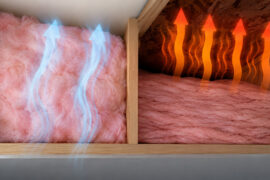
In Remodeling Magazine’s 2016 Cost vs. Value Report, a fiberglass attic insulation upgrade recouped 117% of its installed cost at resale. It was the only project category that year to return more than its price, beating every kitchen and bath remodel on the list.
That number gets quoted a lot, and it’s worth handling carefully, because resale value and energy savings are two different things. Insulation ROI measures the return an upgrade generates against what it cost to install. Homeowners, energy auditors, and contractors run that math on attic, wall, and crawl space work, then check the result against the local climate zone and whatever r-value is already sitting up there.
What Is Insulation ROI?
Two numbers do all the work. What the project costs upfront, and how much it takes off the annual energy bill. Divide the second by the first and you have the metric.
That’s narrower than home insulation spending in general, which folds comfort, noise, and moisture control into the same conversation. Those things are real. They just don’t show up on a utility statement in a form you can divide.
Renovation ROI is the fuzzier cousin, blending resale value, how a room looks, and what a buyer might pay extra for. Insulation ROI doesn’t have that problem. You can check it against last winter’s bill.
Everything below builds off those two figures.
How Is Insulation ROI Calculated?

A $2,000 project that saves $400 a year returns 20% annually and pays for itself in five years. That’s the whole calculation: net annual energy savings divided by installation cost, multiplied by 100.
The ROI Formula and a Worked Example
Written out, it’s annual energy savings divided by installation cost, times 100.
Say you have a 1,500 square foot attic. Insulating it costs $2,400, and the heating and cooling bill drops $360 a year.
- $2,400 to install
- $360 saved per year
- 15% return annually
- 6.7 year simple payback
Some contractors prefer the net present value method, which discounts future savings back to today’s dollars and accounts for energy prices climbing. It’s the more accurate approach. For a homeowner deciding whether to call an insulation crew, simple payback gets you close enough without opening a spreadsheet.
What Counts as a Good Payback Period
Two to seven years is strong for residential work, and most decent projects land inside that. A payback period for insulation longer than that isn’t automatically bad, but it needs a reason.
Attic work and rim joists sit at the fast end, usually finishing in two to five years. Whole-wall retrofits and crawl space encapsulation take six to ten, since the labor is heavier and the cavities are harder to reach.
Past ten or twelve years, something is off. Oversized project, inflated quote, or a house that didn’t need much insulation in the first place.
Insulation Cost and Energy Savings
HomeAdvisor’s 2026 cost data puts a standard residential insulation project between $1,066 and $2,639 installed, averaging around $1,852.
On the savings side, EPA estimates run 11% to 15% off total energy costs. That range assumes air sealing happens alongside the insulation itself. Skip the sealing and you’re at the bottom of it, or under.
The published figures worth writing down:
- Average installation cost: $1,852, typical range $1,066 to $2,639 (HomeAdvisor, 2026)
- Heating and cooling savings: up to 15% annually from sealing and insulating (EPA / Energy Star)
- Total energy cost savings: around 11% annually (EPA / Energy Star)
- Average attic insulation cost: $2,500 (Angi)
Average Installation Cost by Material
Material choice swings the cost per square foot for insulation more than almost any other variable, per HomeAdvisor’s 2026 cost breakdown.
- Fiberglass runs $0.30 to $1.50 per square foot
- Cellulose sits higher, $0.60 to $2.30
- Mineral wool jumps to $1.40 to $4.00
- Open-cell spray foam lands around $1.00 to $2.00 per square foot, and closed-cell costs more than that
Tearing out old insulation before a re-insulation job adds another $1 to $2 per square foot. That line gets left off a surprising number of quotes.
Annual Energy Savings by Project Type
Whole-attic sealing and insulation saves the most in absolute dollars, because the attic is the single largest heat loss surface in most houses.
One wall section or a single crawl space zone saves less money even when the percentage return on that smaller job looks similar on paper.
Doing the whole envelope at once costs more and the savings show up in every room. Targeting one zone is cheaper, and the comfort improvement stays where the work happened.
Plenty of people start with the attic and come back for walls and crawl spaces once the first utility bill confirms the savings were real. Reasonable way to do it.
Which Factors Change Insulation ROI?
Climate zone matters most. After that, the r-value already in place, the age of the house, what a kilowatt hour costs locally, and how much air leakage survives the job.
Two houses with identical insulation can post very different returns once those variables land.
R-Value and Climate Zone
What R-value a house needs depends on where it sits on the map.
The Department of Energy recommends attic insulation between R-30 and R-60 depending on climate zone, with colder northern regions at the top of that range.
- Warm southern zones usually do fine at R-30 to R-38
- Mixed and northern zones call for R-49 to R-60
A house sitting at R-19 in a zone that wants R-49 will underperform its projection no matter how clean the installation was.
And even correctly rated material loses ground where thermal bridging lets heat skip around it through studs, joists, and uninsulated framing.
Home Age and Current Insulation Levels
A 2024 study by ICF Consulting for the North American Insulation Manufacturers Association found 89% of U.S. single-family homes fall short of 2012 building code insulation levels.
That gap is where the return comes from. The less insulation a house starts with, the bigger the percentage improvement a new project delivers.
Pre-1980 houses tend to have the thinnest original insulation and the fastest payback once upgraded. Anything built after 2010 is already close to code, so the same dollar buys a smaller gain.
An energy auditor can tell you which side of that line a specific house falls on before anyone orders material.
Which Insulation Material Delivers the Best ROI?

Cellulose and fiberglass pay back fastest on standard attic and wall projects. Spray foam and mineral wool cost more upfront and earn it back over a longer horizon, mostly in humid or fire-sensitive spots where the cheaper materials struggle.
The space decides, not the price tag.
| Material | R-Value per Inch | Avg Cost per Sq Ft | Typical Payback |
|---|---|---|---|
| Fiberglass | R-2.2 to R-2.7 | $0.30 – $1.50 | 4 – 7 years |
| Cellulose | R-3.2 to R-3.8 | $0.60 – $2.30 | 4 – 6 years |
| Spray foam | R-3.5 to R-6.5 | $1.00 – $4.50 | 6 – 10 years |
| Mineral wool | R-3.0 to R-3.3 | $1.40 – $4.00 | 7 – 11 years |
Picking among the types of insulation materials comes down to r-value per dollar and where in the house the stuff is going.
Fiberglass batts from Owens Corning and CertainTeed stay the default for open wall cavities and standard attics. Part of that is cost. A bigger part is that crews already know how to install it without leaving gaps around every obstruction.
Cellulose, often GreenFiber, packs a slightly higher r-value per inch and blows into an older attic without anyone touching the drywall.
Deciding between spray foam or cellulose insulation usually comes down to whether air sealing matters as much as thermal resistance in that particular space.
Spray foam costs more per square foot and does two jobs at once, insulating and sealing, which cellulose can’t match on its own.
Mineral wool runs more expensive than fiberglass. It resists fire and keeps most of its r-value when compressed slightly, which is useful in tight retrofit cavities where nothing fits the way the spec sheet imagined.
Which Area of the Home Delivers the Best ROI?
Attics win in most climates. Heat rises and leaves through the roof first, so that’s where the gap between what you spend and what you save is widest. Walls come next, with crawl spaces and rim joists as cheap add-ons that punch above their cost.
An uninsulated attic caps the return on every other insulation project in the house.
Attic Insulation ROI
Attics lose more heat than any other part of a typical home, which is why contractors and auditors go up there first.
Several attic insulation types work in that space:
- Blown-in fiberglass or cellulose across an open attic floor
- Batts between exposed joists
- Spray foam applied to the roof deck if you want a conditioned attic
Most attic jobs wrap in a single day. The savings show up on the very next utility bill.
Wall and Crawl Space Insulation ROI
Walls cost more, because reaching the cavity means drilling access holes or opening drywall. Older homes with nothing in the walls still see a fast return, since they’re starting from zero.
Crawl spaces and basements cover less square footage. They’re also where cold floors and humidity problems come from, and insulation alone won’t fix either one without proper sealing.
Insulating basement walls pairs naturally with rim joist sealing. Both sit on the same band of exposed framing where heat escapes.
Rim joists and basement walls cost less than a full wall retrofit and often pay back quicker, mostly because the labor is simpler.
Do Tax Credits and Rebates Improve Insulation ROI?
They lower the cost side of the formula, which shortens payback without changing a single kilowatt hour of actual savings.
Whether any of them apply to you right now is another matter, and the federal credit is the obvious example.
Federal Tax Credit (Section 25C)
The federal insulation tax credit under Section 25C covered 30% of insulation and air sealing costs, up to a combined $1,200 annual cap shared with windows and doors.
- 30% of qualifying material and installation costs
- $1,200 annual cap, shared across insulation, windows, and doors
- Expired December 31, 2025, per IRS guidance
Anyone who installed qualifying insulation before that date can still claim it using Form 5695 on the return covering that tax year.
Planning a project now means checking current IRS rules rather than assuming the credit carried over. It didn’t.
State and Utility Rebate Programs
State energy offices, local utilities, and nonprofit programs often step in where the federal credit left off.
- Utility-sponsored rebates for verified attic or wall upgrades
- State weatherization offices with matching funds for income-qualified households
- Local efficiency programs tied to a home energy audit
The Weatherization Assistance Program funds full insulation upgrades for eligible low-income households at no cost to the homeowner, run through state agencies on federal Department of Energy money.
A weatherization rebate from a state or utility program can stack with other local incentives. Stacking it with an expired federal credit, obviously, is not on the table.
Databases like DSIRE track which programs are live in a given zip code. Coverage shifts by state and sometimes by utility territory, so a neighbor two towns over may qualify for something you don’t.
Does Insulation Increase Home Resale Value?
Indirectly, yes. Mostly by lowering the utility costs a buyer folds into an offer, not by adding a fixed dollar amount the way a kitchen remodel does.
Appraisers rarely list it as its own line item unless it’s documented.
The National Association of Realtors’ 2025 Residential Sustainability Report found 58% of real estate professionals say highlighting energy-efficient features in a listing, insulation included, can add value.
Documented upgrades get factored into value when the paperwork backs up the work. Without paperwork it reads as ordinary maintenance and earns no separate credit, which is a frustrating outcome for someone who just spent $3,000 doing an attic properly.
Appraisers can attach the Appraisal Institute’s Green and Energy Efficient Addendum to a listing file, giving buyers and lenders documented proof of upgrades a standard appraisal form doesn’t capture.
Buyers respond to comfort and lower bills more than to insulation itself. Which is why how you frame the benefits of home insulation in listing language matters nearly as much as the upgrade did.
How Does Insulation ROI Compare to Other Home Energy Upgrades?

Insulation generally pays back faster than windows, HVAC replacement, or solar. Material costs less, and nobody has to rip out a working system to install it.
That’s the reasoning behind the standard auditor advice to insulate before touching anything mechanical.
Insulation is cheap per unit of savings and works with whatever HVAC equipment is already in place. Its ceiling is real, though. Once a house hits its climate zone’s recommended r-value, the savings stop growing.
Windows look better on a brochure than they do on a payback chart. ENERGY STAR certified windows cut energy bills by an average of up to 13% nationwide when replacing single-pane glass, per ENERGY STAR, which is a solid number. The material and labor cost per opening is what stretches the timeline past insulation.
HVAC replacement makes sense once the building envelope is sealed, since a right-sized system in a tight house runs efficiently and handles load better. Pulling a working unit early throws away the life left in it, and the payback clock doesn’t really start until the old one would have failed anyway.
Solar wipes out a large share of the electric bill and can reach net-zero metering in sunny regions with the right system size. It also carries the highest upfront cost of the four, with paybacks that typically run 6 to 10 years industry-wide.
Nonprofit tools like Rewiring America’s upgrade calculator help sequence these projects based on projected savings instead of guesswork.
Insulation and air sealing come first on nearly every version of that list. Everything downstream performs better once the envelope stops leaking.
How to Calculate Your Own Insulation ROI
Start with the bills you already have and work forward.
- Pull twelve months of utility bills to set a baseline before any work starts.
- Schedule a home energy audit. The auditor measures your current r-value and finds where air is leaking.
- Get two or three quotes, written for the target r-value your climate zone recommends rather than whatever the first contractor proposes.
- Run the numbers. Projected annual savings from the audit, divided by total installed cost, times 100.
- Track actual bills for a year afterward and compare them against the projection. That comparison is what tells you whether the walls are worth doing next.
A home energy audit is what makes step two worth anything.
Most audits include a blower door test, which measures how much conditioned air escapes through gaps insulation won’t close.
If a paid audit isn’t in the budget yet, the Department of Energy’s Home Energy Score gives a rough efficiency baseline for free.
None of this needs software. A notebook and a calculator cover the whole process.
When Does Insulation Not Pay Off?

When a house already meets its climate zone’s recommended r-value, the math stops working. Same when the owner sells before the payback period finishes, or when air leakage goes unsealed and the new material never performs at its rating.
The material itself rarely underperforms. The conditions around it do.
Climates and Homes Where Insulation Underperforms
According to Redfin’s 2025 homeowner tenure data, the typical U.S. homeowner stays in a house for about 12 years before selling.
A wall or crawl space project with an 8 to 10 year payback still clears that window for most owners. Anything pushing 12 to 15 years is a coin flip on whether the money comes back before the sale.
Mild coastal climates are the other soft spot. Smaller temperature swings mean less heat transfer to stop, so each r-value point installed returns fewer dollars.
Newer houses have the same problem for a different reason. A home built to current code has little room left to improve, and diminishing returns arrive fast once it crosses the recommended r-value. Heat transfer through a wall or ceiling drops off sharply past that point, so the extra material mostly just sits there costing money.
Installation Mistakes That Erase ROI
Poor installation kills returns faster than any material choice, since a correctly rated product performs like a cheaper one the moment it’s compromised.
- Gaps left around junction boxes, pipes, and wiring penetrations
- Material stuffed into a cavity instead of filling it evenly
- Vapor barriers installed on the wrong side of the wall for the climate
- Loose-fill that settles and thins out over the years
Compressed insulation loses roughly half a point of R-value for every percentage point it’s squeezed down, according to a NAIMA technical bulletin. An R-19 batt compressed 12% into a tighter cavity ends up around R-18.
Small on paper. It compounds across a whole attic or wall run when a crew is rushing to finish before dark.
Insulation settlement does something similar to loose-fill over time, sometimes costing several inches of depth in the first few years after installation.
FAQ on What Is ROI on Insulation
What’s the Difference Between Insulation ROI and Payback Period?
ROI expresses the return as a percentage of installed cost recovered each year. Payback states the same relationship in years. Both use annual savings and installation cost as inputs. A 20% ROI is a five year payback.
Is Spray Foam Insulation Worth the Higher Cost?
It costs more per square foot than fiberglass or cellulose, and it insulates and air seals in one step. That trade-off usually settles whether spray foam insulation is worth it in leaky spaces like rim joists and cathedral ceilings.
How Long Does Insulation Last Before ROI Figures Need Updating?
Fiberglass and mineral wool hold up for decades if moisture and pests stay out. Loose-fill cellulose settles and loses depth within the first decade. Recalculate ROI whenever insulation gets disturbed, energy prices move, or you can see settling in the attic.
Does DIY Installation Change the ROI?
It lowers the cost side, so ROI improves on paper. Guides covering how to install insulation in attic spaces rarely go into air sealing, and skipping that step usually drags real savings below what a professional job delivers.
How Often Should a Home Get an Energy Audit to Verify Insulation ROI?
Every 3 to 5 years works for most houses, or sooner after a major insulation project, a renovation, or an unexplained jump in bills. An audit confirms whether actual savings match the projection before you write the upgrade off as a dud.
What Should You Fix First in What Is ROI on Insulation?
Air sealing goes before new material. A correctly rated product loses real-world performance to unsealed gaps no matter how thick the layer measures on paper.
Order matters more than most people expect:
- Seal air leaks throughout the envelope
- Insulate the attic to code r-value
- Finish wall and crawl space work last
- Check the next heating season’s bills against the projection
Each step performs better once the one before it finishes, since sealed leaks let insulation hold its full rated value.
Putting walls last trades slower room-by-room comfort for the fastest whole-house payback. If cold rooms are the reason you started looking at this, that order might not suit you.
A practical walkthrough on how to improve home insulation covers the sequencing and material choices this calculation depends on.