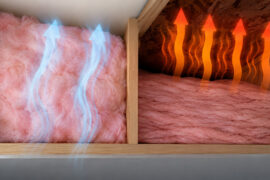
Two liquids sitting in separate drums, mixed at the gun, sprayed onto a surface where they expand into foam within seconds. That’s spray foam insulation stripped down to what actually happens. The polyurethane it forms insulates and blocks air movement in the same application, which is the part that separates it from everything else on the supply house shelf.
Contractors proportion the two components on site and spray the mix into attics, wall cavities, crawl spaces, and rim joists. Codes compare it to fiberglass batts and blown cellulose on R-value per inch. Air sealing never enters that comparison, mostly because neither alternative does any.
The chemistry shifted in 2017, when U.S. Environmental Protection Agency phase-out rules pushed HFC blowing agents out of closed-cell formulas. Honeywell’s Solstice blowing agent, introduced in 2014, replaced them at a global warming potential of 1, 99.9 percent lower than what it displaced (Honeywell, 2014).
What Is Spray Foam Insulation?
The material arrives as a liquid and turns rigid or semi-rigid within seconds of hitting a surface. Two polyurethane components do the work.
It sits in the same broad category as fiberglass and cellulose. How it insulates has almost nothing in common with either one.
Most insulation slows heat transfer and stops there. Foam does that and seals air leaks in the same pass, because the liquid expands into whatever gap it lands in.
That’s where it parts ways with batt insulation, which gets cut to a fixed size and pressed into a cavity rather than grown to fit it.
Loose-fill insulation behaves differently again. It settles into open spaces under gravity and bonds to nothing.
One clarification worth making early. The two-component product is not the same thing as the small aerosol cans sold for filling gaps around windows and outlets. Those run a single-component formula sized for tiny cracks, not full cavities.
- Two-component, professionally proportioned foam for full wall, attic, and crawl space cavities
- Single-component canned foam for trim gaps and small penetrations only
The Spray Polyurethane Foam Alliance is the main US trade group behind the category, and it sets the installation standards most manufacturers reference.
What Is Spray Foam Insulation Made Of?
An isocyanate on one side, a polyol resin blend on the other. They ship to the job site in separate drums and stay completely inert until a proportioner brings them together under pressure at the spray gun.
The isocyanate, called the A side, reacts on contact and drives the expansion. The B side carries everything else, meaning the blowing agent, the catalysts, and the flame retardants. That blowing agent is what turns reacting liquid into the foam cells that give cured foam its structure.
Which blowing agent got used was a chemist’s concern for a long time. Federal rules changed that.
Honeywell’s Solstice blowing agent, now standard in many closed-cell formulas, carries a global warming potential of 1, 99.9 percent lower than the HFC blowing agents it replaced under EPA phase-out rules that took effect in 2017 (Honeywell).
On the equipment side, a proportioner meters both liquids at a fixed ratio and temperature before they ever meet.
Graco and similar manufacturers build the proportioners contractors mount inside their spray rig equipment, usually a trailer or box truck set up to run hose out to the job.
Open-Cell vs Closed-Cell Spray Foam
Open-cell and closed-cell foam come out of the same base chemistry and end up with almost nothing in common. Density, R-value, price, all of it splits.
| Attribute | Open-Cell Foam | Closed-Cell Foam |
|---|---|---|
| Density | About 0.5 lb per cu ft | About 2.0 lb per cu ft |
| R-value per inch | R-3.5 to R-3.7 | R-6.0 to R-7.0 |
| Vapor permeability | Permeable, often needs a separate vapor barrier | Semi-impermeable, acts as its own vapor retarder |
| Typical use | Interior walls, attics, sound dampening | Crawl spaces, roof decks, exterior walls |
Open-Cell Spray Foam
Open-cell keeps a spongy texture after curing because its cell walls stay broken open. That’s where the half-pound density comes from.
It expands up to 100 times its liquid volume. One pass fills a full 2×6 stud bay without a second lift.
- Interior and partition walls
- Attics with continuous ventilation
- Sound-dampening retrofits between floors
Cured open-cell stays permeable to water vapor, which is why cold-climate codes usually call for a separate vapor barrier insulation layer on the room side of the assembly.
Icynene helped popularize the category back in the 1980s and still shows up as a recognized open-cell brand today.
Closed-Cell Spray Foam
Closed-cell runs roughly four times the density of open-cell, around 2.0 lb per cu ft, stiff enough to walk on once it’s cured. The higher R-value per inch means thinner assemblies still clear code minimums, and the closed cell structure blocks bulk water rather than only vapor.
At two and a half inches, closed-cell permeance drops to about 0.8 perm (SprayFoam.com). Low enough to function as both an air barrier and a Class II vapor retarder with no separate membrane.
Against rigid closed-cell insulation boards, sprayed foam wins on air sealing for an obvious reason. It conforms to irregular framing instead of leaving gaps at every joint.
BASF and Demilec both sell closed-cell systems built specifically for below-grade and exterior use.
How Does Spray Foam Insulation Work?

A chemical reaction does the work here, not a mechanical fit.
The isocyanate and polyol resin react the instant they mix, throwing off heat and gas that force the liquid to expand and cure within seconds.
Every insulation material leans on the same principle behind how insulation works, which is trapped air resisting heat flow. Foam adds a second mechanism on top. As it expands, it fills the irregular gaps rigid materials can’t reach.
Expansion and Cell Formation
The reaction between isocyanate and polyol resin is exothermic, meaning it generates its own heat as it happens.
That heat matters. It drives off the blowing agent, which forms the millions of tiny gas-filled cells that give cured foam its insulating structure.
Installers apply foam in passes, called lifts. Closed-cell usually goes on no thicker than 1 to 2 inches at a time.
Go thicker and the core can overheat, which scorches the foam and, in rare cases, ignites it. Thin lifts cure evenly and bond better to the substrate.
Open-cell tolerates a thicker single pass. Its open structure lets the heat escape.
Air Sealing Effect
Fiberglass and cellulose slow conductive heat loss and do very little about air moving through gaps, seams, and penetrations. Foam closes those gaps because it arrives as a liquid and takes the shape of whatever it lands on.
That’s what air sealing means in a building science context, stopping uncontrolled air movement through the envelope rather than only slowing heat transfer through it.
- Rim joists and band joists
- Top plates and wiring penetrations
- Plumbing stacks and duct chases
Fomo, the manufacturer behind Handi-Foam products, documented a retrofit where post-installation blower door testing showed a 22 percent reduction in hourly air exchanges after crews foamed the attic floor, rim joists, and a bay window with closed-cell foam (Walls & Ceilings).
What R-Value Does Spray Foam Insulation Have?
Closed-cell spray foam delivers R-6.0 to R-7.0 per inch. Open-cell lands at R-3.5 to R-3.7. Fiberglass batts and blown cellulose average R-3.2 to R-3.8 per inch regardless of brand, which puts both foam types above them, one of them by a wide margin.
R-value measures resistance to heat flow, derived from a material’s thermal conductivity, the rate heat moves through it once air movement stops being a factor.
R-value as a concept applies to every insulation type. Foam is one of the few materials where the number shifts meaningfully by product line and density, not just by category.
Energy Star and the US Department of Energy publish attic targets by climate zone.
- Zone 1 (Florida, Hawaii, southern Texas): R-30 for an uninsulated attic
- Zone 2 to 3 (most of the Sun Belt): R-49 for an uninsulated attic
- Zone 4 to 6 (mixed and cold zones, most of the Midwest and Northeast): R-60 for an uninsulated attic
- Zone 7 and 8 (northern Minnesota, most of Alaska): R-60, with floor insulation up to R-38
Hitting the R-60 target common in colder zones takes roughly 9 to 10 inches of closed-cell foam. Blown cellulose or fiberglass needs 16 to 19 inches for the same number, since a small per-inch gap compounds fast at high targets.
How Much Does Spray Foam Insulation Cost?
Installed spray foam runs $1.50 to $5.00 per square foot, with open-cell at $1.50 to $3.50 and closed-cell at $3.00 to $5.00. Whole-home projects mostly land between $2,000 and $8,000, depending on square footage, foam type, and how much of the structure has to be opened up first (HomeGuide, 2026).
Quotes come by the board foot, meaning one square foot of coverage at one inch of thickness, multiplied by however many inches the job needs.
Batts and blown-in material get quoted as a flat cost per square foot for insulation instead, where thickness doesn’t move the per-unit price the same way.
Board-foot pricing right now, roughly:
- Open-cell foam, $0.44 to $1.50 per board foot (Angi, 2026)
- Closed-cell foam installed, $1.30 to $3.10 per board foot (Angi, 2026)
- Labor alone, $0.44 to $3.30 per square foot on top of material (HomeAdvisor)
- Contractor minimum job fee, typically $1,000 to $2,000 (HomeGuide, 2026)
New construction comes in cheaper than a retrofit, generally $1 to $4 per square foot against $3 to $5, because a retrofit means opening finished walls before anyone sprays anything (HomeAdvisor).
For a full breakdown by project type and room, see how much spray foam insulation actually costs across attics, walls, and crawl spaces.
Where Is Spray Foam Insulation Used?
Attics, roof decks, exterior wall cavities, crawl spaces, rim joists. Anywhere a contractor wants thermal resistance and an air seal out of the same material, foam is a candidate. Closed-cell takes the wet and structural spots. Open-cell covers the big, dry interior volumes.
Attics and Roof Decks
Two placements, and they produce different buildings. Foam on the attic floor leaves the attic outside the thermal envelope. Foam against the underside of the roof deck pulls it inside, creating an unvented, conditioned attic.
Unvented roof decks usually call for closed-cell foam, since it doubles as a vapor retarder over sheathing that would otherwise sit exposed to humid attic air.
- A conditioned attic brings ductwork and HVAC equipment inside the thermal envelope, which kills the duct losses that plague vented attics
- Open-cell handles floor-level attic insulation where roof deck contact isn’t part of the job
Wall Cavities
In new construction the foam goes into stud bays before drywall, the same stage where batts would otherwise get stapled in.
Standard 2×4 framing leaves closed-cell about 3.5 inches to work with, good for roughly R-21 to R-24.
Open-cell fills the same bay for less money. You give up total R-value, and in colder zones you add a vapor barrier.
The same fill-the-gap logic shows up in cavity wall insulation for masonry construction, where foam or loose fill goes between two wythes instead of a wood stud bay.
Retrofitting a finished wall is the hard version. Installers either drill access holes or pull drywall, and the job drifts toward the top of the cost range.
Crawl Spaces and Rim Joists
Moisture decides the material choice here. Crawl spaces and basement walls both sit close to grade, where ground moisture and bulk water never stop being a risk.
Closed-cell is the default in both spots, for insulating basement walls and for sealing the band joist where the foundation meets the framing.
Rim joists get extra attention because they stack an air leak, a thermal gap, and an awkward cavity shape into one location.
- Sill plate to floor joist transition
- Foundation vent openings, if the crawl space stays vented
- Plumbing and wiring penetrations through the band joist
Spray Foam Insulation vs Fiberglass and Cellulose
Most real comparisons get settled on cost, not chemistry. Fiberglass batts are cheapest to buy, cellulose sits in the middle, and closed-cell spray foam costs the most per square foot installed.
| Attribute | Spray Foam | Fiberglass | Cellulose |
|---|---|---|---|
| R-value per inch | R-3.5 to R-7.0 | R-3.2 to R-3.8 | R-3.2 to R-3.8 |
| Air sealing | Built into the material | None, needs a separate step | Minimal, needs a separate step |
| Settling over time | None once cured | About 1% loose-fill | About 20% (NAIMA) |
None of those cost numbers account for air sealing, which fiberglass and cellulose don’t do on their own.
A fiberglass insulation job still needs house wrap, caulk, and taped seams to control air movement. That’s labor foam skips.
Settling changes the math over a longer horizon. The North American Insulation Manufacturers Association puts cellulose settling at about 20 percent, which drags installed R-value down if the material was only blown to its labeled thickness.
Greenfiber, a major cellulose manufacturer, designs its coverage charts around roughly 10 percent settling already built into the installed depth, a lower figure than NAIMA’s industry-wide estimate.
Home Innovation Research Labs pulled fiberglass batts out of real attics between 30 and 40 years old and measured them at 95.5 percent of labeled R-value on average.
Neither foam type settles once cured. That’s the whole argument for the higher upfront cost in a house somebody plans to keep.
For a closer look at where each material wins on cost and performance, see spray foam or cellulose insulation broken down by room and climate.
Is Spray Foam Insulation Safe?
Cured spray foam is chemically inert and carries no ongoing exposure risk once it finishes reacting. Installation is where the actual risk lives. Uncured isocyanate vapors mean protective gear and a vacated work site until curing and ventilation finish.
Fire Safety and Code Requirements
ASTM E84 produces two numbers codes care about, a flame spread index and a smoke-developed index.
- Flame spread index of 75 or less for covered applications, 25 or less for certain exposed uses
- Smoke-developed index of 450 or less in both cases
The International Residential Code adds a physical requirement on top of the lab numbers.
A thermal barrier, normally half-inch gypsum board, has to hold against a simulated 1,200 degrees Fahrenheit for 15 minutes without the foam behind it overheating (ASTM E119).
Attics and crawl spaces used only for utility access can swap in a lighter ignition barrier. Mineral fiber at 1.5 inches, gypsum at 3/8 inch, or a 1/4-inch wood structural panel all qualify.
Get a full breakdown of how that classification system works at insulation fire rating, which applies across material types, not just foam.
Off-Gassing and Cure Time
The EPA sets no fixed re-entry time, since curing speed moves with formulation, temperature, and ventilation.
Manufacturers of two-component, high-pressure systems generally recommend waiting at least 24 hours, sometimes up to 72, before anyone re-enters without protective equipment (EPA).
During that window the isocyanate and polyol resin finish their reaction, unreacted vapors dissipate if the ventilation is adequate, and whatever odor lingers usually fades as the foam finishes curing.
After that, the foam counts as chemically inert, and ongoing exposure risk for anyone who wasn’t on site during application drops close to zero.
Whether the foam is safe after it cures is a separate question, and it depends mostly on whether it got mixed and applied correctly in the first place.
How Is Spray Foam Insulation Installed?

Site prep, equipment setup, controlled spraying in thin passes, then trim and inspection. Surface temperature, substrate moisture, and mixing ratio all have to land within range. Miss on any of them and the cured foam can shrink, crack, or refuse to bond.
The order runs like this.
- Check substrate temperature and moisture. Most systems spray between 60 and 80 degrees Fahrenheit ambient, since off-ratio foam becomes far more likely outside that range.
- Stage the proportioner and heat both component drums to the manufacturer’s target temperature before the first test spray.
- Spray in lifts no thicker than 1 to 2 inches of closed-cell foam per pass, letting each layer cool before adding the next.
- Check the ratio between the A side and B side continuously. Systems are designed to mix at 1:1 by volume, within about 2 percent (JLC).
- Trim any foam that expanded past the framing line, then inspect for voids, delamination, or off-ratio color and texture.
DIY kits drop most of that control. Pre-measured, fixed-ratio components cap coverage thickness, which also caps how badly a ratio error can go.
A professional rig gives a contractor more range, thicker lifts, bigger jobs. It also gives more ways to get it wrong if temperature or ratio drift during a long spray session.
NCFI Polyurethanes, one of the larger SPF manufacturers, requires documented technician training before a contractor can install its systems under full warranty.
Pros and Cons of Spray Foam Insulation

The advantage is one material doing two jobs. The drawback is money, plus the fact that taking it out later is nothing like pulling out batts.
Open-cell costs less per board foot, expands far enough to cover large cavities in fewer passes, and dampens sound between rooms better than the dense stuff. The trade is a lower R-value per inch, and a material that soaks up water if bulk moisture ever reaches it.
Closed-cell claims the highest R-value per inch of any common insulation material. It acts as its own air barrier and vapor retarder, adds rigidity and some structural strength to the assembly, and handles bulk water better than anything else in the category.
It also costs the most per board foot. Hidden leaks get harder to inspect for once it’s in, since the foam covers the framing, and removal means cutting and scraping rather than simple pulling.
When Spray Foam Insulation Does Not Work
Foam fails when moisture gets trapped behind it with nowhere to dry. It fails when it goes on off-ratio. And it fails, in a different sense, when the project budget can’t absorb the higher upfront cost. None of these are rare edge cases. They’re what callbacks are made of.
Moisture and Vapor Failures
Closed-cell sprayed straight onto a roof deck makes a one-way seal. Moisture caught between the foam and the sheathing has no path to dry in either direction.
Rot follows, and it usually goes unnoticed for years because the foam hides the damage from view.
Open-cell has the reverse problem in exterior applications. Higher vapor permeability lets moisture-laden air pass through more easily.
- Used without a Class II vapor retarder in cold climates
- Applied directly to an exterior wall assembly without adequate drying potential
- Installed over a substrate that wasn’t fully dry to begin with
The IRC specifically requires that added Class II vapor retarder for open-cell foam in zones 5 through 8 and Marine 4, which is exactly the exterior scenario where skipping it causes problems (JLC).
Installation and Cure Failures
Off-ratio foam is the most common cure-related failure, and temperature is usually the root cause behind it.
- Too much isocyanate leaves brittle, dark, shrunken foam that pulls away from the substrate
- Too much resin leaves soft, gummy foam that never fully hardens
- Component drums stored outside the manufacturer’s temperature range cause either one
Skipping the ignition barrier in a space used for anything beyond utility access is a code violation, not a judgment call. How well the foam itself performed doesn’t enter into it.
Sometimes the failure isn’t the material at all, it’s the math. A small, tight-budget project rarely earns back spray foam’s cost premium fast enough to justify it, a question worth running at is spray foam insulation worth it before committing.
Foam that fails one of these tests usually has to come out rather than get patched. Most homeowners hire that part out, and how to remove spray foam insulation covers what it actually involves.
FAQ on What Is Spray Foam Insulation
Is spray foam insulation the same as foam board or canned expanding foam sealant?
No. Spray foam cures on site from two liquid chemicals sprayed together. Rigid foam board insulation ships pre-manufactured in solid panels, and canned sealant uses a single-component formula meant only for small gaps.
Does spray foam insulation stop air leaks completely?
Not perfectly. Cured foam blocks the vast majority of air movement, but installers occasionally find blisters or voids during a blower door test that let small amounts through. Those spots get patched rather than accepted as normal.
Which type of spray foam works better in attics versus walls?
Attics favor open-cell for floor-level jobs, since the lower cost per board foot fits the larger volume. Wall cavities favor closed-cell, because higher R-value per inch matters more in a shallow 2×4 or 2×6 space.
Can a homeowner install spray foam insulation themselves?
DIY kits run about $350 for 200 square feet up to roughly $2,000 for 600 square feet at current retail pricing. They use pre-measured, fixed-ratio canisters, which limits mistakes and also limits coverage thickness. Large jobs still favor a professional rig.
How long does spray foam insulation last?
Manufacturers typically warranty closed-cell foam for the life of the structure, since cured foam doesn’t settle or compress the way loose-fill materials do. Open-cell holds up similarly as long as it stays dry and undisturbed.
Can spray foam insulation cause health problems after installation?
Properly cured foam is chemically inert and presents no ongoing exposure risk to occupants. Health complaints almost always trace back to foam that was mixed off-ratio or never finished curing, not to foam that cured correctly the first time.
What Should You Verify Before Hiring a Spray Foam Insulation Contractor?
Certification comes first, then quality control during the spray itself, then code compliance for the specific climate zone and application. Each check catches a different kind of failure, which is why none of them substitutes for another.
Ask for the manufacturer certification number instead of accepting a verbal claim. During the session, the proportioner ratio readout should be visible and somebody should be watching it. The last check is vapor retarder compliance for whatever zone the house sits in.
That last one carries the most weight in Department of Energy zones 5 through 8, where open-cell foam legally needs the added Class II vapor retarder the IRC requires. Easy detail to miss without checking how to install a vapor barrier against local code first.
All of this adds time to hiring. Most installers don’t volunteer certification numbers or ratio logs unless someone asks directly.