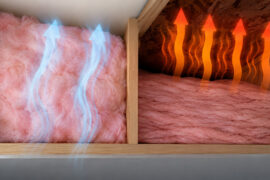
Your heating and cooling system works hard. But without proper insulation, up to 40% of that energy escapes through walls, attics, and floors.
Understanding what is home insulation helps you stop wasting money and start living comfortably year-round.
The Department of Energy reports that most American homes remain under-insulated, costing homeowners hundreds annually in unnecessary utility bills.
This guide covers everything you need to know: how thermal barriers work, the different material options from fiberglass to spray foam, where to install for maximum impact, and how to calculate the ROI on insulation upgrades.
Whether you’re building new or improving an existing home, making informed insulation decisions pays dividends for decades.
What is Home Insulation
Home insulation is a thermal barrier material installed within walls, attics, floors, and roofs to reduce heat transfer between indoor and outdoor environments.
It keeps your house warm in winter and cool in summer by slowing the movement of heat through your building envelope.
The Department of Energy estimates that proper insulation can reduce heating and cooling costs by up to 15%.
Most residential insulation works by trapping pockets of air or gas within fibrous or foam materials, which limits thermal conductivity through the structure.
Without adequate insulation, your HVAC system works overtime. You pay more. Your home stays uncomfortable.
How Does Home Insulation Work
Heat moves through three mechanisms: conduction, convection, and radiation.
Insulation disrupts all three. Understanding how insulation works helps you choose the right material for each application.
Conduction happens when heat passes directly through solid materials like wood studs, concrete, or glass.
Insulation materials have low thermal conductivity, meaning they resist this direct heat transfer.
Convection occurs when air currents carry heat. Fibrous insulation traps air in small pockets, preventing these currents from forming.
Radiation involves heat traveling as infrared energy. Reflective insulation and radiant barriers bounce this energy back toward its source.
The effectiveness of any insulation depends on its R-value, which measures thermal resistance.
Higher R-values mean better performance. Climate zones determine minimum R-value requirements per the International Energy Conservation Code.
What Are the Types of Home Insulation
Choosing the right types of insulation materials depends on your application, budget, and performance requirements.
Each material has distinct characteristics for thermal resistance, moisture handling, and installation method.
What is Fiberglass Insulation
Fiberglass insulation consists of fine glass fibers spun into batts or loose-fill form, delivering R-values between R-2.9 and R-3.8 per inch.
Brands like Owens Corning and Johns Manville dominate this market. It’s the most common residential insulation in North America.
What is Cellulose Insulation
Cellulose insulation contains 82-85% recycled paper fiber treated with borate fire retardants, achieving R-3.2 to R-3.8 per inch.
GreenFiber is a leading manufacturer. Installers blow it into attics and wall cavities using specialized equipment.
What is Spray Foam Insulation
Spray foam insulation expands on contact to fill gaps and create an air sealing barrier simultaneously.
Open-cell foam provides R-3.7 per inch; closed-cell delivers R-6.5 per inch. Companies like Icynene and BASF produce professional-grade formulations.
What is Mineral Wool Insulation
Rock wool insulation offers R-3.0 to R-3.3 per inch with superior fire resistance up to 2000°F.
Rockwool (formerly Roxul) leads this category. Excellent for soundproof insulation applications too.
What is Rigid Foam Board Insulation
Rigid foam board insulation comes in three main types:
- EPS (Expanded Polystyrene) – R-3.8 to R-4.4 per inch
- XPS (Extruded Polystyrene) – R-5.0 per inch
- Polyisocyanurate – R-5.7 to R-6.5 per inch
Dow Chemical Company manufactures popular XPS products. Best for foundation walls and exterior sheathing.
Where to Install Home Insulation
Strategic placement matters more than total coverage. Heat escapes through specific weak points in your building envelope.
Prioritize areas with the highest heat loss first for maximum energy savings and comfort improvement.
Attic Insulation
Uninsulated attics account for 25% of a home’s heat loss according to ENERGY STAR guidelines.
Climate zones 1-3 require minimum R-30; zones 4-8 need R-38 to R-60. Loose-fill insulation or batt insulation both work well here.
Wall Insulation
Cavity wall insulation fills the space between interior drywall and exterior sheathing.
Standard 2×4 walls hold R-13 to R-15; 2×6 walls accommodate R-19 to R-21. Watch for thermal bridging through wood studs.
Floor and Crawl Space Insulation
Underfloor insulation prevents heat loss to unheated spaces below living areas.
Install a vapor barrier in crawl spaces to control moisture. R-25 to R-30 recommended for floors over unconditioned spaces.
Basement Insulation
Insulating basement walls reduces heat loss through below-grade concrete and improves comfort in finished basements.
Rigid foam or spray foam handles moisture better than fiberglass in these applications. Don’t forget rim joists.
What is R-Value in Insulation
R-value measures a material’s resistance to conductive heat flow. Higher numbers indicate better insulating performance.
The Federal Trade Commission requires all insulation products to display R-value ratings clearly on packaging.
R-value requirements vary by climate zone:
- Zone 1 (Hot) – Attic R-30, Wall R-13
- Zone 3 (Warm) – Attic R-38, Wall R-13
- Zone 5 (Mixed) – Attic R-49, Wall R-20
- Zone 7 (Cold) – Attic R-60, Wall R-21
ASHRAE and the International Energy Conservation Code set these minimum standards.
R-values are additive. Two layers of R-19 insulation provide R-38 total thermal resistance.
Proper installation matters. Compressed, wet, or gapped insulation loses significant R-value regardless of its rating.
What Are the Benefits of Home Insulation
The benefits of home insulation extend beyond simple temperature control.
Proper insulation affects your energy bills, comfort, and even your home’s structural integrity.
- Energy cost reduction – EPA estimates 15% average savings on heating and cooling
- Temperature regulation – Eliminates hot and cold spots throughout living spaces
- Moisture control – Reduces condensation and mold risk when paired with vapor barrier insulation
- Sound dampening – Mineral wool achieves STC ratings of 45-52 for noise reduction
- HVAC efficiency – Systems run shorter cycles, extending equipment lifespan
- Carbon footprint reduction – Lower energy use means fewer greenhouse gas emissions
Homes with adequate insulation also qualify for LEED certification for insulation credits and better HERS ratings.
How Much Does Home Insulation Cost

Understanding cost per square foot for insulation helps you budget accurately for your project.
Material costs vary significantly. Labor typically adds 50-100% to the total.
Fiberglass Insulation Cost
Batts run $0.30-$1.50 per square foot installed; blown-in fiberglass costs $1.00-$2.00 per square foot.
DIY batt installation saves roughly 50% on labor. Most affordable option for attics and open walls.
Spray Foam Insulation Cost
Open-cell foam costs $1.00-$1.50 per square foot; closed-cell insulation runs $1.50-$3.00 per square foot.
Professional installation required. Spray rig equipment costs $15,000-$50,000, making DIY impractical.
Cellulose Insulation Cost
Blown-in cellulose averages $0.60-$1.20 per square foot installed.
Home Depot and Lowe’s rent blowing machines for DIY attic projects. Best value for retrofit insulation applications.
How to Choose the Right Home Insulation
Your decision depends on five factors: climate zone, installation location, budget, existing construction, and local building codes.
Comparing spray foam or cellulose insulation comes down to your specific application needs.
Climate zone considerations:
- Hot climates benefit from reflective insulation and radiant barriers
- Cold climates need high R-value materials like closed-cell foam
- Mixed climates require balanced approaches addressing both heating and cooling
Installation location matters:
- Attics – Blown-in or batts work well
- Walls – Dense pack insulation or drill-and-fill insulation for existing homes
- Basements – Rigid foam or spray foam handles moisture
- Crawl spaces – Closed-cell foam with vapor barriers
New construction offers more options. Existing homes often require specialized retrofit techniques.
How is Home Insulation Installed

Installation method affects both cost and performance. Poor installation reduces effective R-value by 30% or more.
Professional Installation Process
Contractors start with a home energy audit and blower door test to identify air leaks.
They seal gaps first, then install insulation. Inspection follows per local code requirements. Typical timeline: 1-3 days for whole-home projects.
DIY Insulation Installation
Attic batts and blown-in cellulose suit DIY installation. Wear proper PPE: respirator, goggles, gloves, long sleeves.
Avoid compressing material; insulation compression reduces R-value significantly. Never cover recessed lights or exhaust fans.
What Building Codes Apply to Home Insulation
The International Energy Conservation Code sets baseline requirements adopted by most states.
California’s Title 24 exceeds IECC standards with stricter energy efficiency mandates.
Building permits typically required for:
- New construction insulation
- External wall insulation additions
- Major renovation projects
- Spray foam installations in some jurisdictions
ENERGY STAR insulation guidelines exceed code minimums for optimal performance.
RESNET’s Home Energy Rating System scores insulation quality from 0-150. Lower scores indicate better efficiency.
Check your local building department. Requirements vary by municipality and project scope.
Signs Your Home Needs Better Insulation
A thermal imaging camera reveals heat loss patterns invisible to the naked eye.
Building Performance Institute certified auditors use this tool during energy assessments.
Observable warning signs:
- Uneven temperatures between rooms
- High heating and cooling bills compared to similar homes
- Ice dams forming on roof edges in winter
- Cold drafts near walls, windows, or electrical outlets
- HVAC system running constantly without reaching set temperature
- Frozen pipes in exterior walls
Older homes built before 1980 often have inadequate or degraded insulation.
Insulation settlement reduces coverage over time, especially in attics with loose-fill materials.
Schedule a professional assessment if energy bills spike without usage changes. Many utilities offer free or subsidized audits.
Check if you qualify for a weatherization rebate or insulation tax credit through the Inflation Reduction Act before starting any upgrade project.
FAQ on What Is Home Insulation
What is the best type of insulation for homes?
The best insulation depends on location and budget. Spray foam offers highest R-value per inch and air sealing. Fiberglass batts cost less for attics. Mineral wool excels for fire resistance. Cellulose works well for retrofits in existing walls.
How long does home insulation last?
Most insulation lasts 80-100 years when properly installed and kept dry. Fiberglass and mineral wool maintain performance indefinitely. Spray foam degrades minimally. Cellulose may settle over time, reducing coverage. Moisture damage shortens lifespan significantly for all materials.
Is home insulation flammable?
Most insulation materials resist fire. Fiberglass and rock wool are non-combustible. Cellulose contains borate fire retardants. Spray foam burns but self-extinguishes. Check insulation fire rating specifications before purchasing any product.
Can I install insulation myself?
DIY works for attic batts and blown-in cellulose. Rent blowing equipment from Home Depot or Lowe’s. Spray foam requires professional installation and specialized equipment. Always wear respirator, goggles, and protective clothing when handling insulation materials.
How much insulation do I need?
Climate zone determines minimum requirements per IECC standards. Zones 1-3 need R-30 to R-38 in attics. Zones 4-8 require R-49 to R-60. Walls typically need R-13 to R-21 depending on construction type and regional codes.
What is the difference between R-value and U-value?
R-value measures thermal resistance; higher is better. U-value measures heat transfer rate; lower is better. They’re inverse calculations. Builders use R-value for insulation products and U-value for windows, doors, and complete wall assemblies.
Does insulation help with soundproofing?
Yes. Dense materials like mineral wool and cellulose absorb sound effectively. Fiberglass provides moderate noise reduction. Blanket insulation in interior walls reduces sound transmission between rooms. STC ratings measure acoustic performance.
How do I know if my insulation needs replacing?
Warning signs include uneven temperatures, high energy bills, visible damage, pest infestation, or moisture problems. Professional energy auditors use thermal cameras to detect gaps. Consider insulation vacuum removal before installing new material in attics.
Who qualifies for free home insulation programs?
Low-income households may qualify for Weatherization Assistance Program funding through the Department of Energy. Income limits vary by state. Seniors and disabled homeowners often receive priority. Check free home insulation eligibility with your local energy office.
What is the payback period for adding insulation?
Most insulation upgrades pay for themselves in 2-5 years through energy savings. Attic insulation offers fastest returns. The payback period for insulation depends on local energy costs, climate, and existing insulation levels.
Conclusion
Understanding what is home insulation puts you in control of your energy costs and indoor comfort.
The right material choice, proper installation, and adequate R-values make the difference between a drafty house and an energy-efficient home.
Start with an energy audit to identify your biggest heat loss areas. Prioritize attic insulation first since it delivers the fastest returns.
Consider passive house insulation standards if you want maximum efficiency, or explore aerogel insulation for space-constrained applications.
Don’t overlook pipe insulation to prevent freezing and reduce water heating costs.
Ready to take action? Learn how to improve home insulation in your specific situation.
Your building envelope protects everything inside. Make it count.