Insulation that stops noise and insulation that stops heat look nearly identical sitting in a stud bay, but they’re built for different jobs. The acoustic version exists to block and absorb sound moving between spaces instead of resisting heat transfer.
It goes inside wall cavities, ceiling assemblies, and floor systems. The spec numbers that matter are the Sound Transmission Class rating and the Noise Reduction Coefficient. R-value, the figure everyone quotes for thermal work, tells you almost nothing here.
Walls separating dwelling units have to reach a minimum Sound Transmission Class of 50, according to code data compiled by Commercial Acoustics in 2025. A bare uninsulated stud wall isn’t remotely close.
What Is Soundproof Insulation?
The category covers any building insulation chosen for its ability to stop and soak up sound between spaces rather than slow heat transfer.
It sits under the wider umbrella of home insulation, but the job changes once sound becomes the target.
Thermal batts are there to slow heat flow. Acoustic material deals with vibration and airborne noise instead.
Two things happen at once. The material absorbs sound energy so the room itself doesn’t ring, and it blocks sound energy so less of it crosses into the next room.
- Wall cavities between bedrooms, offices, or apartment units
- Ceiling and floor assemblies separating levels
- HVAC ducts carrying mechanical noise
- Recording studios, home theaters, and party walls
Manufacturers like ROCKWOOL and Owens Corning sell dedicated acoustic product lines, Safe’n’Sound and Sound Attenuation Batts among them, built specifically around the blocking job.
Most insulation gets bought for comfort and lower energy bills. Acoustic batts usually get bought after a complaint, because someone downstairs can hear every footstep.
How Does Soundproof Insulation Work?

Absorption happens inside the fiber itself. Blocking comes from mass, and from decoupling the two faces of the assembly so vibration can’t walk across. Most products are noticeably better at one than the other.
Sound Absorption
Porous, fibrous material catches sound waves and converts the energy into small amounts of heat inside the fibers.
This is what an NRC rating measures. The denser and thicker the fiber mat, the more energy gets trapped before it can bounce back into the room.
- Open-cell fiber structure (mineral wool, fiberglass)
- Cellulose fill, though less absorptive per inch
- Thickness matters more than density for absorption
Absorption reduces echo and reverberation inside a room. It does not, by itself, stop sound from reaching the next room.
Sound Blocking (Mass-Spring-Mass)
Each doubling of a wall’s mass adds roughly 6 STC points, based on acoustic testing data compiled by Commercial Acoustics (2025).
Blocking runs on a different principle than absorption. A wall behaves like two masses connected by a spring, in this case the air cavity, and sound has to shake both masses to get through.
Heavier drywall, denser batts, or a vinyl barrier all add resistance to that shaking. Decoupling handles the other half of the problem, since a resilient channel or a staggered stud breaks the rigid path and keeps vibration from jumping straight across.
Skip either half and the other has to work twice as hard.
What Ratings Measure Soundproof Insulation Performance?

STC covers airborne blocking and NRC covers absorption. IIC deals with impact noise, OITC with exterior noise that runs low. They test different kinds of sound, so a single number never settles the question.
- STC 50 is the International Building Code minimum for walls separating dwelling units (Commercial Acoustics, 2025)
- STC 39 is what fiberglass batts bring a standard 2×4 wood-framed wall to, per Insulation Institute testing (2016)
- NRC 0.95 to 1.09 is the absorption range for 2-inch mineral wool acoustic panels (GreenBuildingAdvisor, 2022)
- 5 to 8 STC points get lost when a wall cavity ships uninsulated (Commercial Acoustics, 2025)
Sound Transmission Class (STC)
STC rates how much airborne sound an assembly blocks across normal speech frequencies, tested under ASTM E90 and calculated per ASTM E413.
- STC 30: normal speech audible and understandable
- STC 40: loud speech audible, not understandable
- STC 50: loud speech barely audible
- STC 60+: shouting is not audible
Building codes set the floor. Recording studios and hotel demising walls chase numbers well above it.
Noise Reduction Coefficient (NRC)
NRC measures absorption, not blocking. It runs from 0, fully reflective, to 1, fully absorptive, averaged across four ASTM C423 test frequencies.
A material with a high NRC and a low STC will quiet the echo in a room while doing very little for the people next door. Flip it around and an assembly with a strong STC keeps sound from leaving regardless of how the room sounds from the inside.
A spec sheet listing only one of the two numbers is telling half the story.
Impact Insulation Class (IIC) and Outdoor-Indoor Transmission Class (OITC)
Both ratings apply the same blocking logic to noise that standard speech-range testing handles poorly, namely footsteps overhead and traffic or aircraft outside.
| Rating | What It Measures | Typical Use |
|---|---|---|
| IIC | Impact noise through floors | Condos, multi-story apartments |
| OITC | Low-frequency exterior noise | Flight paths, highway-facing walls |
Standard STC testing under-represents the low frequencies both of these ratings care about, which is why they exist as separate numbers.
What Materials Are Used in Soundproof Insulation?

Mineral wool, fiberglass, mass loaded vinyl, and blown fills like cellulose cover most of what actually gets installed. They trade cost, density, and installation difficulty against each other in different ways.
| Material | Typical Density | Fire Rating | Typical Cost per Sq Ft |
|---|---|---|---|
| Mineral wool | 2.4 to 8 lb/ft3 | Noncombustible, Class A | $2.00 to $5.00 |
| Fiberglass batts | 0.5 to 6 lb/ft3 | Noncombustible, Class A | $0.50 to $1.50 |
| Mass loaded vinyl | 1 to 2 lb per sq ft | Class A when certified | $1.00 to $3.00 |
| Cellulose (blown-in) | 2 to 3.5 lb/ft3 | Treated with borate, Class A | $1.00 to $1.50 installed |
Mineral Wool
Nothing else in common use packs this much mass per inch. Spun from basalt rock or recycled slag, mineral wool outweighs fiberglass in the same cavity depth, which is why it dominates rock wool insulation product lines built for sound control.
ROCKWOOL’s Safe’n’Sound batt runs 2.5 pounds per cubic foot actual density, according to the manufacturer’s own product specification.
Two-inch acoustic panels reach STC 45 to 52 and NRC 0.95 to 1.09 (GreenBuildingAdvisor, 2022), numbers few other batt materials touch at that thickness.
- Holds its shape and R-value even when it gets damp
- Melts above 2,150°F, so it doubles as fire blocking
Fiberglass
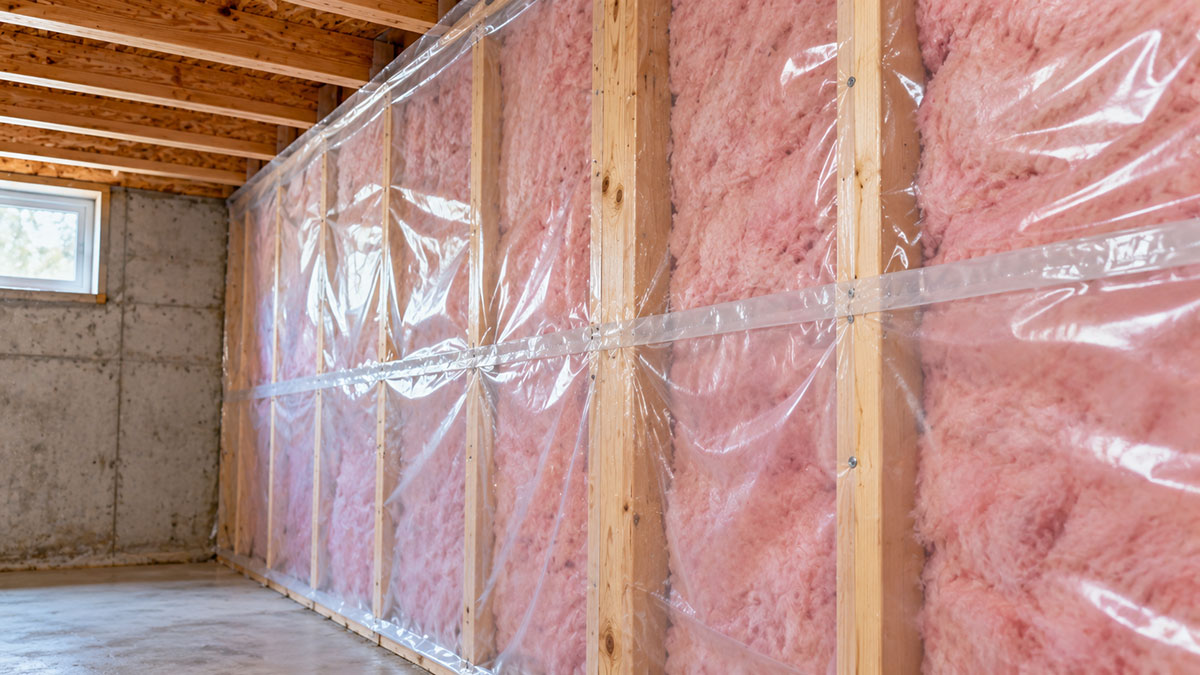
Fiberglass batts reach STC 39 inside a standard 2×4 wood-framed wall and post an NRC up to 1.00, roughly 33 percent higher absorption than spray foam or cellulose at NRC 0.75 (Insulation Institute, 2016).
Fiberglass insulation costs less than mineral wool per square foot, and it’s what most contractors reach for first on a standard renovation budget. It’s cheap, it’s on the shelf at every supply house, and it cuts clean with a utility knife. The catch is density. Lower mass means you need more inches of it to match what mineral wool does at the same thickness.
Unfaced fiberglass is naturally noncombustible and carries the same Class A rating as mineral wool, though it melts at a lower 1,000°F (Insulation Institute, 2026).
Mass Loaded Vinyl
Standard 1 pound per square foot mass loaded vinyl runs $1.00 to $2.00 per square foot and, installed correctly inside a wall assembly, adds 7 to 10 STC points on its own (Commercial Acoustics, 2025).
It’s a thin, dense, rubbery sheet, not a fluffy batt. No absorption to speak of, pure mass.
- Retrofits where cavity depth is too tight for thicker batts
- Layered between two sheets of drywall on party walls
- Wrapped around ductwork carrying mechanical noise
Heavier 2 pound sheets exist for mechanical rooms, but most residential jobs never need to go past the 1 pound version.
Cellulose and Foam
Cellulose is shredded, borate-treated paper fiber, usually blown into a closed cavity. Spray foam is a different material entirely, and not always a good pick for sound.
Borate treatment gets cellulose a Class A fire label, but the material underneath that label is still combustible, unlike naturally noncombustible mineral wool or fiberglass (Insulation Institute, 2026).
Blown-in cellulose runs about $1.00 to $1.50 per square foot installed in standard wall cavities (HomeAdvisor, 2024).
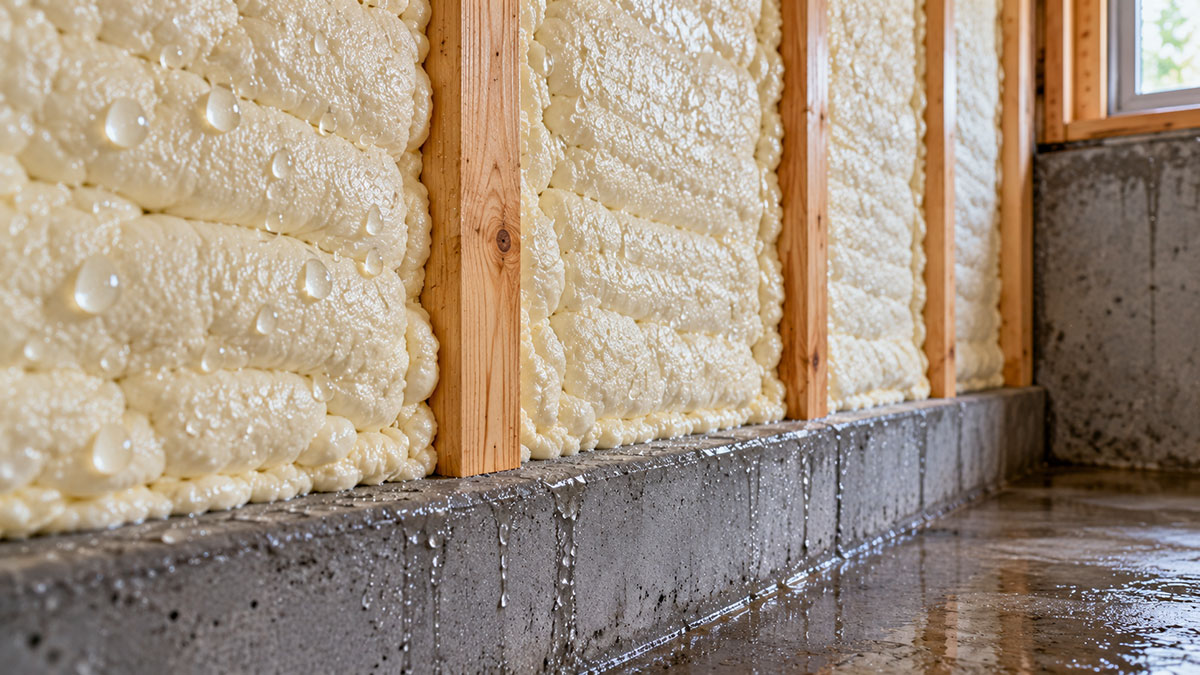
Closed-cell foam gives you an excellent air seal and strong R-value. It also cures rigid and bonds tightly to the studs, so vibration gets transmitted rather than absorbed. NRC lands around 0.75, well below fiberglass or mineral wool at similar thickness (Insulation Institute, 2016).
If sound control is the actual goal, foam is rarely the first pick. It’s a thermal and air-sealing material that happens to share the same cavity.
How Is Soundproof Insulation Different From Thermal Insulation?
Thermal insulation and soundproof insulation solve different problems, even when the exact same batt sits inside a wall.
One slows heat. The other blocks or absorbs sound energy, and the two jobs don’t move together.
Thermal insulation is scored by R-value, a measure of resistance to heat flow through a material.
Sound performance runs on STC and NRC instead, and the mechanism behind thermal resistance doesn’t carry over to blocking sound.
For heat, you want the material fluffy and light, full of trapped air pockets. Compress it or let it get damp and the R-value drops. Acoustic performance behaves almost the opposite way:
- Density and weight help rather than hurt
- Decoupling the material from framing matters as much as the material itself
- STC and NRC are the numbers on the spec sheet
- Moisture and modest compression barely register
Mineral wool’s R-value sits around 4.3 per inch at 75°F, according to ROCKWOOL’s own product specification, a figure that says nothing about how much airborne sound the same batt will stop.
Builders chasing energy codes and builders chasing quiet are often solving two separate spec sheets, even inside the same wall cavity.
Which Soundproof Insulation Is Best for Walls, Ceilings, or Floors?

Location drives the answer more than brand does. Walls want batts plus some form of decoupling, ceilings want more density than a typical attic batt because impact noise is the real enemy, and floors depend far more on what sits above the subfloor than on anything stuffed into the joist bay.
Walls
Standard 2×4 or 2×6 cavities take batt insulation directly, paired with resilient channel or RSIC clips on one face to break the structural path.
Installation is straightforward, the material options are wide, and it works in new construction and gutted renovations alike. The weak point is the channel. One screw that’s a quarter inch too long reaches the stud behind it and short-circuits the whole thing. A single stud wall also has a practical ceiling on how high the STC can climb, no matter what you stuff inside it.
Most interior partition walls land in the STC 45 to 50 range once batt insulation and one extra drywall layer go in.
Ceilings
Ceilings carry a harder job than walls, because impact noise travels through a floor-ceiling assembly more efficiently than airborne speech does.
- Density needs to be higher than a typical attic batt
- Resilient channel or isolation clips matter even more here than in a wall
- Carpet or underlayment upstairs helps more than any ceiling material downstairs
Done properly, an isolated ceiling handles speech and low-frequency thumps together. The cost is access. Retrofitting an existing ceiling means opening it up, and that’s a messier job than a wall retrofit by a wide margin.
Floors
Floors rarely get true cavity insulation unless the joist bay is open below. Most of the acoustic work happens above the subfloor instead.
Carpet with a dense pad blocks impact noise for roughly $2 to $8 per square foot installed (HomeGuide, 2025), well under the cost of a full floating floor rebuild.
A floating floor does perform better than anything else, handling impact and airborne noise both, and it works under hardwood or tile. It also raises the floor height, costs real money, and only makes sense if there’s enough ceiling clearance below to absorb the added inches.
How Much Does Soundproof Insulation Cost?
Soundproof insulation runs $3.00 to $9.00 per square foot installed. Material choice and cavity access drive most of the swing between the low and high end.
- $3.00 to $9.00 per sq ft installed, typical range for soundproof insulation (RemodelingExpense.com, 2026)
- $1,500 to $4,500 total for a typical 500 sq ft project
- $0.50 to $1.50 per sq ft for fiberglass batt material alone
- $2.00 to $5.00 per sq ft for mineral wool or specialty acoustic batt material alone
General insulation cost per square foot depends heavily on whether the job targets heat, sound, or both, and soundproofing usually sits above a basic thermal-only installation.
Material Costs
Material choice alone can swing the budget 3 to 4 times per square foot before labor even enters the picture.
- Density: higher density costs more per cubic foot
- Brand and certification: fire-rated, tested assemblies cost more
- Thickness: more inches needed to reach a target STC
Mineral wool and mass loaded vinyl sit at the high end because of density and manufacturing cost. Fiberglass batts sit at the low end since they’re produced at a much larger scale.
Installation Labor Costs
Labor often costs more than the material itself, especially on a retrofit where existing drywall has to come down first.
In new construction the insulation goes in during framing, before drywall, so labor stays close to a standard thermal insulation job. A retrofit adds demolition, disposal, and re-hanging drywall, which can double or triple the total compared to the same work done during framing.
A retrofit job on a full-height party wall commonly lands in the $2,000 to $5,000 range, according to industry cost guides (SoundProSolutions, 2025).
When Does Soundproof Insulation Not Work?
Sound sneaks around the assembly through flanking paths. Anything below 125 Hz passes through more or less untouched. And structure-borne vibration ignores cavity insulation entirely.
Each failure mode has a different fix, and none of them is thicker batt insulation.
Flanking Noise
A steel stud demising wall rated STC 57 to 59 under the 2006 British Columbia Building Code tested at just Apparent STC 46 once flanking paths were measured in the field (Canadian Acoustics journal, 2012).
Flanking noise travels around the insulated wall, not through it. Corridors, shared ceilings, and continuous floor slabs carry sound past the exact assembly that was supposed to stop it.
- Electrical outlets placed back to back on either side of a wall
- Ductwork that runs continuously between rooms
- A ceiling plenum spanning over the top of a demising wall
- Gaps at the top or bottom plate where the wall meets structure
No amount of batt insulation inside the cavity fixes a flanking path outside it.
Low-Frequency Sound
STC testing stops at 125 Hz. The rating comes from sixteen one-third octave bands between 125 Hz and 4,000 Hz under ASTM E413, so nothing below that range factors into the number at all.
Bass, subwoofer output, and mechanical rumble live mostly below 100 Hz. A wall rated STC 55 can still leak a subwoofer through almost unaffected, since the rating was never testing that range.
Batt insulation absorbs mid and high frequencies well. It does very little against a bass line coming through a floor or a shared wall.
The fix is a heavier, decoupled assembly tuned so its resonance point sits well below the offending frequency. Adding inches of batt does not get you there.
Structural Vibration
Vibratec’s isolation system for a rooftop basketball court in Odense, Denmark, cut impact noise more than 20 dB below a standard concrete slab resting on a mineral wool mat, the same material found inside most soundproofed floor assemblies (Vibratec, 2026).
Concrete, steel, and continuous framing carry vibration directly, independent of any batt sitting in a nearby cavity. A shared slab under a gym, a mechanical room, or a staircase moves the whole structure, not just the air next to it.
| Approach | Stops | Misses |
|---|---|---|
| Batt insulation in a cavity | Airborne sound, mid to high frequency | Structure-borne vibration |
| Spring or elastomer isolators | Structure-borne vibration | Airborne sound without added mass |
Soundproof insulation and vibration isolation solve two different physical problems, and swapping one in for the other rarely ends well.
A fire rating and a high STC number are unrelated, too. A noncombustible batt can carry mediocre acoustic performance, and a strong sound blocker can still burn.
How Do You Install Soundproof Insulation?
The order is always the same. Prep the cavity, fit the material without compressing it, add any decoupling hardware, then seal every seam before drywall goes up.
Skip a step and the whole assembly underperforms its rated number.
- Prep the cavity. Clear wiring and pipes from the bay, then check depth so the batt or board fits without forcing.
- Cut to fit, not to squeeze. A batt cut oversized turns into compressed insulation at the edges, and Oak Ridge National Laboratory testing found that even a “perfectly installed” batt loses about 11 percent of its rated R-value to compression and gaps, with commonly installed batts losing closer to 28 percent.
- Fit the insulation. Friction-fit batts or set rigid mineral wool boards flush with the framing, no gaps at the top or bottom plate.
- Add resilient channel or clips, if the target STC calls for it. Use a screw length short enough that it never reaches the stud behind the channel.
- Seal every penetration. This step is basically air sealing with an acoustic-rated product, OSI’s SC-175 sealant is a common choice, run around outlets, pipes, and the perimeter before drywall closes the cavity.
- Hang drywall and check the seams. Stagger any joints so they don’t line up with the framing bay behind the insulation.
Most performance loss happens at steps two and five. A pinched batt or a missed penetration erases work done everywhere else in the wall.
During new construction the insulation goes in before any drywall, so access is easy and mistakes cost almost nothing to fix. On a retrofit the cavity is already closed, which usually pushes the job toward a denser board, a mass loaded vinyl sheet, or blown-in fill rather than conventional batts.
FAQ on What Is Soundproof Insulation
Is Soundproof Insulation the Same as Acoustic Foam Panels?
No. Acoustic foam panels sit on a wall’s surface and absorb sound to reduce echo inside a room. Soundproof insulation sits inside the framing cavity itself and blocks sound from crossing into the next room entirely.
What Is Soundproof Insulation Called in Building Terms?
Builders and spec sheets use acoustic insulation, sound attenuation batts, or sound-rated insulation interchangeably. Manufacturers brand it too, ROCKWOOL calls its line Safe’n’Sound, Owens Corning calls its version Sound Attenuation Batts. All describe the same category of material.
Does Soundproof Insulation Also Provide Thermal R-Value?
Most fibrous soundproof batts, mineral wool and fiberglass, carry an R-value simply because they trap air. Mass loaded vinyl and rigid barriers carry almost none, since they work through mass, not trapped air. Neither number predicts the other.
Is Mass Loaded Vinyl Better Than Mineral Wool for Soundproofing?
Neither wins outright. Mass loaded vinyl suits tight retrofits where cavity depth is limited. Mineral wool suits new construction with a full stud bay, since density and absorption both come into play. Most high-STC assemblies use both together.
Is Soundproof Insulation Worth It for Apartments Specifically?
Apartments see the fastest payoff, since party walls and shared floors carry footsteps, voices, and plumbing noise constantly. A single wall retrofit often resolves complaints a full-unit renovation never touches. Landlords increasingly treat it as a retention tool, not a luxury.
What Mistakes Are Commonly Made When Installing Soundproof Insulation?
Mismatched components undercut the whole assembly, high-STC drywall paired with a low-density batt caps performance at the weakest link. Skipping acoustic sealant around outlets is another common gap. Both mistakes stay invisible until the wall is tested or lived in.
Can Existing Walls Be Soundproofed Without Removing Drywall?
Yes, though options narrow. A layer of mass loaded vinyl or Green Glue compound goes over the existing drywall, followed by a fresh sheet on top. This is standard retrofit insulation work, weaker than opening the cavity, but far less disruptive.
Do You Need a Vapor Barrier With Soundproof Insulation?
Not for the sound itself. A vapor barrier manages moisture, not noise, and the two jobs are unrelated. Exterior walls in cold climates often still need one for thermal reasons, independent of whatever acoustic material fills the same cavity.
What Should You Check First in What Is Soundproof Insulation?
Soundproof insulation that underperforms almost always fails at the same point first. Check for flanking paths and unsealed gaps before assuming the batt, board, or vinyl inside the cavity is the problem, since one unsealed penetration outweighs most material upgrades.
- Check every seam, outlet, and penetration for gaps first
- Confirm the batt or board still fills the cavity at full thickness second
- Test for structural or ductwork flanking paths last
Opening a finished wall to inspect for gaps costs labor and drywall repair.
Skipping that inspection and upgrading to denser mineral wool or thicker mass loaded vinyl instead often changes nothing, since the untouched gap keeps carrying sound around the new material.
Finding those gaps systematically is exactly what a blower door test measures, which makes it the logical next stop for anyone troubleshooting a soundproof insulation assembly that still tests below its rated number.