Most vapor barriers that fail were the right product installed the wrong way. The sheet gets stapled to the cold side of the insulation, or a seam never gets taped, and nobody notices until a wall cavity has stayed damp for a season.
How to install a vapor barrier depends first on what the material is rated for. Installers use perms under ASTM E96 for that, not R-value, and the class required on an interior wall changes by climate zone under the International Residential Code.
Thickness rules have moved as well. The 2021 IRC raised the minimum thickness for an under slab vapor retarder from 6 mil to 10 mil, citing puncture failures in the field (International Code Council, 2021 IRC, Section R506.2.3).
What is a vapor barrier installation

Installers put a low permeance material into a wall, floor, crawl space or slab so water vapor has a hard time moving through it.
The material itself usually just gets called a vapor barrier, although the trade splits the term in two. A true vapor barrier tests at 0.1 perm or lower under ASTM E96, so almost nothing passes through. A vapor retarder covers a wider range, up to 10 perm, and only slows diffusion down.
People mix the two up constantly. Put the barrier on the wrong side of a wall and condensation can start forming inside the cavity instead of outside it.
Neither one keeps a wall warm. That’s insulation’s job, and insulation is measured in R-value, a resistance to heat flow. A vapor barrier gets measured in perms, which is resistance to water vapor.
Confuse the two and you end up with the wrong material in the wrong spot on a wall.
What materials are used to install a vapor barrier

Polyethylene sheeting dominates, usually sold in rolls from 6 to 20 mil. Kraft-faced batts, foil-faced batts, smart membranes and spray foam handle the rest, and each suits a different part of the house.
| Material | Best for | Trade-off |
|---|---|---|
| Polyethylene sheeting | Crawl spaces, stud walls | Cheap, but tears without care |
| Kraft-faced batt | Wood-frame walls | Barrier built in, less flexible on placement |
| Smart membrane | Cold and mixed climates | Higher cost, more forgiving of mistakes |
| Spray foam | Rim joists, irregular framing | Fast, but needs professional equipment |
CertainTeed MemBrain is a common example of a smart membrane. Its permeance rates below 1 perm dry and above 10 perm wet, so the same sheet blocks vapor in winter and lets a wall dry inward in summer.
That change in behavior is why builders increasingly choose it over plain vapor barrier insulation in mixed and marine climates. It costs more, and in a mixed climate I think the extra money is usually worth it.
Closed-cell spray foam insulation is a different case. Once it goes past roughly 1.5 inches thick at rim joists and band boards, it meets Class II by itself and needs no separate sheeting.
What are vapor retarder classes and how is perm rating tested
ASTM E96 is the test that assigns a class to a material, and it comes in a dry cup version and a wet cup version.
The International Residential Code references the dry cup method, also called the desiccant method, for classification.
Sheet polyethylene and glass land in Class I, which means 0.1 perm or less. Kraft-faced fiberglass batts are Class II, greater than 0.1 up to 1.0 perm. Class III takes everything from just over 1.0 up to 10 perm, and that includes latex paint and plywood.
Anything above 10 perm isn’t treated as a vapor retarder at all under the code.
A wet cup test on the same sheet can come back with a different class. That gap is how smart membranes manage to act as Class I in winter and something far more open in summer.
Building Science Corporation, the research group behind much of the field’s guidance, treats this dry versus wet gap as the main reason vapor barrier and vapor retarder get confused in the first place.
How mil thickness affects vapor barrier performance
Mil thickness is a rough measure of how much material sits between the barrier and anything that can puncture it, from framing crews to foot traffic. One mil is one thousandth of an inch, and thin sheeting doesn’t last long on a job site.
The code reflects that. The 2021 IRC raised the minimum thickness for an under-slab vapor retarder from 6 mil to 10 mil, citing puncture failures in the field (International Code Council, 2021 IRC, Section R506.2.3).
Six mil is still the code minimum for crawl space ground cover, and it’s thin enough to tear under a knee or a tool drop. Under a conditioned concrete slab the current minimum is 10 mil, per ASTM E1745 Class A. Crawl spaces with regular foot traffic or stored equipment do better with reinforced sheet somewhere between 12 and 20 mil.
Stego Wrap is one of the more widely specified under-slab films in North America, and it ships in several of these thicknesses to match the class a project needs.
But thicker isn’t automatically better. A 20 mil sheet is harder to work into tight pier spaces and seams, so most crawl space jobs settle on 10 to 12 mil as the practical middle ground.
Where does a vapor barrier go in a building assembly

Placement depends on which part of the house is being sealed and which way vapor tends to move through it. In a heating climate the barrier belongs on the warm-in-winter side of the insulation, closest to the living space.
| Location | Typical material | Common class | Typical thickness |
|---|---|---|---|
| Crawl space floor | Polyethylene sheeting | Class I | 6 to 12 mil |
| Interior wall | Poly sheeting or smart membrane | Class I or II | 6 mil |
| Under slab | Reinforced polyethylene | Class I, ASTM E1745 Class A | 10 mil minimum |
| Attic ceiling | Polyethylene sheeting | Class I | 6 mil |
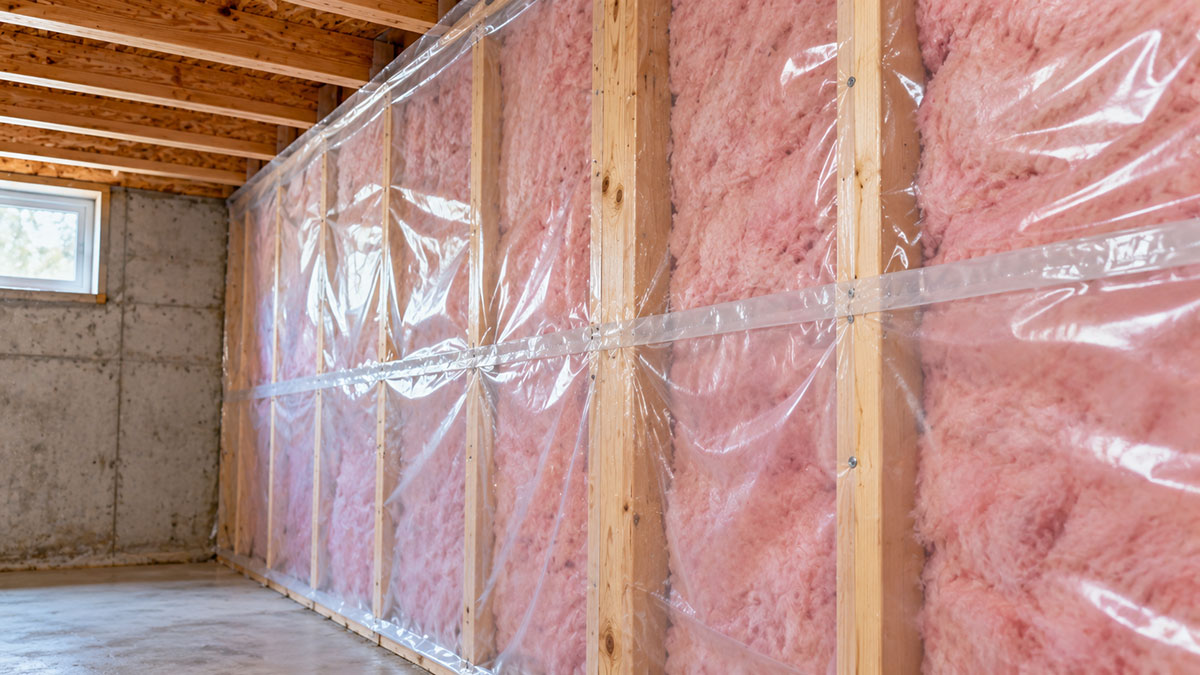
On interior stud walls, the sheeting gets stapled to the framing right before drywall, on the room side of the insulation.
Anyone insulating basement walls runs into this placement question constantly, because a below-grade wall behaves differently from a framed exterior wall above it.
Crawl spaces and slabs work the other way around. The barrier goes down first, against the soil or subgrade, before any concrete or subfloor covers it. Piers, posts and foundation walls each get wrapped separately, and every one of those wraps has to tie back into the main sheet.
Americover’s Pro Crawl Barrier, for instance, is a 10 mil film built specifically for those pier and wall wraps.
What climate zones and codes require a vapor barrier

The interior vapor retarder requirement follows the climate zone map published with the International Energy Conservation Code. Cold and very cold zones need one, and mild or hot zones generally don’t.
Under IRC Section R702.7, Zones 1, 2 and 3 need no interior vapor retarder class at all. Zone 4, except Marine 4, requires a Class II or Class III retarder on the interior side of the insulation, and Class I is not permitted there. Zones 5, 6, 7, 8 and Marine 4 go the other direction and permit a Class I or Class II retarder on the interior side of the insulation.
Crawl spaces follow a separate rule that applies in every zone. IRC Section R408.3 calls for a continuous Class I ground cover over exposed soil, with joints lapped at least 6 inches.
Local jurisdictions can push past the base code, and they often do. California’s Title 24 energy standards layer extra moisture and insulation requirements on top of the state’s adopted IRC edition.
Check the locally adopted code before assuming a national figure applies. County level amendments are common.
What tools and materials are needed before installing a vapor barrier

A basic wall or crawl space job needs a short tool list, not a truck full of gear. The item that gets forgotten most is the sealant, and it’s the most common reason a barrier fails inspection.
| Tool or material | Purpose |
|---|---|
| Polyethylene sheeting or facing product | The barrier itself, sized to the area with overlap allowance |
| Cap stapler or staple gun with T50 staples | Fastens sheeting to studs without tearing the film |
| Acoustical sealant or butyl tape | Seals the perimeter and seams so the barrier also blocks air |
| Utility knife and tape measure | Cuts sheeting to size and trims around fixtures |
Sealed seams do more than block vapor. They also work as a layer of air sealing.
Any job with more than one sheet, which is almost every job, also needs seam tape or mastic.
W.R. Meadows sells this as a system, pairing PERMINATOR sheeting with PERMINATOR TAPE and a termination bar that locks the sheet to the foundation wall.
Spray foam changes the tool list completely. Instead of a staple gun, the crew needs proportioning spray rig equipment and protective gear for the applicator. A typical DIY crew doesn’t own that equipment and can’t rent it easily, which is one reason spray foam vapor barriers usually get contracted out.
How to install a vapor barrier in a crawl space

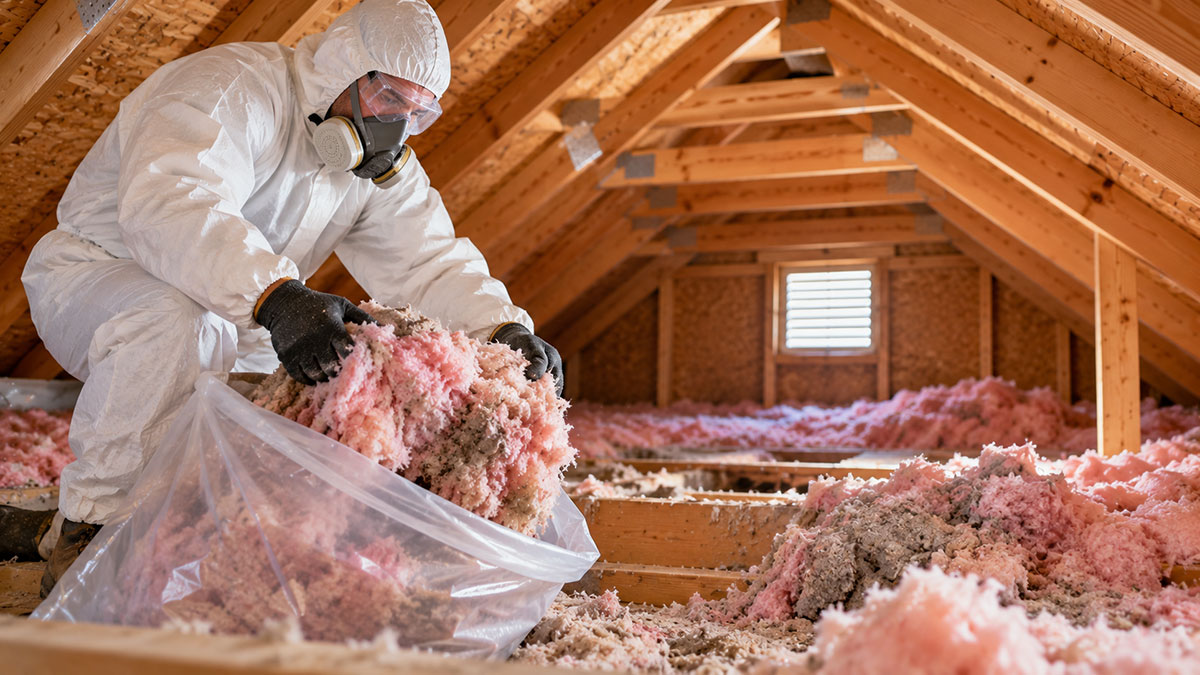
Crawl space work starts before the plastic comes out of the box. Clear out stored items, dry any standing water and deal with mold before covering the ground.
Clearance matters too. IRC Section R317.1 sets wood floor joists at least 18 inches above exposed earth and girders at 12 inches, and Section R408.4 requires an access opening of at least 18 by 24 inches through a floor or 16 by 24 inches through a wall.
- Roll the sheeting out along the long dimension of the crawl space to cut down on seams.
- Overlap adjacent sheets by 6 inches at minimum. Going to 12 inches holds up better if the sheets shift later.
- Run the barrier 6 to 12 inches up the foundation wall and tape it in place.
- Wrap every pier and post individually, and tie each wrap back into the main sheet.
- Seal all seams, wall laps and penetrations before calling the job done.
Skipping the pier wraps is a common shortcut, and it defeats the point. Moisture still reaches the crawl space through every post left uncovered.
CleanSpace, the reinforced liner from Basement Systems, ships at 20 mil for a reason. Standard 6 mil sheeting tears too easily under the foot traffic a crawl space install involves.
There’s a separate guide on installing a vapor barrier in a crawl space that goes through the specifics step by step, pier wraps and access clearance included.
How to install a vapor barrier on interior walls and ceilings
Stud walls and ceilings share the same basic method, with a few details that change by surface. Both go up just before drywall, on the room side of the insulation.
Installing on walls
- Run acoustical sealant along the top plate, bottom plate and studs first.
- Staple the top edge of the sheet every 16 inches to hold it in place.
- Smooth the sheet downward in roughly 2 foot sections, stapling each framing member as you go.
- Overlap the next sheet over a stud so the seam has something solid behind it.
The Arrow T50 staple gun is still the standard tool for this step. Space the staples closely enough to hold the sheet taut without tearing it.
Installing on ceilings
Ceilings follow the same logic on a bigger surface that’s harder to reach.
A second person makes or breaks it, since one of you has to pull the sheet tight while the other staples the top edge. Leave 4 to 6 inches of extra material hanging at the wall to close the transition.
That extra material gets taped once both the wall and ceiling sheets are up, which closes the last gap in the room’s envelope.
How to install a vapor barrier under a concrete slab
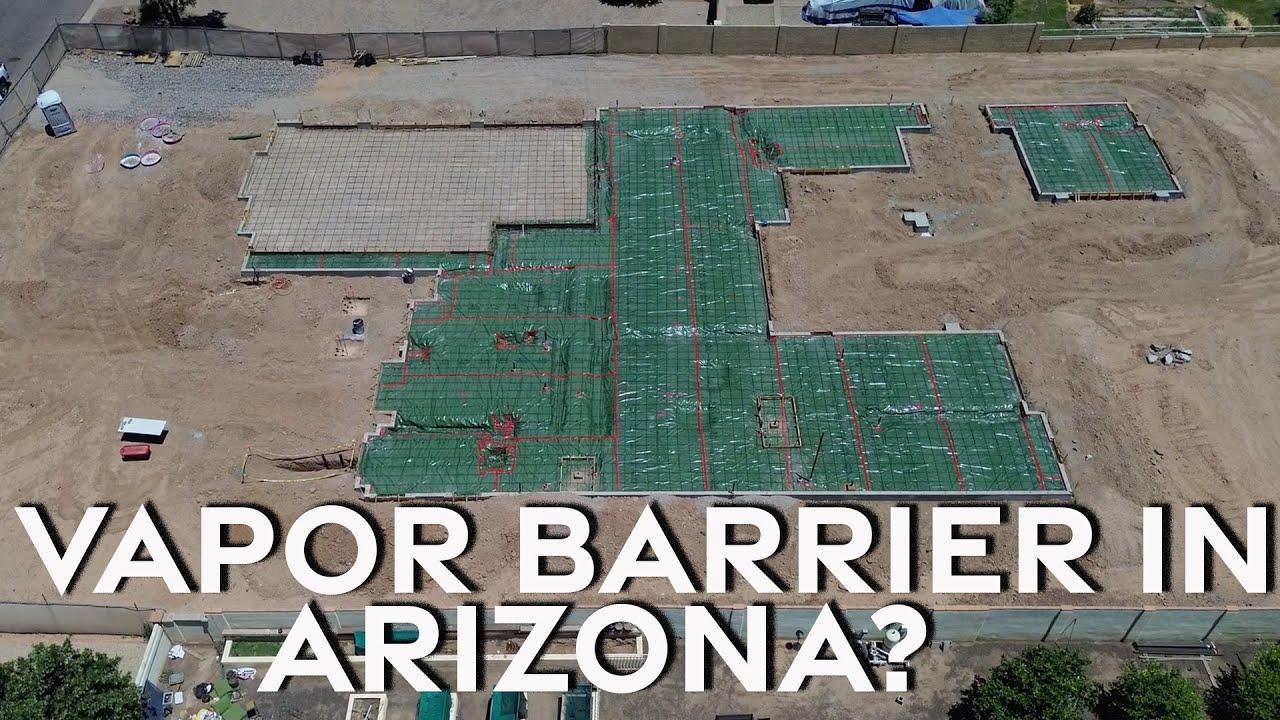
Under-slab work happens before the pour, over a compacted base instead of framing. The order matters because every later trade builds on top of this layer.
| Stage | What happens |
|---|---|
| Base prep | Compact earth, sand or aggregate to a smooth, stable surface |
| Sheet placement | Roll the vapor retarder out flat, working from one end of the pour |
| Seaming | Overlap joints per code, 6 inch laps for 10 mil ASTM E1745 Class A products, and seal with seaming tape |
| Wall termination | Run the sheet up the foundation wall and lock it with butyl tape and a termination bar |
Patch and tape around plumbing, wiring and posts before the rebar goes down, not after. Once rebar is in place, torn corners are far harder to reach and fix.
Poly-America sells polyethylene sheeting under its Husky line, which is a common source for the material used in this step.
The whole point of an under-slab layer is one continuous, sealed sheet. A single unpatched tear defeats the code requirement just as surely as skipping the material altogether.
How to seal vapor barrier seams and penetrations
A vapor barrier that isn’t sealed at every seam is just loose plastic. Sealing is what turns individual sheets into one continuous layer.
Sealing seams and overlaps
Butyl tape suits wall terminations, pier wraps and anywhere the seal has to flex. Flat overlaps between two sheets on the ground get seam tape or mastic instead.
Roll or squeegee every seam after taping to press out trapped air before it becomes a bubble in the seal.
Polyguard’s BF20 butyl flashing tape installs down to 15 degrees F and holds up to service temperatures of 240 degrees F, which is the range a seam tape needs on a job that spans seasons.
Sealing penetrations and fixtures
Pipes, wiring and posts each puncture the barrier, and each puncture needs its own fix. The two-patch method works well here. Bond a tight patch directly over the penetration first, then lay a larger patch over it so any gap in the inner patch stays covered.
Electrical outlet boxes get the same treatment on interior walls. They’re sealed, not just cut around.
Gaps left at penetrations create the exact concentrated pathway a sealed vapor barrier is supposed to remove.
When a vapor barrier installation does not apply or fails
A vapor barrier isn’t automatically the right move on every project. The code itself carves out exceptions, and building science adds a few more.
Conditions where it should not be installed
Garages, utility buildings and other unheated accessory structures are exempt from the IRC under-slab requirement. So are carports and unheated storage rooms under 70 square feet. Driveways, walks, patios and other flatwork also skip it, as long as they’re not likely to be enclosed and heated later.
Climate direction matters as much as the exceptions list. Building Science Corporation’s own research, published as BSI-073, makes the point directly. A second vapor barrier on the wrong side of an already sealed wall traps moisture instead of blocking it, and the assembly loses its ability to dry in either direction.
So a double barrier isn’t extra protection. It’s often the cause of the failure.
Installation mistakes that cause failure
Most failures trace back to execution rather than material choice. Seams get left untaped, or taped with general-purpose tape instead of a vapor-rated product. Pipes, posts and wiring get cut around and never patched. Staples end up spaced so far apart that the sheet sags and pulls away from the wall. And sometimes the barrier goes on the cold side of the insulation instead of the warm-in-winter side.
House wrap also gets mistaken for a true vapor barrier more often than it should. Whether Tyvek counts as a vapor barrier is worth settling before anything gets stapled to a stud, since house wrap and vapor barrier solve different problems.
Any one of these mistakes can turn a code-compliant material into a barrier that fails in practice.
FAQ on How To Install Vapor Barrier
How much does vapor barrier installation cost

Material alone runs $0.05 to $0.60 per square foot depending on mil thickness. A professional crawl space installation with labor lands between $3 and $7 per square foot, or up to $10 per square foot for crawl spaces with significant moisture problems (This Old House, 2026).
DIY material-only jobs on a small crawl space often stay under 400 dollars.
Is a vapor barrier a DIY job or one for a professional installer
A straightforward stud wall is fine as a DIY job. All it takes is polyethylene sheeting, a staple gun and acoustical sealant.
Crawl space and under slab work leans toward a professional, since pier wraps, termination details and code inspection add complexity that a first attempt usually misses.
Does a vapor barrier stop radon gas
A standard polyethylene vapor barrier slows radon entry through the slab, but it is not a certified radon barrier by itself.
Full radon mitigation adds a dedicated vent pipe, fan and sealed penetrations, confirmed with testing against the EPA action threshold.
Can a vapor barrier be installed in a pole barn or metal building
Yes, though the assembly differs from a wood frame wall.
Metal buildings typically use a faced vinyl or foil vapor barrier draped between purlins and the metal skin before insulation goes in, since condensation on bare metal is the main risk a barrier addresses there.
How long does a vapor barrier last
It depends on mil thickness and how much foot traffic the space sees.
Reinforced 10 to 20 mil sheeting resists tears and UV far longer than basic 6 mil poly, which cracks and thins under repeated crawl space traffic and heat exposure.
Can you paint over a vapor barrier instead of installing plastic sheeting
Vapor barrier primer and paint exist as an alternative to sheeting on interior walls, typically rated near 1 perm so they work as a Class II retarder.
Inspectors don’t always accept it in place of poly, so check the locally adopted code before relying on paint alone.
What Should You Fix First in Vapor Barrier Installation?
Sort out the required class and perm rating for the climate zone first. Placement comes second, meaning which side of the insulation the sheet sits on. Sealing every seam and penetration comes last, and it has to happen before drywall or concrete covers anything. Working in that order avoids the rework that follows from finding a mistake after the assembly is closed up.
The 2021 code shift from 6 mil to 10 mil applies only under a slab. Crawl space ground cover stays at a 6 mil minimum under that same code, which reflects how much more abuse a sub-slab layer takes during a pour than a ground cover laid after excavation ends.
Once the moisture layer is settled, the next decision is which product fills the cavity behind it, and this guide to installing fiberglass insulation covers that.