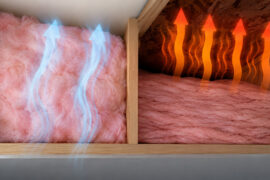
Your walls might be leaking money right now.
If you’re asking what is closed-cell insulation, you’re looking at one of the highest-performing thermal barriers available for residential and commercial buildings.
This spray polyurethane foam delivers R-6 to R-7 per inch, blocks moisture, seals air leaks, and adds structural strength to wall assemblies.
But it costs more than other options. And it’s not the right choice for every situation.
This guide covers how closed-cell foam works, where to install it, how it compares to open-cell alternatives, and whether the investment makes sense for your project.
By the end, you’ll know exactly when closed-cell insulation is worth the premium.
What is Closed-Cell Insulation
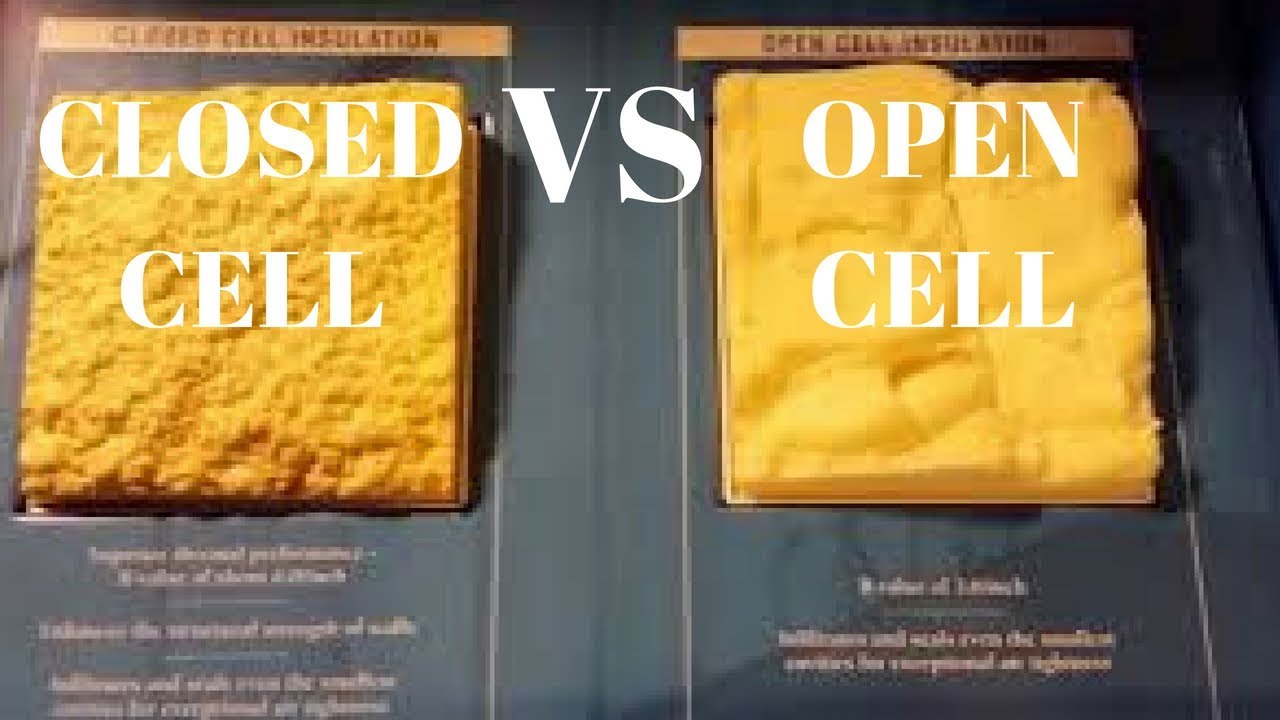
Closed-cell insulation is a rigid spray polyurethane foam with fully encapsulated, gas-filled cells that resist heat transfer, block moisture, and add structural strength to building assemblies.
The foam density sits around 2.0 pounds per cubic foot. This makes it one of the densest insulation materials on the market.
During application, two chemicals mix and expand rapidly. The bubbles stay intact rather than rupturing, creating millions of tiny closed pockets filled with insulating gas.
That cell structure is what separates it from open-cell foam. And it is why closed-cell delivers such high thermal resistance per inch.
How Does Closed-Cell Insulation Work
Understanding how insulation works starts with heat movement. Closed-cell foam tackles conduction, convection, and air leakage simultaneously.
How Do Closed Cells Trap Heat
Each cell contains a low-conductivity blowing agent (HFO or HFC gas) that slows thermal conductivity. Heat struggles to pass through millions of gas-filled pockets, reducing energy loss through walls and roofs.
How Does Closed-Cell Foam Create an Air Barrier
The foam expands on contact, adhering directly to studs, sheathing, and substrates. This expansion fills gaps completely, eliminating air infiltration paths that other insulation types miss.
Proper air sealing cuts heating and cooling costs significantly.
How Does Closed-Cell Insulation Act as a Vapor Barrier
At 1.5 inches or thicker, closed-cell foam qualifies as a Class II vapor retarder under the International Residential Code. Vapor permeance drops below 1 perm, blocking moisture diffusion into wall cavities.
What is the R-Value of Closed-Cell Insulation
The R-value measures thermal resistance. Higher numbers mean better insulating performance. Closed-cell foam delivers some of the highest R-values available in residential and commercial construction.
How is R-Value Measured in Closed-Cell Foam
Manufacturers test using the ASTM C518 procedure. A heat flow meter measures thermal resistance between hot and cold plates under controlled lab conditions.
Field performance can vary based on installation thickness, ambient temperature, and substrate type.
What R-Value Does Closed-Cell Foam Provide Per Inch
Closed-cell spray foam delivers R-6 to R-7 per inch. Premium products like Icynene ProSeal can achieve R-21 in a three-inch pass.
The dense cell structure retains its R-value over time better than most alternatives.
How Does Closed-Cell R-Value Compare to Other Insulation Types
Here is how common insulation materials stack up per inch:
- Closed-cell spray foam: R-6 to R-7
- Open-cell spray foam: R-3.5 to R-3.8
- Fiberglass batts: R-3.2 to R-3.8
- Cellulose insulation: R-3.2 to R-3.7
Closed-cell provides nearly double the thermal resistance of fiberglass in the same thickness.
Where is Closed-Cell Insulation Installed
Closed-cell foam works best in moisture-prone areas, tight spaces requiring high R-value, and applications needing structural reinforcement.
When Should Closed-Cell Foam Be Used in Basements
Basement walls face constant ground moisture and humidity. Closed-cell foam creates an integrated moisture barrier while insulating basement walls in a single application.
When Should Closed-Cell Foam Be Used in Crawl Spaces
Crawl spaces trap moisture from soil evaporation. Closed-cell foam on foundation walls controls humidity, prevents condensation, and supports encapsulation projects without needing separate vapor barriers.
When Should Closed-Cell Foam Be Used on Exterior Walls
Exterior-facing thermal boundaries benefit most from closed-cell’s high R-value per inch.
In a 2×4 wall cavity (3.5 inches deep), closed-cell achieves approximately R-20. A 2×6 cavity can exceed R-30. This reduces thermal bridging through framing members.
When Should Closed-Cell Foam Be Used Under Roof Decks
Unvented conditioned attic assemblies require insulation applied directly to roof sheathing. Closed-cell foam handles this perfectly, providing the necessary R-value and vapor control without ventilation channels.
When Should Closed-Cell Foam Be Used at Rim Joists
Rim joists are notorious air leakage points. A 2-inch application of closed-cell foam seals and insulates the basement box sill in one step, stopping drafts and moisture intrusion.
What is the Difference Between Closed-Cell and Open-Cell Spray Foam
Both are spray foam insulation products. The cell structure creates dramatically different performance characteristics.
How Do Cell Structures Differ Between Closed-Cell and Open-Cell Foam
Open-cell foam has ruptured bubbles, leaving only the struts where cells touched. This creates a soft, spongy texture at 0.5 lb/ft3 density.
Closed-cell foam keeps bubbles intact. The result is rigid, dense material at 2.0 lb/ft3.
How Do Moisture Properties Differ Between Closed-Cell and Open-Cell Foam
Open-cell foam has vapor permeance around 16 perms at 3 inches. It breathes and can absorb water.
Closed-cell foam drops below 1 perm, acting as a built-in vapor barrier. No additional moisture protection needed.
How Do Applications Differ Between Closed-Cell and Open-Cell Foam
A common rule: use closed-cell north of the Pennsylvania border where temperature swings exceed 70 degrees F between indoors and outdoors.
Open-cell works for interior walls and sound control applications. Closed-cell handles exterior walls, basements, crawl spaces, and anywhere moisture resistance matters.
What Does Closed-Cell Insulation Cost
Closed-cell foam costs more upfront than most insulation types. The ROI on insulation comes from energy savings, moisture protection, and longevity.
What Factors Affect Closed-Cell Insulation Pricing
Several variables impact the cost per square foot for insulation:
- Material cost per board foot ($1.00-$1.50)
- Required thickness and total R-value
- Labor rates in your region
- Project accessibility and complexity
- Spray rig equipment mobilization fees
Expect $1.50-$3.00 per board foot installed for residential projects.
How Does Closed-Cell Cost Compare to Open-Cell Cost
Open-cell foam runs $0.50-$1.25 per board foot installed. Cheaper per square foot, but you need nearly twice the thickness to match closed-cell R-values.
The payback period for insulation shortens in cold climates where closed-cell’s superior performance saves more on heating bills.
How is Closed-Cell Spray Foam Installed
Professional installation is required. The chemical reaction, equipment complexity, and safety requirements put this outside DIY territory.
What Equipment is Required for Closed-Cell Installation
Contractors use proportioning spray rigs with heated hoses, spray guns with mixing chambers, and personal protective equipment including respirators and suits.
The two-component system (A-side isocyanate and B-side polyol) mixes at the gun tip.
What Surface Preparation Does Closed-Cell Foam Require
Substrates must be clean, dry, and within 40-100 degrees F. Moisture on surfaces prevents proper adhesion. Most contractors check conditions with infrared thermometers before spraying.
How Thick Can Closed-Cell Foam Be Sprayed in One Pass
Maximum lift thickness: 2 inches per pass. Thicker applications trap heat from the exothermic reaction, potentially causing scorching or fire.
Achieving R-21 requires multiple passes with cooling time between each.
What Are the Structural Benefits of Closed-Cell Insulation
Beyond thermal performance, closed-cell foam strengthens building assemblies. The rigid, adhesive nature adds measurable structural value.
How Does Closed-Cell Foam Add Wall Strength
The foam bonds directly to studs and sheathing, increasing racking strength by up to 300%. This glue-like adhesion distributes loads across the entire wall assembly rather than just through fasteners.
How Does Closed-Cell Foam Reinforce Roof Assemblies
Roof sheathing sprayed with closed-cell foam resists wind uplift better than conventionally insulated roofs. Hurricane-prone regions see real benefits from home insulation that doubles as structural reinforcement.
What Building Codes Apply to Closed-Cell Insulation
The International Energy Conservation Code (IECC) and local amendments set minimum R-value requirements. Insulation fire rating codes add additional compliance layers.
What R-Values Does the IECC Require by Climate Zone
2021 IECC minimums for wood-frame walls:
- Climate Zones 1-2: R-13
- Climate Zones 3-4: R-20 or R-13 + R-5 continuous
- Climate Zones 5-8: R-20 + R-5 continuous or R-13 + R-10 continuous
Closed-cell foam meets or exceeds these requirements in standard wall cavities. California projects must also comply with Title 24 energy standards.
What Fire Rating Requirements Apply to Closed-Cell Foam
Spray foam requires a 15-minute thermal barrier (typically 1/2-inch drywall) in occupied spaces. Attics and crawl spaces may allow ignition barriers instead, depending on local codes.
Always verify requirements with your building department before installation.
What Are the Disadvantages of Closed-Cell Insulation
Closed-cell foam is not perfect for every application. Understanding the drawbacks helps you choose the right home insulation for your project.
Higher upfront cost. Closed-cell runs 2-3x more expensive than open-cell or batt insulation per R-value in thick applications.
Professional installation only. No DIY option exists due to equipment requirements and chemical handling safety.
Difficult to trim. The rigid cured foam resists cutting, so installers typically stop 1/2-inch short of stud faces rather than filling cavities completely.
Potential shrinkage. Improper mixing ratios or cold substrates can cause foam to pull away from framing over time.
Off-gassing during installation. The curing process releases fumes requiring evacuation and ventilation for 24-72 hours. Fully cured foam is inert.
Not ideal for sound control. The rigid structure transmits vibrations; open-cell foam or rock wool insulation performs better for acoustic applications.
For retrofit insulation projects in existing walls, dense pack insulation methods may be more practical than spray foam.
FAQ on What Is Closed-Cell Insulation
Is closed-cell insulation waterproof?
Closed-cell foam is highly moisture resistant but not fully waterproof. It blocks vapor diffusion with permeance below 1 perm and won’t absorb water like open-cell foam. Standing water contact over time can still cause issues.
How long does closed-cell insulation last?
Properly installed closed-cell spray foam lasts the lifetime of the building, typically 80+ years. The rigid cell structure doesn’t settle, sag, or degrade like fiberglass batts. R-value retention remains stable over decades.
Can I install closed-cell insulation myself?
No. Closed-cell foam requires professional spray rig equipment, precise chemical mixing ratios, and proper safety gear including respirators. DIY kits exist for small projects but lack the consistency needed for whole-house applications.
Does closed-cell insulation need a vapor barrier?
No additional vapor barrier insulation is needed. At 1.5 inches thickness, closed-cell foam qualifies as a Class II vapor retarder under the International Residential Code, blocking moisture diffusion effectively.
Is closed-cell spray foam worth the extra cost?
Worth it in basements, crawl spaces, exterior walls, and cold climates where moisture control and high R-value per inch matter. Less cost-effective for interior walls or mild climates where open-cell performs adequately.
What is the difference between 1-pound and 2-pound foam?
Two-pound foam is closed-cell (2.0 lb/ft3 density) with R-6 to R-7 per inch. Half-pound foam is open-cell (0.5 lb/ft3) with R-3.5 per inch. The density determines thermal resistance and moisture properties.
Can closed-cell insulation be removed?
Removal is difficult and labor-intensive. The foam bonds permanently to substrates. Insulation vacuum removal doesn’t work on rigid foam. Mechanical scraping or cutting is required, often damaging underlying surfaces.
Does closed-cell insulation off-gas?
During installation and curing (24-72 hours), closed-cell foam releases fumes requiring ventilation. Fully cured foam is chemically inert and safe. Occupants should vacate during application and initial cure time.
Can you use closed-cell foam in hot climates?
Yes, though open-cell often suffices where temperature differences stay below 40 degrees F. Closed-cell excels in humid southern climates where its vapor barrier properties prevent condensation in wall cavities.
How do I find air leaks before installing closed-cell foam?
Schedule a blower door test to measure air infiltration rates. A thermal imaging camera identifies specific leak locations. Many homeowners qualify for a weatherization rebate covering diagnostic costs.
Conclusion
Understanding what is closed-cell insulation helps you make smarter decisions about your building envelope.
This high-density spray foam delivers R-6 to R-7 per inch, acts as a vapor retarder, and strengthens wall assemblies. Few insulation products match that combination.
The higher upfront cost makes sense for basements, crawl spaces, rim joists, and climate zones with extreme temperature swings.
For interior walls or budget-conscious projects, open-cell foam or loose-fill insulation may work better.
Ready to move forward? Get quotes from licensed insulation contractors. Ask about insulation tax credits and rebates that offset material costs.
The right insulation choice depends on your climate, budget, and performance priorities. Closed-cell foam earns its premium when moisture control and energy efficiency top your list.