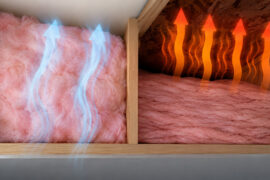
The math on spray foam fits in one sentence, even though the answer never does. You pay more per square foot than you would for fiberglass or cellulose, and some of that comes back every month on the utility bill. Whether it adds up is a question about your specific house.
Contractors spray it into attics, wall cavities, crawl spaces, and rim joists, on new builds and retrofits alike. It goes on as a liquid and expands into a solid layer, which means it air seals and insulates in the same pass. That dual function is why it gets measured against fiberglass batts and blown cellulose on cost per square foot and R-value per inch, and also why those two numbers by themselves never settle anything.
Demand isn’t slowing, for whatever that’s worth as a signal. The global spray foam market reached $3.1 billion in 2025 and is projected to grow to $5.3 billion by 2035, according to a Global Market Insights industry report published in 2026.
What Is Spray Foam Insulation?
Two chemicals sit in separate drums until they’re pumped through a heated hose and meet for the first time inside the gun. Isocyanate on one side, a polyol resin on the other. The reaction starts within seconds, the mixture expands to many times its liquid volume, and it cures into a solid layer that seals gaps and adds thermal resistance at the same time.
Depending on which formulation the contractor loads, that cured layer ends up either soft and open celled or rigid and dense.
It sits in a different category than batt, blown-in, or rigid panel products, even though all four fall under the same broad umbrella of home insulation options homeowners choose between.
Worth clearing up what it isn’t. Spray foam is not a rigid foam board cut to size and fitted into a cavity. And it isn’t automatically a vapor barrier, which depends entirely on which cell type gets sprayed.
How Does Spray Foam Insulation Work?
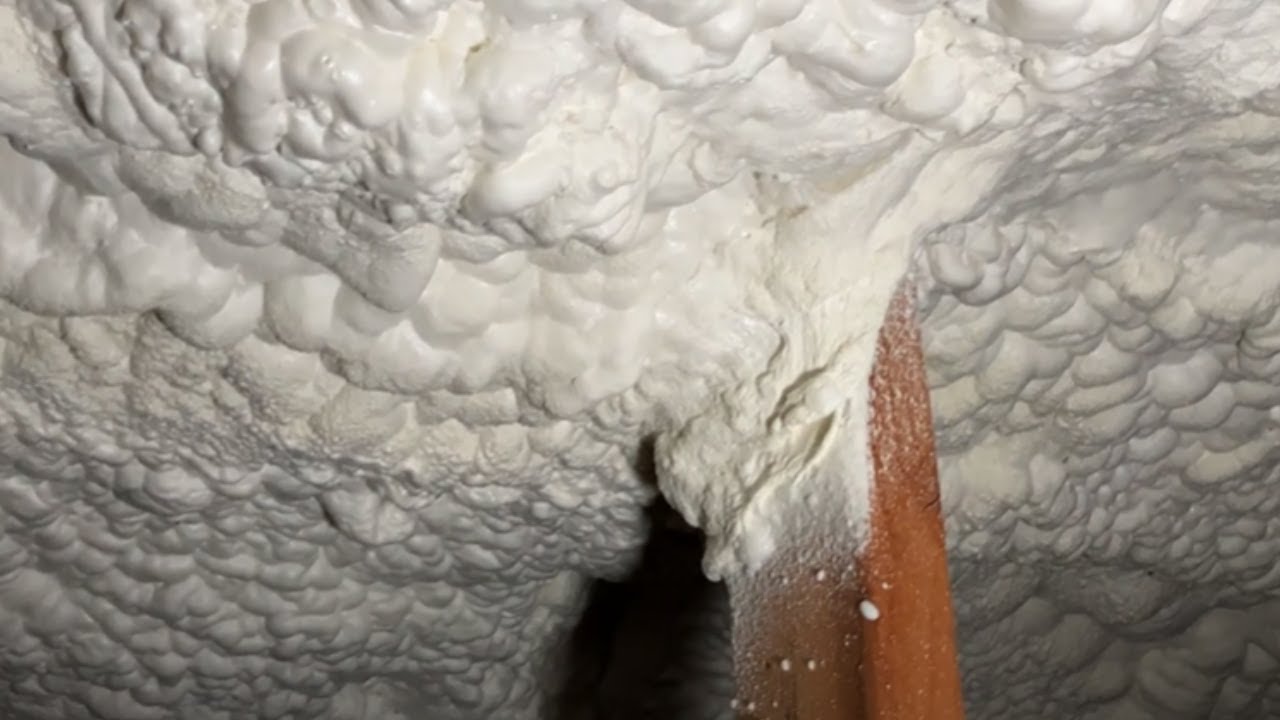
Pre-cut materials leave gaps. Wires, pipes, outlet boxes, the corner where two framing members almost meet. A batt gets stuffed around all of that and air still finds its way through. Foam goes in as a liquid, expands into the same voids, and cures into one continuous layer that works as an air barrier and a thermal layer at once.
Batt insulation only does the second half of that job. It slows heat transfer and does nothing about air moving around it, over it, or straight through it.
The expansion buys you a few things:
- It fills the irregular framing gaps around wires, pipes, and outlet boxes that batts leave open
- It sticks directly to the substrate, so there’s no air gap hiding behind the insulation layer
- Curing finishes within hours, though full R-value performance takes a few days to stabilize
That expansion is what gives spray foam its air sealing advantage, and it matters more to real-world performance than the R-value printed on the label suggests.
It does less for thermal bridging through the studs themselves. That’s a whole-wall problem, and no insulation material fully solves it alone. Foam included.
A Department of Energy Building America case study on a Georgia housing development is a useful reference point here. The builder used low-density spray foam in the wall cavities as part of a broader envelope strategy, and blower door testing on the finished homes came in well under standard leakage targets for the climate zone.
Less air moving through the envelope also means smaller HVAC sizing calculations for the same comfort level. That’s one of the quieter ways spray foam pays for itself, and almost nobody brings it up during the sales call.
Open-Cell vs Closed-Cell Spray Foam: What Is the Difference?
Density is the root of everything else. Open-cell foam cures soft, somewhere in the neighborhood of a stiff sponge, at roughly a quarter the density of the closed-cell product. Closed-cell comes out rigid and gets you about double the insulating power in the same inch of cavity depth.
The R-value difference is the first thing most contractors point to. It shouldn’t be the only thing driving the choice.
Cost, moisture behavior, and where in the house the foam is going all matter just as much. The table below lines those factors up against two common non-foam alternatives.
| Type | R-value per inch | Cost per square foot | Vapor permeability |
|---|---|---|---|
| Open-cell spray foam | R-3.5 to R-3.7 | $1.50 to $3.50 | 10 to 16 perms, vapor open |
| Closed-cell spray foam | R-6 to R-7 | $3.00 to $5.00 | about 1 perm, vapor retarder |
| Fiberglass | R-2.9 to R-3.8 | $1.00 to $1.70 | highly permeable |
| Cellulose | R-3.2 to R-3.8 | $1.10 to $1.80 | highly permeable |
Open-Cell Spray Foam
It expands harder during application than closed-cell does, cures soft, and stays vapor open afterward, so moisture can travel through it in either direction. That permeability is a feature in some assemblies and a liability in others.
Icynene is one of the products that helped popularize open-cell foam for interior walls and attic underside applications, where the sound dampening turns out to be as useful as the R-value. Anyone who has insulated a wall between a bedroom and a laundry room knows why.
Lower material cost is the main draw. Against a cellulose fill in the same interior wall cavity, open-cell foam often lands closer in price than most people expect.
Closed-Cell Spray Foam
Closed-cell foam tests at nearly double the R-value per inch of its open-cell counterpart, and it adds real structural rigidity to whatever it’s sprayed onto.
Where it tends to show up:
- Rim joists and basement walls, anywhere moisture contact is likely
- Exterior-facing roof decks and unvented attic assemblies
- Tight cavities, where there isn’t enough depth to hit the target R-value with anything else
As a closed-cell insulation product, it resists water absorption in a way open-cell foam simply can’t, which is why crawl space and basement jobs lean toward it almost by default.
Demilec and BASF’s Walltite line are two of the closed-cell products contractors reach for most often on exterior assemblies, alongside Icynene’s own closed-cell formulations.
How Much Does Spray Foam Insulation Cost?
Installed, you’re looking at $1.50 to $5.00 per square foot. Open-cell sits at the bottom of that range, closed-cell at the top, and nearly every quote lands somewhere inside it.
Most contractors quote based on cost per square foot for insulation rather than a flat whole-home number, since treated surface area varies so much by project.
Typical pricing across 2025 and 2026, national averages:
- Open-cell spray foam, professionally installed: $1.50 to $3.50 per square foot
- Closed-cell spray foam, professionally installed: $3.00 to $5.00 per square foot
- DIY closed-cell kits, materials only: $0.75 to $2.00 per square foot
- Contractor minimum job fee: usually $1,000 to $2,000, which catches a lot of small jobs
New construction runs cheaper than retrofitting an existing home. A retrofit means opening walls, working around whatever insulation is already in there, and patching drywall afterward.
DIY kits cut labor out of the equation entirely, but they cap out around a few hundred square feet per kit and leave zero margin for mixing errors. A full spray foam insulation cost breakdown by project type and region goes further into how attic, crawl space, and wall cavity pricing diverge from each other.
Attic and roof deck jobs generally cost less per square foot than crawl spaces, mostly because crawl spaces demand more prep and a lot of spraying from awkward positions.
Is Spray Foam Insulation Worth the Cost?

For most homeowners, the break-even point arrives somewhere between year three and year seven. That’s when the accumulated energy savings have covered the premium you paid over fiberglass or cellulose.
The gap is wider than the R-value numbers alone would predict, because air sealing does work the label never accounts for. Industry payback studies built on Department of Energy air-leakage data put total energy savings at 30 to 50 percent higher than fiberglass alone in homes with meaningful prior air leakage, according to a 2026 analysis from MD Spray Foam.
That window compresses when the climate does more of the work, when the existing insulation was bad enough that almost anything would have helped, or when local electricity and gas rates sit above the national average. Stack two of those and payback can arrive well inside five years.
The payback period for insulation is really the number that answers the worth-it question, more than the sticker price ever will on its own.
Resale value is murkier, and I’d be skeptical of anyone who tells you otherwise. Direct resale premiums tied specifically to spray foam aren’t something the available housing data breaks out cleanly, separate from broader energy-efficiency upgrades like certified HVAC replacements or window packages.
What’s better documented is that the ROI on insulation stays positive well past the break-even point, since the foam keeps performing for decades after the initial cost is recovered.
A Building America case study from a Connecticut development took a different approach worth noting here. Nelson Construction used closed-cell foam only at rim joists and known leak points instead of full-cavity coverage, and the finished homes still beat their airtightness target by a wide margin, at a fraction of the material cost full coverage would have required. Targeted beats total more often than the industry likes to admit.
What Are the Pros and Cons of Spray Foam Insulation?

Everything good about spray foam traces back to air sealing and R-value per inch. Everything bad traces back to the price and to the fact that once it’s cured in place, getting it out again is a project nobody enjoys.
On the plus side:
- Highest R-value per inch of any common insulation material
- Seals air leaks and insulates in a single application
- Closed-cell adds moisture resistance and some structural rigidity to the assembly
- It doesn’t sag, compress, or quietly lose performance the way loose-fill products can
Most of that overlaps with the broader benefits of home insulation generally: lower energy bills, steadier indoor temperatures, less strain on HVAC equipment.
Spray foam just delivers more of it per inch of cavity depth.
The drawbacks are just as concrete:
- Costs 2 to 5 times more upfront than fiberglass or cellulose
- Can’t be removed cleanly once cured, unlike batt or loose-fill materials
- Strong odor during curing, which means the house sits empty for a while
- Needs precise mixing and temperature control to perform anywhere near its rated value
Measured against other types of insulation materials, the price gap is real, and it doesn’t close quickly even with strong energy savings.
Not every drawback applies to both cell types equally. Open-cell is cheaper and more vapor open, so some assemblies need a separate vapor control layer added on top of it. Closed-cell handles moisture on its own and charges you for the privilege.
The cost and payback figures above are the two data points that end up carrying the most weight once someone actually sits down to compare this against a fiberglass job from Owens Corning or Johns Manville.
How Long Does Spray Foam Insulation Last?
Decades, assuming a competent install. Manufacturers back that up with warranty terms tied to the life of the building rather than a fixed number of years.
Huntsman Building Solutions covers material defects on both its open-cell and closed-cell lines under a limited lifetime warranty, valid as long as the original owner holds the property. BASF’s Enertite open-cell line carries a comparable lifetime residential warranty.
Read what that warranty actually covers before you rely on it:
- Material defects in the foam itself, not the labor to tear it out and replace it
- Coverage tied to the original homeowner, and contingent on someone remembering to register the installation
- Performance as described in the manufacturer’s technical data sheet at the time of install
Spray foam also sidesteps insulation settlement, the gradual compacting that shrinks the effective depth of loose-fill and some batt products over time.
What actually cuts the lifespan short is rarely the foam aging out. It’s prolonged UV exposure on foam left uncoated in an exposed application, sustained moisture intrusion behind or beneath the layer, or physical damage from rodents, renovation work, and improper cutting.
Since most homeowners recoup the upfront cost inside the first decade, the remaining twenty-plus years of service life are where this investment actually earns its keep.
Is Spray Foam Insulation Safe? Health and Moisture Considerations
Cured foam is safe. The installation is a different situation, and that distinction gets lost constantly in online arguments about the product.
The risk during application comes from isocyanate vapors and dust released while the two components react:
- OSHA sets the permissible exposure limit for MDI, the isocyanate used in most spray foam, at 0.02 parts per million as a 15-minute ceiling
- Sprayers and helpers need supplied-air or organic vapor respirators, not a dust mask
Everyone else needs to clear out. Other trades, residents, kids, pets, all of it, until the manufacturer’s re-occupancy window has passed.
Re-entry timing per EPA Safer Choice guidance:
- Two-component professional systems: at least 24 hours, sometimes up to 72
- One-component low-pressure canister foam: roughly 8 to 24 hours
Bayer MaterialScience ran its own testing on Bayseal CC and Bayseal OC foam and landed on a more specific window: 12 hours for trades workers, 24 hours for residents and other sensitive occupants.
Once curing finishes, the health picture changes. Whether spray foam insulation is safe after it cures comes down to whether the reaction actually went to completion and whether the space got proper ventilation beforehand.
A cured, correctly mixed foam has essentially no free isocyanate left to off-gas. An under-cured or off-ratio batch is a different story, and that’s a workmanship problem more than a product problem.
Moisture is the second safety angle, and it plays out differently than most people expect. Closed-cell foam functions much like dedicated vapor barrier insulation in an assembly, which is exactly why it has to go on the correct side of a wall or roof deck.
Joseph Lstiburek and Building Science Corporation have documented a mechanism they call hygric buoyancy in unvented attics. Sheathing gets cold and absorbs moisture overnight, then that moisture gets driven inward once the sun heats the roof.
Open-cell foam is vapor open enough to let that moisture pass through into the living space, which is uncomfortable but rarely destructive. Trap the same moisture behind low-permeability closed-cell foam on the wrong side of the assembly and it has nowhere to go. That’s where mold and sheathing damage actually start.
How Is Spray Foam Insulation Installed?

Same chemistry either way, wildly different equipment. A professional crew shows up with a full rig; a homeowner working on a rim joist buys a two-canister kit. Both mix isocyanate and polyol resin and let the result expand and cure in place.
Professional Installation Process
Three pieces of hardware do the real work on a job site. A proportioner pumps both chemical sides at a fixed ratio. Primary heaters and heated hoses bring the chemicals up to temperature, since most formulations won’t react correctly cold. Then there’s the spray gun, where the two sides meet for the first time, a fraction of a second before they hit the substrate.
A professional job runs on spray rig equipment that keeps the two chemicals fully separated until that final moment in the gun.
- Clear and clean the substrate so it’s free of dust, oil, and standing moisture (manufacturer application guides call for substrate moisture content under 19 percent)
- Mask off anything that shouldn’t get sprayed, since overspray is difficult to remove once cured
- Bring the proportioner, hoses, and drums up to the product’s specified temperature range before starting
- Apply the foam in controlled passes, pausing between lifts so the surface can cool rather than overheat
- Trim any overspray once the foam has cured and add a code-required coating or barrier where the assembly calls for one
Skipping the cooling pause between passes is a known failure point. Manufacturer application guides warn that spraying too thick in one lift can push reaction temperatures high enough to scorch the foam or, in extreme cases, ignite it.
DIY Spray Foam Kits
Dow’s Froth-Pak 200 kit, one of the more common consumer options, covers about 200 square feet at a 1-inch depth per the manufacturer’s own product listing.
Tiger Foam’s TF-600FR closed-cell kit yields roughly 529 board feet, which the company defines as one square foot of coverage at a 1-inch thickness.
Inside the box you get two pressurized component tanks, an A side and a B side, a gun and hose assembly that’s usually 15 feet, and a set of interchangeable spray tips.
Getting the ratio wrong is the single most common DIY mistake, and it isn’t forgiving. Tilt or shake the tanks unevenly, let one side run low on pressure, and the foam either refuses to expand properly or cures tacky and off-gassing. There’s no fixing that after the fact.
Once the job’s done, a follow-up blower door test is the only real way to confirm the air sealing improved instead of just assuming the foam did its job.
When Is Spray Foam Insulation Not Worth It?
Three situations kill the case for it: you won’t own the house long enough to reach payback, there’s already water getting in, or the assembly and local code won’t support the product you’d be spraying.
Ownership timeline first. Selling within a year or two means the payback window closes before you see any of it. Renting the property out means you pay and the tenant collects the energy savings, which is a hard sell to anyone doing the math honestly.
Foam doesn’t fix a house that’s about to change hands faster than the investment can recover.
Existing moisture is the more serious disqualifier:
- An active roof leak, since foam seals over the symptom without touching the source
- Ongoing bulk water intrusion at a foundation or crawl space
Stephen MacDougall of Brown and Beattie Ltd, a building science forensic engineering firm, presented case findings at the Canadian Conference on Building Science and Technology showing that spray foam applied to the underside of flat roof decks can conceal leaks for extended periods, letting damage spread before anyone notices.
Sealing over a problem that needs a repair, not an insulation upgrade, tends to make the eventual fix more expensive.
Then there are the code and assembly mismatches. Unvented attics or crawl spaces without an approved ignition barrier over the exposed foam. Open-cell foam on a cold-climate roof deck, which runs straight into the moisture-drive risk covered above.
Part of why codes get strict here traces back to a basic question. Is spray foam insulation flammable in its raw, uncoated state?
Yes, which is exactly why an accessible attic or crawl space needs an ignition barrier over it even when a thermal barrier already separates the living space below.
And then the mistakes that void the value entirely:
- Off-ratio mixing, which product application guides link to scorching and offensive odors that never fully dissipate
- Wrong cell type for the climate zone or assembly, which is a different and worse error than picking the wrong brand
- Spraying over a substrate that wasn’t clean or dry, undercutting adhesion from day one
None of these are cheap to walk back. Anyone who has looked into how to remove spray foam insulation after a bad install knows it’s closer to demolition than a touch-up, which is the real cost of getting any of the above wrong.
FAQ on Is Spray Foam Insulation Worth It
What Building Codes and Certifications Apply to Spray Foam Insulation?
Before a formulation gets approved for use, it needs ASTM C518 R-value testing and an ICC-ES evaluation report. Fire performance falls under ASTM E84 separately. Low-emission products can also carry GREENGUARD certification for indoor air quality.
Is Spray Foam Insulation Flammable, and What Fire Safety Rules Apply?
Uncoated polyurethane foam burns like most plastics, which is why codes require a barrier. Foam rated Class 1 under ASTM E84 keeps flame spread under 25 and smoke development under 450, the threshold most jurisdictions accept without extra fireproofing.
Can Spray Foam Insulation Be Removed?
Yes, though no solvent softens cured foam. Removal means mechanical work: cutting with a reciprocating saw, scraping, and sanding down to the substrate.
Contractors price it closer to demolition labor than a standard insulation swap.
Does Spray Foam Insulation Void a Roof Warranty?
Depends on the shingle manufacturer. Atlas Roofing excludes roof deck spray foam from coverage outright.
GAF keeps the shingle warranty valid but excludes any damage the foam itself causes. Check the specific policy before anyone starts spraying.
Does Homeowners Insurance Cover Spray Foam Insulation Problems?
In the US, insurers such as State Farm and Allstate do not treat spray foam as a coverage risk on its own. The UK market is stricter: lenders like TSB Bank and Skipton have declined properties with it.
Can Spray Foam Be Added to an Existing Finished Home Without Opening the Walls?
Yes, through injection foam, a lower-pressure variant drilled through small access holes between studs rather than sprayed openly. Contractors patch the holes once cured, making it practical for finished walls never opened during construction.
What Should You Do First in Is Spray Foam Insulation Worth It?
Measure the house before you collect quotes. A blower door test shows where the air is actually going and whether moisture is already sitting in the assembly, and spraying foam over either of those doesn’t correct them.
Baseline R-value, current air changes per hour, and moisture readings in the assembly all come before a single quote.
Code targets also shift the math more than people expect. The 2021 IECC sets attic insulation at R-60 across climate zones four through eight, pushing closed-cell foam past 8.5 inches there and narrowing its price edge over thinner applications.
That baseline comes from a home energy audit, the step that turns a spray foam insulation quote into a number specific to that house.