Ask three installers whether spray foam is waterproof and you’ll probably get three slightly different answers. Most of the disagreement traces back to cell structure, since the same polyurethane behaves very differently depending on whether its cells are sealed or open.
Spray foam insulation is a two-component polyurethane that expands on contact and seals air gaps. Closed-cell foam, the denser kind, resists liquid water and limits vapor movement through a wall, roof, or floor assembly.
Contractors spray it into wall cavities, rim joists, crawl spaces, and roof decks, where it insulates and air-seals in one pass. Building code doesn’t grade its moisture behavior as waterproof or not. It uses perms.
ICC-ES evaluates closed-cell spray foam as a water-resistive barrier material under Section 3.1.6 of its Acceptance Criteria AC377, dated June 2023 (editorially revised June 2024).
Is Spray Foam Insulation Waterproof?

No, not strictly.
Closed-cell foam gets close because its sealed cells shed most liquid water on contact. Open-cell foam soaks water up and keeps it, much like a kitchen sponge. Call the material water-resistant and you’ll be right. Call it waterproof and you’ll be wrong, and that gap matters if you’re insulating somewhere wet or flood-prone.
Spray foam sits alongside other home insulation materials that pair an air seal with thermal resistance in one application. I think that pairing is why the waterproof question keeps coming up. Something that stops air movement gets assumed to stop water too, and that only holds for one version of the product.
Waterproof means liquid water is blocked completely, whatever the exposure. Water-resistant means absorption is limited, but water can still get in under long or pressurized contact.
Open-Cell vs Closed-Cell Spray Foam: Water Resistance Compared

Closed-cell foam resists water because it’s dense and its cells are sealed. Open-cell foam has cells that stay open and connected, so water moves through it.
The two differ on almost every water-related property, from density to R-value to how they act in a flood.
| Property | Open-Cell Foam | Closed-Cell Foam | Field Impact |
|---|---|---|---|
| Cell structure | Open, interconnected cells | Sealed, closed cells | Determines whether water can pass through |
| Density | 0.4 to 0.6 lb/ft³ | 1.7 to 3.0 lb/ft³ (about 2.0 for typical insulation-grade foam) | Higher density resists compression and water uptake |
| R-value per inch | R-3.5 to R-3.8 | R-6.0 to R-7.0 | Closed-cell needs less thickness for equal resistance |
| Vapor permeance | 10 to 16 perms at 3 to 3.5 inches | Under 1.0 perm at roughly 1.5 to 2 inches | Only closed-cell can act as a vapor retarder |
| Water behavior | Absorbs and holds water | Sheds most liquid water | Closed-cell suits damp or below-grade spaces |
Density and R-value figures are typical industry ranges, including those published by SprayFoam Magazine, the Spray Polyurethane Foam Alliance’s publication. Exact values vary by product, so the manufacturer’s data sheet is the number to trust for a specific job.
Density matters because a heavier, tighter closed-cell insulation product leaves less room for water molecules to travel. It also lifts the R-value per inch, since the gas trapped in sealed cells conducts heat more slowly than the air in open ones.
Icynene and Demilec, both now part of Huntsman Building Solutions, sell open-cell and closed-cell lines. Open-cell tends to go into interior sound and thermal work. Closed-cell is what gets specified for basements and crawl spaces.
Open-cell still makes sense in a dry interior wall, where sound damping and a lower price count for more than water exposure.
Why Does Closed-Cell Spray Foam Resist Water?
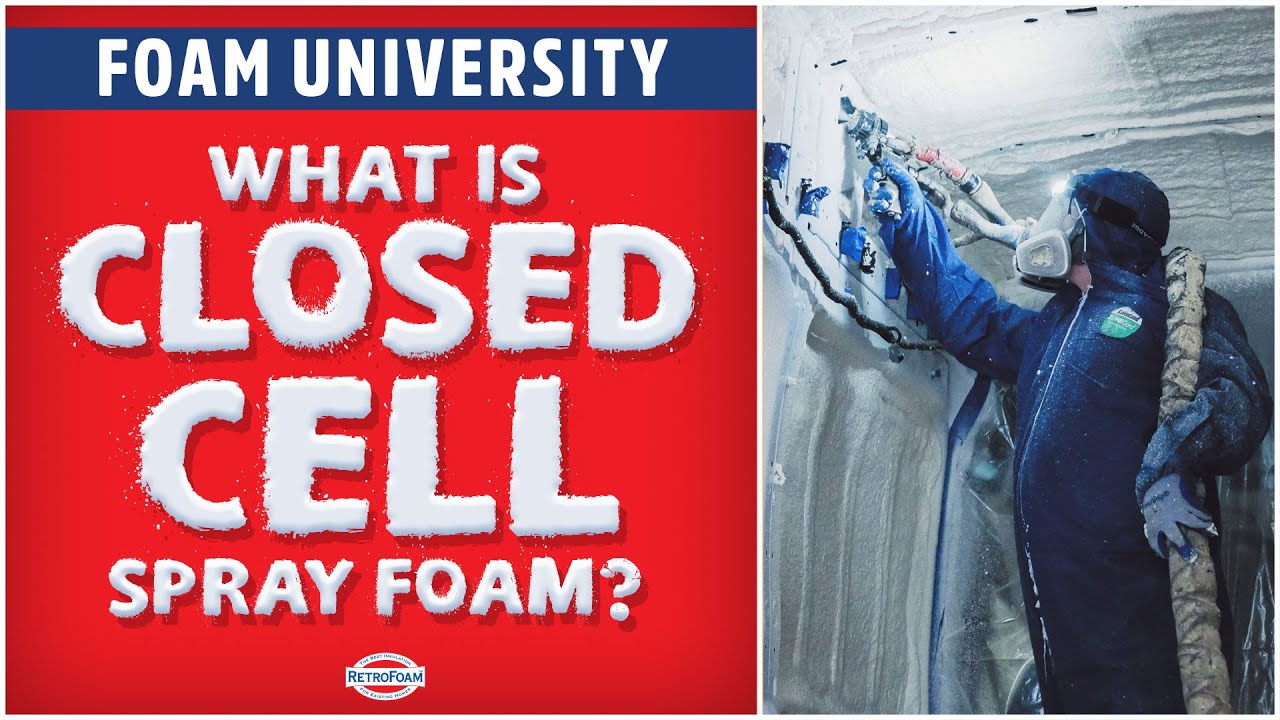
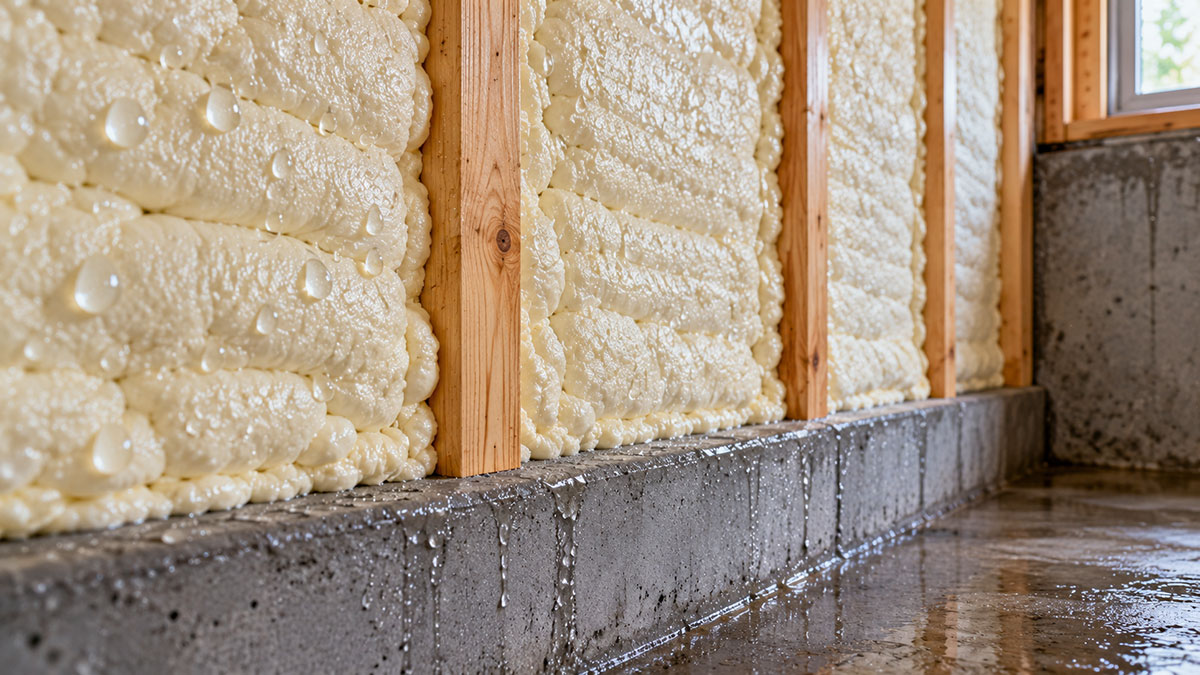
Every closed cell is a tiny sealed pocket. Liquid can’t enter without breaking the cell wall, and that’s the mechanical reason the foam sheds water.
One closed-cell product, Gaco 183M, showed water absorption of just 0.71% by volume after 96 hours of immersion under ASTM D2842, according to the manufacturer’s own data sheet.
Density for closed-cell foam runs 1.7 to 3.0 pounds per cubic foot (SprayFoam Magazine), and R-value lands around 6.0 to 7.0 per inch, both typical industry ranges. The absorption number comes from that Gaco data sheet alone, so treat it as one product’s result.
Open-cell foam fails the same test. Its sponge-like structure hands water a straight path through.
The sealed structure is also why closed-cell foam can double as air sealing at certain thicknesses. Whatever stops liquid water tends to stop moving air as well.
BASF’s Walltite closed-cell system has an ICC-ES evaluation report (ESR-2642) covering use as a water-resistive barrier, and it’s one of several commercial products tested that way before it ever reaches a job site.
Does Spray Foam Insulation Work as a Vapor Barrier?

Sometimes. Closed-cell foam acts as a Class II vapor retarder once it reaches roughly 1 to 2 inches thick, depending on the product. Thinner than that, it mostly just air-seals.
Code sorts materials into classes by perm rating. Class I is 0.1 perm or less and counts as a true vapor barrier. Class II covers anything above 0.1 perm up to 1.0 perm, which makes it a vapor retarder. Class III runs above 1.0 perm up to 10 perm and is considered semi-permeable.
Getting to Class I generally takes a much thicker application or a separate membrane. That’s why “vapor retarder” is the more accurate term for closed-cell foam.
Huntsman Building Solutions design guidance puts the typical minimum thickness for Class II at 1 to 2 inches, depending on the formulation.
Open-cell foam stays vapor-permeable even at 3 inches, with permeance around 10 to 16 perms, per building-science guidance from R-Value Associates. That sits at or above the 10-perm ceiling of Class III.
You only need a separate vapor barrier insulation product when the foam layer is too thin to hit Class II, or when the job calls for open-cell.
Hot, humid climates flip the moisture drive, so code sometimes wants a permeable layer on the interior instead of a tight Class I barrier.
Spray Foam Insulation Performance by Application Location

Where the foam goes in the envelope changes how it behaves. Most of the water questions homeowners ask come down to four spots.
Crawl Space
Crawl spaces sit closest to the ground, which makes them the steadiest moisture source in a house.
Closed-cell foam on the underside of the floor system over a vented crawl space forms a continuous underfloor insulation layer that also controls vapor, following guidance from the Building America Solution Center.
You still need a ground vapor barrier over any exposed soil, plus drainage that works. Foam on the joists does nothing for water sitting on the dirt below.
Rim Joist
The rim joist is the band of framing where the floor meets the foundation wall. In most houses it’s among the leakiest and coldest spots.
Air leaks plus temperature swings create thermal bridging there, and closed-cell foam is the usual fix because it seals the gap and resists the condensation that likes to form. Here the threat is condensation, not standing water.
Roof Deck
Closed-cell foam sprayed against the underside of the roof deck makes an unvented, conditioned attic.
It won’t stand in for roof maintenance. A leak still gets through the shingles and decking before it touches the foam.
When water does reach the deck it shows up as staining rather than swelling, which makes active leaks easier to catch on a routine attic inspection.
Basement Wall
Basement walls sit in constant ground contact and now and then take hydrostatic pressure, when the soil is saturated by rain or the water table climbs.
Closed-cell is the only spray foam recommended against a foundation wall. It bonds straight to concrete or block, so no separate moisture barrier is needed underneath.
For a typical basement wall, 2 to 3 inches of closed-cell meets the required R-value in many climate zones and clears the roughly 1.5 to 2 inch mark where it reaches Class II vapor retarder performance. Check local code and the product data sheet for exact requirements.
Spray Foam Insulation vs Fiberglass and Cellulose for Moisture Control

Both fiberglass and cellulose handle moisture worse than closed-cell foam, though they go wrong in different ways.
Fiberglass doesn’t absorb much water on its own. What hurts it is compression. Wet batts lose loft, and loft is where the R-value comes from.
Cellulose is a different story. It’s highly absorbent, and wet cellulose can hold water for days while it dries slowly, long enough for mold to start.
A full breakdown of spray foam or cellulose insulation covers installed cost and R-value side by side, beyond just moisture.
Mineral wool falls in between. Rock wool insulation handles water better than fiberglass or cellulose since its fibers don’t absorb moisture, but it isn’t sealed the way closed-cell foam is.
Owens Corning fiberglass batts remain the baseline most contractors measure spray foam against when moisture comes up.
Closed-cell foam sheds liquid water, seals air, and doubles as a vapor retarder. The downsides are the highest material cost of the bunch and the need for professional spray equipment.
Open-cell costs less and dampens sound well. It also absorbs and holds water, and it isn’t rated for below-grade use.
Fiberglass is cheap and easy to find in batts and rolls, though it compresses and loses R-value when wet and does no air sealing at all.
Cellulose, made from recycled material, is good for sound. It takes on water readily, dries slowly, and settles over time.
Mineral wool resists moisture better than fiberglass and is naturally fire resistant. On its own it gives you no air seal or vapor control, and it costs more than fiberglass.
Can You Install Spray Foam in a Flooded Basement or Crawl Space?
Closed-cell foam can go into a basement or crawl space that flooded before, but only after the space is completely dry and the water source is fixed.
Open-cell doesn’t belong in either place, flood history or not.
Standing water and hydrostatic pressure are a different problem from everyday dampness, and closed-cell foam has limits against both.
Moisture content in the framing and masonry should read at or below roughly 16 to 19% before anyone sprays. Standing water gets pumped out, and the space then needs days to weeks to dry depending on ventilation. Whatever caused the flooding, be it a cracked foundation, a failed sump, or bad grading, needs a real repair. A layer of foam isn’t one.
Sprayed polyurethane foam and other closed-cell plastic foams are the only insulation types FEMA rates as flood damage-resistant for wall and ceiling use, under National Flood Insurance Program Technical Bulletin 2 (January 2025 edition). Fiberglass, mineral wool, cellulose, and open-cell foams are all rated unacceptable.
In crawl spaces, contractors often install a vapor barrier over the exposed soil before spraying. Covering the ground cuts the moisture load the foam has to deal with over the years.
A basement wall that flooded once follows the same process as insulating basement walls that never did, with a drying and moisture-testing step added first.
When Spray Foam Insulation Fails to Block Water

Foam type and installer skill only go so far. Prolonged pooling or hydrostatic pressure can exceed what any spray foam layer is rated to resist.
Thin spots and voids break the sealed cell structure and give water a direct route through. Open-cell below grade absorbs water no matter how well it was sprayed. And water goes around the foam entirely at unsealed seams and penetrations, like pipe boots, outlets, and panel joints.
The most common failure isn’t the foam, though. It’s spraying over an active leak instead of fixing the leak first.
Closed-cell foam against a cracked or leaking foundation wall will keep water from reaching the finished side, the same way a vapor barrier traps moisture when it ends up on the wrong side of an assembly.
The water doesn’t leave. It stays caught between the hydrostatic pressure outside and the sealed foam inside, where it keeps breaking down concrete and can work its way up into untreated wood framing.
Thermalcore Insulation calls the right order code-first. Fix the water source before building the thermal envelope, never after.
Foam thickness and cell type change how much water a wall resists. Neither one changes what happens when the source itself is left alone.
Does Spray Foam Insulation Cause Mold?

Not on its own. Mold needs an organic food source, and cured polyurethane foam isn’t one.
Fiberglass, mineral wool, and spray foam are inorganic, so mold has nothing to eat there. Cellulose, untreated wood, and paper facings are organic and can feed it. That sorting comes from the Insulation Institute, the trade group representing fiberglass and mineral wool manufacturers.
If you want a quick way to sort insulation by mold risk, look at types of insulation materials by composition rather than by brand or price.
Mold doesn’t need long to start. Indoor mold can begin developing on a damp surface within 24 to 48 hours, per the U.S. Environmental Protection Agency.
With spray foam, the real risk is what it traps, not what it feeds.
Open-cell lets more vapor through to the framing behind it, so trapped moisture condenses on wood more easily than it would behind closed-cell.
Wood framing, drywall, and any cellulose insulation touching that framing are the actual food, and all they need is the moisture spray foam sometimes traps behind it.
Injection foams like RetroFoam are a separate product. RetroFoam is a three-part resin foam that RetroFoam of Michigan installs into enclosed wall cavities of older homes. It air-seals existing walls, but it isn’t closed-cell spray foam and shouldn’t be treated as a water barrier.
Cured spray foam is routinely evaluated for fungal resistance under ASTM G21 before it goes to market.
Signs of Water Damage Under Spray Foam Insulation
Look for discoloration or a yellow-brown tint on the foam surface, and for foam that feels soft and spongy where it used to be rigid. Sagging or pulling away from the framing in isolated patches is another giveaway. So is a musty smell with no visible source, or heating and cooling bills creeping up for no clear reason.
That last one is easy to miss, since the foam still looks fine from the outside.
Moisture absorption of just 20% can cut insulation value by up to 55%, according to Professional Service Industries Inc., a division of Intertek.
Separate testing by Hunter Panels, a polyiso manufacturer, found that a wet mineral fiber board lost 62% of its published R-value, while a closed-cell polyiso board stayed within 3% of its rating.
Spray foam holds up better than fibrous materials in that kind of comparison. It isn’t immune, though. Water trapped behind a foam layer still displaces the low-conductivity gas responsible for its R-value.
The utility bill is often the first clue that something is off behind the foam. Surface signs tend to appear only after the damage has been building a while.
A thermal imaging camera can find cold, wet patches behind foam well before staining or sagging shows to the eye.
Framing rot is the damage nobody sees until the foam comes off the wall or ceiling. That’s one reason a proper inspection sometimes means removal instead of a surface check.
How to Remove and Repair Water-Damaged Spray Foam Insulation
Water-damaged spray foam gets cut out, not dried in place. Foam that has held moisture against framing rarely gets its performance back once disturbed.
The repair goes in a set order, and skipping a step usually means doing the job twice.
- Identify the full extent of saturation, not just the visibly stained area, since trapped moisture spreads further than it shows on the surface
- Score and cut out the affected foam with a utility knife or oscillating multi-tool, working past the stained section into dry material
- Inspect and dry the exposed framing and sheathing before doing anything else, since sealing over wet wood restarts the same problem
- Treat any rot or mold found on the framing, and replace structural wood that has softened or lost strength
- Reapply foam only after the moisture source itself is fixed, and confirm the area reads dry before the crew leaves
Closed-cell takes more effort to remove than open-cell. Its higher density and stronger bond to the substrate usually mean power tools instead of a hand scraper.
A full walkthrough of how to remove spray foam insulation covers tool choices and safety steps for each surface type, from framing to concrete.
Reinstalling calls for the same spray rig equipment used on the original job. That’s why most water-damage repairs go to a professional crew instead of a weekend DIY fix.
Skipping the drying step is the most common mistake here, and the same water stain tends to come back within a year.
FAQ on Is Spray Foam Insulation Waterproof
Does Spray Foam Insulation Stop Condensation on Surfaces?
Closed-cell foam keeps the sheathing it covers above the dew point, which cuts condensation inside the wall cavity.
It does nothing for condensation on unrelated cold surfaces, like single-pane windows, ductwork, or uninsulated pipes elsewhere in the building.
Is Spray Foam Insulation Allowed in FEMA-Designated Flood Zones?
FEMA’s Technical Bulletin 2 lists sprayed polyurethane foam and other closed-cell plastic foams as flood damage-resistant insulation, the standard required below the Base Flood Elevation in a Special Flood Hazard Area. The 2008 edition graded closed-cell foam Class 5, the top tier, and the January 2025 edition replaced the five classes with simple acceptable and unacceptable ratings.
Open-cell doesn’t meet that standard and isn’t approved there.
What Does Spray Foam Insulation Cost in Humid or Wet Climates?
Humid climates usually push installers toward closed-cell foam over open-cell, and closed-cell costs more per board foot.
Extra vapor strategies, thicker passes, or protective coatings on exterior applications can push the total above a comparable dry-climate job.
How Long Does Spray Foam Take to Dry or Cure After Installation?
Open-cell foam turns tack-free in seconds to minutes and reaches full cure in 8 to 24 hours.
Closed-cell skins over in 30 to 60 seconds but needs 24 to 72 hours to fully cure, depending on thickness and temperature.
Can Spray Foam Be Applied Over Damp or Wet Surfaces During Installation?
No. Moisture on the substrate reacts with the foam’s isocyanate component before the resin does, which produces off-ratio foam with weak cell structure and poor adhesion.
Manufacturers require a clean, dry surface, and concrete typically needs 28 days to cure first.
What Should You Verify Before Trusting Spray Foam Insulation Near Water?
Start with density and cell structure, because those decide whether the foam sheds water at all. Then confirm the water source is resolved, since foam over an unresolved leak only hides the problem. Last, compare the applied thickness against the vapor class the assembly requires. Having foam there isn’t the same as having enough of it.
That trust only lasts while the layer stays covered and undisturbed. A roof tear-off, a basement excavation, or a plumbing repair that exposes the foam is the time to recheck it.
Verifying thickness across a whole assembly, not just the parts you can reach, sometimes means cutting inspection ports into finished drywall. Most installers skip that once a job is signed off.
Once water resistance is confirmed, what’s left is deciding whether air sealing and R-value justify the total installed cost for that building.