Toxicity with spray foam is mostly a question of timing. Sprayed as a liquid, the material is hazardous until the reaction finishes, and once it has cured it is essentially inert.
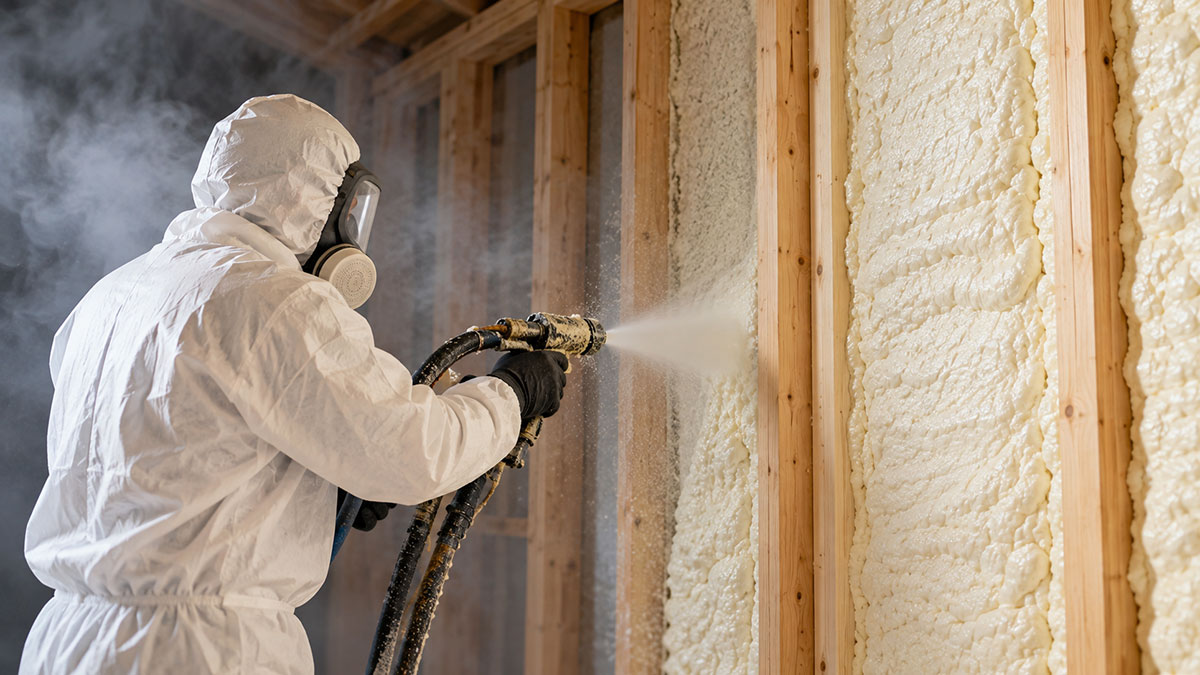
The foam itself is a two-component polyurethane that expands and hardens in place, sealing air leaks and insulating whatever cavity it was sprayed into. Licensed contractors spray it into walls and attics, and into crawl spaces too. The isocyanate and polyol sides react into a solid polymer within hours to days.
Most of the risk traces back to MDI, the reactive chemical behind it. Back in 1998, the EPA’s Integrated Risk Information System set a chronic inhalation reference concentration for MDI of 0.6 micrograms per cubic meter.
The A-Side and B-Side Reaction

The A-side supplies the isocyanate, almost always methylene diphenyl diisocyanate (MDI). It meets the B-side at the spray gun at roughly a 1:1 ratio. The B-side is a polyol resin blend with catalysts, a blowing agent, and flame retardants mixed in, and within seconds the combined liquid expands 30 to 100 times its volume.
That isocyanate share gives the foam its insulating strength and its chemical hazard at once.
BASF and Huntsman make the raw isocyanate and polyol systems that installers mix on site, and brands like Demilec and Icynene sell finished spray foam built on the same two-part chemistry.
Is Spray Foam Insulation Toxic?

Yes, while it’s reacting and curing. After that, it’s essentially inert.
The isocyanates, the blowing agent, and the other chemicals on both sides are hazardous as liquids and as vapors. Isocyanates make up roughly 50% of the formulation by weight (US EPA), so they’re not a trace ingredient.
Once the A-side and B-side fully react, those compounds no longer exist as free chemicals. They’ve become a stable solid polymer. Most of the disagreement about whether spray foam is safe comes from people describing different stages of the same product.
On reentry, the EPA reports safe times of 8 to 24 hours for one-component foam and 23 to 72 hours for two-component systems. It also opened a formal Toxic Substances Control Act review of MDI and related isocyanates in 2011.
Whether the material is genuinely safe once it has fully cured depends on the installation carrying that reaction through to completion. A rushed job, a wrong mix ratio, or a skipped step outlined on the product’s safety data sheet can leave chemicals reacting long after the crew has left.
How Long Does Spray Foam Insulation Take to Cure and Off-Gas?

It comes down to how long the A-side and B-side need to finish reacting into a stable polymer, and that changes with the product.
Off-gassing runs alongside the reaction. Volatile organic compounds and leftover isocyanate vapor release during the same window. The reaction gives off heat, so a thick application can stay warm and keep releasing vapor longer than a thin one.
How soon people can go back in, the reentry time, is set by the manufacturer for each specific product and system.
| Foam Type | System | EPA Safe Reentry Range | VOC Off-Gassing Level |
|---|---|---|---|
| One-component foam sealant | Single canister, moisture-cured | 8 to 24 hours | Highest in the first hours, drops quickly |
| Two-component SPF (open-cell or closed-cell) | A-side and B-side mixed on site | 23 to 72 hours | Elevated through the full window |
| Fully cured foam (either type) | Reaction complete | Not applicable, chemically inert | Effectively none |
ASTM-backed research shows actual emissions vary by foam type and building conditions, so read the ranges above as a floor. They don’t guarantee the air is clear by the end of the window.
Temperature and humidity can move the real off-gassing window in either direction, and so can how thick each pass of foam was sprayed.
Open-Cell vs Closed-Cell Spray Foam: Are They Equally Toxic?

During application, pretty much. Both run on the same isocyanate chemistry, so the hazard is essentially the same. What differs is density and blowing agent, and how the finished material behaves after it has cured.
Open-cell foam is typically water blown, so the carbon dioxide from the reaction itself does the expanding. Closed-cell foam relies on a separate physical blowing agent. Older closed-cell formulations used HFC blowing agents, and newer ones increasingly use HFO chemistry, such as Solstice Advanced Materials’ Solstice line, which was formerly part of Honeywell until it spun off as an independent company in 2025.
Open-cell costs less per board foot and is easier to trim during installation. It’s softer and more flexible, which dampens sound well. The downsides are a lower R-value per inch and higher vapor permeability, so many climates need a separate vapor control layer on top.
Rigidity is where closed-cell wins. It’s stiff enough to add structural strength, and in many assemblies it works as both an air barrier and a vapor barrier. It costs more per board foot, though, and it depends on a blowing agent that open-cell foam generally skips.
On R-value, closed-cell typically reaches R-6 to R-7 per inch. Open-cell sits at R-3.5 to R-3.7.
Closed-cell spray foam is also the denser branch of closed-cell insulation generally, which is part of why it costs more and resists moisture better than its open-cell counterpart.
What Health Symptoms Can Spray Foam Insulation Exposure Cause?
Irritation comes first. Isocyanate exposure hits the eyes, nose, throat, and skin before it does anything else, and it tends to show up during application and in the hours right after, while the foam is still reacting.
Short-Term Irritation vs Long-Term Sensitization
Beyond the irritation, symptoms around installation can include coughing, chest tightness, and shortness of breath. Skin can redden or burn on contact.
Repeated exposure is where it gets more serious. It can lead to sensitization, where the immune system starts reacting to smaller amounts of isocyanate over time. Occupational asthma is a possible result, and that diagnosis can persist even after exposure stops. Once someone is sensitized, unrelated irritants like dust or pollen can also trigger stronger reactions.
NIOSH has identified isocyanates as the leading attributable cause of work-related asthma among the chemicals it tracks.
Who Is Most at Risk From Spray Foam Insulation Exposure?
The occupational numbers have improved a lot. A 2021 systematic review in the International Journal of Environmental Research and Public Health found that occupational asthma tied to isocyanate exposure fell from more than 5% of exposed workers in the early 1990s to 0.9% in 2017 in the United States.
That drop tracks with better respirators and ventilation, plus stricter work practices. The chemistry itself stayed the same.
The same exposure doesn’t hit everyone equally. Anyone with a history of asthma, respiratory allergies, or isocyanate sensitization is at higher risk, and infants and young children are too, since their airways are smaller and more reactive. Consumer guidance typically advises pregnant occupants to vacate during and after application. On-site applicators and helpers get the highest dose of anyone in the process.
Manufacturers recommend medical surveillance before someone with a relevant health history works around isocyanates at all.
What Regulatory Limits and Agencies Oversee Spray Foam Insulation Chemicals?
No single agency owns spray foam safety. Several overlap, each covering a different piece, and between them they set exposure limits and testing standards and decide what paperwork installers and manufacturers have to provide.
Occupational and Environmental Exposure Limits
OSHA enforces a ceiling exposure limit of 0.02 ppm (0.2 mg/m3) for MDI, a level that can’t be exceeded even briefly.
NIOSH issued the original hazard alerts and recommended work practices, which OSHA guidance and manufacturer safety data sheets are built on. The EPA coordinates the federal safety guidance described above and keeps publishing consumer-facing installation checklists.
CPSC works with the other agencies on consumer fact sheets and applies the Federal Hazardous Substances Act’s chronic hazard guidelines to spray polyurethane foam (SPF) products. Beyond the federal rules, industry groups like the American Chemistry Council’s Center for Polyurethanes Industry publish additional technical guidance of their own.
Product Certification and Building Code Standards
Building codes require specific fire and smoke protection for any exposed foam surface. That’s where insulation fire rating testing comes in, and most codes point to ASTM E84 for flame and smoke spread measurements. Codes also call for a thermal or ignition barrier over exposed foam.
The fire requirement exists because spray foam insulation can ignite and burn like most plastics, and the isocyanate chemistry doesn’t change that.
On the paperwork side, an ICC-ES evaluation report confirms compliance with the International Residential Code. GREENGUARD Gold certification, administered by UL, marks products tested for low chemical emissions.
Natural Polymers’ Natural Therm line, for instance, carries GREENGUARD Gold certification specifically for its low post-cure emissions.
What Safety Precautions Reduce Toxicity Risk During Spray Foam Installation?

Most of what matters happens before and during the spraying, not after. Under OSHA’s hierarchy of controls, engineering and administrative controls come first. Respirators and other PPE are the backstop for when those controls can’t bring exposure low enough on their own.
In practice, the order looks like this.
- Read the label and safety data sheet for ingredients, hazards, and the manufacturer’s stated reentry time.
- Set up ventilation with exhaust fans or negative pressure before spraying starts.
- Fit the correct respirator, an air-purifying or powered air-purifying one outdoors and a supplied-air one indoors, and complete an annual fit test.
- Cover all exposed skin with a Saranex-coated suit, chemical-resistant gloves, and goggles.
- Vacate unprotected occupants and helpers for the full reentry window the manufacturer specifies.
- Confirm air quality before anyone goes back in, either by the stated time passing or through an independent test.
OSHA’s Respiratory Protection Standard (29 CFR 1910.134) backs the respirator step specifically. It requires a written program and annual fit testing, and anyone using tight-fitting respiratory protection also needs a medical evaluation.
NIOSH’s own recommended exposure limit for MDI is stricter than OSHA’s enforceable ceiling, set at 0.05 mg/m3 (0.005 ppm) as an 8 to 10 hour average rather than a momentary ceiling.
A NIOSH survey of SPF crews sampled the air on real jobs. Average MDI concentrations came to 10.1 micrograms per cubic meter in the sprayer’s breathing zone, against 2.86 for a helper standing nearby.
A gap like that is why the applicator needs full-face respiratory protection every time, even on jobs where the helper’s exposure looks manageable.
When Does Spray Foam Insulation Become Dangerous or Fail to Cure Properly?
Spray foam stops being low-risk when the reaction doesn’t finish. An incomplete cure leaves free isocyanate and other reactive chemicals in the material indefinitely, well past the stated reentry window.
Common Installation Failures
The reaction can stall for several reasons. The A-side and B-side may be mixed off the correct 1:1 ratio, or too thick a lift gets sprayed in one pass and traps heat, which slows things down. Foam applied outside the manufacturer’s temperature and humidity range runs into the same problem, and so does skipping the ventilation or evacuation period the label calls for.
A worn or clogged nozzle on the spray rig equipment is a common culprit too, since it throws off the spray pattern and the mix ratio together.
Any one of these can leave a home smelling of foam long after the crew has packed up.
Warning Signs of Improperly Cured Foam
A persistent fishy or chemical odor days or weeks after installation is the clearest sign something went wrong. Other signs include headaches or nausea that ease when you’re away from the house, ongoing eye, nose, or throat irritation indoors, and foam that stays tacky or spongy or shrinks away from the framing instead of setting firm.
Florida homeowner Phillip Scearce sued after inspectors found his newly sprayed foam carried an uncharacteristic odor, and he later reached a settlement with American Residential Products.
Once foam has failed to cure correctly, removing it is typically the only fix. Additional ventilation time doesn’t reverse a bad reaction.
How Do You Choose a Safer Spray Foam Insulation Product and Installer?
Most of the uncertainty can be cleared up on paper before the job starts, through the product’s certification documents and the installer’s training record. Neither guarantees a perfect job, but both lower the odds of ending up with the failures described above.
| Document | What It Confirms | Issued By |
|---|---|---|
| Safety data sheet | Chemical hazards, PPE needs, reentry time | Manufacturer |
| GREENGUARD Gold certificate | Total VOC emissions under 220 micrograms per cubic meter | UL |
| ICC-ES evaluation report | Compliance with International Residential Code | ICC-ES |
| SPFA PCP credential | Installer training and tested competency | Spray Polyurethane Foam Alliance |
Standard GREENGUARD certification caps total VOC emissions at 500 micrograms per cubic meter. Gold cuts that to 220, which is the tier worth asking for in a bedroom or nursery.
Accufoam is one manufacturer that carries GREENGUARD Gold certification across its spray foam line, and that’s a detail worth confirming for any product you’re considering.
Ask the installer directly for their SPFA Professional Certification Program credential, since the card is issued per person and not per company.
A written proposal that names the exact product and its reentry time, along with the ventilation plan, gives you something to hold the crew to if the job goes sideways.
If you’re still weighing whether spray foam insulation is worth it after all this, the certification paperwork above is the quickest gut check before you sign a contract.
FAQ on Is Spray Foam Insulation Toxic
What is the difference between spray foam insulation and older urea-formaldehyde foam insulation?
They share an era more than a formula. Urea-formaldehyde foam insulation (UFFI) used formaldehyde resin chemistry rather than isocyanates, and the Consumer Product Safety Commission banned it in 1982 after more than 2,200 consumer complaints. A federal appeals court vacated that ban in 1983 for insufficient evidence, and it was never reinstated. Spray foam insulation runs on unrelated polyurethane chemistry.
Can you still smell spray foam insulation after it has fully cured?
Not if it cured properly. Properly cured spray foam carries no odor at all, since the reaction has finished and the material is chemically stable. A smell that lingers past the manufacturer’s reentry window points to a curing problem and isn’t a normal feature of a finished job.
Does burning spray foam insulation release toxic smoke?
According to EPA guidance, a fire involving cured spray foam insulation releases isocyanates, hydrogen cyanide, and other toxic gases. Fire departments require supplied-air respirators when fighting polyurethane fires. That risk is separate from installation-phase exposure and comes with most foam plastics.
How does spray foam insulation toxicity compare to fiberglass or cellulose insulation?
Fiberglass irritates skin and lungs mechanically, through glass fibers, rather than through a chemical reaction, and it carries no isocyanate hazard. Cellulose uses borate fire retardants and is low-toxicity once installed. That leaves spray foam as the only common option with a chemical curing hazard during installation.
How much does it cost to remove or fix improperly installed spray foam insulation?

Removal runs roughly $3 to $12 per square foot, well above installation cost, since cured foam bonds permanently and must be cut or ground away mechanically. A 1,000-square-foot attic removal totals $3,000 to $12,000, plus the cost of reinstalling replacement insulation.
What Should You Verify First in Is Spray Foam Insulation Toxic?
The first thing to confirm is the exposure margin, meaning the gap between the manufacturer’s reentry time and the point where indoor air actually clears. Check that before any certification or brand claim.
OSHA’s enforceable ceiling for MDI is 0.2 mg/m3. NIOSH’s recommended exposure limit is four times lower, at 0.05 mg/m3, so air that passes the legal limit can still fail the stricter benchmark.
- The reentry time, in writing and not as a verbal estimate
- Indoor air after that window, tested rather than judged by smell
Symptoms that linger deserve a look against the sensitization pattern before you blame something new.
Picking a certified product narrows the field but does nothing about the installer’s own error rate, and it’s worth raising that before anyone signs a contract.
If a lower-chemical alternative is next on your list, spray foam or cellulose insulation compares the two side by side.