Yes, once the two-part reaction actually finishes. That qualifier carries the whole answer. Foam that feels dry to the touch is not foam that has reached full completion, and the gap between those two states is where most complaints start.
The material is a two-component polyurethane that expands and reacts in place, sealing wall, attic, and crawl space cavities into one continuous air barrier. Contractors spray it straight onto framing. What happens afterward gets judged against occupational exposure limits and VOC emissions testing, so there is no single pass-fail stamp to look for.
EPA’s Safer Choice program (2016) states that off-gassing potential from spray foam after full cure is not fully understood, an area the agency lists as needing further research. Sit with that for a second. The program that certifies safer chemistry is openly saying the long-tail data is thin.
Spray Foam Insulation and the Curing Process
Two liquids leave the gun tip and meet for the first time as they hit the framing. An isocyanate on the A side, most often MDI in current formulations, a polyol resin on the B side, and a blowing agent driving the expansion. The reaction is fast and it gives off heat.
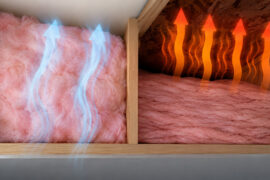
That chemistry is also why spray foam gets specified as much for its air sealing effect as for raw R-value.
- The isocyanate reacts with the polyol resin and drives the exothermic cure.
- Polyol resin supplies the polymer backbone once that reaction finishes.
- The blowing agent creates the cell structure that gives cured foam its R-value.
- Catalysts and surfactants sit in the background controlling reaction speed and cell uniformity.
Manufacturers such as Demilec and Icynene document these stages on their technical data sheets, which matters because spray foam insulation performance hangs on hitting the right ratio and temperature during application.
Cured is the word everything below measures against. It is a different state from foam that is merely tack-free, or firm enough to trim.
How Long Does Spray Foam Insulation Take To Cure?
Minutes for the surface. Hours to days for the core.
Tack-free arrives within 30 seconds to a few minutes on most formulations. Full cure, the point where off-gassing drops sharply and R-value stabilizes, runs roughly 8 to 24 hours for open-cell foam and 24 to 72 hours for closed-cell, with thicker applications sitting at the long end of that range.
The re-entry number people usually quote is 24 hours without PPE, per Spray Polyurethane Foam Alliance guidance cited by the EPA.
Temperature and humidity move all of those figures more than first-time buyers expect. Ambient and substrate temperature ideally lands between 65 and 85 degrees Fahrenheit. Relative humidity at the jobsite pushes the cure one direction or the other, and so does lift thickness per pass along with the overall density of the foam being sprayed.
Closed-cell insulation cures slower because its higher density traps more heat from the reaction. Thick closed-cell lifts get sprayed in stages for exactly that reason, not out of caution for its own sake.
What Chemicals Does Spray Foam Release, and How Long Does Off-Gassing Last

Isocyanates, amine catalysts, and blowing agent residue all come off the foam in the first hours and days after application. Levels then fall to trace once the reaction completes.
That decay curve is really the exposure question homeowners are asking when they wonder whether spray foam insulation is toxic. Not “does it contain chemicals” but “for how long, and how much.”
Chemicals Present In Curing and Cured Foam
MDI has largely replaced the older TDI formulation in residential products. It reacts with the polyol resin to form the solid polymer matrix, and once that bond is made, the isocyanate is no longer free to be inhaled.
- MDI, or methylene diphenyl diisocyanate, is the primary isocyanate in most residential spray foam today.
- Amine catalysts speed the reaction along and carry their own distinct odor.
- Blowing agents are increasingly HFO-based now, replacing older high-GWP formulas.
- Flame retardants get blended in so the foam meets fire testing requirements.
OSHA sets the permissible exposure limit for MDI at 0.02 parts per million as a ceiling limit, a threshold built for occupational settings, not finished homes (OSHA). Applying a factory number to a bedroom is a category error, though it does tell you which direction the caution runs.
BASF and Huntsman are among the larger suppliers of the raw MDI and polyol resin that go into residential formulations.
Off-Gassing Timeline After Full Cure
California’s CDPH testing protocol notes that VOC emissions from insulation products, spray foam included, diminish substantially after 10 days of chamber conditioning (California Department of Public Health, 2017).
That lab timeline tracks what happens in an actual house.
Concentration peaks in the first 24 to 72 hours, which is when ventilation earns its keep. Over the next one to two weeks it drops off fast as the cure finishes throughout the material. From there out, weeks to months, you are looking at trace-level background comparable to other synthetic building products.
A strong odor still hanging around past that window is not a late stage of normal curing. It is a signal that something went wrong during application.
What Health Symptoms Are Linked to Spray Foam Exposure
Documented reactions include respiratory irritation, headache, eye and throat irritation, and asthma-like symptoms. Isocyanate sensitization is the serious long-term concern behind all of them.
EPA data shows inhalation exposures during spray foam application typically exceed OSHA occupational limits when ventilation and protective equipment fall short (EPA). Which is the whole reason installers face more exposure than occupants ever do.
- Respiratory irritation and coughing
- Headache, eye irritation, or throat irritation
- Chemical bronchitis in acute cases
- Asthma-like breathing difficulty
- Skin reddening or rash from direct contact
Sensitization symptoms can surface hours after exposure rather than during it. That delay makes cause and effect genuinely hard for a homeowner to trace on their own.
Who Faces the Highest Exposure Risk
Risk breaks down unevenly across the people involved.
- Installation crews carry the highest exposure by a wide margin, which is why respirators and suits are non-negotiable during the spray.
- For occupants of a newly cured space, risk drops sharply once the manufacturer’s stated re-entry window passes.
- Already sensitized individuals have no recognized safe exposure level, per NIOSH.
- Infants, pregnant occupants, and people with asthma are generally advised to wait past the bare minimum re-entry window.
A properly cured job does not keep producing symptoms indefinitely. The first days carry the real risk, and that is what should decide who walks back in and when.
Is Cured Spray Foam Insulation Safe Years After Installation

Properly cured spray foam is considered chemically stable and relatively inert years after installation, per EPA guidance on spray polyurethane foam.
All of which assumes the original job went right.
Heat, moisture intrusion, or physical damage can reopen the off-gassing question long after the cure window closed. Roof or plumbing leaks that saturate the foam over time are the common one. Renovation work that grinds, cuts, or heats the material counts too, as does rodent damage that exposes fresh interior surfaces, or a fire or extreme heat event near the insulated cavity.
One thing cured foam has over fiberglass batts and loose-fill products is that it does not experience insulation settlement. R-value and coverage stay put for decades instead of thinning out at the top of the cavity.
Age alone is not the risk. A disturbed installation is.
Is Spray Foam Insulation a Fire Risk, and Does It Meet Code Without Extra Material
Cured spray foam is a combustible plastic, and most building codes will not let it sit exposed in occupied space. The covering requirement holds regardless of how cleanly the foam cured.
The International Residential Code requires a 15-minute thermal barrier, commonly half-inch gypsum drywall, that keeps the foam’s surface temperature below 250 degrees Fahrenheit for 15 minutes of fire exposure (International Code Council).
Attics and crawl spaces get a lighter requirement. An ignition barrier, quarter-inch OSB or a listed coating, covers it there, on the reasoning that nobody is regularly occupying those spaces.
| Barrier Type | Where Required | Typical Material | Fire Test Basis |
|---|---|---|---|
| Thermal barrier | Occupied living space | 1/2 inch gypsum drywall | 15-minute rating, ASTM E119 |
| Ignition barrier | Attics, crawl spaces | 1/4 inch OSB or coating | Small-flame ignition test |
The deeper question homeowners tend to ask, whether spray foam insulation is flammable in the first place, does not resolve to a flat yes or no, since flame spread results vary by formulation and coating.
Manufacturers publish an insulation fire rating for each product line based on ASTM E84 flame spread and smoke development results. Code officials check that rating against the whole assembly, never the raw foam on its own.
What Emissions and Safety Standards Must Cured Spray Foam Pass
Named test standards do the work here, not general reassurance. ASTM E84 for flame spread and CDPH Standard Method V1.2 for VOC emissions are the two that come up most.
- ASTM E84 requires a flame spread index of 25 or less for a Class 1 rating.
- CDPH Standard Method V1.2 (2017) measures VOC emissions after 10-day chamber conditioning.
- GREENGUARD Gold (UL 2818/2821) caps total VOC concentration at 0.22 mg/m3 for certification.
- UL 723 covers surface burning characteristics and gets referenced in most residential code approvals.
Passing any of these confirms the product formulation. It says nothing about the specific job in your specific attic.
A correctly cured install from a trained crew and a badly mixed one from an untrained crew can carry identical manufacturer paperwork while performing nothing alike once they are in the wall.
Products that clear CDPH testing usually carry that data into green building programs as well, since LEED certification for insulation and similar rating systems reference the same CDPH emissions data instead of running their own tests.
Closed-Cell vs Open-Cell Spray Foam: Which Is Safer After Curing
Both types cure into chemically similar materials with physically different results, and neither one is inherently unsafe once it hits full cure on a correctly installed job.
Closed-cell foam density runs close to 2.0 pounds per cubic foot with an R-value near 6.0 to 7.0 per inch, while open-cell foam settles around 0.5 pounds per cubic foot with an R-value near 3.5 per inch, figures consistent across major manufacturers’ technical data sheets.
| Property | Closed-Cell Foam | Open-Cell Foam |
|---|---|---|
| Typical density | near 2.0 lb/ft3 | near 0.5 lb/ft3 |
| R-value per inch | 6.0 to 7.0 | about 3.5 |
| Moisture permeability | low, near vapor impermeable | higher, more vapor open |
| Typical placement | exterior walls, roofs, damp assemblies | interior walls, sound-damping cavities |
Closed-cell buys you more R-value per inch plus real structural rigidity once it hardens, and it is close to impermeable to water, which is why it shows up in flood-prone and damp assemblies. The density costs you on both cure time and material price.
Open-cell trades differently:
- Cures faster and expands more easily into irregular framing cavities
- Dampens sound better between interior walls
- Lower R-value per inch
- More vapor open, so some climates need a separate moisture strategy layered in
During the cure window itself, neither type carries more isocyanate exposure risk than the other. Same MDI-based chemistry underneath.
The safety variable that actually moves is density and lift thickness control at the point of spray, not which cell structure the crew happened to pick.
When Is It Safe To Re-Enter a House After Spray Foam Installation
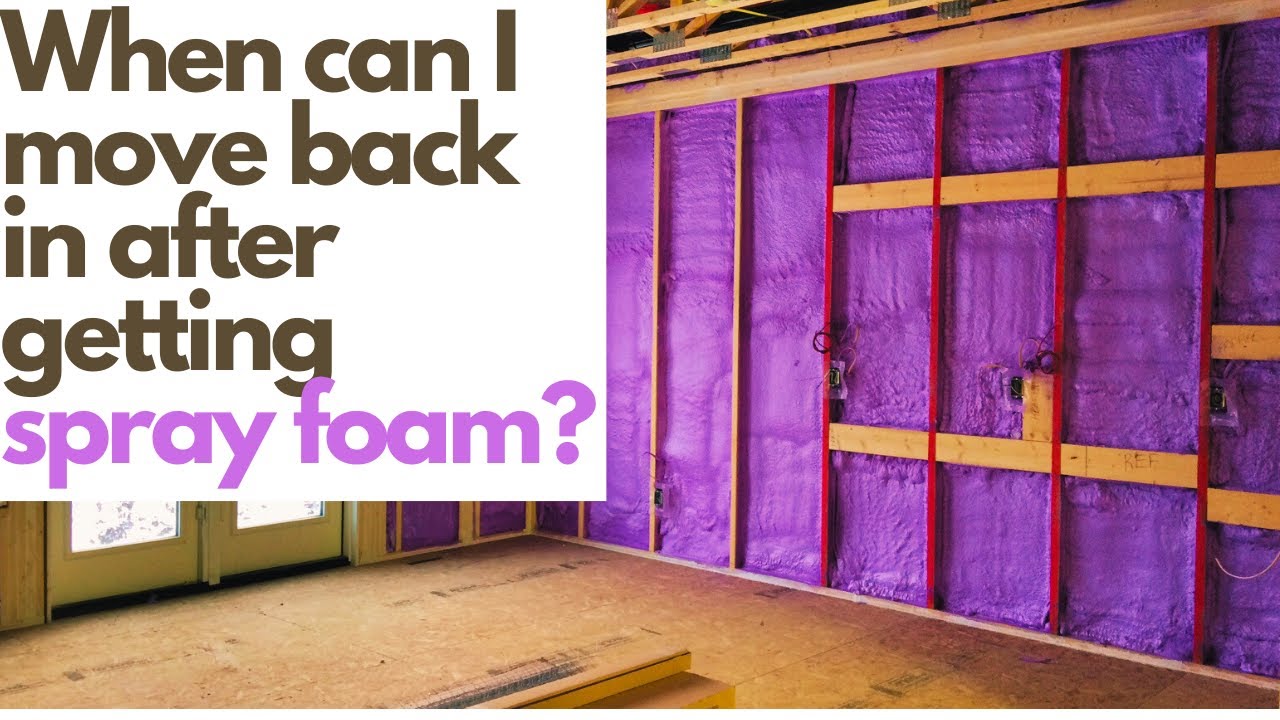
Timing follows the manufacturer’s stated window for the specific product sprayed. There is no universal number that covers every job.
Standard re-entry protocols call for sustained ventilation at roughly 40 air changes per hour to shorten the wait (Insulation Institute), though field-verifying that rate on a retrofit is genuinely difficult and most crews are estimating.
Gaco’s OnePass formulations carry a documented one-hour re-entry time for trade workers at 10 air changes per hour, verified through third-party testing by Wood Industrial Health Associates.
- Confirm the product-specific re-entry window with the installer before the crew leaves the site
- Keep mechanical exhaust running and hold negative pressure in the work zone through that stated window
- Switch to passive ventilation, windows open on each level, once mechanical exhaust stops
- Check for lingering odor at the stated re-entry time before bringing in sensitive occupants
- Push re-entry later for infants, pregnant occupants, or anyone with asthma if any odor remains
No product ventilates itself. Someone has to run the exhaust and physically walk the space before the job counts as finished.
Does a Certified Installer Affect How Safe Cured Spray Foam Is
Installer skill changes the chemical outcome of the cure. Not just how tidy the finished job looks.
The Spray Polyurethane Foam Alliance requires 100,000 board feet of documented spraying experience for its Insulation Installer certification and 500,000 board feet for Master Installer, tested against ISO 17024 assessment standards (Spray Polyurethane Foam Alliance).
Those thresholds exist because ratio control, lift thickness, and substrate temperature checks are manual judgment calls made in real time. They are not settings you dial into a machine and walk away from.
What a Certified Installer Controls During Application
The variables that decide how the foam cures sit with the person holding the gun, not with the product.
- Mix ratio gets confirmed at the gun tip, not just at the drum, where it can read correctly while the delivered foam is off.
- Lift thickness caps each pass so the exothermic heat does not build up and stall the full cure.
- Substrate temperature means checking framing and ambient conditions before any spraying starts.
- Equipment calibration keeps proportioning pumps tuned so off-ratio foam never leaves the hose.
Certified crews also maintain the spray rig equipment, and a worn transfer pump is one of the more common causes of off-ratio foam on a job that otherwise looked fine.
Certification from the Spray Polyurethane Foam Alliance or the Air Barrier Association of America does not guarantee a flawless spray. It does mean someone is accountable to a documented standard when things go sideways.
When Does Spray Foam Insulation Fail To Cure Safely
Bad cures trace back to a handful of causes. Components mixed off the correct ratio, jobsite temperature outside the manufacturer’s range, or components that were stored badly before anyone picked up a gun.
SPF systems are engineered for a 1:1 mix ratio by volume, and even a small deviation is enough for the cured foam to start showing off-ratio symptoms. Proportioning equipment includes ratio-monitoring alarms that shut the system down on drift for that reason.
- Off-ratio mixing from a failed transfer pump or a miscalibrated proportioner
- Component storage outside the 60 to 80 degree Fahrenheit range the manufacturer specifies
- Spraying in ambient or substrate temperatures below the product’s stated minimum
- Lifts sprayed too thick in a single pass, trapping heat and unreacted chemical at the core
- Expired or contaminated A-side or B-side components
At a glance, off-ratio foam looks close enough to the real thing. It stays soft, crumbly, or gummy depending on which side ran rich, and it keeps releasing odor well past the normal window.
A strong smell three weeks in is not patience running out. The material is telling you the reaction never finished.
What To Do If Spray Foam Still Smells or Causes Symptoms After Curing

Odor past the manufacturer’s stated cure window needs diagnosis. Waiting longer is not a plan.
- Contact the original installer or manufacturer first, since warranty and liability usually run through them
- Ask for or arrange independent air testing rather than judging the problem by smell alone
- Document any symptoms and their timing if an occupant is reacting physically
- Keep the affected space closed off and ventilated while the diagnosis is pending
EPA guidance on unresolved SPF complaints recommends working with the contractor first, then escalating to an independent indoor air quality consultant if the odor or symptoms do not resolve.
When Removal Is the Only Remaining Option
Off-ratio foam does not fix itself, and coating over it stops neither the odor nor the lost R-value. The unreacted chemistry sits inside the material, not on the surface where a sealer could reach it.
Where off-ratio foam is confirmed, mechanical removal and respray is the standard fix rather than any surface treatment. When installer error is confirmed, most manufacturer warranties cover removal cost provided the original crew was certified. And if no clear cause turns up, independent lab testing comes before anyone commits to tearing foam out.
The physical process, covered in a separate guide on how to remove spray foam insulation, involves cutting the material away from framing in sections rather than scraping it in place.
Removal is rare. Most cured jobs never need it. It is still the correct answer when the chemistry never finished reacting.
FAQ on Is Spray Foam Insulation Safe After It Cures
Can spray foam insulation cause cancer?
The isocyanate in most current spray foam, MDI, holds an IARC rating of not classifiable for human carcinogenicity.
TDI, an older formulation, carries a Group 2B possible-carcinogen rating. Neither classification applies once foam reaches full cure.
How much does spray foam insulation cost compared to other insulation types?
Budget roughly $1.80 to $4.50 per square foot installed, against $0.30 to $1.50 for fiberglass batts (HomeAdvisor, 2025).
Closed-cell costs more than open-cell, driven by higher density and R-value per inch.
Does spray foam insulation affect home insurance or resale value?
Insurers generally treat correctly cured, code-compliant spray foam the same as other insulation types.
Improperly cured or undocumented installations are where claims and resale inspections get complicated, since appraisers flag missing thermal barrier documentation or lingering odor complaints.
Can you install spray foam insulation yourself with a DIY kit?
For small gaps, one-component canned foam sealants sold in 12 to 24 ounce cans cure in about 8 to 24 hours and do the job fine (EPA).
Two-component professional-grade systems require certified equipment, and most manufacturers restrict full-cavity kits to licensed installers.
Does spray foam insulation cause mold if installed incorrectly?
Cured polyurethane carries no organic nutrient value, so the foam itself does not feed mold.
The risk comes from moisture trapped behind foam that lacks proper flashing or venting, not from the cured material breaking down.
What Should You Fix First in Is Spray Foam Insulation Safe After It Cures?
Start with cure completion. Everything else depends on it, including the thermal barrier check and the installer documentation that most homeowners jump to first.
- Cure completion, verified against the stated window
- Thermal barrier integrity, checked for gaps
- Installer documentation, matched to certification tier
The order matters because a 15-minute thermal barrier rating only holds when the foam beneath it was sprayed within thickness limits, and that judgment sits with the higher SPFA installer certification tier.
Putting cure completion ahead of schedule means waiting longer before drywall closes the cavity. You trade a few days of project speed for air quality margin, which is a trade most people regret only in the direction of not having made it.
Anyone weighing a cavity fill right now tends to compare spray foam against cellulose insulation, since the two sit at opposite ends of the moisture-permeability spectrum.