Summarize this article with:
Your walls might be costing you hundreds of dollars every year. The U.S. Department of Energy reports that heating and cooling account for 50-70% of energy use in average American homes.
Choosing the right types of insulation materials directly affects those numbers.
Fiberglass, spray foam, cellulose, mineral wool, rigid foam board, radiant barriers, natural fibers. Each performs differently depending on where you install it and what problems you’re solving.
This guide breaks down every major insulation type by R-value, cost, best applications, and real pros and cons. You’ll learn which materials work for attics versus basements, what building codes require, and how to maximize the benefits of proper insulation for your specific situation.
What is Insulation Material
Insulation material is any substance that slows heat transfer between indoor and outdoor environments.
It creates a thermal barrier within walls, attics, floors, and ceilings.
The U.S. Department of Energy estimates that proper home insulation reduces heating and cooling costs by 15% on average.
Different climate zones require different insulation approaches. A house in Minnesota needs more thermal resistance than one in Florida.
Most building codes reference the International Energy Conservation Code (IECC) for minimum requirements.
How Does Insulation Material Work
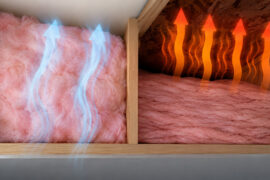
Insulation traps tiny pockets of air or gas within its structure, and since still air conducts heat poorly, this creates resistance to temperature change.
Heat naturally moves from warm spaces to cold ones through conduction, convection, and radiation. Understanding how insulation works helps you pick the right product for your situation.
What are the Main Properties of Insulation Materials
Every insulation product shares certain measurable characteristics:
- R-value – thermal resistance per inch of thickness
- Fire rating – ASTM E84 Class A, B, or C designation
- Moisture resistance – ability to repel water vapor
- Density – pounds per cubic foot
- Installation method – blown, sprayed, rolled, or fitted
ASTM International sets testing standards for all these properties. The cost per square foot varies wildly between material types.
What are the Different Types of Insulation Materials
Seven main categories dominate the residential and commercial insulation market.
Each has specific strengths. Fiberglass costs less but spray foam seals better. Cellulose uses recycled content while mineral wool resists fire.
Your choice depends on location, budget, and performance goals. Attic applications differ from wall cavities and basement situations.
What is Fiberglass Insulation
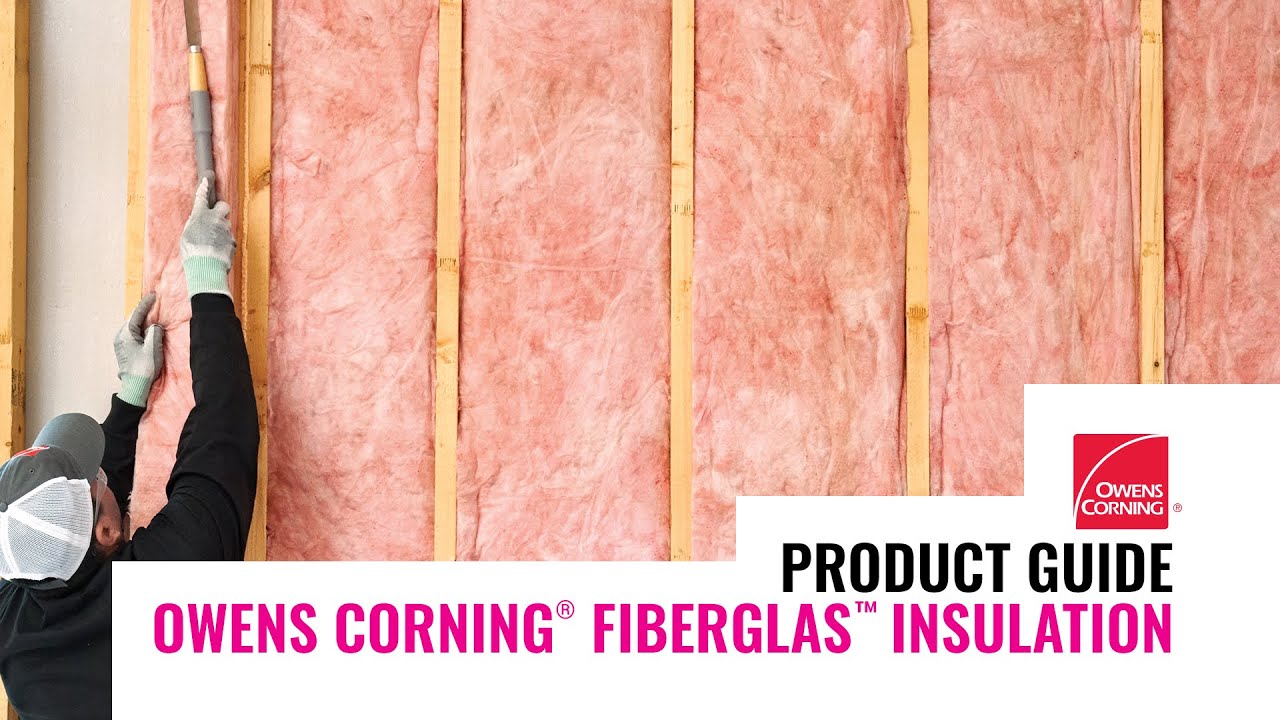
Fiberglass insulation consists of extremely fine glass fibers spun into a wool-like texture. Owens Corning and Johns Manville manufacture most of the fiberglass sold in North America.
It comes in batts, rolls, and loose-fill forms. About 90% of American homes contain fiberglass somewhere in their structure.
What is the R-Value of Fiberglass Insulation
Standard fiberglass batts deliver R-2.9 to R-3.8 per inch depending on density.
High-density versions reach R-4.3 per inch. A 6-inch batt typically provides R-19 total.
Where is Fiberglass Insulation Used
Attics, exterior walls, floors over crawl spaces, and basement ceilings. Works best in standard stud cavities with minimal obstructions.
Poor choice for irregular spaces or areas with lots of wiring and plumbing.
How is Fiberglass Insulation Installed
Batt insulation gets friction-fitted between studs or joists. No adhesive needed.
Loose-fill versions require a blowing machine for attic applications.
What are the Advantages and Disadvantages of Fiberglass Insulation
Pros: Lowest material cost, widely available, non-combustible, DIY-friendly for batts.
Cons: Loses effectiveness when compressed or wet, requires protective gear during installation, air still moves through it freely.
What is Spray Foam Insulation
Spray foam insulation is a two-component polyurethane mixture that expands on contact.
BASF Corporation and Huntsman Corporation produce the chemical systems. Professional installation requires specialized spray rig equipment.
What is the Difference Between Open-Cell and Closed-Cell Spray Foam
Open-cell foam has interconnected air pockets. Softer, cheaper, R-3.7 per inch. Absorbs water.
Closed-cell foam traps gas in sealed bubbles. Rigid, expensive, R-6.5 per inch. Acts as its own vapor barrier.
What is the R-Value of Spray Foam Insulation
Open-cell: R-3.5 to R-3.7 per inch. Closed-cell: R-6.0 to R-7.0 per inch.
Closed-cell delivers the highest R-value per inch of any common insulation type.
Where is Spray Foam Insulation Used
Rim joists, cathedral ceilings, irregular cavities, and anywhere air sealing matters most.
Popular for retrofit projects where access is limited.
What are the Advantages and Disadvantages of Spray Foam Insulation
Pros: Superior air barrier, high R-value, fills gaps completely, adds structural rigidity with closed-cell.
Cons: Highest cost, requires professional installation, off-gassing during cure, difficult to remove if problems occur.
What is Cellulose Insulation
Cellulose insulation is made from recycled newspaper treated with borate fire retardants.
Contains 82-85% post-consumer recycled content. Greenfiber and Nu-Wool are major manufacturers.
What is Cellulose Insulation Made Of
Ground-up newspaper and cardboard form the base material. Boric acid and ammonium sulfate provide fire and pest resistance.
The most environmentally friendly option among mainstream insulation products.
What is the R-Value of Cellulose Insulation
Loose-fill cellulose delivers R-3.2 to R-3.8 per inch. Dense-pack cellulose reaches R-3.5 to R-4.0.
Comparable to fiberglass but with better air-blocking characteristics.
Where is Cellulose Insulation Used
Attic floors via loose-fill, enclosed wall cavities via drill-and-fill installation.
When comparing spray foam or cellulose insulation, budget often decides.
What are the Advantages and Disadvantages of Cellulose Insulation
Pros: Eco-friendly, cost-effective, good sound dampening, fills irregular spaces well, treated for fire and pests.
Cons: Absorbs moisture, can settle over time causing insulation settlement, requires blowing equipment for installation.
What is Mineral Wool Insulation

Rock wool insulation is made from molten basite rock or iron ore slag spun into fibers.
Rockwool International and Knauf Insulation dominate this market segment.
What is the Difference Between Rock Wool and Slag Wool
Rock wool comes from natural basalt; slag wool uses steel manufacturing byproducts.
Performance is nearly identical. Slag wool costs slightly less.
What is the R-Value of Mineral Wool Insulation
R-3.0 to R-3.3 per inch for standard batts. Slightly lower than fiberglass but denser.
Where is Mineral Wool Insulation Used
Fire-rated assemblies, soundproof insulation applications, external wall systems, and high-temperature areas near chimneys.
What are the Advantages and Disadvantages of Mineral Wool Insulation
Pros: Fire resistant to 2000°F, excellent sound dampening, water-repellent, dimensionally stable.
Cons: Heavier than fiberglass, higher cost, fewer retailers stock it, still requires protective gear.
What is Rigid Foam Board Insulation
Rigid foam board insulation consists of stiff panels made from polystyrene or polyisocyanurate.
Dow Chemical Company and GAF Materials are major producers.
What are the Types of Rigid Foam Board
Three main categories exist:
- EPS (Expanded Polystyrene) – R-3.6 to R-4.2 per inch, lowest cost
- XPS (Extruded Polystyrene) – R-5.0 per inch, moisture resistant, blue or pink colored
- Polyiso (Polyisocyanurate) – R-5.7 to R-6.5 per inch, foil-faced, best for roofing
What is the R-Value of Rigid Foam Board Insulation
EPS: R-3.6 to R-4.2. XPS: R-5.0. Polyiso: R-5.7 to R-6.5.
Polyiso performance drops in cold temperatures below 50°F.
Where is Rigid Foam Board Insulation Used
Foundation walls, basement wall applications, roof decks, sheathing, and continuous insulation over studs to reduce thermal bridging.
What are the Advantages and Disadvantages of Rigid Foam Board Insulation
Pros: High R-value per inch, structural support, moisture resistance with XPS, easy to cut and install.
Cons: Must be covered with fire barrier, seams need taping, vulnerable to UV damage, termites can tunnel through EPS.
What is Reflective or Radiant Barrier Insulation
Reflective insulation uses aluminum foil surfaces to reflect radiant heat rather than absorb it.
How Does Radiant Barrier Work
Shiny surfaces reflect up to 97% of radiant energy. Requires an air gap of at least 3/4 inch to function.
Does nothing against conduction or convection. Understanding thermal conductivity clarifies this limitation.
Where is Radiant Barrier Insulation Used
Attic rafters in hot climates, underfloor applications, and ductwork in unconditioned spaces.
Most effective in southern states where cooling costs exceed heating costs.
What are the Advantages and Disadvantages of Radiant Barrier Insulation
Pros: Reduces attic temperatures 20-30°F, lightweight, never loses effectiveness, no R-value degradation.
Cons: Works only against radiant heat, dust accumulation kills performance, useless in cold climates, needs air gap.
What is Natural Fiber Insulation
Natural fiber options include cotton, wool, hemp, and other plant or animal-based materials. Growing segment for eco-conscious builders.
What Types of Natural Fiber Insulation Exist
- Cotton – recycled denim, treated with borate
- Sheep’s wool insulation – naturally fire resistant, absorbs and releases moisture
- Hemp – fast-growing, carbon-negative crop
- Cork – harvested from bark, fully renewable
What is the R-Value of Natural Fiber Insulation
Cotton: R-3.4 per inch. Wool: R-3.5 to R-3.8. Hemp: R-3.5. Cork: R-3.6.
What are the Advantages and Disadvantages of Natural Fiber Insulation
Pros: Sustainable, low embodied energy, safe to handle, moisture regulating, biodegradable.
Cons: Premium pricing (2-3x fiberglass), limited availability, some need pest treatment, fewer contractors install them.
How to Compare Insulation Materials
Direct comparison requires consistent metrics across all products. The Building Science Corporation recommends evaluating thermal performance, moisture behavior, air permeability, cost, and longevity together.
What is the Best Insulation Material by R-Value
Aerogel insulation leads at R-10 per inch but costs $2-4 per square foot.
Closed-cell spray foam offers R-6.5 per inch at more practical pricing. Polyiso rigid board delivers R-6+ per inch for sheathing.
What is the Most Cost-Effective Insulation Material
Fiberglass batts cost $0.30-0.50 per square foot for materials. Blown cellulose runs $0.60-1.00 installed.
Calculate ROI on insulation based on local energy rates and climate zone requirements.
What is the Best Insulation Material for Soundproofing
Mineral wool outperforms fiberglass for sound transmission class (STC) ratings.
Dense-pack cellulose also blocks sound well. Spray foam helps when combined with decoupled wall assemblies.
What is the Most Fire-Resistant Insulation Material
Mineral wool withstands 2000°F without melting. It’s the only fibrous insulation rated non-combustible.
Concerned about safety? Read whether home insulation is flammable.
What is the Most Eco-Friendly Insulation Material
Cellulose contains 85% recycled content. Sheep’s wool is fully renewable and biodegradable.
LEED certification credits favor recycled and low-VOC materials.
How to Choose the Right Insulation Material
Location determines material choice more than any other factor. Start with a home energy audit to identify priorities.
What Insulation Material is Best for Attics

Blown fiberglass or cellulose for attic floors. R-38 to R-60 depending on climate zone.
Spray foam for cathedral ceilings where venting is impractical.
What Insulation Material is Best for Walls
Cavity wall insulation typically uses fiberglass batts or blown cellulose.
Continuous exterior insulation with rigid foam eliminates thermal bridging through studs.
What Insulation Material is Best for Basements
Closed-cell spray foam or XPS rigid board handle moisture best below grade.
Never use fiberglass directly against concrete. It absorbs water and grows mold.
What Insulation Material is Best for Crawl Spaces
Encapsulated crawl spaces work best with spray foam on walls. Vented crawl spaces need blanket insulation between floor joists.
Consider vapor barrier insulation to control ground moisture.
What are the Building Codes and Standards for Insulation Materials
Oak Ridge National Laboratory provides research data that shapes building codes nationwide.
Code Requirements by Climate Zone
The International Energy Conservation Code divides the U.S. into eight climate zones. Zone 1 (hot) requires R-13 walls; Zone 7-8 (cold) requires R-20+5 continuous.
ENERGY STAR certification exceeds code minimums. Passive house standards demand even higher performance.
Testing and Certification Standards
- ASTM C518 – measures thermal conductivity
- ASTM E84 – surface burning characteristics
- UL 723 – fire test standards
- Title 24 – California’s energy efficiency requirements
Verification Methods
A blower door test measures overall air leakage after installation.
Thermal imaging cameras reveal gaps, voids, and missing insulation behind finished walls.
RESNET-certified raters verify compliance for ENERGY STAR insulation programs.
Financial Incentives
Federal insulation tax credits cover 30% of material and labor costs through 2032.
State and utility weatherization rebates stack on top. The payback period often drops below 5 years with incentives.
Low-income households may qualify for free insulation programs through the Weatherization Assistance Program.
FAQ on Types Of Insulation Materials
What is the most effective type of insulation?
Closed-cell spray foam delivers the highest R-value per inch at R-6.5 among common materials. It also creates an air barrier and vapor barrier simultaneously. Best for areas where space is limited and maximum thermal resistance matters.
Which insulation material is cheapest?
Fiberglass batts cost $0.30-0.50 per square foot for materials alone. Blown cellulose runs slightly higher but installs faster in attics. Factor in labor costs, as DIY-friendly fiberglass batts often beat professionally installed options on total price.
What insulation is best for old houses?
Dense-pack cellulose works well for improving insulation in older homes without removing walls. Contractors drill small holes, blow in material, then patch. Spray foam handles irregular cavities and provides air sealing simultaneously.
Is spray foam insulation worth the cost?
Spray foam costs 2-3 times more than fiberglass but eliminates air leakage. The energy savings often justify the premium in leaky older homes or extreme climates. Calculate your local energy rates before deciding.
What is the difference between R-value and U-value?
R-value measures thermal resistance; higher numbers mean better insulation. U-value measures heat transfer rate; lower numbers indicate better performance. Building codes typically specify R-value for insulation and U-value for windows and assemblies.
Can you mix different types of insulation?
Yes. Many homes combine rigid foam on exterior walls with fiberglass batts in cavities. Layering cellulose over existing fiberglass in attics is common. Avoid trapping moisture between layers with incompatible vapor permeability ratings.
How long does insulation last?
Fiberglass and mineral wool last 80-100 years if kept dry. Spray foam maintains performance for 80+ years. Cellulose may settle 15-20% over decades, reducing effectiveness. Insulation compression from storage or foot traffic shortens lifespan.
What insulation is best for soundproofing?
Mineral wool outperforms other materials for sound dampening with higher density and fiber structure. Dense-pack cellulose also reduces noise transmission effectively. Standard fiberglass provides minimal acoustic benefits compared to these alternatives.
Is insulation removal necessary before adding new material?
Not always. New insulation can often layer over existing material in attics. Damaged, wet, or pest-contaminated insulation requires professional vacuum removal first. Vermiculite insulation from before 1990 may contain asbestos and needs testing.
What insulation works best in humid climates?
Closed-cell spray foam and XPS rigid board resist moisture absorption. Open-cell foam and fiberglass can trap humidity and grow mold in wet conditions. Proper vapor barrier placement matters more than material choice in humid regions.
Conclusion
The right types of insulation materials depend on your climate zone, budget, and specific application. There’s no single best choice for every situation.
Fiberglass remains the most affordable option. Spray foam delivers superior air sealing. Mineral wool handles fire and sound better than alternatives. Cellulose offers the greenest profile.
Check your local IECC requirements before purchasing. ENERGY STAR guidelines often exceed minimum code for better long-term energy savings.
Consider scheduling a professional assessment to identify where your home loses the most heat. The utility bill reduction from proper insulation typically pays back the investment within 3-7 years.
Start with the biggest problem areas first. Attics and basements usually offer the highest return.