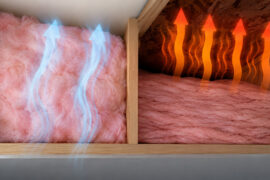
Heat leaves a building at a rate you can put a number on. That number is the U-value, and it covers a whole element rather than any one material inside it: watts lost per square metre, per degree of temperature difference across the build-up, with every layer and both surface films already accounted for.
Building control checks the figure against the ceiling set for new work, energy assessors feed the same number into SAP, and manufacturers print it on the data sheet because both of those audiences ask for it. One thing to know before you start calculating anything: ISO 6946:2017 excludes windows, doors and ground floors from its scope. Each of those gets worked out under its own method.
What Is U-Value?

Think of it as a leak rate. Watts of heat escaping through a square metre of the element, for every degree Kelvin of difference between inside and outside.
The unit gets written W/m2K. Every wall, roof, floor, door and window in a building has one.
Lower is better. A U-value of 0.15 loses a fraction of what a U-value of 2.0 loses, and that gap is the entire reason insulation exists.
It is not the same thing as thermal conductivity. Conductivity describes one material on its own. U-value describes a finished assembly, air gaps and surface films included.
A brick has a conductivity value. A wall built from that brick, plastered on one side and rendered on the other, has a U-value.
That distinction bites on site. Two houses can use the same bricks from the same pallet and land on very different U-values once cavity width, insulation choice and the standard of the actual bricklaying come into it.
U-Value vs R-Value: What Is the Difference?

U-value measures how much heat escapes through an entire building element. R-value measures how much a single layer resists that heat flow.
They are mathematically linked. U-value equals one divided by the total R-value of every layer in the assembly, including the air films sitting on each surface.
| Attribute | R-value | U-value |
|---|---|---|
| What it measures | Resistance of a single layer | Heat loss through the whole element |
| Formula | Thickness divided by conductivity | 1 divided by total R-value |
| Ideal direction | Higher is better | Lower is better |
| Where it appears | Product spec sheets | Building regulations |
Say a wall has two layers: brick at an R-value of roughly 0.12, and insulation at an R-value of roughly 3.5.
Add the internal and external surface resistances, sum everything, then flip it. What comes out is the U-value for the whole wall, not for one product sitting inside it.
Which is why regulations never quote R-value. A regulator wants to know what the finished wall does, and an insulation board’s own number cannot answer that.
How Is U-Value Calculated?

Add up the thermal resistance of every layer, add the surface resistances on each face, then divide 1 by the total.
The method comes from ISO 6946, used across Europe for opaque elements like walls, roofs and floors.
- List every material layer in the assembly, from inside to outside
- Find the thermal conductivity, or lambda value, of each material
- Divide each layer’s thickness by its conductivity to get that layer’s R-value
- Add the internal surface resistance (Rsi) and external surface resistance (Rse)
- Sum every resistance value, then divide 1 by the total to get U-value
Take a fairly ordinary cavity wall: 100mm brick, a 50mm filled cavity, 100mm blockwork, 13mm plaster.
Every layer contributes something, though the cavity insulation carries most of the load here. That is how insulation works in any layered build-up.
Manual calculations fail in the same few places, every time. Somebody forgets the surface resistances. Somebody grabs a generic conductivity figure off a textbook table instead of the manufacturer’s declared lambda. Or the drawing shows a filled cavity and nobody has checked whether it was actually filled.
Calculating Window U-Value Separately
Windows do not follow the wall method at all.
The standard is ISO 10077-1, and it treats the frame, the glass and the spacer bar as separate components before combining them into a single whole-window figure.
Brilliant glass inside a poor frame still gives you a mediocre window, because the frame takes up a meaningful share of the total area and drags the average with it.
That is where the two competing numbers come from on a supplier’s quote. The centre-pane figure covers the glass alone. The whole-window figure includes the frame, and it is always the worse of the two.
What Factors Change a Building Element’s U-Value?
Material thickness and conductivity set the theoretical number. Air gaps and the standard of the build decide whether the wall ever gets near it.
Get any of that wrong and the figure on the drawing quietly stops describing the building.
Material Thickness and Conductivity
Thicker insulation lowers U-value, but not forever. Each extra layer helps less than the one before it, and past a point you are paying for millimetres that barely register.
- Mineral wool sits at a moderate conductivity, so it needs more depth to reach the same target
- PIR foam board gets there thinner
- Aerogel is the one you reach for when there is genuinely no space left, and you will pay for the privilege
Moisture is the variable nobody puts on the drawing. Wet insulation conducts heat far more readily than dry insulation, so a leaking roof or a failed damp course can push a wall’s real U-value well above its design figure without anyone noticing until the heating bills arrive.
Thermal Bridging at Junctions
Heat does not leave a wall evenly. Certain points let far more through than the material around them.
A steel lintel counts. So does a wall tie, or a window reveal. Thermal bridging happens anywhere a more conductive material cuts straight through the insulation layer.
Cavity width feeds into the same problem. Widening a cavity and filling it properly with cavity wall insulation cuts heat loss substantially, though going wider past a certain point gives you very little unless the ties themselves are low-conductivity.
Workmanship is the factor spec sheets pretend does not exist. A government-commissioned study of solid wall properties in England found the theoretical default U-value of 2.1 W/m2K did not match reality, with in-situ measurements of standard solid brick walls averaging around 1.57 W/m2K (BRE research for DECC, 2014).
Worth saying that the gap runs both ways. A badly fitted insulation batt with daylight showing round the edges leaves a wall performing worse than its calculated figure, not better, and that is the more common direction in my experience.
How Does U-Value Affect Condensation Risk?
A high U-value means the inside surface runs colder. Cold surfaces are where airborne moisture condenses first.
That is surface condensation. Damp patches, mould in the cold corner behind the wardrobe, misting on the inside pane of a tired double-glazed unit.
The second risk is harder to spot, because it happens inside the wall rather than on it. Interstitial condensation forms somewhere in the middle of the build-up.
Checking for it means running the Glaser method, set out in BS EN ISO 13788 and applied in the UK under the BS 5250 code of practice. It tracks temperature and vapour pressure layer by layer through the wall.
A vapor barrier goes on the warm side of the insulation for exactly this reason. Moist internal air never gets far enough in to reach a cold layer.
Thermal bridging concentrates the problem at one spot rather than spreading it across the element, which is why a surveyor investigating mould that keeps coming back to the same corner heads straight for the junctions and the window reveals.
What Is a Good U-Value for a Wall, Roof, Floor or Window?
Depends entirely on which element you mean. A U-value that would be excellent for a window would be dreadful for a wall.
Engineers tend to check against CIBSE Guide A or a manufacturer’s own tested data rather than chase one universal target.
- Uninsulated solid wall: around 2.1 W/m2K, the theoretical default still used in some existing-home assessments (BRE research for DECC, 2014)
- New-build wall under current regulations: no worse than 0.26 W/m2K (Approved Document L, 2021 edition incorporating the 2023 amendments)
- Passivhaus wall: no worse than 0.15 W/m2K (Passivhaus Institute)
- Passivhaus window, whole-window figure: no worse than 0.80 W/m2K (Passivhaus Institute)
Roofs and floors work the same way with different pressures behind them. A roof of a given build era usually carries more insulation than the walls, because more heat rises out through it than escapes sideways.
Floors lose less than either, since ground temperature stays fairly stable year round. An underfloor insulation upgrade still makes a room over an unheated void noticeably less miserable to sit in, which is not the same thing as a big energy saving.
Older properties rarely hit their theoretical figure. Moisture content, wall thickness that varies course to course, and whatever the original builder did all pull the number the wrong way. A site survey beats a spec sheet every time.
What U-Value Do Building Regulations Require?
Every UK and Irish nation sets its own maximum for new dwellings, and the figures do not match across borders.
Limiting values are backstops, not targets. They mark the worst any element is allowed to be, which is a different question from what a design should be aiming at.
| Element | England | Scotland | Ireland |
|---|---|---|---|
| Wall | 0.26 | 0.17 | 0.18 |
| Roof | 0.16 | 0.12 | 0.16 |
| Floor | 0.18 | 0.18 | 0.18 |
| Window | 1.4 | 1.4 | 1.4 |
All figures are W/m2K. England’s figures come from Approved Document L, the 2021 edition incorporating the 2023 amendments. Scotland’s come from Section 6, 2023 edition. Ireland’s come from Technical Guidance Document L, 2022.
In practice the SAP or RdSAP calculation for an English dwelling drags the design below the backstop anyway, usually toward a notional wall figure nearer 0.18 W/m2K, because the carbon and primary energy targets have to be met on top of the elemental limits.
NHBC and BREEAM assessors look at the same fabric figures at different moments, one at warranty inspection and one at certification. A wall that fails one of those checks has a habit of failing the other.
How Do Insulation Materials Affect U-Value?
Your material choice decides how thick the wall, roof or floor has to be to reach a target U-value. Nothing more complicated than that.
Lower conductivity means a thinner layer does the same job, and the types of insulation materials on the market trade that off in very different ways.
PIR foam board is the default for most UK builds, and the reason is depth. Celotex declares a thermal conductivity of 0.022 W/mK for its GA4000 general-purpose board, a figure repeated across most mainstream PIR ranges (Celotex, manufacturer data sheet). It is stocked everywhere, Kingspan and Recticel included. The catch is a combustible core and foil facings that need proper detailing wherever a service penetration goes through, which is precisely where site teams get sloppy.
Mineral wool gives up some performance for peace of mind. Rockwool’s declared lambda sits around 0.035 W/mK, according to its published Environmental Product Declaration, which is fairly typical for stone rock wool insulation generally. You need more depth to match PIR, and compressing it to fit a tight stud bay throws away the performance you paid for. In exchange it is non-combustible, it kills sound, and it forgives an irregular gap in a way rigid board never will.
EPS is the cheap option and behaves like one. Mid-range conductivity, light to handle, moisture resistant in its closed-cell form, and it softens at lower temperatures than PIR.
Kingspan’s Kooltherm phenolic range pushes further, down near 0.019 W/mK. That is why it turns up in loft conversions where the headroom fight has already been lost.
How Does U-Value Differ Under US Building Codes?
Same physics, different name, different unit.
U-factor is the American term. It is calculated the same way but reported in Btu per hour per square foot per degree Fahrenheit rather than W/m2K.
| Term | Region | Unit | Governing Standard |
|---|---|---|---|
| U-value | UK and EU | W/m2K | ISO 6946 |
| U-factor | United States | Btu/(h.ft2.F) | NFRC 100 |
Window U-factor gets rated by the National Fenestration Rating Council, which runs simulation software called THERM to model heat flow through frame, glass and spacer together.
ENERGY STAR does not run its own tests. It builds its qualification criteria straight on top of the NFRC numbers.
As of Version 7.0, ENERGY STAR requires a residential window in the northern climate zone to hit a U-factor of 0.22 or lower under the prescriptive path to qualify, tightened from 0.27 under the previous Version 6.0 (ENERGY STAR, EPA). That is a real jump, and it pulled a lot of products off the qualifying list.
Commercial work goes down a separate road. ASHRAE 90.1 sets maximum U-factors by climate zone, and for a nonresidential mass wall in Climate Zone 4 the current limit is U-0.104, achieved with roughly R-9.5 of continuous insulation (ASHRAE 90.1-2022, Table 5.5-4).
The IECC mostly mirrors those figures, so once a jurisdiction adopts one, the project team rarely has to think about the difference.
How Is U-Value Tested and Verified?
A calculated U-value comes out of a spreadsheet. A tested one comes out of a physical rig.
The lab method is ISO 8990, the calibrated and guarded hot box. A full-size wall, roof or window sample sits between two temperature-controlled chambers while the rig measures the heat actually crossing it.
- One side is heated to a set internal temperature
- The other side is cooled to a set external temperature
- Sensors record the steady-state heat flow once both sides stabilise
The National Physical Laboratory in the UK runs a rotatable guarded hot box built to this standard. Manufacturers use facilities like it to stand behind the numbers on a product data sheet.
BRE does similar testing, and it also produces the U-value calculator that a lot of UK assessors use for compliance work.
Passivhaus certification takes a wider view and verifies the building rather than the component.
PHPP, the Passive House Planning Package, is the software the Passivhaus Institute requires for certification.
Design figures then get checked against an on-site blower door test, targeting an airtightness of 0.6 air changes per hour or better at 50 pascals (Passivhaus Institute).
Calculated and tested figures rarely land in the same place. A hot box picks up real material behaviour that a spreadsheet has no choice but to assume away.
When Does U-Value Stop Being a Reliable Measure?
U-value describes steady-state conduction through one element. It was never built to describe a building.
It ignores solar gain and thermal mass. A glazed south-facing wall with a superb U-value can still cook a room in July, because the figure says nothing about how much solar energy comes through the glass.
Thermal mass is the other half of that. Heavy masonry soaks up heat and releases it slowly. A lightweight timber frame does not. U-value cannot see either effect.
It excludes air leakage entirely. The calculation covers heat conducted through material, not air moving through gaps, cracks and service penetrations. That is air sealing territory, and on a lot of older houses it matters more than any insulation upgrade.
Air infiltration through gaps in the building envelope can account for up to one third of total heat loss in older UK dwellings, a share large enough to outweigh whatever the fabric U-values achieve on paper (peer-reviewed research, ScienceDirect, 2015).
It does not cover linear thermal bridges. An elemental U-value calculation deals with the flat, uninterrupted middle of a wall or roof. That is all.
Junctions need their own psi-value calculation, whether that is a wall meeting a floor slab or the return around a window reveal. Skip that step and the building’s real heat loss comes out too low even when every U-value in the file is correct.
It does not represent a whole dwelling. One element’s U-value is an input, not a result.
SAP, RdSAP and EPC assessments take every element’s U-value and combine it with airtightness, heating system efficiency and orientation to reach a whole-building answer.
Ground floors need a correction most people skip. Heat loss through a solid ground floor does not behave like heat loss through a wall, because the ground underneath acts as a heat store.
The proper floor method works from the exposed perimeter and the floor area instead. Apply the simple layer-by-layer wall method to a floor and you will understate the real heat loss.
FAQ on What Is U-Value
Does a Lower U-Value Always Mean Lower Energy Bills?
Not automatically. U-value only measures fabric heat loss, while bills also depend on heating system efficiency, fuel price and occupancy patterns. A wall with an excellent U-value can still sit inside a house with an inefficient boiler.
What Is the U-Value of Single Glazing Versus Double Glazing?
Single glazing typically sits around 5.6 W/m2K. Double glazing with a standard air cavity drops to roughly 2.8 W/m2K, and a low-emissivity coating with argon gas can bring that closer to 1.5 W/m2K.
Can U-Value Be Calculated Without Professional Software?
Yes, for a simple layered wall. Add each layer’s thickness divided by conductivity, include the surface resistances, then divide 1 by the total. Complex junctions, windows and thermal bridges are harder to do by hand and usually need dedicated software.
Does U-Value Change Over Time as Insulation Ages or Settles?
Cellulose and fiberglass loose-fill insulation can settle after installation, reducing effective thickness. Cellulose settles by roughly 10 to 20 percent, fiberglass by 2 to 4 percent (Building America Solution Center, PNNL). Rigid boards and batts hold their thickness over time.
What Should You Check First When a U-Value Figure Looks Wrong?
When a building loses more heat than its paperwork says it should, start with the physical condition of the insulation rather than the arithmetic. Site errors are far more common than calculation errors, and they are cheaper to find.
- Installation quality around insulation edges, especially anywhere a board had to be cut to fit
- Thermal bridging at lintels, ties and reveals
- Moisture content inside the insulation layer
- Whether a cavity marked as filled on the drawing actually is
The measured-versus-assumed gap already found in solid brick walls and the separate share of heat lost through air leakage are rarely checked in the same survey, so a property showing both problems can undercount its true heat loss twice over rather than once.
Booking a home energy audit turns any of these checks into a corrected figure for one specific property rather than a general assumption.