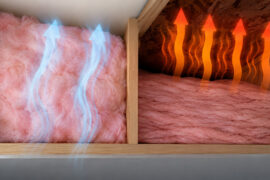
Your coffee mug gets hot. Your cooler stays cold. Both outcomes depend on a single material property.
Understanding what is thermal conductivity explains why copper pans heat evenly, why aerogel protects spacecraft, and why your energy bills spike in winter.
This property governs heat transfer in everything from electronics to building envelopes.
You’ll learn:
- The formula and SI units for thermal conductivity
- Which materials conduct heat fastest (and slowest)
- Factors that change conductivity values
- Real applications in insulation, electronics, and cookware
- How Joseph Fourier’s 1822 discovery still shapes engineering today
What is Thermal Conductivity
Thermal conductivity is a material property that measures how efficiently heat transfers through a substance.
Materials with high thermal conductivity allow thermal energy to pass through quickly. Materials with low values resist heat flow.
Joseph Fourier first defined this property in 1822 through his work on heat conduction. His research established the mathematical foundation for understanding how temperature gradients drive energy transfer between molecules.
Every solid, liquid, and gas has a specific thermal conductivity value. Copper conducts heat rapidly. Aerogel barely conducts at all.
This property determines everything from cookware performance to home insulation effectiveness.
How Does Thermal Conductivity Work
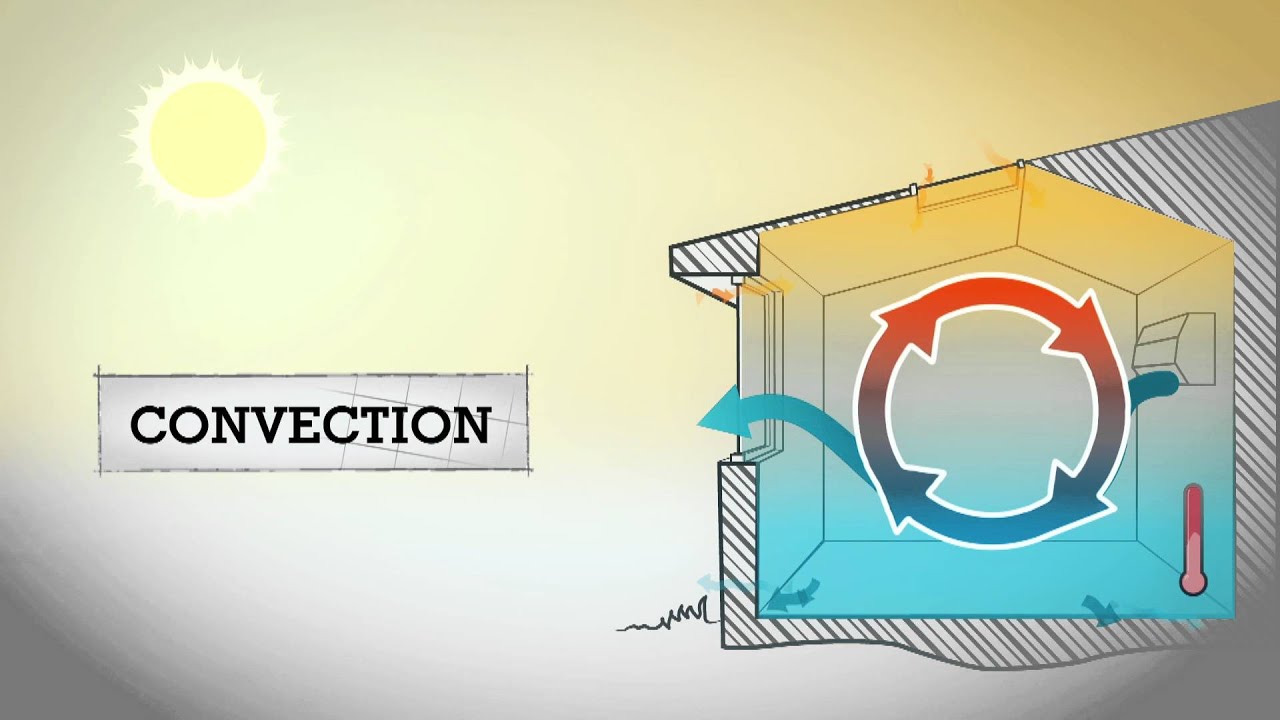
Heat moves from hot regions to cold regions through a material’s atomic structure.
In metals, free electrons carry most of the thermal energy. These electrons move rapidly, colliding with atoms and transferring kinetic energy throughout the lattice structure.
Phonon transport handles heat transfer in non-metals. Phonons are quantized lattice vibrations that propagate through the material like waves.
The efficiency depends on:
- Electron mobility within the material
- Mean free path of energy carriers
- Atomic bonding strength
- Crystal structure regularity
Understanding how insulation works starts with these principles. Materials that disrupt phonon movement or lack free electrons become effective thermal barriers.
What is the Formula for Thermal Conductivity
Fourier’s Law of heat conduction expresses thermal conductivity mathematically:
q = -k × (dT/dx)
Rearranged to solve for conductivity:
k = -q / (dT/dx)
Where q represents heat flux density in watts per square meter. The negative sign indicates heat flows opposite to the temperature gradient direction.
What Does Each Variable in the Thermal Conductivity Formula Represent
- k = thermal conductivity (W/m·K)
- q = heat flux, the rate of heat transfer per unit area
- dT = temperature difference between two points
- dx = distance between measurement points
Higher k values mean faster heat transfer under identical conditions.
What is the SI Unit of Thermal Conductivity
The International System of Units expresses thermal conductivity in watts per meter-kelvin (W/m·K).
Some industries use watts per meter-degree Celsius. The numerical values are identical since Kelvin and Celsius scales have equal interval sizes.
Imperial measurements use BTU/(hr·ft·°F). Converting between systems matters when comparing material specifications across international standards.
ASTM International and the National Institute of Standards and Technology publish standardized testing protocols using SI units.
What Materials Have High Thermal Conductivity
Diamond tops the list at approximately 2000-2500 W/m·K. Its rigid carbon lattice transmits phonons with minimal scattering.
Common high-conductivity materials:
- Silver: 429 W/m·K
- Copper: 401 W/m·K
- Aluminum: 237 W/m·K
- Gold: 318 W/m·K
- Brass: 109 W/m·K
These materials excel in heat sinks, cookware, and heat exchangers where rapid thermal energy dissipation matters.
Why Do Metals Conduct Heat Better Than Plastics
Metals contain free electrons that move independently through the atomic lattice. These electrons transfer energy roughly 100 times faster than phonon vibrations alone.
The Wiedemann-Franz Law confirms this relationship: materials with high electrical conductivity also have high thermal conductivity.
Plastics lack free electrons entirely. Heat transfers only through slow molecular vibrations, resulting in conductivity values below 0.5 W/m·K for most polymers.
This difference explains why various types of insulation materials use plastic-based foams and fibers rather than metal components.
What Materials Have Low Thermal Conductivity
Aerogel holds the record at 0.013 W/m·K. This silica-based material is 99.8% air trapped in a nanoporous structure.
Common low-conductivity materials:
- Still air: 0.024 W/m·K
- Polyurethane foam: 0.022-0.028 W/m·K
- Expanded polystyrene (Styrofoam): 0.033 W/m·K
- Fiberglass insulation: 0.032-0.044 W/m·K
- Rock wool insulation: 0.035-0.040 W/m·K
These materials trap air pockets that interrupt heat flow. Aerogel insulation takes this principle to the extreme with billions of nanoscale pores.
What Factors Affect Thermal Conductivity
A material’s conductivity value isn’t fixed. Multiple variables influence how efficiently heat transfers through any substance.
How Does Temperature Affect Thermal Conductivity
Metals decrease in conductivity as temperature rises; increased atomic vibrations scatter electrons. Non-metals typically increase in conductivity at higher temperatures due to enhanced phonon activity.
Cryogenic temperatures produce dramatically different values than room temperature measurements.
How Does Material Density Affect Thermal Conductivity
Denser materials generally conduct heat faster. More atoms per unit volume means more pathways for energy transfer.
Compressed insulation loses effectiveness because trapped air pockets collapse.
How Does Moisture Content Affect Thermal Conductivity
Water conducts heat 25 times better than air. Wet insulation fails because moisture fills air gaps that normally block heat flow.
A vapor barrier prevents condensation from degrading thermal performance.
How is Thermal Conductivity Measured
Two categories exist: steady-state methods and transient methods. Steady-state techniques wait for thermal equilibrium. Transient methods measure heat pulse propagation.
What Instruments Measure Thermal Conductivity
- Guarded hot plate apparatus
- Heat flow meter
- Laser flash analyzer
- Thermal conductivity detector
- Hot wire/hot disk systems
What is the Guarded Hot Plate Method
A sample sits between a heated plate and a cooled plate. Guard heaters eliminate edge losses. ASTM C177 standardizes this approach for building materials.
What is the Heat Flow Meter Method
Faster than guarded hot plate testing. A calibrated heat flux sensor measures energy passing through the sample under controlled temperature difference. Ideal for quality control in insulation manufacturing.
What is the Difference Between Thermal Conductivity and Thermal Diffusivity
Thermal conductivity measures how much heat flows through a material. Thermal diffusivity measures how quickly temperature changes propagate.
The relationship:
α = k / (ρ × cp)
Where α is diffusivity, k is conductivity, ρ is density, and cp is specific heat capacity.
High diffusivity means rapid temperature equalization. A material can have high conductivity but low diffusivity if it stores significant thermal energy.
What is the Difference Between Thermal Conductivity and Thermal Resistance
Conductivity is a material property. Resistance depends on material thickness.
R = thickness / k
The R-value used in building codes represents thermal resistance. Higher R-values mean better insulation performance.
The U-value is the inverse: it measures heat transfer rate through an assembly. Lower U-values indicate superior thermal barriers.
What is the Thermal Conductivity of Common Materials
| Material | Thermal Conductivity (W/m·K) |
|---|---|
| Diamond | 2000–2500 |
| Silver | 429 |
| Copper | 401 |
| Aluminum | 237 |
| Steel | ~50 |
| Glass | 0.8–1.0 |
| Concrete | 0.8–1.4 |
| Wood | 0.12–0.17 |
| Water (liquid) | ~0.6 |
| Fiberglass | ~0.035 |
| Air (still) | ~0.024 |
| Aerogel | ~0.013 |
How is Thermal Conductivity Used in Building Insulation
Lower conductivity means less heat loss through walls, roofs, and floors. Building designers select materials based on thermal performance requirements and available space.
Spray foam insulation achieves low conductivity (0.022-0.028 W/m·K) in thin applications. Cellulose insulation requires greater thickness to match the same thermal resistance.
The benefits of home insulation stem directly from choosing materials with appropriate conductivity values for your climate zone.
What R-Value Means in Insulation Materials
R-value equals material thickness divided by thermal conductivity. A 100mm layer of material with k=0.04 W/m·K delivers R-2.5 m²·K/W.
Thermal bridging occurs when high-conductivity elements like steel studs bypass insulation layers, reducing effective R-value.
How is Thermal Conductivity Used in Electronics
Processors generate intense heat in tiny areas. Without rapid heat dissipation, thermal runaway destroys components.
Thermal interface materials fill microscopic gaps between chips and heatsinks. Thermal paste and thermal grease improve contact conductivity from air’s 0.024 W/m·K to 1-12 W/m·K.
Why Heat Sinks Require High Thermal Conductivity Materials
Heat sinks spread concentrated thermal energy across larger surface areas. Aluminum (237 W/m·K) offers the best cost-to-performance ratio. Copper (401 W/m·K) handles extreme applications where maximum heat flux density matters.
How is Thermal Conductivity Used in Cooking Equipment
Cookware materials balance conductivity, cost, and durability.
- Copper pans: Superior heat distribution, rapid response to temperature changes
- Aluminum: Lightweight, affordable, excellent conductivity
- Cast iron: Lower conductivity (52 W/m·K) but high thermal mass retains heat
- Stainless steel: Poor conductor (16 W/m·K), often bonded with aluminum cores
Professional kitchens favor copper-clad or aluminum-core construction for precise temperature control.
Who Discovered Thermal Conductivity
Joseph Fourier published “Théorie analytique de la chaleur” in 1822. This work established the mathematical framework for heat conduction analysis still used today.
Fourier developed his equations while studying heat flow through solid bodies. His methods predicted temperature distributions under various boundary conditions.
What is Fourier’s Law of Heat Conduction
Fourier’s Law states that heat flux is proportional to the negative temperature gradient. Heat flows from hot to cold at a rate determined by material conductivity.
The equation: q = -k∇T
This principle underlies every thermal conductivity measurement, building energy calculation, and heat transfer simulation. A home energy audit applies these fundamentals when assessing insulation effectiveness with tools like thermal imaging cameras.
FAQ on What Is Thermal Conductivity
What is thermal conductivity in simple terms?
Thermal conductivity measures how easily heat passes through a material. High values mean heat transfers quickly (metals). Low values mean heat transfers slowly (insulation). The property is measured in watts per meter-kelvin (W/m·K).
What has the highest thermal conductivity?
Diamond has the highest thermal conductivity of any natural material at 2000-2500 W/m·K. Among metals, silver leads at 429 W/m·K, followed by copper at 401 W/m·K. These materials excel in heat dissipation applications.
Is high or low thermal conductivity better for insulation?
Low thermal conductivity is better. Insulation materials like rigid foam board insulation and fiberglass have values below 0.05 W/m·K. This resistance to heat flow keeps buildings warm in winter and cool in summer.
What is the difference between thermal conductivity and thermal resistance?
Thermal conductivity is a material property independent of thickness. Thermal resistance (R-value) depends on both conductivity and material thickness. A thicker layer of the same material provides greater resistance to heat transfer.
Does thermal conductivity change with temperature?
Yes. Metals typically decrease in conductivity as temperature rises due to increased electron scattering. Most non-metals show the opposite trend. Testing at room temperature provides standard reference values for material comparison.
Why do metals have high thermal conductivity?
Metals contain free electrons that move independently through the atomic lattice. These electrons transfer thermal energy rapidly between atoms. The Wiedemann-Franz Law confirms the link between electrical and thermal conductivity in metals.
What is the thermal conductivity of water?
Liquid water has a thermal conductivity of approximately 0.6 W/m·K at room temperature. This is 25 times higher than still air. Wet insulation loses effectiveness because water replaces trapped air pockets.
How is thermal conductivity measured?
Common methods include the guarded hot plate test (ASTM C177) and heat flow meter analysis. Laser flash analysis measures thermal diffusivity for calculating conductivity. The National Institute of Standards and Technology provides calibration standards.
What is a good thermal conductivity value for building insulation?
Building insulation should have conductivity below 0.05 W/m·K. Closed-cell insulation achieves 0.022-0.028 W/m·K. Lower values mean thinner material can achieve required thermal resistance for passive house insulation standards.
Does air have thermal conductivity?
Still air has very low thermal conductivity at 0.024 W/m·K. Most insulation materials work by trapping small air pockets that prevent convective heat transfer. Moving air transfers heat much faster through convection.
Conclusion
Understanding what is thermal conductivity gives you the foundation to make smarter decisions about material selection, energy efficiency, and thermal management.
From Fourier’s Law to modern laser flash analysis, measuring heat flow through materials remains central to engineering and construction.
The principles are straightforward. High conductivity materials like copper and aluminum move thermal energy fast. Low conductivity materials like foam and fiberglass create effective thermal barriers.
Temperature gradients, moisture content, and material density all influence real-world performance.
Whether you’re selecting a heat sink for electronics, choosing building insulation, or picking cookware, conductivity values in watts per meter-kelvin tell you exactly how heat will behave.
Apply this knowledge to improve home insulation or evaluate the ROI on insulation upgrades.