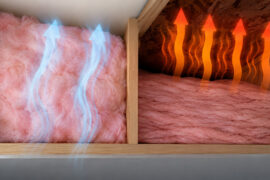
Heat always moves toward cold. A warm room sitting against a cold exterior wall pushes heat into that wall and keeps pushing until both sides even out. Insulation slows that transfer down. It never stops it, and any product that claims otherwise is selling something.
The material itself is a building product class, installed in attics, wall cavities, roof decks, and crawl spaces, sized to whatever climate zone and code apply where the house sits. Performance gets written as R-value, the resistance-to-heat-flow number that building codes actually reference.
Before spending a dollar on any of it, one figure is worth sitting with. Space heating and cooling together account for 52 percent of a household’s annual energy use, according to the U.S. Energy Information Administration’s 2020 Residential Energy Consumption Survey. Half the energy bill, going into keeping air at a temperature you like.
What Is Thermal Insulation
Any material that slows the rate of heat transfer across a wall, ceiling, floor, or roof assembly belongs in this category. The definition is broad on purpose, because the products inside it look nothing alike. A fluffy pink batt and a rigid foil-faced panel are both insulation.
What they share is resistance to at least one of the three ways heat travels: conduction, convection, and radiation. Most products handle one or two of those well and more or less ignore the third.
Insulation, vapor barriers, and air barriers get lumped together constantly, and they are doing different work. Insulation slows conductive and convective heat flow through the material. A vapor barrier blocks water vapor from diffusing through an assembly. An air barrier stops bulk air movement through gaps and cracks. Confusing these is one of the most common mistakes in a retrofit, and it is an expensive one to discover after the drywall is back up.
Building columnist Tim Carter has made the point plainly for years: if two insulation products carry the identical R-value, they perform identically, no matter what the material is called on the bag.
A good building envelope needs insulation, air sealing, and moisture control working together, though home insulation is usually the first upgrade homeowners think about.
How Does Insulation Block Heat Transfer

Heat moves from a warmer area toward a cooler one until the temperature difference disappears. That is Fourier’s law of conduction in plain language, and no amount of material thickness overrides it. Insulation buys time, nothing more.
Three mechanisms carry that heat. Each one needs a different response from whatever material sits in its path, which is why the wrong product in the wrong place underperforms even when the R-value on the label looks fine.
Conduction
Conduction is heat moving through direct contact between molecules inside a solid material.
Grab a metal fence handle on a hot afternoon and you have felt it. Same thing happens, more slowly, as heat crosses wood studs, drywall, or an aluminum window frame.
Densely packed molecules conduct heat faster than loose, fibrous ones. That is the whole trick behind batt and blown insulation: the trapped air pockets inside cut this process down by half or more compared with an open cavity.
Convection
Convection moves heat through circulating air or liquid. Warm air rises, cool air sinks, the cycle repeats until temperatures equalize.
- Gaps around wiring, plumbing penetrations, and top plates let convective loops form inside wall cavities
- Attics lose heat fastest this way, since warm air pools at the ceiling before finding a way out
Air sealing, not insulation thickness, is what actually interrupts convective loss. Stuffing more material into a leaky cavity is a common and mostly wasted instinct.
Radiation
Radiant heat travels in straight lines as electromagnetic waves. It needs no material to carry it, which is why it crosses a vacuum without trouble.
Sunlight through a window and the warmth you feel standing near a fireplace are both radiation.
Bulk insulation barely slows this down. A reflective insulation layer facing an open air space does block it, since a low-emissivity foil surface reflects the energy rather than absorbing it. Emergency space blankets work on the same principle, and so does the multilayer insulation wrapped around spacecraft.
What Is R-Value and Why Does It Matter

R-value measures how well a material resists conductive heat flow, expressed in square foot times hour times degree Fahrenheit per BTU. Nobody says that out loud. Everyone just says “R-38.”
It is the inverse of thermal conductivity, the k-value used in physics calculations for how fast heat moves through a substance.
Whole-assembly performance gets expressed instead as U-value, the rate of heat flow through every layer combined, framing, sheathing, and drywall included.
Higher R-value always means slower heat flow. It never means zero heat flow.
ASTM International sets the official test standard behind every published R-value. ASTM C518 measures thermal transmission with a heat flow meter apparatus and holds a reproducibility of about 3 percent, tight enough that manufacturers lean on it for routine quality control rather than one-off lab testing.
Federal regulation backs the number up. The FTC’s R-Value Rule, codified at 16 CFR 460, requires manufacturers to print tested R-value on packaging so shoppers can compare products on equal footing regardless of brand.
R-value adds up with thickness. Materials differ in how much they add per inch, sometimes by a factor of two.
What Types of Insulation Material Are Available

Fiberglass, cellulose, mineral wool, spray foam, and rigid foam board cover most residential jobs. There are other products out there, but a contractor working on a typical house is pulling from that set.
The North American Insulation Manufacturers Association points out that fiberglass and mineral wool batts span a wide range of performance levels, letting builders hit a target R-value at almost any budget.
Density, R-value per inch, moisture behavior, and fire performance all vary between them, so the right pick depends on the cavity you are filling rather than the price on the shelf tag.
| Material | R-Value per Inch | Density | Typical Use |
|---|---|---|---|
| Fiberglass batt | R-2.9 to R-3.8 | Low | Wall cavities, attics |
| Cellulose (blown) | R-3.2 to R-3.8 | Medium | Attics, dense-pack walls |
| Mineral wool (batt) | R-3.0 to R-3.3 | Medium-high | Walls, fire-rated assemblies |
| Open-cell spray foam | R-3.5 to R-3.6 | Low | Wall cavities, roof decks |
| Closed-cell spray foam | R-6.0 to R-7.0 | High | Rim joists, crawl spaces |
Figures come from U.S. Department of Energy insulation reference data, with the top end of the closed-cell range matching Johns Manville’s published rating for its Corbond III formula.
Fiberglass
Fiberglass is molten glass spun into fine fibers, then formed into batts, rolls, or loose fill.
The fiberglass insulation market remains the largest in residential construction. It is cheap, non-combustible in raw form, and cuts with a utility knife, which covers most of what a builder wants from a commodity product.
The weakness shows up during installation rather than in the material. Compressed batts, or gaps left around a wiring box, can cut effective R-value by half. A rushed fiberglass job is barely better than no job.
Cellulose
Cellulose is mostly recycled newsprint treated with borate for fire and insect resistance.
- Dense-packed into wall cavities, it fills irregular spaces around wiring and pipes more completely than batts
- Blown loose into attics, it settles into a fairly even layer with fewer gaps than hand-cut fiberglass
The U.S. Department of Energy notes that cellulose installed at the correct density typically needs no separate moisture barrier, unlike some other loose-fill products.
Mineral Wool
Mineral wool, sold as rock wool or stone wool depending on the brand, gets spun from basalt rock or recycled steel slag at high temperature.
The fiber is mineral rather than plastic or organic, so it does not burn. Density is the other selling point: a mineral wool batt is noticeably heavier than fiberglass in the same cavity, which is why it performs so much better in interior walls where sound matters as much as temperature.
Same cavity, higher R-value, higher cost per square foot. That is the trade, and for an interior wall between a bedroom and a laundry room it is usually worth it.
Spray Foam
Spray foam starts as two liquid chemicals mixed on site, then sprayed into a cavity where it expands and cures into a solid, air-sealing layer.
Open-cell foam uses water as the blowing agent and stays soft and vapor-open. Closed-cell insulation is the denser cousin, cures rigid, uses a different blowing agent, and lands at roughly twice the R-value per inch.
Air sealing and insulating happen in the same step with spray foam, which is not true of any other material on this list. That single fact explains most of the price difference.
Rigid Foam Board
Rigid foam board arrives as pre-cut panels of polystyrene, polyisocyanurate, or something similar, usually faced with foil or plastic film.
- Consistent, factory-rated R-value with no settling or compression over time
- Works as continuous exterior insulation, covering the framing instead of just filling the cavity
Board joints need taping or sealing, though, or the panel becomes just another gap in the air barrier.
Fire Resistance by Material Type
ASTM E84 is the standard fire test for insulation, rating surface burning through a flame spread index and a smoke developed index.
Class A covers a flame spread index of 0 to 25, Class B covers 26 to 75, and Class C covers 76 to 200, with most building codes capping foam plastic insulation at Class B or better.
Fiberglass and mineral wool are inherently non-combustible in raw form, since neither fiber burns the way a plastic does.
Spray foam and rigid foam board are plastics. Codes generally require a gypsum drywall thermal barrier over any exposed foam to slow ignition, which is why you rarely see bare foam in a finished space.
Where each one lands on the trade-off:
- Fiberglass is the cheapest option, and performance drops fast with sloppy installation
- Cellulose gives denser fill and fewer gaps, though it can settle in a wall cavity over the years
- Mineral wool is naturally fire resistant and better at blocking sound, at a higher cost per square foot
- Spray foam carries the highest R-value per inch and air seals as it cures, but it is the most expensive and the hardest to remove
- Rigid foam board has no settling risk and works as continuous exterior insulation, though joints need careful sealing
Where Is Insulation Installed in a Home

Insulation goes wherever a temperature difference crosses a building surface: attics, exterior walls, floors over unheated space, crawl spaces, basements, and mechanical lines.
Not every location carries equal weight. The U.S. Department of Energy attributes roughly 42 percent of a typical building’s energy loss to the combined envelope, doors, roofs, attics, walls, floors, and foundations. Attics and walls take the largest share of that, which is why they get first attention in almost every retrofit.
Attic and Roof
Warm air rises, so an uninsulated attic is usually the single biggest opening in a home’s thermal envelope.
- Loose-fill and blown insulation fill irregular joist bays without leaving gaps
- Roof deck insulation works better in finished attics and cathedral ceilings, where there is no separate attic floor to cover
Air sealing the attic floor before adding insulation matters more here than almost anywhere else in the house.
Wall Cavity
Cavity insulation fills the space between studs. Continuous insulation goes on the outside of the sheathing, covering the studs themselves.
Most homes rely on cavity fill alone, which leaves the framing as an uncovered thermal bridge. More on that below, because it is the single most underestimated number in residential insulation.
Retrofits that skip opening the wall usually rely on a dense-pack or drill-and-fill method through small holes drilled from outside.
Crawl Space and Basement
Below-grade spaces bring a moisture problem the attic never has to deal with, since they sit against soil and groundwater.
Insulating basement walls usually means rigid foam board against the concrete rather than batt insulation, which can trap moisture against a cold wall.
Crawl spaces increasingly get sealed and conditioned instead of vented, a shift building scientists have pushed for over the past two decades.
Pipes and Ductwork
Hot water pipes and supply ducts lose heat the moment they leave a mechanical room, before that heat ever reaches a faucet or a vent.
Pipe insulation is cheap, sold as foam sleeves or wrap, and pays for itself fast on long hot water runs. It is the rare upgrade where the material costs less than the trip to buy it.
Duct insulation matters just as much in unconditioned attics and crawl spaces, where a duct run can lose a large share of its heat before conditioned air ever reaches a room.
How Does Thermal Bridging Reduce Insulation Performance
Wood studs, steel studs, headers, and window frames all conduct heat faster than the insulation packed around them.
Each one acts as a bridge that lets heat cross the wall assembly while bypassing the insulation entirely, a problem building scientists call thermal bridging.
The cavity R-value printed on a bag almost never matches the effective R-value of the finished wall. The gap between those two numbers depends on what the wall is framed with.
- Wood stud walls: lose about 10 percent of in-cavity R-value to the framing (Oak Ridge National Laboratory)
- Metal stud walls: lose up to 55 percent of in-cavity R-value to the framing (Oak Ridge National Laboratory)
Fifty-five percent. Steel conducts heat far faster than wood, so even a thin steel stud punches straight through a wall’s insulation value, and no amount of cavity fill compensates for it.
The fix is external wall insulation applied as a continuous layer outside the framing, breaking the bridge before it ever reaches the cavity insulation.
The Passive House Institute’s Passivhaus standard treats exactly this kind of continuous coverage as a core design rule rather than an optional upgrade.
How Does Insulation Interact With Moisture and Vapor
Insulation and moisture control are separate jobs, even though they usually get installed in the same wall cavity on the same day by the same crew.
Water vapor moves through materials by diffusion, a slow process measured in perms, the standard unit of vapor permeability.
Building codes sort materials into three classes based on that perm rating, tested under ASTM E96 and written directly into the International Residential Code.
- Class I: 0.1 perm or less, essentially impermeable (polyethylene sheet, sheet metal, glass)
- Class II: 0.1 to 1.0 perm, semi-impermeable (kraft-faced batt insulation, unfaced extruded polystyrene)
- Class III: 1.0 to 10 perm, semi-permeable (latex paint, unfaced expanded polystyrene)
A vapor barrier controls water vapor diffusion through an assembly. It has nothing to do with stopping bulk air movement. That job belongs to air sealing, a separate measure that closes physical gaps instead of slowing diffusion.
Putting a vapor barrier on the wrong side of a wall is one of the more common insulation mistakes. Done backward, it traps moisture instead of keeping it out, and the damage happens invisibly for years.
Here is the mechanism. Warm, moist air hits a cold surface and reaches its dew point, the temperature at which vapor condenses into liquid water. Inside a wall or attic, that point often sits right on the insulation or on the sheathing behind it.
Trapped moisture soaks fibrous insulation, collapses its air pockets, and lowers effective R-value while creating exactly the damp conditions mold wants.
CertainTeed and other manufacturers now sell smart vapor retarders whose permeance shifts with humidity, tightening up in dry winter air and opening again once conditions turn humid enough to let a wall dry outward.
How Much R-Value Do You Need for Your Climate Zone
The right R-value depends on where the building sits. There is no single national number, and anyone quoting one is skipping a step.
The U.S. Department of Energy divides the country into eight climate zones, and Energy Star insulation guidance sets a recommended R-value range for each one.
| Climate Zone | Attic (uninsulated) | Wall | Floor |
|---|---|---|---|
| 1 to 2 | R-30 to R-49 | R-13 | R-13 |
| 3 | R-49 | R-13 to R-15 | R-19 |
| 4 | R-60 | R-13 to R-21 | R-19 to R-30 |
| 5 to 8 | R-60 | R-15 to R-21 | R-30 to R-38 |
Source: U.S. Department of Energy and Energy Star climate zone guidance, simplified from the full eight-zone breakdown.
Houston and Phoenix sit in zone 2, where attic recommendations top out around R-49. Go north to Minneapolis or Fairbanks, zone 6 and higher, and the same attic often needs a full R-60 to hit the same comfort target.
How much insulation you need in your attic comes down to reading that zone number off a map, not guessing based on what a neighbor installed.
More insulation past the recommended range rarely pays for itself. Every additional inch resists slightly less heat than the one before it, so the curve flattens out well before a wall or attic runs out of physical space.
Does Insulation Actually Reduce Energy Bills
Yes, and the U.S. Environmental Protection Agency has put a number on it.
EPA estimates a home can cut heating and cooling costs by 15 percent (11 percent of total energy costs) by combining air sealing with attic, floor, and rim joist insulation.
Where those figures come from, and what they leave out:
- EPA modeled savings: 15 percent off heating and cooling costs, 11 percent off total energy costs, from air sealing plus insulation (Energy Star)
- Documented case: a 1915 home in Dayton, Washington had a projected 66 percent cut in annual energy costs from a Department of Energy Building America retrofit centered on installing a multi-head ductless heat pump; attic, wall, and rim-joist insulation plus air sealing were anticipated as a later phase of the same project, tracked separately (Pacific Northwest National Laboratory)
- Federal incentive: a federal tax credit (Section 25C) let homeowners claim up to $1,200 toward qualifying insulation tax credit projects, but that credit expired for any insulation placed in service after December 31, 2025, under the One Big Beautiful Bill Act, so it is no longer available for new projects (Energy Star)
The Dayton house gets cited a lot, and usually cited wrong. That projected 66 percent came from modeling the heat pump on its own. The insulation and air-sealing work was still in the planning stage when the projection was made, with Pacific Northwest National Laboratory intending to track its impact separately once it was carried out.
Which is the honest caveat on most retrofit savings numbers. A single headline figure often traces back to one measure, even when the case study describes a broader envelope plan alongside it.
The payback period for insulation shortens considerably when a project bundles air sealing into the same visit, since a contractor is already on site and mobilized.
How Is Insulation Installed
Installation order matters as much as material choice. Skip a step early in the sequence and you undo work done later.
RESNET-certified raters grade the finished job. A Grade 1 rating requires full contact between the batt and every surface of the cavity, not a rough stuff-and-close.
- Inspect the space and clear old insulation, debris, or pest nesting material before starting
- Air seal first: caulk, foam, or gasket every penetration, top plate gap, and duct chase
- Choose the delivery method for the space, batts for open regular cavities, blown or dense-pack for irregular or finished areas
- Install to full, uncompressed thickness, cutting batts around wiring and boxes rather than stuffing them behind
- Cover with the appropriate facing or baffle, keeping soffit vents clear if the job is in an attic
- Verify coverage with a visual check or a post-job blower door test
Installing insulation in an attic follows this same order with one addition: baffles go in at the eaves before any loose-fill goes down, so soffit airflow never gets blocked.
Fiberglass batts are what most homeowners attempt themselves, and installing fiberglass insulation without cutting it around obstructions is the single most common do-it-yourself mistake. Splitting a batt around a wire takes thirty seconds. Cramming it behind costs you the R-value you paid for.
Spray foam and dense-pack cellulose are contractor jobs. Both need pressurized equipment and trained technicians, and getting either wrong is expensive to undo.
When Does Insulation Stop Working or Fail
Insulation does not fail all at once. It loses effectiveness in specific, identifiable ways, and most of them are preventable.
Compression causes the most trouble. Foot traffic in an attic, stored boxes, a poorly fitted batt, anything that squeezes the air pockets that make insulation work in the first place.
Squeezing a batt to half its rated thickness does not cut R-value by half. It can cut it by more, because the trapped air pockets collapse faster than the material compresses. Manufacturers call this insulation compression, and it explains why walking across attic insulation without a plank underfoot undoes a good installation so quickly.
Loose-fill products lose thickness on their own, even with nobody touching them.
Pacific Northwest National Laboratory, a Department of Energy research lab, documents insulation settlement of 10 to 20 percent in loose-fill cellulose over time, purely from gravity and vibration inside the cavity.
Installers who do not account for that settling leave an attic under-insulated within a few years of a job that passed inspection on day one.
- Moisture saturation: a roof leak or a missing vapor barrier soaks fibrous insulation and collapses its structure, sometimes permanently
- Pest damage: rodents nesting in loose-fill or batt insulation displace material and leave gaps no thermal camera catches until the wall is opened
- Uncorrected thermal bridging: no amount of cavity insulation offsets a wall’s framing losses, covered in the thermal bridging section above
None of these failure modes show up on the product label. A bag rated R-38 only delivers R-38 under the installation conditions the manufacturer tested it in.
How Do You Know If Your Home Has Enough Insulation

A visual depth check, a blower door test, and a thermal scan will answer this without guesswork. Start with the free one.
Measure the depth of attic insulation against the joists. Most batts and loose-fill products list a minimum depth for their rated R-value right on the packaging, so a tape measure and five minutes tells you whether you are anywhere close.
Depth alone will not catch every problem, though. Gaps, compression, and wall cavities hidden behind drywall need different tools.
A blower door test depressurizes the house with a calibrated fan and measures how much air leaks in, in cubic feet per minute.
Results get converted to air changes per hour at 50 pascals, or ACH50, the standard metric codes and energy raters use nationwide.
Current residential energy code sets the bar at 3 ACH50 in most climate zones, loosening to 5 ACH50 in the warmest zones, under the International Residential Code.
RESNET-certified raters run this same test to calculate a home’s HERS Index score, the industry benchmark for overall energy performance.
A thermal imaging camera reads surface temperature differences and shows missing or compressed insulation as a visible color pattern on a wall or ceiling. It works best on a cold day with a real temperature gap between inside and outside. Try it in mild weather and the camera has almost nothing to detect.
Symptoms worth paying attention to, even before anyone brings equipment out:
- Uneven room temperature between floors, or between rooms on the same floor
- Ice damming along roof eaves in winter, a sign of heat escaping through the attic
- Energy bills that climb faster than a neighbor’s similarly sized home
Any one of these signs is worth investigating. Two or more together usually means the insulation is under-performing, not just aging.
FAQ on How Does Insulation Work
What Is the Difference Between Insulation and a Vapor Barrier
Insulation slows heat flow through conduction and convection. A vapor barrier does a different job: it blocks water vapor from diffusing through a wall assembly.
Many products combine both, but R-value and perm rating measure entirely different things.
What Is Thermal Conductivity
Thermal conductivity, also called the k-value, measures how fast heat moves through a specific material, independent of thickness.
R-value is its inverse and accounts for thickness, which is why R-value, not k-value, appears on insulation packaging and in building codes.
Does Insulation Density Affect Performance
Density changes how insulation resists heat and sound, but a higher density does not automatically mean a higher R-value.
Dense-packed cellulose reduces air movement inside a cavity. Compressing a fiberglass batt also raises density, and lowers its rated performance. Same variable, opposite outcome.
Is Spray Foam or Fiberglass Better
Spray foam wins on R-value per inch and air seals in one step. Fiberglass wins on cost and easy installation in open cavities.
Tight budgets favor fiberglass; irregular framing and rim joists favor spray foam.
Does More Insulation Always Mean Better Performance
No. R-value adds up with thickness, but returns diminish once a cavity or attic already meets its climate zone target.
Beyond that point, air sealing, moisture control, and fixing thermal bridging usually deliver more comfort per dollar than extra insulation thickness.
Can You Install Insulation Yourself or Does It Need a Professional
Fiberglass batts and rigid foam board are common do-it-yourself projects in open, accessible spaces.
Spray foam and dense-pack cellulose require pressurized equipment and training, which is why most manufacturers and installers treat those two materials as licensed-contractor work.
How Long Does Insulation Last Before It Needs Replacing
Fiberglass, mineral wool, and rigid foam board perform for the life of a building if they stay dry and uncompressed.
Loose-fill cellulose needs a top-up as it settles, and insulation exposed to a roof leak or flooding needs inspection.
What Should You Prioritize First in a Thermal Insulation Upgrade?
Air sealing goes first. Sealing gaps before any material goes in keeps new insulation from bleeding performance to convective air movement the moment it is installed, and that ordering decides the outcome more than the material choice does.
Going straight to a thicker batt or a deeper layer of loose-fill without sealing first just traps the same drafts under a thicker blanket. The house feels slightly better. The bill barely moves.
- Air seal every penetration and top plate gap
- Bring cavities up to the climate-zone R-value target
- Verify with a blower door or thermal scan
That order costs more up front than insulating alone, since a proper sequence adds a diagnostic visit most single-material jobs skip entirely.
A home energy audit is the natural next step, measuring existing R-value, air leakage, and duct performance before any material gets purchased.