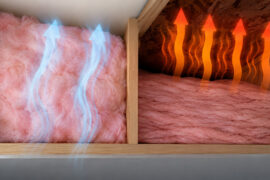
Your attic insulation is shrinking right now. Slowly, invisibly, but definitely.
Insulation settlement affects every home with blown-in material, and most homeowners have no idea it is happening until energy bills spike or rooms refuse to stay comfortable.
The U.S. Department of Energy estimates that inadequate attic insulation causes up to 25 percent of heating energy loss in single-family homes.
This guide covers what insulation settlement actually is, why it happens, which materials settle most, and exactly how to fix it.
You will learn how to measure your current insulation depth, recognize warning signs, and decide whether to top off or replace your existing home insulation.
What is Insulation Settlement
Insulation settlement is the gradual compaction and thickness reduction of loose-fill insulation over time.
Blown-in cellulose, fiberglass, and mineral wool lose trapped air pockets as gravity compresses the fibers.
The result? Reduced thermal resistance and lower R-value performance throughout your attic or wall cavities.
Settlement happens to every loose-fill installation eventually. The question is how much and how fast.
Understanding how insulation works helps explain why settlement matters so much for your energy bills and home comfort.
Why Does Insulation Settle Over Time
Three factors drive insulation settling: gravity, moisture, and installation quality.
Each one contributes differently depending on your climate, attic conditions, and the type of insulation material installed.
How Does Gravity Affect Blown-In Insulation
Gravity works constantly on loose fibers, compressing them downward and eliminating air pockets that provide thermal resistance.
Attic installations settle faster than wall cavities because there is no containment pressure holding the material in place.
How Does Moisture Contribute to Insulation Settlement
Humidity and water absorption accelerate fiber breakdown; wet insulation settles faster and loses R-value more quickly than dry material.
A properly installed vapor barrier prevents moisture intrusion that causes premature compaction.
What Role Does Installation Quality Play in Settlement
Poor installation technique causes the worst settling problems.
Contractors who blow material too thin or skip air sealing create conditions where insulation compacts rapidly within the first few years.
Which Insulation Types Settle the Most

Settlement rates vary dramatically by material. Cellulose compacts the most; fiberglass and mineral wool hold their thickness better over time.
How Much Does Cellulose Insulation Settle
Cellulose insulation settles 15 to 20 percent from its original installed depth.
Professional installers compensate by blowing extra thickness; the Cellulose Insulation Manufacturers Association (CIMA) recommends accounting for this expected loss.
How Much Does Fiberglass Insulation Settle
Fiberglass insulation settles only 2 to 5 percent, making it more dimensionally stable than cellulose over a 20-year period.
Owens Corning AttiCat and similar expanding products settle even less when installed at proper density.
How Much Does Mineral Wool Insulation Settle
Rock wool insulation settles 2 to 4 percent and resists moisture better than both cellulose and fiberglass.
Higher material density means fewer air pockets to lose over time.
What Are the Signs of Settled Insulation
Settled insulation shows itself through measurable depth loss, temperature problems, and rising energy costs.
How Do You Identify Thin or Uneven Insulation Depth
Measure depth with a ruler at multiple attic locations; insulation should be 10 to 16 inches for R-38 to R-60 performance.
Bald spots, hills, and valleys indicate uneven coverage that reduces your thermal envelope integrity.
What Temperature Problems Indicate Settled Insulation
Hot and cold spots throughout the house, rooms that won’t stay comfortable, and HVAC systems running constantly all point to inadequate insulation depth.
Thermal bridging becomes worse when settled insulation exposes framing members.
How Do Higher Energy Bills Relate to Insulation Settlement
The U.S. Department of Energy (DOE) estimates that inadequate attic insulation accounts for up to 25 percent of heating energy loss in single-family homes.
When blown-in insulation settles and loses R-value, your heating and cooling systems work harder to maintain temperature.
How Does Settlement Affect R-Value
Settlement directly reduces thermal resistance. Every inch of lost depth means lower R-value performance.
Here is what the numbers look like:
- Cellulose provides R-3.2 to R-3.5 per inch; a 20% depth loss means significant thermal performance decline
- Fiberglass provides R-2.2 to R-2.9 per inch; minimal settling preserves installed R-value longer
- For every 25% of insulation compression, you lose approximately 50% of effective R-value
A home energy audit can identify exactly how much thermal resistance your settled insulation has lost.
Scheduling a professional inspection every 3 to 5 years catches settlement problems before they cause major energy bill increases.
Where Does Insulation Settlement Occur Most Often
Settlement happens everywhere loose-fill material is installed, but attics and wall cavities experience it differently.
Why Do Attics Experience the Most Settling
Attic floors have no containment; insulation sits exposed to temperature fluctuations, humidity changes, and constant gravitational pressure.
Seasonal expansion and contraction cycles break down fibers faster than enclosed spaces.
How Does Settlement Happen in Wall Cavities
Wall insulation settles vertically within stud bays, creating gaps at the top where cavity wall insulation pulls away from the top plate.
These gaps become direct paths for heat loss and air infiltration; a blower door test reveals exactly where air escapes.
How Do You Fix Settled Insulation
Two options: top off what you have or replace it entirely. The right choice depends on the condition of your existing material.
When Should You Top Off Existing Insulation
Top off when existing insulation is dry, clean, and simply too thin; add enough material to reach your climate zone’s recommended R-value.
This is the most cost-effective retrofit insulation approach for most homeowners.
When Is Full Insulation Replacement Necessary
Replace entirely when you find moisture damage, mold growth, pest contamination, or material that crumbles at the touch.
Insulation vacuum removal clears the old material before fresh installation.
What Is Dense Pack Installation
Dense pack insulation compresses material during installation at 3.5 to 4.0 pounds per cubic foot, preventing future settling almost entirely.
Best for wall retrofits where you cannot add more material later.
How Do You Prevent Insulation Settlement
Prevention starts at installation and continues with proper maintenance throughout your insulation’s lifespan.
Why Does Proper Initial Installation Matter
Professional installers account for expected settling by blowing 15 to 20 percent extra thickness on cellulose jobs.
Proper density and even distribution prevent the worst settlement problems before they start.
How Does Avoiding Compression Protect Insulation
Never store boxes or heavy items directly on attic insulation; compressed material loses R-value immediately and permanently.
Install raised platforms or proper attic flooring if you need storage space above insulated areas.
What Maintenance Extends Insulation Lifespan
Inspect depth every 3 to 5 years using a ruler at multiple locations; check for moisture, pest activity, and uneven coverage.
A thermal imaging camera reveals hidden gaps and thin spots invisible to the naked eye.
How Long Does Blown-In Insulation Last Before Settling
Material type and installation quality determine settling timelines:
- Fiberglass: 15 to 20 years before significant settling; maintains thickness longest
- Cellulose: noticeable settling within 10 to 15 years; absorbs moisture faster
- Mineral wool: 15 to 20 years with minimal compaction; best moisture resistance
Western Kentucky and similar climates with cold winters and humid summers accelerate fiber breakdown through expansion and contraction cycles.
Poor attic ventilation, rodent activity, and water leaks shorten these timelines dramatically.
How Much Does It Cost to Fix Settled Insulation
Budget depends on whether you top off or replace entirely.
Here is what to expect for cost per square foot for insulation projects:
- Topping off: $1.00 to $2.50 per square foot for blown-in material and labor
- Full replacement: $1.50 to $3.50 per square foot including removal and new installation
- Dense pack retrofit: $2.00 to $4.00 per square foot for walls
The payback period for insulation improvements typically runs 3 to 5 years through energy savings.
Check for a weatherization rebate or insulation tax credit to offset your upfront costs; many utility companies and federal programs offer incentives for energy efficiency upgrades.
The ROI on insulation improvements remains one of the best home upgrade investments available.
FAQ on What Is Insulation Settlement
Does all insulation settle over time?
Only loose-fill materials settle. Blown-in cellulose, fiberglass, and mineral wool all compact gradually under gravity. Batt insulation, rigid foam board insulation, and spray foam insulation maintain their original thickness indefinitely when properly installed.
How do I know if my insulation has settled?
Measure depth at multiple attic locations using a ruler. Insulation below 10 inches indicates settlement. Other signs include temperature fluctuations between rooms, HVAC running constantly, and energy bills increasing without explanation.
Can I add new insulation over settled insulation?
Yes, if existing material is dry and free of mold or pest contamination. Adding fresh blown-in material over settled insulation restores lost R-value. Never compress the old layer when adding new material on top.
Which settles more, cellulose or fiberglass?
Cellulose settles 15 to 20 percent from original depth. Fiberglass settles only 2 to 5 percent. When choosing between spray foam or cellulose insulation, consider long-term settling behavior alongside initial R-value performance.
How often should I check my attic insulation depth?
Inspect every 3 to 5 years, or immediately after noticing comfort problems or energy bill spikes. Climate zones with extreme temperature swings accelerate settling, so homeowners in these areas should check more frequently.
Does insulation settlement void my warranty?
Most manufacturers expect some settling and account for it in warranty terms. Professional installers following NAIMA or CIMA guidelines blow extra thickness to compensate. Check your installation documentation for specific coverage details.
Can dense pack installation prevent settlement?
Yes. Dense pack compresses material to 3.5 to 4.0 pounds per cubic foot during installation, eliminating air pockets that cause future settling. Best for wall cavities where adding more insulation later is difficult or impossible.
Does moisture make insulation settle faster?
Absolutely. Wet insulation fibers clump together and compact rapidly. Cellulose absorbs more water than fiberglass, making it more vulnerable to moisture-accelerated settling. Proper attic ventilation and vapor barriers prevent this problem.
Will settled insulation cause ice dams?
Yes. Settled insulation allows heat to escape through the roof, melting snow unevenly. Water refreezes at the eaves, forming ice dams that damage gutters and shingles. Restoring proper insulation depth prevents this cycle.
Is it better to replace or top off settled insulation?
Top off when existing material is clean and dry. Replace entirely when you find moisture damage, mold, rodent contamination, or material that crumbles. A professional inspection determines which approach delivers benefits of home insulation upgrades most cost-effectively.
Conclusion
Insulation settlement is not a question of if, but when. Every loose-fill installation loses thickness over time.
The good news? Now you know what to look for and how to fix it.
Measure your attic depth regularly. Watch for temperature fluctuations and rising energy costs. Act before small problems become expensive ones.
Whether you top off existing material or invest in full replacement, restoring proper thermal resistance pays for itself through lower heating and cooling bills.
Consider upgrading to materials that resist settling, or explore how to improve home insulation performance across your entire thermal envelope.
Your home comfort and your wallet will thank you for staying ahead of settlement before it drains your energy budget.