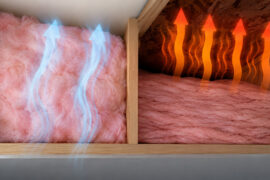
Open the hatch on an older attic and you’ll usually find one of two things between the joists. Either fiberglass batts sitting in neat rectangles, or a loose gray or pink layer that clearly got dumped in from above. That second one is loose-fill.
It goes in as uncompressed fiber or granules, either blown through a hose or poured straight out of the bag, and it takes the shape of whatever cavity it lands in. Most of it ends up on attic floors, though closed wall cavities account for a good share of the work too. Performance gets rated in R-value per inch, same as batt, spray foam and rigid board, so you can line them up on a spec sheet even though they behave nothing alike on a job site.
The fiberglass version got a serious redesign after Oak Ridge National Laboratory’s 1992 work with manufacturer Energy Savings Solutions changed how the fibers disperse. By 2014 the Department of Energy reported that nearly 75 percent of homes with loose-fill fiberglass were using that formulation, cutting cold-climate heating costs 5 to 10 percent.
What Is Loose-Fill Insulation?
The category covers any home insulation made of uncompressed fibers or granules that get blown or poured instead of cut to a fixed shape. Settling into whatever shape the cavity happens to be is the trait that separates it from batts, rolls and rigid board.
Most contractors just call it blown-in, since a hopper-fed machine forces it through a hose and packs it at a set density.
It’s one branch of home insulation, sitting next to batt, spray foam and reflective systems as another way to slow heat moving through a building shell.
Cellulose and fiberglass account for the bulk of what actually gets installed. Rock wool shows up regularly. Vermiculite and perlite turn up mostly in houses old enough that neither has been sold new for insulation in decades. All of them belong to the wider set of types of insulation materials used in residential and light commercial work, and each carries its own density, fire behavior and thermal resistance.
What Materials Make Up Loose-Fill Insulation?

A National Renewable Energy Laboratory report produced for the Department of Energy lays out how the three common materials compare on paper. These are lab numbers, worth remembering when a bag promises something an attic won’t deliver.
| Material | R-value per inch | Density (lb/ft3) | Fire treatment |
|---|---|---|---|
| Cellulose | 3.2 to 3.8 | 1.5 to 2.0 | Borate or ammonium sulfate added |
| Fiberglass | 2.2 to 2.7 | 0.5 to 1.0 | Non-combustible, none needed |
| Rock wool | 3.0 to 3.3 | 1.7 | Non-combustible, none needed |
Cellulose
Shredded newsprint and cardboard, chemically treated, which makes it the most widely sold cellulose insulation product for attic and wall jobs.
The base fiber is recycled newsprint, boxboard and other wastepaper. Borate or ammonium sulfate goes in for fire and insect resistance. Nothing works as a binder, which is what keeps the stuff loose and pourable.
Applegate, now part of the combined Applegate • Greenfiber company, is one real example, marketed on producing less dust during installation than older cellulose products did.
Fiberglass
Somewhere between 20 and 40 percent of the fiberglass sold as loose-fill is recycled glass content, according to Pacific Northwest National Laboratory. It’s chopped from the same glass fiber that goes into batts, then loosened up so a blower can move it.
It’s the lightest of the common materials, which is why it shows up in mobile home ceilings where weight limits matter. Getting it wet won’t permanently ruin it, unlike cellulose. The catch is that it’s worse at slowing airflow than cellulose or rock wool at the same depth, and in a drafty attic that costs you more than the R-value on the bag suggests.
Owens Corning sells its PROPINK line as fiberglass insulation with no fire-retardant chemicals at all, since glass fiber doesn’t burn on its own.
Mineral Wool and Rock Wool
Same family, two names. Both are spun fiber made from basalt rock or recycled slag rather than plant fiber or glass.
It’s non-combustible by composition, so no fire retardant additive is needed, and it resists mold and pests without added chemicals. Density runs higher than fiberglass, which helps it block airflow. You’ll find it in commercial and multifamily wall cavities about as often as attics.
Vermiculite and Perlite
Both are expanded minerals, heated until small pellets pop into lightweight granular pieces. They pour rather than blow.
Loose-fill vermiculite and perlite reach a thermal resistance of up to R-2.4 per inch, according to the Department of Energy’s Office of Energy Efficiency and Renewable Energy.
Where you still run into either one is attics of homes built before 1950. Vermiculite also carries a separate safety issue tied to one specific mine source, covered in detail further down this page.
What R-Value Does Loose-Fill Insulation Provide?
The trapped air pockets between fibers or granules do the insulating, not the fiber or granule itself. Density matters too, since a denser pack resists convective air movement better than a fluffy layer of the same depth. That’s the same mechanism behind every insulation category, covered in more depth on how insulation works across materials.
Cellulose lands between 3.2 and 3.8 R per inch, with rock wool just behind it at 3.0 to 3.3. Fiberglass is the weak one here, 2.2 to 2.7. The DOE attic minimum sits at R-30 and climbs to R-60 in the coldest climate zones.
Reaching R-38 takes 10 to 12 inches of cellulose. The same target needs 14 to 17 inches of fiberglass, which becomes a real problem in a shallow attic where you run out of headroom before you hit the number.
The Washington State Energy Code requires attics to reach R-60, or R-49 wherever the full depth of insulation extends uncompressed over the wall top plate at raised-heel trusses. It also mandates physical depth markers every 300 square feet so an inspector can verify the fill without guessing, which is a sensible rule more states should copy.
Always specify an R-value target by number, not by inches. Coverage charts differ by manufacturer and density, so “twelve inches” means different things depending on whose bags are sitting in the driveway.
Where Is Loose-Fill Insulation Installed?
Irregular cavities and spots that are awkward to reach with a pre-cut product are where loose-fill earns its keep. Residential work concentrates in a few places.
Attic Floors
The attic floor is the most common target by a wide margin, poured or blown directly over the ceiling joists until it reaches the marked depth. No demolition, since the space is already open and unfinished.
Two details decide whether the job holds up. Baffles at the eaves keep insulation off the soffit vents, and depth markers or a coverage chart confirm the R-value that actually went in. Skip the second one and you’re taking the crew’s word for it.
Closed Wall Cavities
A finished wall needs a different approach than an open attic floor. Installers drill small access holes, one per stud bay, pack the cavity through a hose, then patch the holes. The trade calls it drill-and-fill insulation.
Floor Cavities and Garage Ceilings
Blown between floor joists from below, loose-fill cuts heat loss through an uninsulated subfloor over an unheated crawl space. The same method applies where living space sits above an unheated garage bay.
How Is Loose-Fill Insulation Installed?

The order is fixed, whether the crew is filling an attic or a wall.
- Air-seal penetrations such as wiring holes, plumbing chases, and the attic hatch first
- Install baffles at every eave to protect soffit airflow
- Mark the target depth on the joists or trusses around the attic
- Load the hopper and blow material to the marked depth in even passes
- Check the final depth against the bag’s coverage chart before signing off
Skipping the first step undercuts everything after it, since air sealing gaps first is what keeps blown insulation from just filling around a leak instead of stopping it.
ASTM C1015, reapproved in 2025, is the industry practice standard covering how cellulosic and mineral fiber loose-fill should be installed.
The federally funded Weatherization Assistance Program leans toward cellulose for exactly this kind of retrofit work in older, leakier homes, which tells you something about how it behaves in real houses rather than test chambers.
Dense-Pack Wall Installation
Dense pack insulation targets a density instead of a depth, because a closed wall cavity gives you nothing to measure the way an open attic does.
Air escapes through every crack in the cavity as it fills, carrying fine particles with it. Eventually the holes clog with insulation, airflow stops, and the material behind that plug packs tighter. Heavy-duty blowing machines run at higher pressure than a standard attic rig to make that happen.
Does Loose-Fill Insulation Settle Over Time?
Some of the installed depth disappears after the crew leaves. Gravity and everyday vibration in the structure account for most of it.
Pacific Northwest National Laboratory data puts cellulose settling at 10 to 20 percent, compared with only 2 to 4 percent for fiberglass.
That gap has a practical consequence. An attic measuring R-38 on installation day can read noticeably lower inside the first year if the crew filled to depth rather than to the settled target.
Manufacturers account for this with a settled-density coverage chart printed on every bag, so installers overfill on purpose rather than guessing at insulation settlement after the fact.
Rock wool and fiberglass hold their loft better than cellulose does over time. That’s one of the tradeoffs buyers weigh against cellulose’s higher R-value per inch, and it’s an easy call in a house where nobody plans to go back into the attic for twenty years.
How Does Loose-Fill Insulation Compare to Batt and Spray Foam Insulation?
Most insulation jobs come down to loose-fill, batts or spray foam, and each one wins under different conditions.
Loose-fill fills irregular cavities and works around obstructions that pre-cut material can’t wrap, and it’s fast to add over existing insulation in an open attic. It also settles, and it needs a blower machine to install correctly.
Batt insulation cuts and fits quickly in open, regular stud bays with nothing in the way. No machine needed, so smaller jobs go faster with hand tools alone. It leaves gaps around wiring, pipes and odd framing unless someone cuts precisely, and plenty of installers don’t bother.
Spray foam delivers a higher R-value per inch than any loose-fill material and air-seals in the same application step. It costs more per square foot and requires a certified installer.
None of the three acts as a standalone air barrier on its own, which is why spray foam or cellulose insulation decisions usually come down to budget and how irregular the cavity is, not R-value alone.
Is Vermiculite Loose-Fill Insulation Safe?
Vermiculite ore mined near Libby, Montana was contaminated with up to 26 percent amphibole asbestos, according to a CDC-authored mortality study published in the Journal of Exposure Science and Environmental Epidemiology.
That single mine supplied over 70 percent of all vermiculite sold in the United States between 1919 and 1990, per a U.S. Environmental Protection Agency fact sheet. Most of it reached homeowners under the Zonolite brand, sold by W.R. Grace and Company until the mine closed around 1990.
The EPA’s position today is to assume any vermiculite attic insulation may contain asbestos, since testing a small sample isn’t reliable. Leave it undisturbed. No vacuuming, sweeping or bagging it yourself. Testing or removal is work for a licensed asbestos abatement contractor.
Vermiculite the mineral isn’t the hazard on its own. The asbestos that hitched a ride from one specific mine is.
If you’re not sure what’s sitting in an old attic, the visual cues in how to tell the difference between cellulose and asbestos insulation are a reasonable place to start before calling anyone in.
What Do Loose-Fill Insulation Projects Cost?
Honest national pricing for loose-fill is hard to pin down, because material choice, attic access and local labor rates all move the number independently. Anyone quoting a tidy per-square-foot figure for the whole country is guessing.
What actually moves the price is your target R-value and how many inches or how much density that takes, which material you pick (suppliers price cellulose, fiberglass and rock wool differently), how bad the attic access is, and whether the job includes tearing out and disposing of a failed material first. Dense-pack work in a finished wall costs more in labor than an open attic pour, every time.
Fiberglass tends to run cheaper on material cost alone. Dense-pack cellulose in a finished wall commands a premium for the extra labor it takes.
One concrete anchor point comes from the Weatherization Assistance Program’s cost cap. The Department of Energy set it at $8,497 per home for Program Year 2024, covering labor and materials for a full retrofit, not insulation alone.
Paying out of pocket, you can often offset part of the bill through an insulation tax credit. Many utilities and states also run a weatherization rebate program, and eligibility usually doesn’t depend on which loose-fill material gets installed.
What Building Codes and Standards Apply to Loose-Fill Insulation?
Code minimums set the floor for how much insulation a new home needs, and the number changes by climate zone rather than applying nationwide.
| Climate Zone | 2021 IECC Ceiling R-Value | Example Region |
|---|---|---|
| Zone 1 | R-30 | South Florida, Hawaii |
| Zones 2 and 3 | R-49 | Gulf Coast, Southern California |
| Zone 4 and higher | R-60 | Mid-Atlantic through the northern states |
That’s a jump from the 2018 IECC, which topped out at R-49 for the coldest zones before the 2021 revision raised it to R-60.
On the material side, ASTM C739 sets composition and physical requirements for cellulosic loose-fill insulation, and ASTM C764 covers the same ground for mineral fiber. ASTM C516 specifies vermiculite loose-fill. ASTM C687 is the lab method manufacturers use to test and publish R-value per inch, which is exactly why those published figures come off a bench and not out of somebody’s attic. All of them sit alongside ASTM C1015, already covered above for its role in how the material actually gets installed.
Beyond a straight code minimum, a home can pursue energy star insulation criteria for a voluntary efficiency bar above what the IECC requires. States layer stricter rules on top too, the way California enforces title 24 alongside the national code baseline.
When Does Loose-Fill Insulation Not Work?
Loose-fill fails under a handful of predictable conditions, and nearly every one traces back to airflow or moisture rather than the material itself.
- Wind blowing in through an unbaffled soffit pushes loose fiber away from the perimeter, leaving the edge of the attic thin or bare
- Standing water in a wet or flood-prone crawl space saturates cellulose especially, and wet insulation stops resisting heat flow the way dry material does
- A cathedral ceiling or exterior wall with no solid backing can’t hold loose fill in place without netting
- Blowing insulation over a roof deck that’s still leaking or condensing traps moisture instead of fixing the source of it
- Some jurisdictions restrict loose-fill cellulose directly over exposed knob-and-tube wiring without a clearance gap
A Department of Energy Building America case study investigated wind washing in 56 homes and found retrofit fixes averaged $350 per house, ranging from $100 to $1,200, against roughly $121 in annual energy savings once corrected. Not a fast payback on paper. The comfort difference in the rooms along the perimeter is the better argument for doing it.
Infrared scans in that research showed hot attic air pushing into floor cavities at wall intersections. A thermal imaging camera will usually catch that pattern before it shows up on a utility bill.
Crawl space moisture calls for a different fix than an attic problem does, closer to what’s covered in how to install vapor barrier in crawl space than anything a blower machine solves.
FAQ on What Is Loose-Fill Insulation
Is Loose-Fill Insulation the Same as Blown-In Insulation?
Same product, different name. Installers use a blower machine to force cellulose, fiberglass or rock wool through a hose, which is where “blown-in” comes from. Loose-fill describes the form the material comes in; blown-in describes how it gets there.
Can Loose-Fill Insulation Be Added on Top of Existing Insulation?
Usually, yes. Blowing new loose-fill over old batts or old loose-fill raises the total R-value, as long as the existing layer is dry and uncompressed. One exception: don’t top up over vermiculite until a professional confirms it’s asbestos-free.
Does Loose-Fill Insulation Need a Vapor Barrier?
Not always, and climate decides it. Cold regions often pair loose-fill with vapor barrier insulation on the room side of the wall to keep moisture out of the fiber, while humid climates sometimes skip it depending on local code.
Is Loose-Fill Insulation Flammable?
Fiberglass and rock wool are non-combustible by composition and need no added treatment. Cellulose is wood fiber, so it gets treated with borate to resist ignition. Codes test how flammable home insulation can be before approving any material for attic or wall use.
Can Loose-Fill Insulation Get Wet?
It can, and what happens next depends on the material. Fiberglass dries out and keeps most of its R-value. Cellulose absorbs water, mats down and loses loft permanently. Either way, soaked insulation needs fast drying or replacement before mold gets going.
How Do I Test Old Attic Insulation for Asbestos Myself?
You can’t, not reliably. Vermiculite’s asbestos content varies within the same bag, so one sample can easily miss what the handful beside it contains. The EPA recommends assuming contamination and hiring a licensed lab instead of testing on your own.
How Many Bags of Loose-Fill Insulation Do I Need for My Attic?
Every bag carries a coverage chart that translates square footage and target R-value into a bag count. Multiply your attic’s square footage by the listed coverage rate for the R-value you’re after.
What Should You Do First With Loose-Fill Insulation?
Before ordering a single bag or settling on an R-value target, check for vermiculite. That one confirmation decides whether the rest of the project runs as a standard attic job or a licensed abatement job, and the cost gap between those two is enormous.
Once the cavity is confirmed clear, seal its air leaks before the first bag goes in. Then match the material to both your R-value target and how much it’s going to settle, not R-value by itself.
Choosing cellulose for its per-inch advantage carries a consequence its own density already implies. You’re putting roughly two to three times the weight of the equivalent fiberglass coverage up there, which becomes a real factor if anyone ever has to pull it out during a later renovation.
The full walkthrough for putting that sequence into practice sits in how to install insulation in attic.