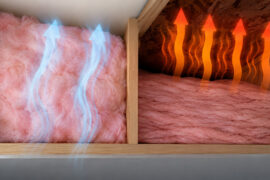
Volcanic rock transformed into fluffy insulation fibers. Sounds strange, but that’s exactly what rock wool is.
This mineral-based material has been keeping buildings warm, quiet, and fire-safe since the 1870s.
Yet many homeowners still don’t know it exists, defaulting to fiberglass without considering alternatives.
Rock wool (also called mineral wool or stone wool) offers thermal performance, acoustic dampening, and fire resistance that few other insulation products can match.
This guide covers everything you need to know: composition, manufacturing, R-values, installation methods, costs, and how rock wool stacks up against competing materials.
By the end, you’ll understand whether this basalt-based insulation belongs in your next project.
What is Rock Wool
Rock wool is a fibrous insulation material made from molten volcanic rock, primarily basalt, spun into fine fibers at temperatures around 1,600 degrees Celsius.
Also called mineral wool or stone wool, this material traps air pockets between its fibers to slow heat transfer.
First produced commercially in 1871 at the Georgsmarienhutte facility in Osnabruck, Germany, rock wool has become one of the most widely used types of insulation materials for residential, commercial, and industrial buildings.
The material offers thermal insulation, fire resistance, and sound absorption in a single product.
What Materials Make Up Rock Wool

Rock wool consists of natural rock minerals combined with industrial byproducts and binding agents.
The primary ingredient is basalt rock, a volcanic rock abundant throughout the earth’s crust.
Manufacturers also add blast furnace slag (a steel production byproduct), limestone, and dolomite to achieve specific performance characteristics.
What Raw Materials Are Used in Rock Wool Production
Typical rock wool contains 70-75% natural aluminosilicate rock with the remaining 25-30% being blast furnace slag.
Recycled content ranges from 16-40% depending on the manufacturer; ROCKWOOL brand products fall within this range while some slag wool products use up to 70% recycled slag.
How is Rock Wool Manufactured
The manufacturing process transforms solid rock into lightweight fiber insulation through extreme heat and mechanical spinning.
Raw materials (basalt, slag, limestone) are fed into a cupola furnace where temperatures exceed 1,500 degrees Celsius.
The molten rock is then spun at high speed through rotating discs or nozzles, creating fine fibers with diameters of 2-6 micrometers.
This spinning method resembles how cotton candy is made, just with molten rock instead of sugar.
What Temperature is Required to Produce Rock Wool
Production requires melting temperatures between 1,500-1,600 degrees Celsius (2,732-2,912 degrees Fahrenheit).
The Danish ROCKWOOL plant in Horsens operates as a CO2-neutral facility, offsetting emissions from this energy-intensive process.
What Binding Agents Are Used in Rock Wool Production
Thermosetting resins (typically phenolic resin) bind the fibers together; dust abatement oils reduce airborne particles during handling.
Some products use natural-based binders for specific applications or environmental certifications.
What Are the Properties of Rock Wool
Rock wool delivers thermal performance, fire resistance, acoustic dampening, and moisture management.
Understanding how insulation works helps explain why trapped air pockets between rock wool fibers create such effective thermal barriers.
The material is inorganic, so it resists mold, mildew, fungi, and bacterial growth.
What is the R-Value of Rock Wool Insulation
Rock wool delivers R-values between R-3.7 and R-4.3 per inch, higher than standard fiberglass insulation.
This thermal performance remains stable over 50+ years without degradation or settlement.
What Temperature Can Rock Wool Withstand
Rock wool withstands temperatures up to 1,000-2,150 degrees Fahrenheit without melting, smoking, or catching fire.
This fire rating meets NFPA 220 and ASTM E 136 standards; the material is classified as non-combustible Class A.
Is Rock Wool Water Resistant
Rock wool repels liquid water while remaining vapor permeable, allowing moisture to pass through without becoming trapped.
This makes it ideal for cavity wall insulation where damp conditions exist.
What Forms Does Rock Wool Come In
Manufacturers produce rock wool in multiple formats to suit different installation methods and applications:
- Rigid boards for walls and roofs
- Semi-rigid batts for stud cavities
- Loose-fill for attics and irregular spaces
- Pipe insulation for mechanical systems
- Spray-applied for fireproofing
What is Rock Wool Board Insulation
Rock wool boards are rigid panels with densities between 40-200 kg/m3, used for external wall insulation, roofing, and load-bearing floor applications.
Higher density boards provide better soundproofing and can support foot traffic.
What is Rock Wool Batt Insulation
Rock wool batts are pre-cut sections sized for standard stud and joist spacing (16″ or 24″ on center).
The material’s dimensional stability means batts stay in place without sagging, unlike some blanket insulation products.
What is Loose-Fill Rock Wool
Loose-fill rock wool is blown into attics, walls, and enclosed cavities using pneumatic equipment.
It resists settling and compression, maintaining thermal performance in hard-to-reach spaces where batts cannot be installed.
Where is Rock Wool Used
Rock wool serves residential, commercial, and industrial applications where thermal performance, fire protection, or acoustic control matter.
The material’s versatility makes it suitable for walls, roofs, floors, ceilings, and mechanical systems.
How is Rock Wool Used in Residential Buildings
Homeowners use rock wool for insulating basement walls, attic floors, exterior walls, and underfloor insulation between joists.
The material excels around electrical boxes, wires, and pipes where precise fitting is needed.
How is Rock Wool Used in Commercial Buildings
Commercial applications include curtain wall assemblies, rooftop systems, and interior partition walls requiring fire-rated assemblies.
Buildings pursuing LEED certification often specify rock wool for its recycled content and durability.
How is Rock Wool Used in Industrial Applications
Industrial facilities use high-temperature rock wool for furnace linings, boiler insulation, and process piping operating above 1,000 degrees Fahrenheit.
Refineries, power plants, and manufacturing facilities rely on the material’s ability to maintain performance at extreme temperatures.
Can Rock Wool Be Used for Soundproofing
Rock wool’s high density (40-100 kg/m3) and fibrous structure absorb airborne sound waves effectively.
The material achieves high noise reduction coefficient (NRC) ratings, making it ideal for home theaters, recording studios, and multi-family separating walls.
Can Rock Wool Be Used for Hydroponic Growing
Horticultural-grade rock wool serves as a sterile, pH-neutral growing medium for hydroponic systems.
The fibers retain moisture while providing root aeration; this application differs from construction-grade insulation products.
How Does Rock Wool Compare to Fiberglass Insulation
Rock wool outperforms fiberglass in several categories but costs more upfront.
Key differences:
- Density: Rock wool is denser, providing better sound absorption
- Fire resistance: Rock wool withstands 2,150°F vs. fiberglass at 1,000°F
- R-value: Rock wool delivers R-3.7 to R-4.3 per inch; fiberglass averages R-2.9 to R-3.8
- Moisture: Rock wool is naturally water-repellent; fiberglass absorbs moisture
- Cost: Rock wool runs about 10% higher per square foot
Fiberglass remains popular for budget-conscious projects; rock wool suits applications demanding fire safety or acoustic performance.
How Does Rock Wool Compare to Spray Foam Insulation
Spray foam insulation provides higher R-values per inch (R-6 to R-7 for closed-cell) and creates an integrated air seal.
Rock wool offers superior fire resistance and doesn’t require specialized spray rig equipment for installation.
Spray foam works better for thermal bridging prevention; rock wool is easier to remove and replace if needed.
How Long Does Rock Wool Insulation Last
Rock wool lasts 50+ years without degrading, settling, or losing thermal conductivity.
Unlike organic materials such as cellulose insulation or sheep’s wool insulation, rock wool is inorganic and immune to rot, pests, and biological decay.
The material maintains dimensional stability even under compression, recovering its original thickness after load removal.
Is Rock Wool Safe to Handle
Rock wool can cause temporary skin, eye, and respiratory irritation during installation.
The International Agency for Research on Cancer (IARC) classifies modern rock wool as “not classifiable as carcinogenic to humans” (Group 3).
Required protective equipment:
- Long sleeves and pants
- Work gloves
- Safety glasses or goggles
- N95 dust mask or respirator
Irritation is mechanical (from fiber contact), not chemical; symptoms resolve after washing exposed skin.
How Do You Install Rock Wool Insulation
Rock wool installation follows similar methods to other home insulation products but requires no special training or equipment.
The material friction-fits into stud cavities without stapling or adhesives.
What Tools Are Needed to Install Rock Wool
Basic tools include a serrated bread knife or insulation knife, straightedge, tape measure, and utility knife for facing materials.
No dense pack blowing machines or specialized equipment required for batt installation.
How Do You Cut Rock Wool
Score rock wool batts with a serrated knife against a straightedge; the material compresses slightly for friction-fit installation.
Cut pieces 1/2 inch larger than the cavity for a snug fit without gaps that create thermal bypasses.
How Much Does Rock Wool Cost
Rock wool costs approximately $1.00-$1.50 per square foot for standard batts, about 10-25% more than fiberglass.
The cost per square foot varies by density, thickness, and regional availability.
Calculate your payback period based on energy savings; most homeowners see positive ROI within 3-5 years through reduced heating and cooling costs.
Check for weatherization rebates and insulation tax credits that offset initial material expenses.
Is Rock Wool Environmentally Friendly
Rock wool contains 16-75% recycled content (varies by manufacturer and product type) and uses abundant natural basalt rock.
The material is 100% recyclable; manufacturers accept used rock wool for reprocessing into new products.
Key environmental considerations:
- Energy payback: Insulation saves more energy over its lifespan than manufacturing requires
- Durability: 50+ year lifespan reduces replacement waste
- No off-gassing: Inorganic composition means no VOC emissions
- Carbon reduction: Properly insulated buildings lower heating/cooling emissions
A home energy audit can identify where rock wool installation delivers the greatest environmental and financial returns.
FAQ on What Is Rock Wool
Is rock wool the same as mineral wool?
Yes. Rock wool is a type of mineral wool made primarily from basalt rock and blast furnace slag.
The terms rock wool, stone wool, and mineral wool are often used interchangeably, though mineral wool also includes slag wool and glass wool products.
Is rock wool better than fiberglass?
Rock wool offers higher density, better fire resistance (2,150°F vs 1,000°F), and superior sound absorption.
Fiberglass costs less. Choose based on whether you prioritize budget or performance in fire safety and acoustics.
Is rock wool insulation safe to breathe?
Modern rock wool is classified by IARC as “not carcinogenic to humans.”
Fibers can cause temporary respiratory irritation during installation. Wear an N95 mask; irritation stops once exposure ends.
Does rock wool absorb water?
Rock wool repels liquid water while allowing water vapor to pass through.
This vapor-permeable quality prevents moisture buildup and condensation problems, making it suitable for damp-prone areas like basements and cavity walls.
Can rock wool be used for soundproofing?
Yes. Rock wool’s high density (40-100 kg/m3) and fibrous structure absorb sound waves effectively.
It achieves excellent noise reduction coefficient ratings for walls, ceilings, and floors separating living spaces.
How long does rock wool last?
Rock wool lasts 50+ years without settling, degrading, or losing R-value.
The inorganic composition resists rot, pests, mold, and fungi. Performance remains stable for the lifetime of most buildings.
Is rock wool fireproof?
Rock wool is non-combustible and withstands temperatures up to 2,150°F without melting or producing smoke.
It meets ASTM E 136 and NFPA 220 fire standards. Check whether home insulation is flammable for comparisons with other materials.
Can I install rock wool myself?
Yes. Rock wool batts friction-fit into stud cavities without staples or adhesives.
Cut with a serrated knife; no specialized equipment needed. Wear gloves, long sleeves, and a dust mask during installation.
What R-value does rock wool provide?
Rock wool delivers R-3.7 to R-4.3 per inch, depending on product density.
A standard 3.5-inch batt provides approximately R-15; 5.5-inch batts reach R-23 for 2×6 wall assemblies.
Is rock wool environmentally friendly?
Rock wool contains 16-75% recycled content and uses abundant natural basalt.
The material is 100% recyclable and lasts 50+ years, reducing landfill waste. Energy Star insulation programs recognize its efficiency benefits.
Conclusion
Understanding what is rock wool helps you make informed decisions about your building’s insulation needs.
This volcanic rock-based material delivers non-combustible protection, vapor permeability, and dimensional stability that synthetic alternatives struggle to match.
The higher upfront cost pays off through 50+ years of consistent performance without settling or degradation.
Rock wool handles extreme temperatures, resists mold growth, and absorbs sound waves effectively.
Whether you’re tackling a retrofit insulation project or new construction, rock wool deserves serious consideration.
Explore the benefits of home insulation further, and weigh your options against rigid foam board or other materials.
The right choice depends on your budget, climate, and performance priorities.