ENERGY STAR insulation is a certification, not a material. A manufacturer submits test data on a specific product line, an independent lab runs the measurements, and a certification body recognized by the EPA signs off before the label can go on the package.
The U.S. Environmental Protection Agency runs the program, working alongside the Department of Energy on the wider ENERGY STAR label that also covers appliances and windows. What gets measured is the product under lab conditions. How that product performs once it is stapled into your attic is a separate question, and one the certification never answers.
The current testing requirements took effect on September 23, 2011, under EPA’s Definitions and Testing Requirements Version 1.0. Every certified manufacturer still tests against that baseline.
What Is ENERGY STAR Certified Insulation?

The label covers residential insulation that has passed independent lab testing under the EPA’s Seal and Insulate with ENERGY STAR program. It describes a testing status, something a manufacturer applied for and a third party verified. Fiberglass, cellulose, and foam products all carry it, and plenty of products in each of those categories do not.
Ordinary home insulation only has to clear local building code, usually some version of the International Energy Conservation Code. The certified stuff clears code and then goes through a second check: a third-party certification body compares the manufacturer’s test data against a published requirements document before anything gets printed on the bag.
That second check covers the R-value claim and a flame resistance test. Nothing else.
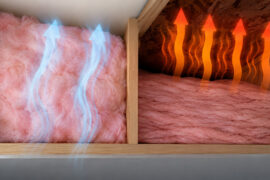
Underneath all of it, insulation is doing the same physical job it always does, slowing heat transfer between inside and outside. How insulation works comes down to trapping air and resisting conductive flow, certified or not.
Insulation sits on its own track inside the ENERGY STAR label, with a separate definitions and testing requirements document from the one governing HVAC equipment or windows.
How Does Insulation Get ENERGY STAR Certified?
Manufacturers start the process. Not contractors, not homeowners, and there is no way for an installer to certify a finished job after the fact.
It runs through a formal agreement with EPA first, then independent lab testing, then review by an EPA-recognized certification body.
The EPA Partnership Agreement and Manufacturer Information Form
Nothing counts toward certification until the company signs a Manufacturer Partnership Agreement with EPA. Test data generated before that point does not carry over.
Once EPA approves the agreement, the company holds Active Applicant status and has one year to certify at least one product line. From there:
- Submit test data to an EPA-recognized certification body
- Certification body issues a product certification report
- Manufacturer Information Form goes to EPA for final approval
Applegate Greenfiber went through exactly this sequence for its FRM and Sanctuary loose-fill insulation lines, with UL Solutions issuing the certification report.
EPA-Recognized Certification Bodies (UL Solutions, Intertek, IAPMO UES)
Most Seal and Insulate certifications go through one of three organizations.
| Certification Body | Accreditation | Typical Scope |
|---|---|---|
| UL Solutions | ISO/IEC 17065 | Loose-fill, batt, foam |
| Intertek | ISO/IEC 17065 | Batt, board, spray foam |
| IAPMO Uniform Evaluation Service | ISO/IEC 17065 | Spray and pour foam |
All three hold accreditation under ISO/IEC 17065, the standard that governs product certification organizations across industries, not just building materials.
Manufacturers usually pick whichever body already handles their product category. The testing requirements document does not change based on who signs off, so the choice comes down to familiarity and turnaround time.
What Lab Tests Does ENERGY STAR Require for Insulation?
Thermal resistance gets measured first. Flame behavior gets measured after. A product has to clear both before EPA recognizes the claim.
Thermal Performance Testing (ASTM C518)
ASTM C518 is the method labs use to measure steady-state thermal transmission. The number it produces becomes the R-value printed on a certified product, and the certification body checks that number against whatever the manufacturer originally claimed.
So the R-value on a certified bag is a tested figure rather than a marketing estimate. That is a smaller distinction than it sounds like, since reputable manufacturers test anyway, but it does mean somebody outside the company looked at the data.
Intertek requires test reports under the current published version of ASTM C518 before it issues a certification report.
Flame Resistance Testing (ASTM E84 and UL 723)
ASTM E84 rates surface burning characteristics. UL 723 covers the same property under a parallel standard, and CAN/ULC S102.2 is accepted for certain facing materials.
Certification bodies want a passing flame spread and smoke development result. A high R-value does not compensate for a failed burn test.
Intertek’s published requirements also call for an ongoing quality control program with periodic facility inspections, so the lab report alone is not the end of it.
Which Insulation Types Qualify for ENERGY STAR Certification?
Batt, blown-in loose-fill, spray foam, rigid board, and reflective facing cover nearly everything certified on the market right now.
Each sits under a slightly different part of the Seal and Insulate requirements, because the physical types of insulation materials behave differently under identical heat flow and flame tests.
| Type | R-Value per Inch | Common Application | Pro Installation Needed |
|---|---|---|---|
| Closed-cell spray foam | About 6.5 | Walls, rim joists | Yes |
| Open-cell spray foam | About 3.6 | Walls, attics | Yes |
| Fiberglass batt | About 3.1 to 3.8 | Walls, floors | Not always |
| Blown-in loose-fill | About 2.2 to 3.7 | Attics | Usually |
| Rigid foam board | About 4.0 to 6.5 | Sheathing, foundations | Not always |
Those figures come from the Department of Energy’s home insulation guide. They move around based on product density and formulation, so treat them as a range rather than a spec.
Is Spray Foam Insulation ENERGY STAR Certified?
Some of it. Certification applies line by line, so the question is never really about spray foam as a category.
Spray foam insulation shows up in two forms. Closed-cell is denser, hits a higher R-value per inch, and doubles as an air barrier. Open-cell is softer and more vapor permeable with a lower R-value per inch, which is fine in some assemblies and a headache in others.
BaySystems earned ENERGY STAR partnership for its Bayseal closed-cell spray polyurethane foam, reporting an aged R-value of 6.9 per inch to EPA as part of the application.
Not every spray foam brand is certified. A company can hold certification on one line and none on the three sitting next to it.
Batt, Blown-In and Loose-Fill Options
Batts are the pre-cut panels, fiberglass or mineral wool, and they make up the most common certified category for walls and floors.
Loose-fill gets blown in with pneumatic equipment, usually into attics. Fiberglass, cellulose, and mineral wool all come in loose-fill form. The advantage over batts is that it fills irregular spaces, around ductwork, over odd framing, into the corners where a rectangular panel never quite sits right.
Certified loose-fill bags list a minimum installed thickness. Below that thickness the coverage does not deliver the tested R-value, which is worth knowing before you sign off on an attic job that looks thin.
Cellulose loose-fill, mostly recycled paper treated with fire retardant, is one of the more common certified materials in this group.
What R-Value Does ENERGY STAR Insulation Need by Climate Zone?

Location sets the target, not product preference. A certified R-30 batt is not “enough” in Minnesota just because somebody tested it.
The Department of Energy and the International Energy Conservation Code split the country into numbered climate zones, each carrying its own attic, wall, and floor numbers.
Attic targets run roughly like this:
- Zone 1 (Miami, Honolulu): R-30
- Zone 3 (Atlanta, Dallas): R-49
- Zone 5 (Chicago, Denver): R-60
- Zone 7 to 8 (Fairbanks, Duluth): R-60
Wall targets are much narrower, typically R-13 to R-21 everywhere, because stud depth caps how much material fits no matter what the climate does.
How Climate Zones Are Determined
Zip code sets the zone, not the state line. Two cities in the same state can land in different zones, which catches people out in places like Oregon and Colorado.
- Portland, Oregon and Seattle, Washington: Zone 4C
- Denver, Colorado and Santa Fe, New Mexico: Zone 5B
The 2021 IECC Residential Provisions, Table R402.1.3, sets the wall sheathing and cavity baseline that ENERGY STAR guidance points to directly.
There are also moist, dry, and marine subtypes, the A, B, and C suffixes hanging off the numbers. They mostly affect moisture control decisions rather than R-value targets, so they matter more for your vapor retarder strategy than for how deep the attic goes.
Is ENERGY STAR Certified Insulation Worth the Cost?
Usually, though it depends on the category and the zone.
Nine of ten single-family homes in the U.S. are under-insulated. Sealing air leaks alongside adding insulation can cut up to 10 percent off annual energy bills, according to ENERGY STAR’s 2025 program materials. That figure assumes you do both, which is the part people skip.
Certification takes some guesswork off the table:
- The printed R-value has been checked by somebody outside the company
- Flame resistance testing was completed rather than claimed
- Manufacturer installation instructions ship with the product as a condition of the label
What it does not do is tell you anything about the crew installing it. Non-certified insulation still meets code and still performs fine in plenty of homes. And the price premium varies enough by category that no reliable payback math attaches to the label itself.
For reference, fiberglass batt runs about $0.20 to $0.40 per square foot at R-13. Closed-cell spray foam runs roughly $1.30 to $2.00 per square foot for one inch, per Department of Energy figures.
The cost per square foot for insulation swings that hard because material, thickness, and labor intensity differ so much across categories.
Worth saying plainly: the benefits of home insulation show up whether or not the label is on the bag. Lower bills, steadier indoor temperatures, less strain on the HVAC equipment. Certification is a quality check on the product, not the source of the benefit.
Koala Insulation, an ENERGY STAR partner franchise, pitches attic air sealing paired with insulation upgrades as one of the better returns available in home improvement. Hard to argue with that one.
Does ENERGY STAR Certified Insulation Qualify for Tax Credits?
It did, through the federal Section 25C Energy Efficient Home Improvement Credit. Past tense matters here.
The credit covered 30 percent of qualifying insulation costs, capped at $1,200 a year, claimed on IRS Form 5695.
Congress closed it to any installation completed after December 31, 2025, under the One, Big, Beautiful Bill Act signed in July 2025. That is years ahead of the original 2032 expiration date.
Work finished on or before that date can still be claimed on the matching tax return. Anything installed in 2026 or later gets nothing under Section 25C.
Knauf Insulation marketed several Performance+ lines, EcoBatt and EcoFill among them, as eligible materials while the insulation tax credit was still running.
Utility weatherization rebate programs are a separate thing entirely and did not end with the federal credit. Homeowners insulating in 2026 still have that route. It just takes more digging, since every provider runs its own version with its own paperwork.
Still in play going forward:
- State and utility weatherization rebates, which vary by provider
- Manufacturer certification statements, useful for warranty and resale documentation
- ENERGY STAR certification itself, which the tax law change did not touch
How Does Certified Insulation Fit Into ENERGY STAR Certified Homes?

Certified insulation is one input into a larger scorecard. Using it everywhere does not certify the house.
ENERGY STAR Certified Homes bundles insulation together with windows, air sealing, ductwork, and HVAC equipment into a single home-level rating.
ENERGY STAR Certified Homes and the HERS Index
Certified homes are at least 10 percent more energy efficient than homes built to code, and 20 percent more efficient on average, according to EPA program data.
The score itself comes from a RESNET-trained Home Energy Rater and is called the HERS Index. A 100 represents a home built to the 2006 IECC reference standard.
- A lower HERS Index score means better efficiency
- A score of 70 is roughly 30 percent more efficient than the reference home
- Insulation levels and installation grade feed directly into the number
A house can use certified insulation in every cavity and still miss the target if the ducts leak or the windows are cheap. The rating does not care which component let you down.
DOE Zero Energy Ready Home Comparison
| Feature | ENERGY STAR Certified Homes | DOE Zero Energy Ready Home |
|---|---|---|
| Baseline | Built on ENERGY STAR Version 3 | Built on ENERGY STAR Version 3, plus more |
| Insulation requirement | Meets IECC-based targets | Meets stricter IECC insulation levels |
| Extra scope | HVAC, windows, air sealing | Adds Indoor airPLUS and water heating criteria |
DOE’s program requirements confirm that Zero Energy Ready Home builds on ENERGY STAR Version 3 rather than replacing it.
New Jersey builder John Hubert Associates hit a HERS score of 46 on its DOE Zero Energy Ready EXIT-0 House, without solar, well under the roughly 100 baseline for a code-built home.
How Do You Find and Verify ENERGY STAR Certified Insulation?
Checking the label takes a second. Confirming it holds up takes a few phone calls, which is roughly why almost nobody does it.
- Check the product packaging or spec sheet for the ENERGY STAR mark and manufacturer name
- Ask the manufacturer or installer for the certification report number
- Match the certifying body listed, UL Solutions, Intertek, or IAPMO UES, against EPA’s recognized list
- Confirm the specific product line, not just the brand, appears on the report
- Verify installed performance after the job, since certification covers the product and not the install
IAPMO UES publishes its insulation evaluations as Uniform Evaluation Service reports, which gives you a paper trail that goes past the printing on the bag.
Step five is where things go wrong.
A blower door test depressurizes the house to 50 pascals, the reference pressure defined in ASTM E779, and measures how hard the fan has to work to hold it. The result says nothing about certification status. What it tells you is whether air sealing around the certified insulation was done properly, which in most homes matters more than the label ever did.
A thermal imaging camera gives you the same information visually, picking up temperature differences where insulation is missing, thin, or squashed flat.
Neither tool verifies the ENERGY STAR label. Both tell you whether the certified product is actually doing its job once installed.
How Should ENERGY STAR Certified Insulation Be Installed?

The tested R-value assumes a textbook installation. Real attics have wiring, plumbing, recessed cans, and a guy working his fourth job of the day.
That gap is exactly why certification requires manufacturer instructions to ship with the product.
Manufacturer Installation Instructions
Every certified product includes them. They cover minimum and maximum installed thickness, the cavity fill method for that specific product type, and safety handling plus indoor air quality guidance.
Installers who skip the instructions and eyeball coverage cause more underperformance than product defects ever do.
Getting the air sealing done before material goes in matters as much as the product choice. Gaps in the envelope let conditioned air move around the insulation entirely, and no R-value stops air it never touches.
Common Installation Errors That Lower Performance
RESNET’s HERS grading standard puts actual numbers on sloppy work.
| Grade | Installation Quality | R-Value Credited |
|---|---|---|
| Grade I | No gaps, no compression, six-sided fill | 100 percent |
| Grade II | Minor gaps, slight compression | 98 percent |
| Grade III | Significant gaps or compression | 95 percent or less |
Insulation compression is the usual reason a cavity lands at Grade III, normally from cramming batts into bays already crowded with wiring or plumbing. Splitting the batt around the wire instead takes maybe thirty extra seconds. Almost nobody does it.
NAIMA, the insulation manufacturers trade group also known as the Insulation Institute, ran a field study with HERS raters confirming that installation grade drives real-world results, not just product choice.
When Does ENERGY STAR Certification Not Apply to Insulation?
The label has real limits. Knowing them ahead of time saves some disappointment later.
- EPA certifies insulation products only, not air sealing products
- Contractors and installers cannot become ENERGY STAR partners directly, only manufacturers can
- Insulation meeting IECC code minimums is not automatically ENERGY STAR certified
- Certification confirms lab performance, not how the finished assembly behaves on site
That last one bites hardest around thermal bridging, the heat loss that travels straight through studs, joists, and other framing members regardless of what is packed into the cavities. A certified batt does nothing about it. The wood conducts heat around the insulation and the label has no opinion on the matter.
Loose-fill carries a second limit baked into the material itself.
Loose-fill cellulose settles by 10 to 20 percent after installation. Loose-fill fiberglass settles by 2 to 4 percent, according to the Department of Energy’s Building America Solution Center.
Insulation settlement is already accounted for in the settled R-value on the coverage chart, not the depth you see the day it goes in. A certified product can still come up short years later if the crew did not overblow to compensate.
None of this makes certification meaningless. It answers a narrower question than most buyers assume: was this product tested, not will this house perform.
FAQ on What Is Energy Star Insulation
What Insulation Brands Carry ENERGY STAR Certification?
Certification runs by product line, not brand. Applegate Greenfiber certifies loose-fill cellulose, Knauf Insulation markets Performance+ EcoBatt and EcoFill lines, and BaySystems holds partnership for Bayseal spray foam. Checking the specific product line still matters more than the brand name on the truck.
Does Adding More Insulation Than Recommended Improve Performance?
Returns shrink fast once insulation hits the recommended R-value for a climate zone. Extra thickness adds cost without matching energy savings, and in some assemblies it risks trapping moisture. ENERGY STAR treats the zone R-value as a cost ceiling, not a floor to exceed.
Where Should You Start With ENERGY STAR Certified Insulation?
The label comes from third-party lab testing of R-value and flame resistance. It has nothing to say about the install. So verification starts with the certification report and ends with somebody checking the work on site.
Retrofit spending tends to follow a clear order once certification is confirmed.
- Attic first, where the gap to target R-value runs widest
- Air sealing second, the cheapest fix per square foot
- Wall cavities third, where access costs the most
Fixing the attic first leaves wall cavities sitting at their current R-value for a while longer. That is a reasonable trade-off, since stud depth caps most wall assemblies at a similar level regardless of climate zone anyway.
From here, match attic insulation types to that same climate zone target before any wall work starts.