Fiberglass, cellulose, mineral wool, spray foam and rigid foam board all slow heat moving between the rooms below and the roof above. They differ on R-value per inch and price, and they each cope differently when the attic has a moisture problem.
Building codes and the U.S. Department of Energy sort these materials by R-value per inch and by how they’re installed. Attic performance then gets judged against the minimum for your climate zone, since there’s no single national standard.
Every R-value on a package comes from the same test. ASTM International’s C518 heat flow meter method, run at a 75-degree Fahrenheit mean temperature, is what manufacturers use to rate each material (ASTM International, 2021).
What Is Attic Insulation
Whatever goes onto the attic floor or into the roof assembly to slow heat moving between the living space and the outdoors counts as attic insulation.
Heat rises, so a thin or gappy attic floor is usually the biggest heating and cooling drain in an average house.
The U.S. Environmental Protection Agency’s ENERGY STAR program states the attic is responsible for up to 25 percent of a home’s winter heat loss.
It’s one part of home insulation overall, though the attic usually carries the largest share of the job.
In practice it slows conductive heat flow through the ceiling, so the furnace and AC don’t run as hard. Rooms also end up closer in temperature to each other. The rest of the gains are the ones covered in our guide to the benefits of home insulation.
Attic insulation isn’t a single product. It’s a category of several materials, each with its own R-value per inch and cost, and they don’t all go in the same way.
What Are the Types of Attic Insulation
Almost every attic job comes down to fiberglass batts, blown-in loose-fill, spray foam, mineral wool, or rigid foam board and radiant barrier.
In Angi’s 2026 survey data, 54 percent of homeowners report having blown-in insulation somewhere in their attic, which makes it the single most common type in place today.
Every type gets rated by R-value, which measures thermal resistance, meaning how much a material slows heat flow per inch of thickness.
A higher number blocks more heat in less space, the same principle behind how insulation works everywhere else in a house.
| Type | R-value per inch | Install method | Typical cost |
|---|---|---|---|
| Fiberglass batt | R-3.0 to R-4.3 | Hand-fit between joists | $0.30 to $1.50 per sq ft |
| Blown-in loose-fill | R-2.2 to R-3.8 | Blowing machine | $1.00 to $2.00 per sq ft |
| Spray foam | R-3.5 to R-7.0 | Spray rig, two-part liquid | $1.00 to $4.50 per sq ft |
| Mineral wool | R-3.0 to R-4.3 | Hand-fit batts or blown | $1.00 to $2.10 per sq ft |
| Rigid foam board | R-3.6 to R-6.5 | Cut and fasten panels | $1.00 to $2.50 per sq ft |
Cost and R-value tend to move together, but attic access and moisture exposure usually decide which type actually gets specified.
Fiberglass Batt Insulation

The pink or yellow rolls at any home center are what most people mean by fiberglass insulation. The tint usually comes from the manufacturer, not the glass itself.
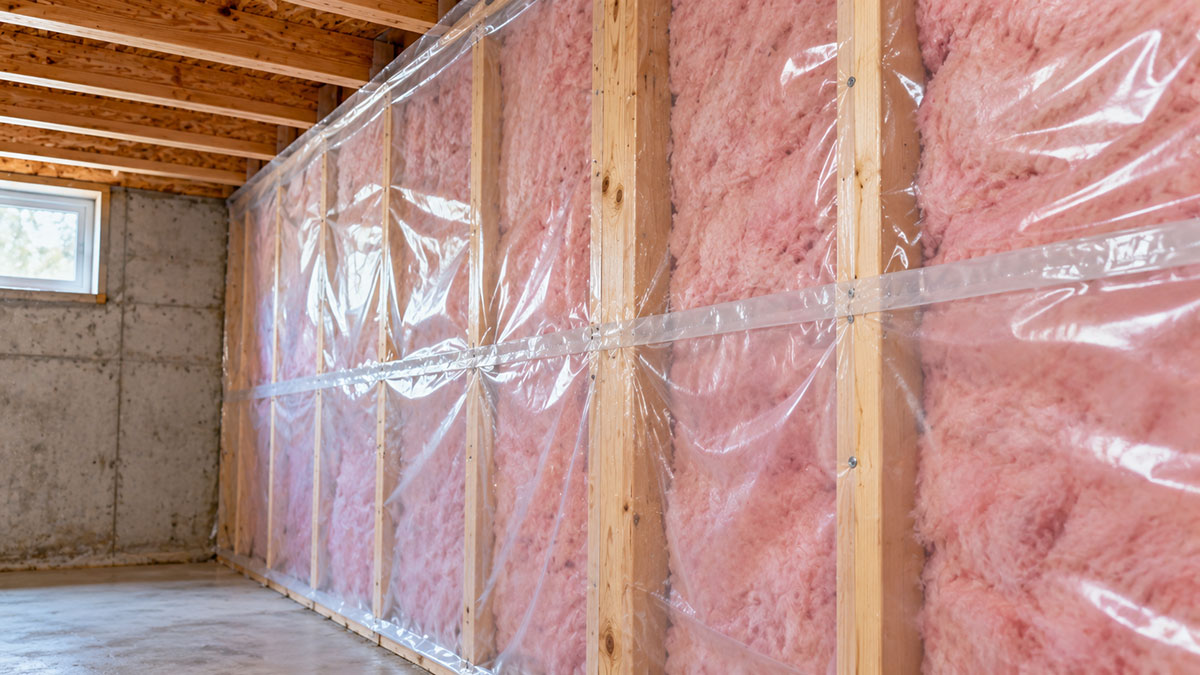
Batts are spun glass fiber cut into panels sized for standard joist and stud spacing. They come faced or unfaced, and the facing (kraft paper or a foil layer on one side) acts as a vapor retarder in some climates.
This batt insulation format is the same one used in walls and floors, just cut to attic joist depth.
It’s the cheapest material here and easy to find, which is why it’s the usual DIY pick. Once it’s installed dry, it doesn’t settle or lose R-value over time.
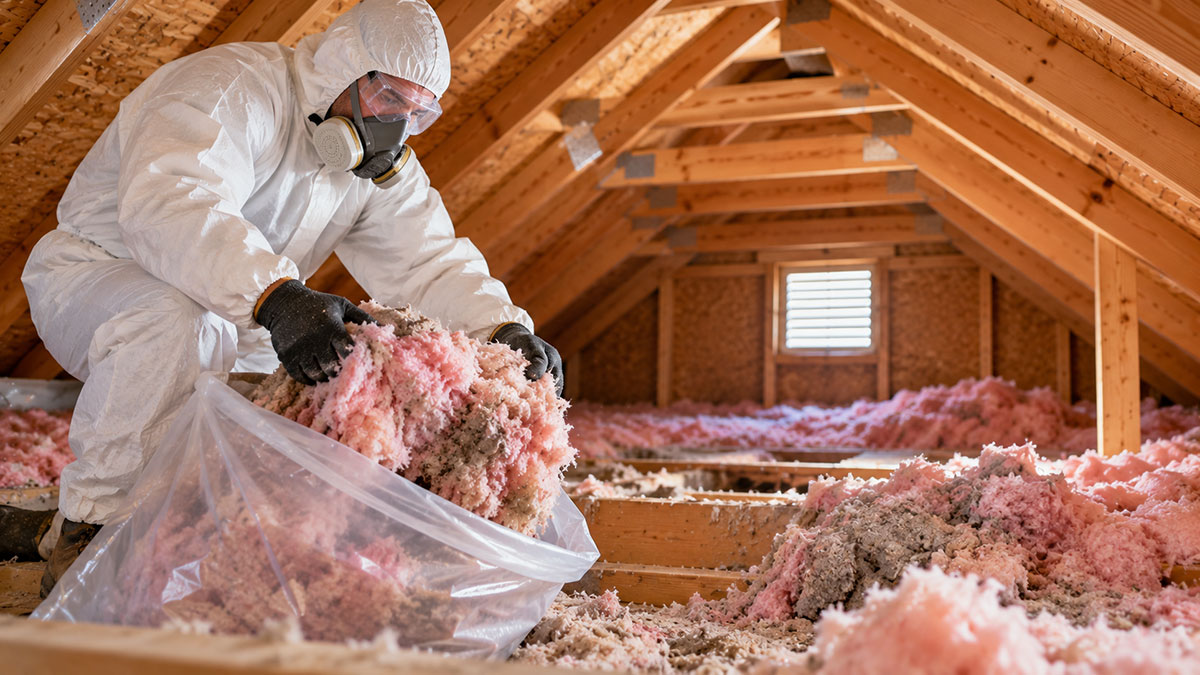
The problems show up around wiring and pipes, and anywhere the framing is irregular. Gaps there pull real-world performance well below what the bag promises. The dust also irritates skin and lungs, so wear a respirator.
Owens Corning’s PINK batts remain the best-known product in this category, and the color itself is trademarked, not a technical spec.
For a simple, unobstructed attic floor with standard joist spacing, batts perform best. Honestly, I’d still call them the default there.
Blown-In Loose-Fill Insulation
A machine blows loose fiber into the attic instead of anyone laying down sheets.
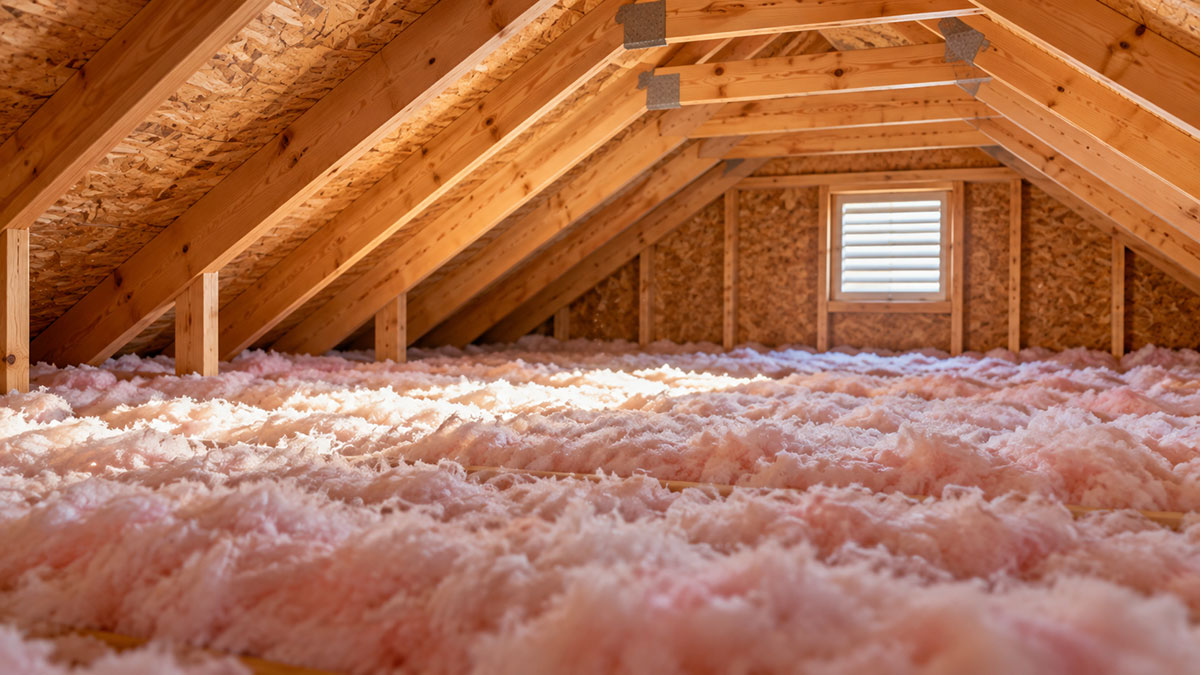
The loose-fill insulation method fills joist bays and irregular framing that batts tend to leave open. Fiberglass and cellulose dominate it.
Blown-In Fiberglass

Same spun glass as batts, just broken into loose tufts. It runs about R-2.2 to R-2.7 per inch and doesn’t absorb moisture, which suits humid attics.
Because it rates lower per inch, coverage needs more depth than cellulose to hit the same target.
Strong ventilation near the eaves can also shift it around over time, more than it moves denser materials.
It does fill joist bays and odd framing that batts miss, so the extra depth is often worth it.
Blown-In Cellulose

Cellulose settles 15 to 20 percent over the first few years, according to building-science data compiled by HomeCalc. That pulls the effective R-value below what gets installed on day one.
The settling is a form of insulation settlement, and it’s the reason contractors overfill cellulose jobs above the target depth.
The material itself is recycled paper, mostly newsprint, treated with borate for fire and pest resistance. It has the highest recycled content of any common insulation and packs more R-value per inch than fiberglass. If the roof leaks, though, it absorbs the water.
GreenFiber is one of the largest cellulose manufacturers in North America and sells both standard loose-fill and stabilized blown formulas.
Spray Foam Insulation
Spray foam goes on as a liquid and expands on contact with air, filling the cavity and air sealing it at the same time.
That’s what sets spray foam insulation apart from every material covered so far, since it insulates and seals in one pass.
It comes in open-cell and closed-cell formulations, and they behave differently enough to count as separate decisions.
Open-Cell Spray Foam

Open-cell foam runs about R-3.5 to R-3.8 per inch, roughly half the rating of its closed-cell counterpart. It expands to nearly one hundred times its liquid volume, which is why it fills irregular cavities so completely.
It costs less than closed-cell and dampens sound well. On the downside, it stays soft after curing and doesn’t block moisture, and you need roughly double the depth of closed-cell to reach the same R-value.
Closed-Cell Spray Foam
Closed-cell foam is denser, rated between R-6.0 and R-7.0 per inch, the highest of any material on this list.
The tight cell structure lets it act as its own vapor barrier at roughly two inches of thickness, which open-cell foam can’t do. It also adds rigidity to the roof deck.
Price is the drawback. It costs two to three times more than fiberglass, and it needs a professional spray rig.
Demilec and Icynene are two of the manufacturers most contractors specify for residential closed-cell and open-cell jobs.
I’d save spray foam for tight roof decks and finished attics where depth is limited. On a wide attic floor that’s easy to get to, other materials usually make more sense.
Mineral Wool Insulation
Most people call it Rockwool, though that’s a brand name and rock wool insulation is the generic term for the whole category. It’s spun from basalt rock and recycled steel slag into a dense fiber, sold as batts or loose product.
It runs about R-3.0 to R-4.3 per inch, close to fiberglass, so fire performance is where it really differs.
Manufacturer testing shows mineral wool fibers withstand temperatures up to 2,150 degrees Fahrenheit without melting, well above the ignition point of most building materials.
That kind of insulation fire rating is why building codes often specify mineral wool around chimneys and flues, and other fire-rated assemblies.
It needs no chemical treatment to resist fire, and it resists mold and pests as well. It also holds its shape and density better than fiberglass over time.
The price is the catch. Mineral wool costs 40 to 70 percent more than fiberglass, and the batts are heavier and stiffer to handle.
Rockwool the company runs dedicated stone wool manufacturing plants in the U.S. specifically to supply this demand.
The premium pays off in attics with a flue or wood stove nearby, or along a shared wall, where fire resistance is the deciding factor.
Rigid Foam Board and Radiant Barrier Insulation
Rigid board adds R-value in a thin solid panel, while radiant barrier blocks heat by reflecting it rather than slowing it.
Rigid Foam Board
Panels get cut to size and fastened to the roof deck or joists.
How well rigid foam board insulation performs depends heavily on the chemistry that gets specified.
Polyisocyanurate, or polyiso, rates highest at R-5.7 to R-6.5 per inch. Extruded polystyrene (XPS) comes in at R-5.0 per inch and does better than polyiso where moisture is a concern. EPS, expanded polystyrene, is the cheapest of the group and also the lowest, at R-3.6 to R-4.2.
A continuous layer of board also cuts thermal bridging through the framing, which batts and loose-fill can’t do on their own.
The downside is labor. Seams need taping to control air leakage, and cutting around obstructions goes slowly.
Owens Corning’s FOAMULAR extruded polystyrene line is a common specification for roof deck applications.
Radiant Barrier
Radiant barrier only makes sense in hot climates, and even there the gain is modest. The U.S. Department of Energy reports that it can cut cooling costs by 5 to 10 percent in hot, sunny climates.
It’s a thin reflective foil, usually stapled to the underside of the rafters, that reflects radiant heat away from the living space instead of absorbing and re-radiating it.
This is a form of reflective insulation, and it works alongside mass insulation rather than replacing it.
Material cost is low, and summer savings are noticeable in hot climates. In cold climates it does very little, and it needs an air gap against the roof deck to work at all.
Radiant barrier makes sense as an add-on in Climate Zones 1 through 3, not as a stand-alone attic solution anywhere.
How Much R-value an Attic Needs by Climate Zone
Where the house sits sets the target, not a single national number.
The U.S. Department of Energy divides the country into climate zones, and each zone has its own minimum for attic floor insulation.
Upgrading an under-insulated attic as part of a sealed, insulated retrofit can save homeowners an average of 15 percent on heating and cooling costs, according to EPA ENERGY STAR estimates.
The DOE targets run R-30 to R-38 in the hot climates of Zones 1 and 2, and R-38 to R-49 in the mixed climates of Zones 3 and 4. Cold climates in Zones 5 and 6 call for R-49 to R-60. The subarctic Zones 7 and 8 sit at R-60.
Climate zone answers most of the question of how much insulation an attic actually needs, but existing depth and the condition of the material already up there can still shift the final number.
A house in Minnesota and one in Florida aren’t solving the same problem, even at identical square footage.
How Much Attic Insulation Costs by Type
Type changes the price more than region does on most attic jobs, for both material and labor. The final invoice still follows access and attic size more than it follows the brand on the bag, and it goes up if old insulation has to come out first.
| Type | Cost per sq ft | 1,500 sq ft attic | Typical payback |
|---|---|---|---|
| Fiberglass batt | $0.30 to $1.50 | $450 to $2,250 | 2 to 4 years |
| Blown-in loose-fill | $1.00 to $2.00 | $1,500 to $3,000 | 3 to 5 years |
| Spray foam | $1.00 to $4.50 | $1,500 to $6,750 | 3 to 6 years |
| Mineral wool | $1.00 to $2.10 | $1,500 to $3,150 | 4 to 6 years |
If that old insulation is wet or contaminated, removing it adds to the bill before any new material goes in. More on that further down.
Return on Investment and Payback Period
The U.S. Environmental Protection Agency estimates that sealing air leaks and adding attic insulation together saves homeowners an average of 15 percent on heating and cooling costs, or about 11 percent on total energy costs.
That figure covers the combined project. It doesn’t describe insulation installed on its own without addressing leaks first.
The federal insulation tax credit that used to offset 30 percent of material costs expired for any project placed in service after December 31, 2025, under current federal law.
State programs and utility weatherization rebates carry more of that cost offset now.
Mass Save, the Massachusetts energy-efficiency program run by the state’s utilities, offers no-cost weatherization assessments that pair with rebates like these.
Payback shrinks fastest in colder zones, where the heating season runs longer and the same R-value upgrade does more work.
How Moisture, Ventilation and Fire Safety Affect Attic Insulation
Insulation manages heat flow, but whether it keeps working depends on moisture and airflow.
Warm, moist air from inside the house rises into the attic and condenses on cold surfaces if it has nowhere else to go.
A vapor retarder controls which direction that moisture can move. Usually it’s the kraft facing on batts, or a separate poly sheet.
Where and how to install a vapor barrier changes by climate, since putting one on the wrong side of the assembly traps moisture instead of blocking it.
Soffit vents at the eaves and a ridge vent at the peak keep air moving across the underside of the roof deck. Without that airflow, moisture builds up and leads to condensation and mold, and in cold climates to ice dams along the roof edge.
Baffles at the eaves hold insulation back from the soffit opening, so the material itself doesn’t block the airflow.
Fire and Pest Resistance
Fire and pest resistance come down to the material. Thickness doesn’t change either one.
Building code treats spray foam insulation as flammable on its own, which is why it has to sit behind an approved thermal barrier such as half-inch drywall in living spaces.
The glass fibers in fiberglass won’t burn, but the binder and facing can. Cellulose fiber does burn on its own, and only the borate treatment covered earlier protects it.
Rodents nest in loose-fill insulation more often than in dense batts, and once inside they compact and soil the material, cutting its effective R-value in the affected area.
How Attic Insulation Is Installed
Getting the sequence right matters more than which material goes in, if the job is going to perform at its rated R-value.
Air sealing has to happen before any insulation goes in. A blower door test shows exactly where the attic air leaks are before anyone touches a bag of insulation.
- Inspect the attic floor and check existing insulation depth and condition
- Locate and mark air leaks around penetrations, top plates and recessed lights
- Seal those gaps with caulk, foam or metal flashing as the material requires
- Install baffles at the eaves to keep soffit vents clear of new material
- Add insulation to the target depth or thickness for the local climate zone
- Check final depth against markers and photograph the finished attic for records
Plenty of jobs skip the sealing step and go straight to insulation, and that’s the most common reason an upgraded attic underperforms its rated R-value. At least in my experience, it’s the step people skip most.
DIY vs Professional Installation
Fiberglass batts are fine for a DIY job, since you just cut and fit them by hand. Rigid foam board works too if the attic floor is accessible and flat.
Spray foam is professional-only in practice, because it needs a heated rig and a certified applicator. Dense blown-in jobs belong with a pro as well, since uneven coverage quietly wastes material and R-value.
Renting a blowing machine is possible at most large home centers, but hauling it up and running it alone in a hot attic takes longer than most people expect.
When Attic Insulation Does Not Solve the Problem
Attic insulation fixes heat transfer through the ceiling plane and nothing else. Several common attic problems sit outside that job, no matter how much material gets added.
An active roof leak has to be repaired before any material goes in wet. Leaky HVAC ducts running through the attic waste conditioned air regardless of the R-value overhead. Unsealed air leaks keep moving air and moisture past the insulation layer, and structural or framing damage needs its own repair first.
Older homes sometimes still have vermiculite loose-fill hiding under later insulation layers, and it helps to know how to tell cellulose apart from older asbestos-based loose-fill before disturbing anything up there.
The EPA estimated in 1985 that roughly 940,000 U.S. homes contained vermiculite attic insulation, most of it traced back to a single contaminated mine in Libby, Montana.
Pest activity is another dead end for a straight insulation upgrade.
Getting rid of mice nesting under attic insulation has to happen first, since new material just goes back to hosting the same problem otherwise.
And past roughly R-60, adding insulation to an attic stops paying back at any meaningful rate, since the extra heat blocked per added inch keeps shrinking.
FAQ on Attic Insulation Types
Which attic insulation type is best for an older home with existing insulation?
It depends on what’s already up there. Dry, intact fiberglass takes a layer of blown-in cellulose well. Compressed or moldy insulation, or anything mixed with vermiculite, needs removal and testing first. Mineral wool is the better fit if the house also needs stronger fire resistance.
Can you mix two types of attic insulation in the same attic?
Yes, and it’s common. Blowing cellulose or fiberglass over existing batts adds R-value fast, provided the old layer is dry and unfaced or the facing gets slit first. Spray foam and loose-fill can be combined too, though layered rather than blended.
What signs indicate an attic is under-insulated?
Ice dams along the roof edge are one of the clearest signals, along with uneven room temperatures. Heating bills that run high for the home’s size point the same way. If joists are poking through the insulation, or there’s frost on nail heads in winter, the layer is too thin.
What does an insulation’s R-value testing standard actually measure?
It measures how much a material resists steady heat flow between a hot and a cold plate. Loose-fill uses a related method, ASTM C687, while spray foam follows ASTM C1029. The methods differ by material, but they all rest on the same heat flow meter principle.
Are attic insulation materials certified by any industry standards body?
Yes. The North American Insulation Manufacturers Association sets fiberglass and mineral wool standards, and the Spray Polyurethane Foam Alliance covers spray foam formulations. Products also carry ASTM ratings and building-code listings that contractors verify before any attic installation begins.
Does a rebate or weatherization program cover attic insulation cost?
The Weatherization Assistance Program, run through the Department of Energy, covers full insulation costs for qualifying low-income households. Everyone else gets a smaller share from utility and state rebates, which typically apply now that the federal tax credit has expired.
What Should You Fix First in Attic Insulation Types?
Attic insulation delivers its full R-value only after moisture and pest problems are dealt with and air leaks are sealed. Matching the material to the local climate zone comes after that.
Start with any roof leaks, pest damage or vermiculite. Seal the air leaks at penetrations and top plates next. Material and depth for the climate zone come last.
Reversing that order wastes money.
A high R-value material installed over unsealed leaks rarely reaches its rated payback window, since moving air keeps carrying heat past the layer anyway.
Choosing spray foam for the fastest R-value gain also means accepting a material a later electrician can’t cut around without professional removal, unlike batts or loose-fill.
Anyone comparing spray foam or cellulose insulation for that final step should settle moisture and air sealing before comparing materials.