Most people try to saw through a fiberglass batt while it’s still puffy, and it goes badly. The blade drags. The fiber pulls into strings instead of parting, and you end up with an edge that looks chewed rather than cut. Squash the batt flat under a straightedge first and the same knife goes through it in one pass.
Same technique on wall batts, attic batts, rolled blanket, and the denser products above R-30. There is no separate contractor version of it.
One number worth knowing before you measure anything: a standard R-19 batt is 6.25 inches thick and a 2×6 wall cavity is 5.5 inches deep. Push the first into the second and NAIMA’s 2020 compressed R-value chart puts the result at R-18. You give up a point just getting it in there.
What Is Fiberglass Insulation?

Spun glass, drawn into fine strands and bound together with resin. That’s the material. It goes into stud cavities, joist bays, and duct chases to slow heat moving between conditioned and unconditioned space, and it deadens sound as a side effect.
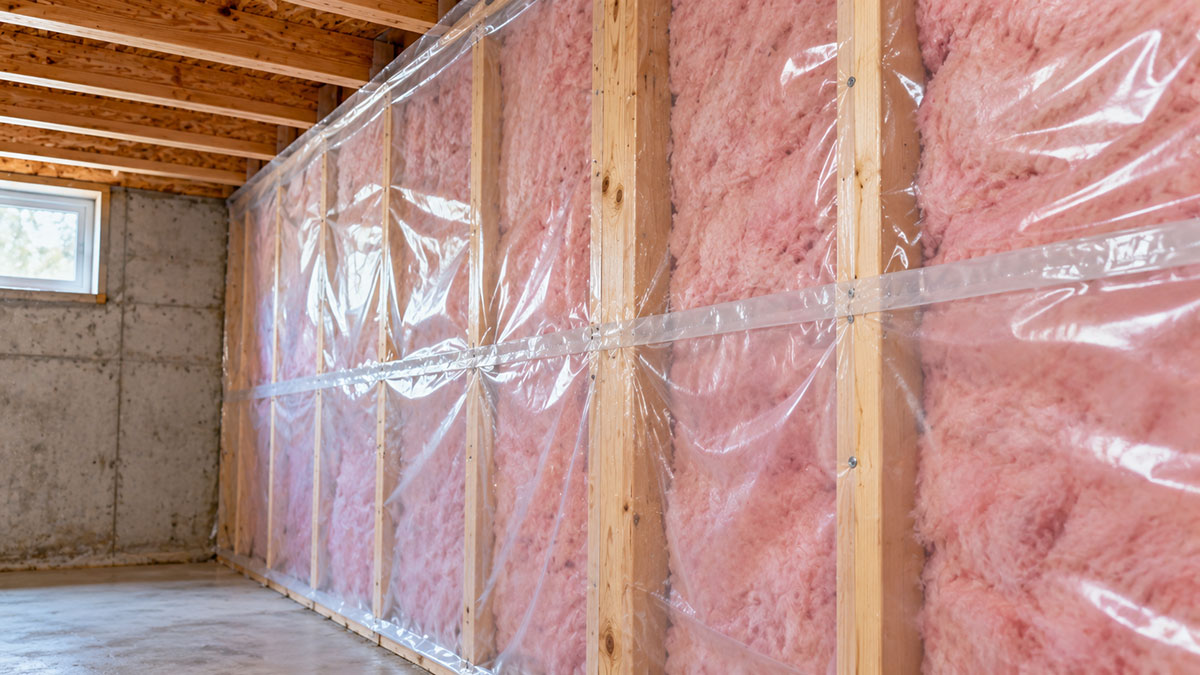
Facing is where the versions split. Kraft-faced batts carry a paper vapor retarder on one side. Foil-faced do the same job with a reflective layer instead. And then unfaced, which has nothing on it and holds position by friction alone.
That paper or foil layer works as a built-in vapor barrier insulation, meant to slow moisture movement into the wall before it reaches the drywall.
Faced batts also carry a covering requirement most homeowners never hear about. Owens Corning’s own product specs treat exposed kraft facing as a hazard, tying directly into the batt’s insulation fire rating, and require the facing to sit behind a code-rated wall or ceiling finish rather than stay exposed.
Johns Manville and CertainTeed sell the same faced-versus-unfaced split, which is why a knife that trims one brand’s batt trims the other just fine.
Types of Fiberglass Insulation and How Each One Cuts Differently
Batts and rolls get cut with a knife. Loose-fill gets blown or poured into place, so a blade never enters the picture at all.
| Form | R-Value Range | Cut With a Knife | Typical Location |
|---|---|---|---|
| Batt | R-11 to R-30 | Yes | Walls, floors |
| Roll (blanket) | R-13 to R-38 | Yes | Attics, long joist runs |
| Loose-fill | 2.2 to 3.8 per inch | No | Attics, retrofit walls |
| Faced batt | R-11 to R-30 | Yes, plus a facing score | Exterior walls, ceilings |
Batt and Roll Insulation
Batt insulation arrives pre-cut to standard stud-bay lengths. Rolls arrive as one long continuous piece, cut to length on site, usually while you’re hunched under a rafter somewhere.
- Batts: pre-cut, easier to handle in short wall cavities
- Rolls: continuous length, better for long attic runs
- Both compress and slice the same way under a blade
CertainTeed and Johns Manville both sell batts and rolls in the same standard widths, so a technique that works on one brand carries straight over to the other.
Loose-Fill Insulation
Loose-fill fiberglass skips the cutting step entirely. It gets blown into open attics or dense-packed into closed wall cavities through a hose, sized by depth and coverage chart rather than by a cut line.
That’s the main reason loose-fill insulation behaves nothing like a batt on a job site, and why nobody reaches for a utility knife when it’s the material on hand.
It has its own annoyances. Loose-fill settles a few inches over the years, which thins coverage right at the edges of a joist bay where you can’t see it happening. It needs a blower machine most homeowners don’t own and end up renting for a day. And keeping it clear of soffit vents takes baffles installed beforehand, which is a job people skip and then regret.
Faced vs Unfaced Batts
An unfaced batt takes one pass. Straight through, done.
A faced batt takes two, because the facing is a separate material and scoring it first stops the paper from bunching up ahead of the blade.
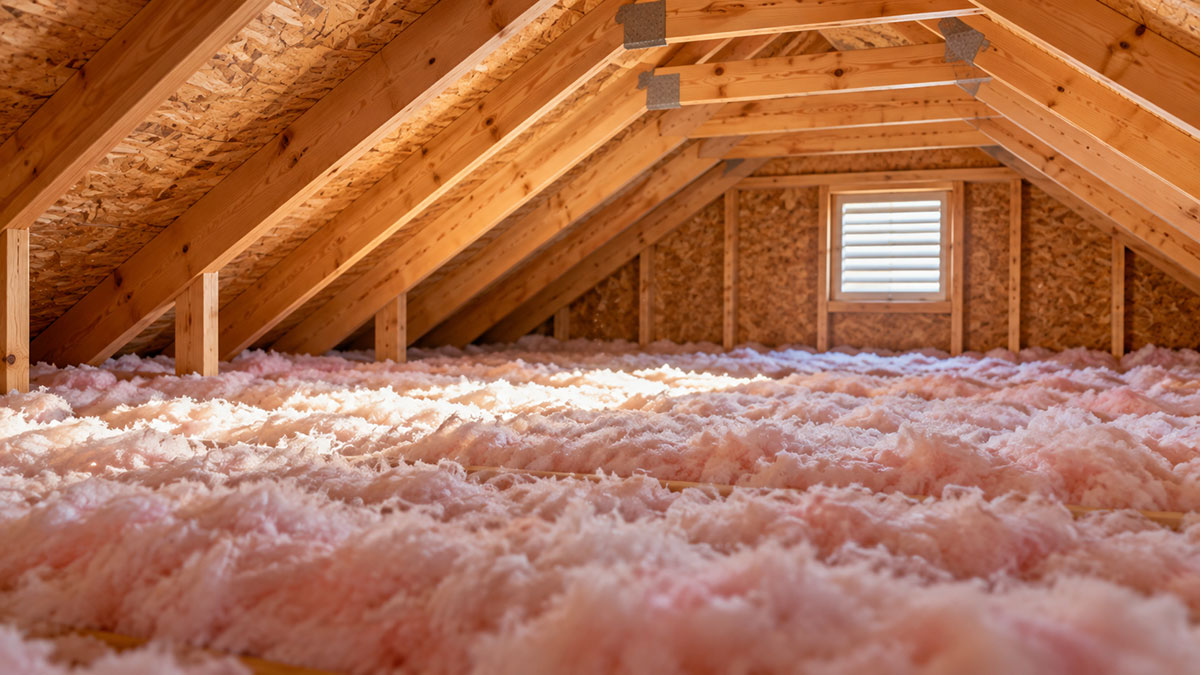
The Department of Energy recommends attic R-values between R-30 and R-60 depending on climate zone, and working out how much insulation you actually need in your attic against that range is what decides how thick a batt has to be before it goes anywhere near a blade.
Tools Needed to Cut Fiberglass Insulation

You need a sharp blade, something straight and rigid to press down with, and a flat surface underneath. A dedicated insulation knife helps on thick batts, though plenty of jobs never call for one.
Utility Knife vs Insulation Knife
The utility knife already in your toolbox handles most of this. On a thin R-13 wall batt it’s the better tool, full stop. Where it starts to struggle is anything above R-30, where you’re making three or four passes to get through, and against resin-heavy facing, which wears an edge down faster than you’d expect.
An insulation knife is the long serrated one. It saws through a thick batt in a single stroke. Malco Products makes the version most building supply houses stock. For one wall in a spare bedroom it’s overkill. For an attic it pays for itself in the first hour.
A fresh-bladed utility knife also handles rigid foam board insulation, though the technique changes since foam snaps along a scored line instead of compressing.
Straightedge and Cutting Surface
A drywall square works. So does any straight scrap of wood. The real job of the straightedge is compressing the batt flat, not just marking a line.
Pressing down hard along that line is the entire trick behind insulation compression, since a blade slices cleanly through squeezed fiber but drags and tears through loose, fluffy fiber.
- Plywood scrap or the subfloor works fine as a base
- A second pair of hands helps on long roll lengths
- Keep the facing side up so the cut line stays visible
Safety Gear for Cutting Fiberglass Insulation Without Skin Irritation

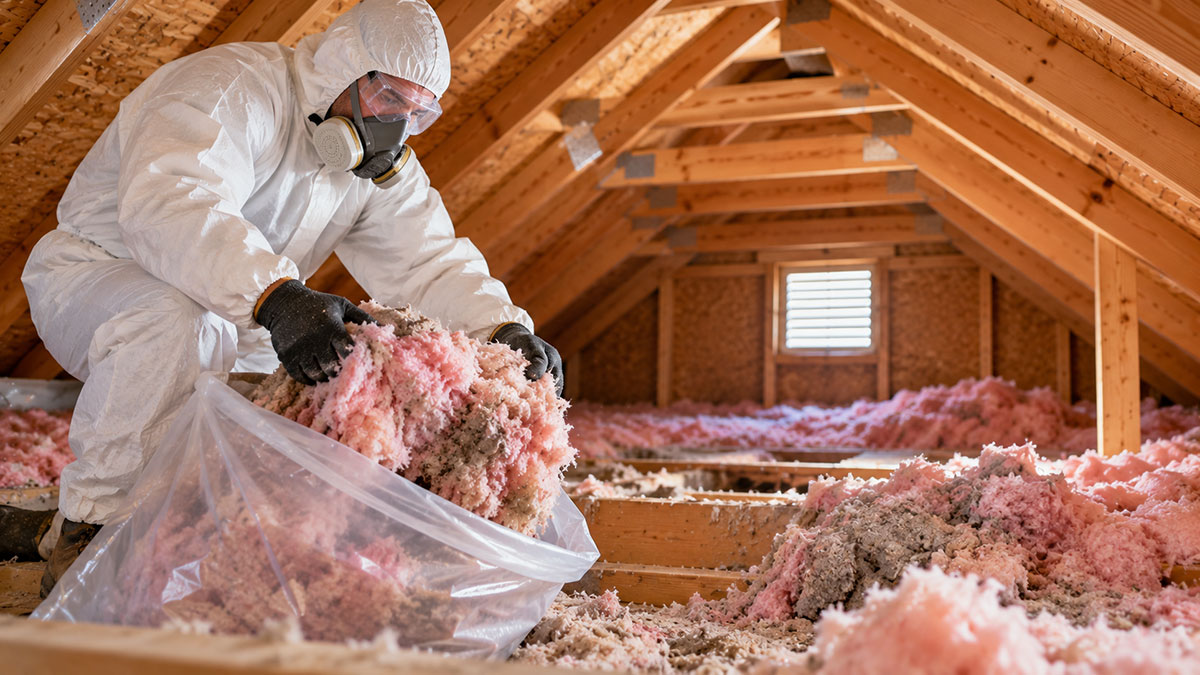
Cutting fiberglass throws fine glass particles and shed resin dust into the air right around the cut line. An N95 on your face, goggles rather than glasses, sleeves down to the wrist. That’s the floor, not the deluxe setup.
The numbers behind that, if you want them:
- OSHA permissible exposure limit for fibrous glass: 15 mg/m3 total dust, 5 mg/m3 respirable dust (OSHA)
- NIOSH recommended exposure limit: 3 fibers per cubic centimeter, time-weighted average (NIOSH)
- N95 respirators filter at least 95 percent of particles at 0.3 microns, the hardest particle size to trap and well below the size of airborne fiberglass fragments (NIOSH)
Respirator and Eye Protection
Any NIOSH-rated N95 blocks fiberglass at the particle size that matters. 3M lists the Aura 9205+ for fiberglass insulating work specifically, right alongside sanding and drywall cutting, if you want one that names the job on the box.
Goggles beat plain safety glasses here, because loose fiber drifts sideways and around open lenses. A snug seal on the respirator matters more than whose logo is on it.
Why Fiberglass Irritates Skin
Itching isn’t an allergic reaction.
Short glass fibers physically lodge in the top layer of skin and mechanically irritate the nerve endings there. That’s the itch. No allergic component behind it at all.
That distinction matters when people ask whether fiberglass insulation is safe to handle, since the reaction is mechanical and temporary rather than a sign of toxic exposure.
Cold water and a soft washcloth pull out more fiber than hot water does. Heat opens pores and lets the fiber work in deeper, which is the opposite of what you want after a day of this.
How Much Oversize to Cut Fiberglass Insulation for a Tight Fit

Cut about a half inch wider than the cavity opening. Not flush to it.
That small excess lets the batt spring back against the framing on both sides instead of leaving a gap.
Owens Corning sizes standard batts and rolls at 15 inches wide for 16-inch on-center wall framing, or 23 inches wide for 24-inch on-center framing (Owens Corning product specifications). Actual stud bays run a touch narrower than those nominal numbers once drywall thickness and slightly bowed studs get factored in, which is exactly why the margin exists.
Cut it flush instead and a small gap opens along one edge, dropping the effective R-value of that whole bay even though the batt itself is rated correctly.
- Half inch oversize on width and height for standard wall bays
- An inch or more oversize when fitting around an odd angle
- Never force more than an inch of compression on any single edge
Push past that limit and the batt turns into compressed insulation along the framing, thinning the fiber and lowering the R-value right where the wall needed it most.
How to Cut Fiberglass Insulation Step by Step

The sequence is short enough that nobody needs to write it down. The step people skip is the compression one, and skipping it is why the blade drags.
- Measure the cavity and mark the batt with a straightedge, adding a half inch for spring-back
- Lay the batt facing down on plywood or the subfloor
- Press the straightedge into the marked line and compress the batt flat
- Draw the blade along the line in one continuous pass, then pull the two pieces apart
This works on batt insulation and on rolled blanket cut to length, since both compress and slice the same way once they’re flat on a surface.
Owens Corning’s own install sheet gives installers the same instruction: shape and size the batt using nothing more than a utility knife.
Once the piece is cut, installing fiberglass insulation into the cavity is its own separate sequence of friction-fitting, stapling flanges, and trimming the last edge flush.
A dull blade is the single most common reason this goes wrong. It drags fiber into a ragged edge instead of slicing through it.
How to Cut Fiberglass Insulation Around Outlets, Pipes, and Ducts

Obstacles mean notching rather than one straight line, and what you’re going around changes the cut.
Outlets and Switch Boxes
Electrical boxes stick out from the stud face, so the batt needs a notch cut around three sides of the box rather than a hole punched straight through the middle.
- Mark the box outline directly onto the facing before cutting
- Cut just past the box edge, not flush against it, so wiring stays clear
- Never compress insulation directly against a hot junction box
Keep insulation clear of any fixture that isn’t rated for zero-clearance contact. That’s code, not preference.
Pipes and Ductwork
A pipe running through a cavity needs the batt split, not notched. Slice the batt to roughly half its thickness, wrap one half above the pipe and one half below, then butt the two seams together.
Splitting the batt this way changes its local thermal conductivity a little, since compressed fiber pressed right against the pipe never gets its full loft back.
Around a duct boot, trim the batt to clear it by an inch so airflow isn’t restricted. Flex duct needs a lighter touch, since pressing the insulation edge against it will crush the duct if you lean on it.
Common Mistakes When Cutting Fiberglass Insulation

This goes wrong in a handful of predictable ways, and most of them trace back to a skipped step rather than the wrong tool.
| Mistake | Why It Happens | Fix |
|---|---|---|
| Sawing instead of compressing | Cutting through loose, un-pressed fiber | Flatten the batt with a straightedge first |
| No flat backing surface | Cutting mid-air or across a knee | Work on plywood or the subfloor |
| Reusing a dull blade | Resin binder wears an edge down fast | Swap in a fresh blade every roll or so |
| Trimming flush, not oversized | Treating the cavity line as the cut line | Add a half inch margin on every side |
Sawing back and forth instead of compressing first shreds the facing into loose strips rather than leaving one clean edge.
The dull blade problem has a safety side to it too. Nearly 40 percent of injuries tied to manual workshop tools involve knives with retractable blades, according to the Consumer Product Safety Commission. A dull blade needs more downward force to get through a batt, and that extra force raises the odds of the blade slipping sideways into a hand instead of staying in the fiber.
More pressure means less control.
A flush cut doesn’t announce itself on the day you make it. You find out months later, usually in winter:
- A cold strip along one edge of an exterior wall
- A faint draft at a baseboard that wasn’t there before the insulation went in
- A gap visible with a flashlight from inside an unfinished attic
Irwin and Stanley both sell their utility blades in ten-packs rather than single units, since the blade is meant to be swapped, not sharpened.
When Cutting Fiberglass Insulation Yourself Does Not Work
A few situations put this outside DIY territory, and none of them are about how good you are with a knife. It’s the condition of the material, or the code covering the wall.
Water-Damaged or Moldy Batts
The EPA’s own mold remediation guidance lists fiberglass insulation under materials to discard and replace, not dry out and reuse, once it has sat wet for more than a day or two.
Mold can start growing within 24 to 48 hours of that exposure, per EPA and CDC guidance. That’s faster than most attics get inspected after a roof leak.
None of that applies to insulation that simply got old. Home Innovation Research Labs, in research funded by NAIMA, found aged fiberglass batts still holding an average of 95.5 percent of their labeled R-value after roughly 40 years in service. Dry, undisturbed fiberglass does not need re-cutting or replacing on any set schedule. Wet fiberglass does, right away.
Whole-Attic or Whole-House Retrofits
Sizing and cutting dozens of individual batts stops being practical once a job covers an entire attic floor or every wall cavity in an older house.
That’s when retrofit insulation work shifts to a blower and loose-fill fiberglass or cellulose instead, since coverage speed matters more than a clean cut line at that scale.
Existing Respiratory or Heart Conditions
OSHA’s own guidance on voluntary respirator use tells anyone with a cardiovascular or breathing condition to check with a doctor before strapping on an N95, since the mask itself adds resistance to every breath.
Cutting batts inside a closed attic without strong ventilation is exactly the situation where that warning matters most.
Continuous Insulation Code Requirements
The 2021 IECC now requires a layer of continuous insulation on many wood-framed walls in colder climate zones, stacked on top of whatever batt sits inside the cavity.
A perfectly cut batt satisfies the cavity R-value and nothing beyond it. In Title 24 states and other jurisdictions with the same rule, that gap between cavity insulation and full code compliance calls for a licensed contractor, not a sharper blade.
- Wet or moldy batts: replace, don’t recut
- Whole-house jobs: loose-fill, not batt by batt
- Health conditions: check with a doctor before masking up
- Coded exterior walls: continuous insulation goes on top of the cavity
FAQ on How To Cut Fiberglass Insulation
How Much R-Value Do You Need for Your Climate Zone?
Attic R-value targets run from R-30 to R-60 depending on climate zone, per Department of Energy guidance. Wall cavities generally need R-13 to R-21, and local codes sometimes require more.
Is Cutting Mineral Wool Insulation Different From Cutting Fiberglass?
Mineral wool (rock wool) batts are denser than fiberglass, so they hold a straight line under a blade with less compression needed. A serrated insulation knife cuts mineral wool cleanly; a light utility knife blade dulls faster on it.
How Do You Dispose of Fiberglass Insulation Scraps?
Bag cut scraps in heavy plastic and seal it before leaving the room, since loose fiber drifts easily. Most municipalities accept sealed fiberglass in regular household trash. Curbside recycling will not take it; large renovation volumes go to a landfill drop-off instead.
Can You Cut Fiberglass Insulation Without a Respirator?
Nothing stops a person from cutting without an N95 respirator, but airborne glass fiber and resin dust go straight into the lungs and throat instead of a filter. A short cut in good ventilation carries less risk than a full attic job.
What Should You Get Right First in How To Cut Fiberglass Insulation?
One decision before the first cut carries the rest of it: whether the batt sits flat and compressed against a straightedge. Every later step depends on that single point of contact.
A cavity with more than one obstacle in it also needs its own order of attack, separate from the cut itself.
- Outlet box first
- Pipe run second
- Duct boot last
Outlet position is fixed by the electrician’s rough-in and pipe runs rarely move once set, but duct boots shift during HVAC trim work. Cutting around them last saves a second trip back.
Pre-cut batts make sense on a fast job where every bay is the same width. Sizing on site is slower, and what you get for that is the ability to fill cavities a supplier’s fixed-width catalog doesn’t stock.
A cut batt still needs proper depth once it reaches the joist bay, where installing insulation in an attic becomes its own separate skill.