Contractors and energy code officials treat open cell vs closed cell spray foam as two different materials, even though both come out of the same two-component polyurethane chemistry. Density is the visible difference. R-value per inch and vapor permeance change too, and only one of the two adds anything structurally.
The structural side gets mentioned less than it should. Spray Polyurethane Foam Alliance testing at Architectural Testing Inc. found that closed-cell foam raises a wall assembly’s racking strength by 70 to 200 percent over the same wall left unfoamed, according to Walls and Ceilings, 2026.
What Is Open-Cell and Closed-Cell Spray Foam?

Two liquids, an isocyanate and a polyol resin, get mixed at the spray gun. They react on contact, expand, and harden into either open-cell or closed-cell foam depending on the formulation.
Both make an air seal while they expand, which is a big part of why spray foam gets specified over batts in tight or irregular framing.
People tend to lump the two together. Once cured they behave like different materials, even though both sit under the broader heading of spray-applied polyurethane insulation.
| Attribute | Open-Cell Foam | Closed-Cell Foam |
|---|---|---|
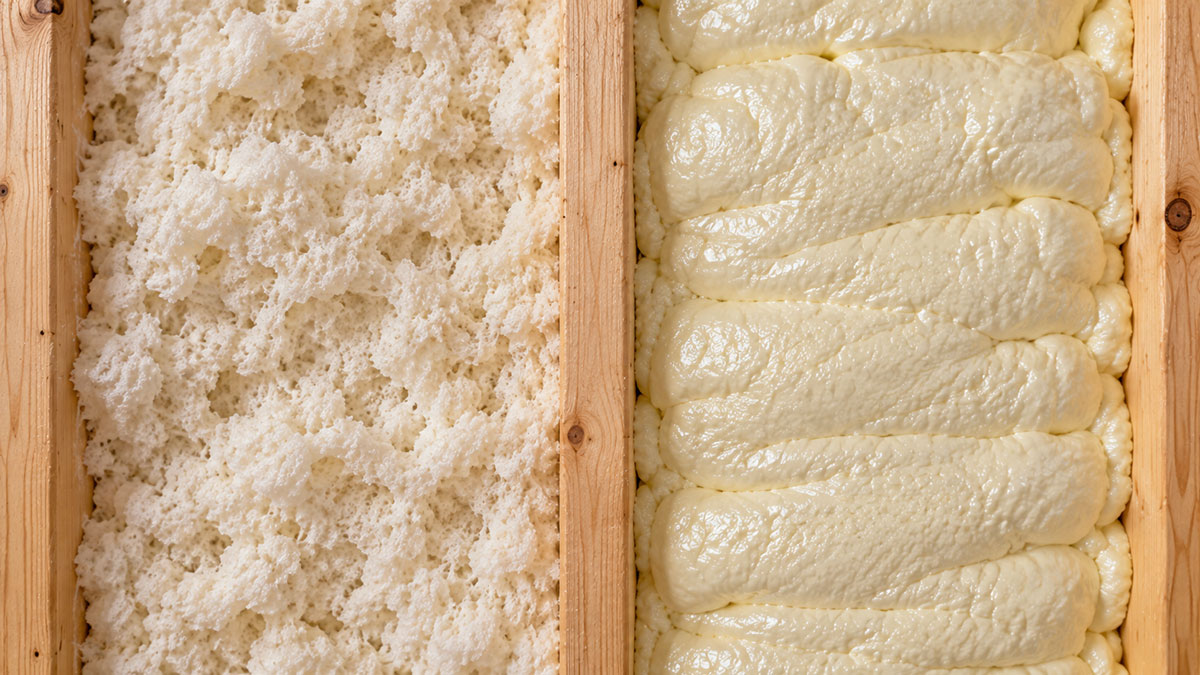
| Cell structure | Cells rupture open during cure | Cells stay sealed and gas-filled |
| Density | 0.4 to 0.6 lb per cubic foot | 1.5 to 2.2 lb per cubic foot |
| R-value per inch | R-3.5 to R-3.8 | R-6.0 to R-7.0 |
| Vapor permeance | Vapor-open, Class III | Vapor-retarding, Class II at 1.5 to 2 in |
| Typical cost per board foot | Lower | Higher, roughly 1.5 to 3 times open-cell |
Open-Cell Spray Foam

Open-cell foam cures soft and spongy because its cell walls rupture as it expands. That open structure lets it fill oddly shaped cavities without putting much pressure on the framing.
Density sits around 0.4 to 0.6 pounds per cubic foot. It expands up to roughly 100 times its liquid volume, and it’s soft and breathable enough to trim easily after cure.
Icynene, founded in 1986, built its early reputation on this exact formulation and helped popularize open-cell foam as a residential attic and wall product in the years that followed.
Closed-Cell Spray Foam
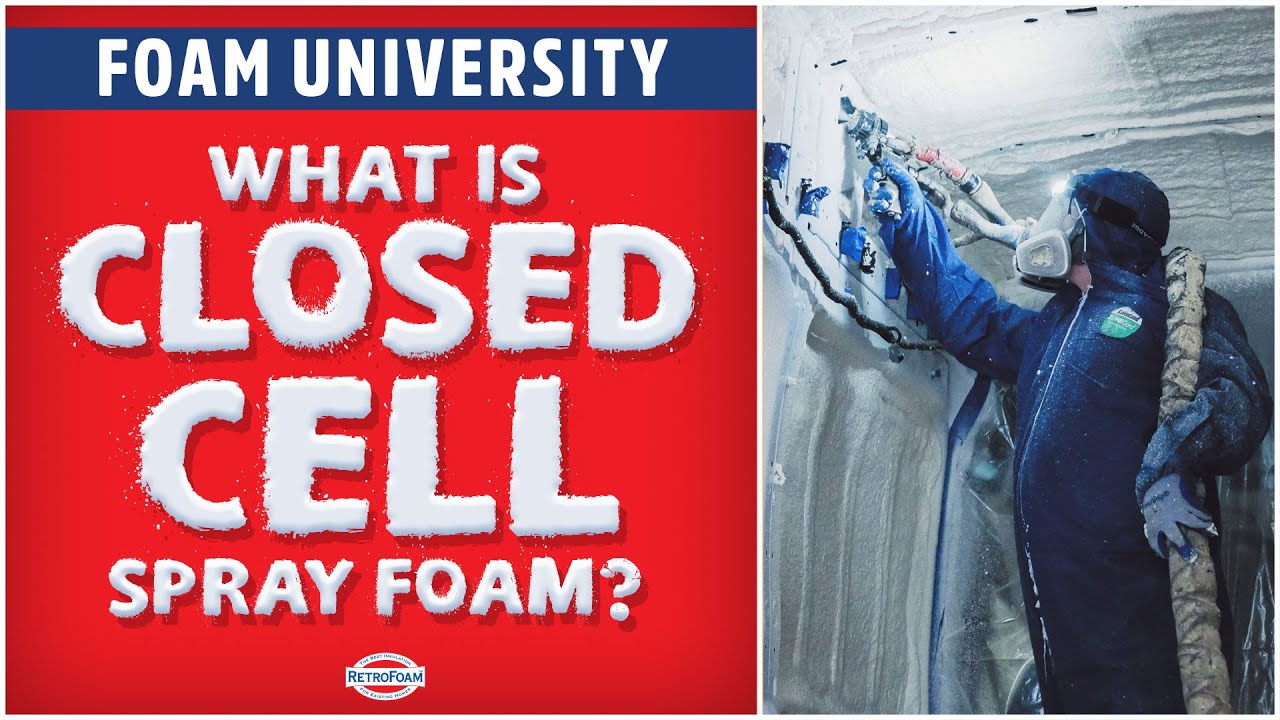
Closed-cell foam keeps its gas-filled cells intact after cure, and that gives it a hard, dense shell. Density runs around 1.5 to 2.2 pounds per cubic foot and it expands roughly 30 to 35 times its liquid volume. Once fully cured, it’s rigid enough to walk on.
The principle is the same one behind closed-cell insulation generally, whether it arrives as rigid foam board or as a sprayed system.
Demilec and Lapolla Industries both sell closed-cell lines built around this sealed-cell chemistry, positioned for below-grade and roofing work.
Open-Cell vs Closed-Cell R-Value and Thermal Performance

Closed-cell foam wins on R-value per inch, and what fills the cells after cure explains why. Once the walls of an open-cell structure rupture, the cells hold ordinary air. Closed-cell foam traps a low-conductivity blowing-agent gas in sealed pockets, and that gas is what most R-value comparisons are really measuring.
Per inch, closed-cell spray foam delivers roughly R-6.0 to R-7.0, compared with R-3.5 to R-3.8 for open-cell foam (ArmorThane, 2026).
In a standard 3.5-inch, 2×4 wall cavity, closed-cell foam reaches about R-21 to R-24 and open-cell foam reaches about R-12 to R-13 (RainyRoofers, 2026). Density follows the same split, with closed-cell foam curing at roughly 1.5 to 2.2 pounds per cubic foot and open-cell foam at roughly 0.4 to 0.6 pounds per cubic foot (R-Value Associates, 2026).
A continuous foam layer also cuts down on thermal bridging through the studs themselves. Batt insulation can’t do that, since it only fills the cavity and leaves the framing exposed. That matters for whole-building envelope performance, and not just for the number printed on a spec sheet.
R-Value in a Standard 2×4 Wall Cavity
A 3.5-inch fill of closed-cell foam takes up a standard stud bay and lands at roughly R-21 to R-24. In warmer and mixed 2021 IECC climate zones (roughly Zones 3-4) that clears the cavity-fill target on its own. Colder zones (5-8) call for additional continuous insulation on a 2×4 wall to meet code.
Open-cell foam in the same cavity lands closer to R-12 to R-13, which usually falls short of that target unless exterior insulation gets added.
Huntsman Building Solutions markets its medium-density HBS closed-cell line squarely within that upper range, for jobs where every inch of cavity depth counts.
Neither number changes with a better contractor. Density and cell structure set them.
Vapor Permeability and Moisture Resistance in Open-Cell and Closed-Cell Foam
The two handle water vapor in nearly opposite ways, and that decides where each one belongs in a building. Closed-cell foam acts as its own vapor barrier once it’s sprayed past a certain thickness. Open-cell foam stays vapor-open no matter how thick the application gets.
Vapor Retarder Classification
Building codes sort materials into vapor retarder classes by how many perms of water vapor pass through them, measured under ASTM E96.
| Class | Perm Rating | Typical Example |
|---|---|---|
| Class I | 0.1 perm or less | Sheet polyethylene, foil-faced board |
| Class II | 0.1 to 1.0 perm | Closed-cell foam at 1.5 to 2 inches |
| Class III | 1.0 to 10 perm | Open-cell foam, unfaced batts |
Closed-cell foam crosses into Class II at about 1.5 to 2 inches of thickness, and open-cell foam never leaves Class III, even at full cavity depth.
Water Absorption and Mold Risk
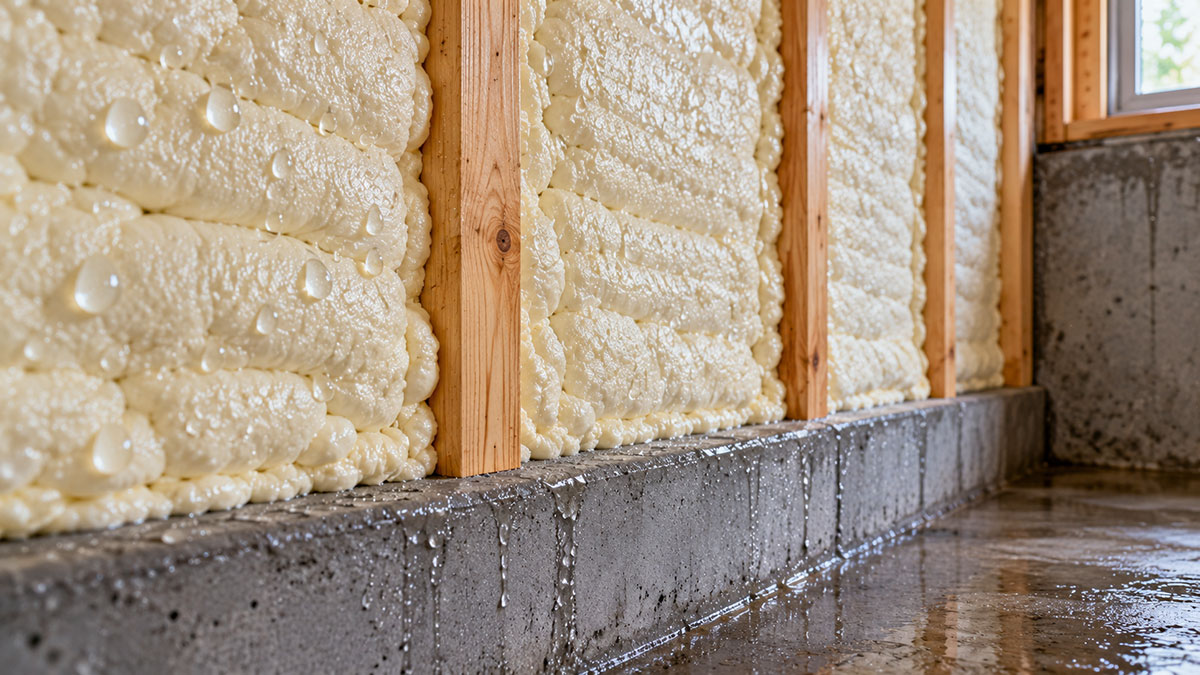
Closed-cell foam resists bulk water well enough for below-grade use, while open-cell foam takes on noticeably more moisture under the same conditions. That gap matters most below grade, where standing water or wicking moisture is a real possibility and not a rare event.
Closed-cell foam can go under a slab or against a foundation wall. Open-cell soaks up water, and it can hold that water against wood framing long enough to start rot.
New England contractor Wade Paquin popularized spraying closed-cell foam directly under a slab before the pour, a technique other builders have since adopted for frost-protected shallow foundations.
Blowing Agents and Global Warming Potential in Spray Foam
The blowing agent turns a liquid polyurethane mix into foam, and it’s also where the two types split chemically. Open-cell foam is blown with water, which reacts with isocyanate and releases carbon dioxide as the expansion gas.
Closed-cell foam historically relied on hydrofluorocarbon (HFC) blowing agents to reach its higher R-value, though that has changed industry-wide over the past two years.
HFC-to-HFO Transition and the 2025 Ban
ThermoSeal USA (2026) puts the global warming potential of HFC-blown closed-cell foam near 1,030. HFO-blown foam sits at a GWP of 1, on par with carbon dioxide, which is the baseline gas the GWP scale is measured against.
Under Environmental Protection Agency rules implementing the American Innovation and Manufacturing Act, new production of HFC-blown closed-cell foam ended January 1, 2025, with sell-through of existing stock allowed until January 1, 2028 (American Chemistry Council).
Water/CO2-blown open-cell foam was never touched by the HFC phase-down. Closed-cell manufacturers have largely moved to HFO blowing agents, many built around the Solstice HFO gas line, which was spun off from Honeywell into the independent Solstice Advanced Materials in October 2025. The phase-down itself traces back to the Kigali Amendment to the Montreal Protocol, which set the broader global HFC reduction targets.
Johns Manville had already moved its closed-cell line to HFO blowing agents ahead of the manufacturing deadline, one of several manufacturers that made the switch early rather than waiting for the ban to force it.
How Closed-Cell Foam Adds Structural Strength
Closed-cell foam bonds tightly to both the studs and the exterior sheathing as it cures, which turns an ordinary stud wall into something closer to a bonded panel.
Open-cell foam doesn’t. It stays soft after cure and adds essentially no structural value to the wall around it.
Open-cell foam tests under 1 psi in compression, so it offers no real resistance to load. Closed-cell foam is rigid enough to carry meaningful compressive force.
National Association of Home Builders (NAHB) research, cited by SprayFoam Magazine, found that walls built with closed-cell foam can carry up to 300 percent more racking strength than the same walls without it.
Third-party racking tests run through the Spray Polyurethane Foam Alliance across OSB, plywood, gypsum board and vinyl siding all point the same direction. Closed-cell foam measurably stiffens the wall it’s sprayed into, whatever sits on the outside.
In some assemblies that means less extra wind or shear bracing. The gain is biggest where the wall starts out weak, which includes light-gauge metal and gypsum-sheathed walls as well as vinyl siding, and it counts most in hurricane and high-wind zones where racking events are a real design load.
Acoustic Performance and Sound Dampening in Spray Foam
Open-cell foam gets marketed heavily for sound control, since its soft, open structure absorbs sound better than a rigid material would. That’s true as far as it goes. Once you look at real wall-assembly testing, the effect is smaller than most product pages suggest, and I’d read those claims with some suspicion.
Journal of Light Construction (2025) reports that neither open-cell nor closed-cell foam meaningfully changes the Sound Transmission Class rating of a standard 2×4 partition wall, citing acoustic engineering firm SoundSense.
Spray foam lacks the mass that actually blocks sound. And because it bonds the wall components together instead of decoupling them, vibration can move through the wall almost as easily as it would with no insulation at all.
Materials built for soundproof insulation specifically, like dense mineral wool, tend to outperform either type of spray foam on Sound Transmission Class scores.
Open-cell foam still helps with echo and reverberation inside a room, even if it doesn’t stop sound from crossing a wall. Closed-cell offers little acoustic benefit beyond its air-sealing effect. If sound isolation is the main goal of a project, neither foam should be the primary strategy.
Fire Codes, Thermal Barriers and Ignition Barriers for Spray Foam
Both types count as a foam plastic under building code, and neither can be left exposed in most occupied spaces without protection. That protection is a thermal barrier or an ignition barrier, depending on where the foam sits in the building.
Every foam product also has to clear a baseline insulation fire rating before it can go behind either barrier, tested under ASTM E84 for flame spread and smoke development.
Under IRC Section R316.3, foam plastic insulation must test at 75 or less for flame spread and 450 or less for smoke development before it can be covered by the thermal barrier required under Section R316.4.
Thermal Barrier Requirements
Any occupied interior space needs a thermal barrier, and that covers bedrooms, living rooms, offices and retail areas under IRC Section R316.4 and IBC Section 2603.4.
Half-inch gypsum wallboard is the most common approved barrier. Quarter-inch plywood or OSB and 3/8-inch cement board are also accepted in many jurisdictions. Whatever the material, it has to hold back heat transmission for at least 15 minutes, which buys occupants time to get out.
Cured foam isn’t inherently dangerous on its own, but the question of whether spray foam insulation is flammable misses the real code issue. It’s a foam plastic, and foam plastics need a fire-rated cover regardless of brand or formulation.
Ignition Barrier Exceptions
Attics and crawl spaces get a narrower exception under IRC Sections R316.5.3 and R316.5.4 and IBC Section 2603.4.1.6, as long as entry stays limited to occasional repairs and not regular use. A lighter ignition barrier qualifies there, such as 1.5 inches of foam plus an intumescent coating, or a product specifically tested and listed for exposed use.
A full thermal barrier is still required anywhere that attic or crawl space connects back to occupied living space. The ignition barrier exception only covers the foam surface facing the attic or crawl space, nothing more.
When a manufacturer’s assembly doesn’t fit the prescriptive thermal barrier rule, code officials typically ask for an ICC-ES evaluation report instead of taking the product data sheet at face value.
Which Spray Foam Is Better for Basements, Crawl Spaces and Below-Grade Walls?
Closed-cell foam is the practical default below grade, and moisture is the reason, not R-value. Basements, crawl spaces and rim joists sit against soil, concrete or masonry that can wick water long after construction wraps up. Open-cell foam’s vapor-open structure and higher water uptake make it a poor match for that exposure.
Most guidance on insulating basement walls points toward closed-cell foam or rigid foam board for exactly this reason, since both resist ground moisture instead of absorbing it.
Closed-cell foam resists bulk water and the moisture wicking out of concrete and soil, and it doubles as an air barrier and a Class II vapor retarder in one layer. The catch is cost per board foot, which adds up fast on tall foundation walls.
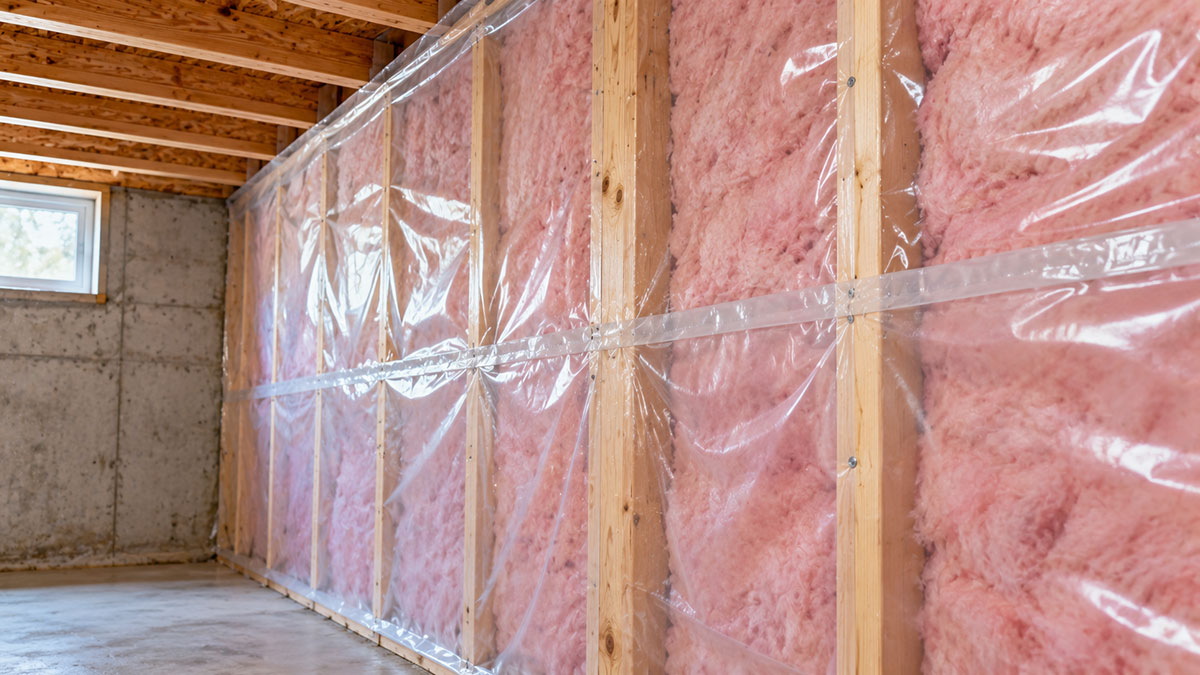
Open-cell is cheaper across large below-grade areas. It needs a separate vapor retarder to be code-compliant in most cold-climate basements, and it can trap and hold moisture against the foundation instead of shedding it.
Metal Buildings and Condensation Control
Metal buildings sweat on the inside of the roof and wall panels whenever warm, moist interior air meets cold metal. Closed-cell foam solves that by pairing insulation with an air and vapor seal in one pass.
BASF markets its Walltite closed-cell line specifically for this kind of condensation control in pre-engineered metal buildings and cold storage structures.
Full encapsulation of a crawl space works along similar lines. The space gets sealed instead of vented, with closed-cell foam sprayed directly on the foundation walls rather than just draped as sheeting.
Anyone doing the work themselves should still check the specifics of installing a vapor barrier in a crawl space first, since a ground-level poly sheet is still required under most codes even after the walls are foamed.
Which Spray Foam Is Better for Attics and Roof Assemblies?
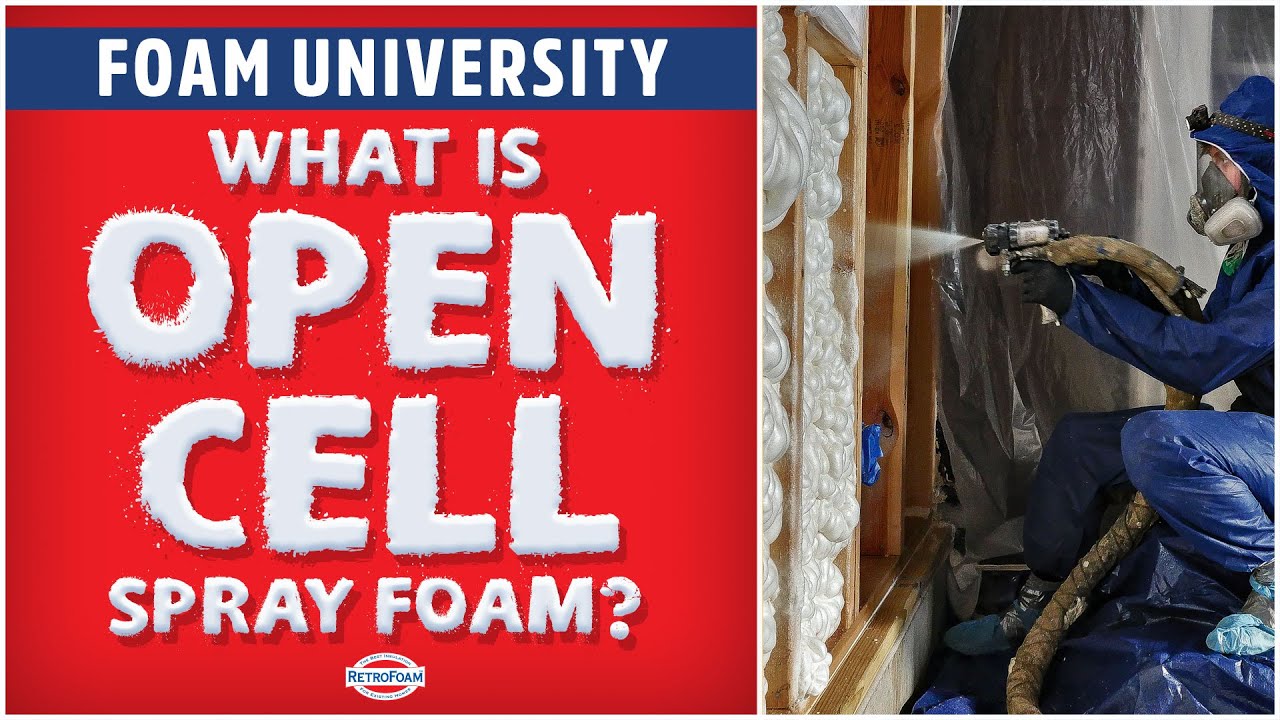
The right foam for an attic depends on whether the roof assembly is vented or sealed, more than on climate. A vented attic floor (the roof deck stays outside the thermal envelope and soffit-to-ridge airflow continues above the insulation) works fine with either type, since the roof itself never becomes conditioned space.
Most attic insulation types compete on that vented-floor job, and open-cell foam usually wins it on cost because the assembly doesn’t need a vapor retarder at the deck.
An unvented, conditioned roof deck is a different assembly entirely, and how much insulation the roof actually needs there depends on climate zone as much as on foam type.
Vented vs Unvented Roof Assemblies
IRC Section R806.5 permits unvented attic and rafter assemblies, but the vapor rules change with climate zone. In Climate Zones 1 to 3, open-cell foam alone typically satisfies the code’s condensation-control requirement at the roof deck. In Climate Zones 5 to 8, air-impermeable insulation at the deck must be, or be paired with, a Class II vapor retarder, which is why closed-cell foam dominates unvented roofs in colder regions.
Climate Zone 4 is often treated as a transition zone, and local building departments frequently want closed-cell or a vapor-retarder coating regardless.
NCFI Polyurethanes markets closed-cell roofing formulations built around this exact use case, sprayed directly to the underside of the deck in unvented assemblies.
A wrong call here stays hidden at first. A year or two later there’s a damp roof deck, once moisture has had time to migrate and condense.
Whichever assembly is in play, the foam still needs whatever ignition or thermal barrier that space calls for.
How Much Does Open-Cell vs Closed-Cell Spray Foam Cost?
Closed-cell foam costs more than open-cell at every stage of a project, from raw material to installed price. Density and chemistry drive the gap. Closed-cell formulations use more material per board foot and, until recently, more expensive blowing agents.
Cost per Board Foot
Open-cell spray foam runs roughly $0.40 to $0.65 per board foot in material cost, while closed-cell runs $1.00 to $1.50 per board foot for the same one-inch, one-square-foot unit (Modernize, 2026).
Board foot pricing is useful for comparing raw material cost, but it leaves out labor, equipment mobilization and job minimums. That’s why most quotes come per square foot instead.
Installed Cost per Square Foot
InsulationRValues.com (2026) puts installed pricing at $1.00 to $3.50 per square foot for open-cell foam and $1.50 to $5.00 per square foot for closed-cell foam, materials and labor included.
A typical 1,000 square foot roof deck runs $3,000 to $5,000 in open-cell or $4,500 to $7,000 in closed-cell. Most contractors also set a job minimum, commonly $1,000 to $2,000, regardless of total square footage, which is the annoying part on small jobs.
Whether spray foam insulation is worth the added cost usually comes down to how much of that price is buying air sealing you’d otherwise pay a separate contractor to handle.
The Environmental Protection Agency estimates that air sealing combined with proper insulation saves homeowners an average of 15 percent on heating and cooling costs, or about 11 percent on total energy costs (ENERGY STAR, EPA).
Against that backdrop, the payback period for a full closed-cell retrofit tends to run shorter in climates with heavy heating or cooling loads, where the energy savings show up faster.
When Spray Foam Insulation Does Not Apply
Spray foam isn’t the right call everywhere, and forcing it into the wrong assembly creates problems that are expensive to undo.
A roof deck or wall cavity with active water intrusion needs to be dried out and repaired first. Foam sprayed over wet framing traps the moisture against the wood instead of letting it dry, which sets up rot that stays hidden until the sheathing fails.
Wiring, plumbing or mechanical runs that get modified regularly are a poor match. Cutting foam out to reach a pipe or a junction box is slow and messy, and it rarely restores the original R-value or air seal.
Older wall systems built to dry to one side, common in pre-1960s construction, are vapor-sensitive. Closed-cell foam seals off that drying path entirely, which can trap moisture and speed up wood decay.
Large, dry attics on a tight budget are another case. When the attic floor is simple, accessible and free of moisture problems, spray foam compared with cellulose insulation often loses on cost per R-value, since blown cellulose covers large flat areas cheaply.
Undocumented assemblies cause trouble too. When a manufacturer’s product hasn’t been tested in the specific assembly a project needs, code officials can reject the installation outright, and no amount of persuasive marketing from the contractor changes that.
In the UK, several major mortgage lenders now decline to lend on homes with spray foam roof insulation until a full inspection clears it, a direct response to unvented roofs installed without proper condensation control.
How Spray Foam Insulation Is Installed
The sequence is fixed whether the crew is running open-cell or closed-cell material. Before the first pass, the crew runs spray rig equipment through a calibration check to confirm the two chemical components are mixing at the correct ratio. Skipping or rushing any step from there is usually where the problems in the next section start.
- Prep the substrate so it’s clean, dry and within the manufacturer’s temperature range, typically 40 to 95 degrees Fahrenheit.
- Mask and protect windows, fixtures and anything else not being sprayed, since overspray bonds to nearly everything it touches.
- Mix and calibrate the A-side isocyanate and B-side resin at the gun before the first pass.
- Apply in controlled passes rather than one thick coat, so the exothermic reaction doesn’t overheat the curing foam.
- Check thickness and density by probing the cured foam and, on larger jobs, cutting and weighing a sample cube.
- Install the required thermal or ignition barrier over the foam before the space is closed up.
- Ventilate the space and hold re-entry until it’s cleared.
Industry practice commonly limits closed-cell lift thickness to roughly 2 inches per pass, since SPFA’s own technical guidance calls for keeping the foam’s internal temperature at or below 180 degrees Fahrenheit during cure. The exact maximum pass thickness depends on the formulation and varies by manufacturer (SPFA Technical Tip I2).
Open-cell foam runs cooler and tolerates thicker single passes without the same scorching risk.
The Environmental Protection Agency notes that many manufacturers recommend 24 hours after application before workers can re-enter without protective equipment, and before residents can safely re-occupy the space (EPA Safer Choice program).
A blower door test after the job wraps up confirms the air-sealing result actually matches what the foam was supposed to deliver, though most residential jobs skip this verification step unless it’s tied to an energy code requirement.
SPFA runs a Professional Certification Program that trains and tests installers on exactly this sequence, one of the few credentials contractors can point to that isn’t self-issued by a single manufacturer.
Common Spray Foam Installation Problems and Failure Modes
Most spray foam failures trace back to the application, not the chemistry.
A contractor on a GreenBuildingAdvisor forum thread described paying for 4.5 inches of closed-cell foam and getting only 2 to 2.5 inches, a gap that traced back to a crew misjudging how much the product would expand.
Off-Gassing and Re-Entry Time
Some smell during spraying and the first day is expected. A strong chemical or fishy odor still hanging around after 48 to 72 hours is not.
Off-ratio mixing, where the A-side and B-side chemicals aren’t balanced correctly, is the most common cause of lingering odor. Expired or contaminated chemical stock reacts unpredictably and can leave unreacted material in the cured foam, and poor ventilation during the cure window keeps vapors in the building longer than they should be.
Whether spray foam insulation is safe after it cures depends entirely on whether the reaction actually finished, which is exactly what that lingering smell is telling you it didn’t.
Shrinkage, Cracking and Trapped Moisture
Closed-cell foam sprayed too thick in a single pass traps its own exothermic heat, and the interior of that thick lift can overheat while the surface cures normally.
The result shows up later as shrinkage and cracking, sometimes with the foam pulling away from the studs. None of it can be patched, so the damaged section has to be cut out and resprayed.
Open-cell foam sprayed against a substrate that was still wet traps that moisture behind it instead of letting it dry, a slower failure that often isn’t visible until drywall comes off during an unrelated repair.
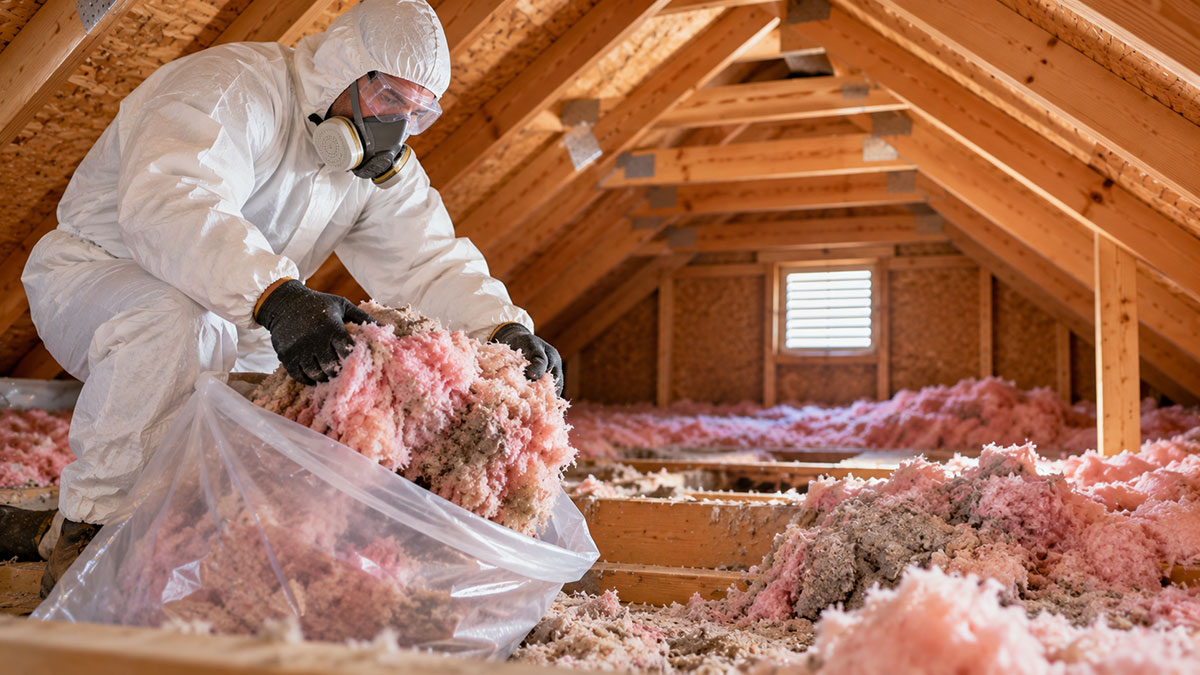
When a section fails outright rather than just underperforming, removing the spray foam insulation back to sound material is the only fix, since there’s no product that bonds reliably to old, cured foam.
FAQ on Open Cell Vs Closed Cell Spray Foam
Is spray foam insulation the same thing as spray polyurethane foam?
Yes. Spray polyurethane foam (SPF) is the technical name code bodies and manufacturers use, and spray foam insulation is the common trade term for the same two-component product. Open-cell and closed-cell foam are both SPF, differing only in cell structure and density.
What are open-cell and closed-cell foam chemically made of?
Both start from an isocyanate, usually MDI, reacting with a polyol resin blend that contains catalysts, surfactants and flame retardants. Open-cell foam is water-blown and releases carbon dioxide as it expands. Closed-cell foam traps a separate blowing-agent gas inside its sealed cells.
Is spray foam worth it compared to fiberglass or cellulose?
It costs more upfront than fiberglass batts or blown cellulose, but it adds air sealing that neither provides on its own. A leaky, hard-to-reach cavity often favors foam, and a large, accessible attic floor tends to go to cellulose.
Can open-cell and closed-cell foam be used together in the same building?
Yes. A technique sometimes called flash-and-batt pairs a thin closed-cell flash coat, usually 1 to 2 inches, against the sheathing for vapor control. The remaining cavity depth then gets filled with open-cell foam or batt insulation to keep material cost down.
How long does spray foam insulation last?
Properly installed spray foam doesn’t settle or lose R-value the way fiberglass or cellulose can over time, and manufacturers commonly warranty it for the life of the structure. Periodic visual checks at accessible cavities still catch shrinkage or bond failure early.
Can spray foam insulation be installed as a DIY project?
DIY kits exist for both types and cost less than professional installation. Each kit covers limited footage, though, and skips the ventilation gear trained crews use. Larger jobs, or any job needing a code-approved thermal barrier, still call for a licensed contractor.
How is failed or contaminated spray foam removed?
Cured spray foam has to be cut and scraped away mechanically, since no solvent dissolves it once it has reacted. Contractors remove the damaged section down to sound substrate, bag the debris for disposal, and respray fresh foam rather than patching over compromised material.
What Determines the Right Call in Open Cell Vs Closed Cell Spray Foam?
Open cell vs closed cell spray foam comes down to how much moisture and structural load the cavity will face. R-value and cost follow from that decision rather than driving it.
Moisture exposure comes first. After that it’s cavity depth against the target R-value, and then whatever the budget per board foot allows.
Choosing closed-cell for its vapor control means accepting a higher installed cost, even in a dry, accessible cavity where the extra R-value per inch goes largely unused.
Open-cell earns its place only when that moisture risk is already low.
Readers weighing spray foam against other materials can compare it directly against the full range of types of insulation materials before committing to a product.