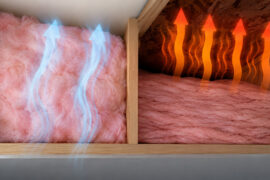
Vapor barrier placement is one decision with two possible answers, and your climate zone picks which one. The sheet faces the side of the insulation that stays warm in winter. In hot, humid regions that logic flips, and an interior sheet often shouldn’t be there at all.
The International Residential Code ties this to climate zone, not to habit or what the last crew did. Everything after placement is detail work: overlap distance, tape choice, how well you sealed around a pier. That detail work is where most installs actually fail. Americover rates its butyl seam tape at up to 240 ounces per inch of adhesion under ASTM D903 testing (Americover product data), which is a number almost nobody checks before buying tape.
What Is a Vapor Barrier?

Water vapor pushes through solid building materials on its own, slowly, with no air movement involved at all. The layer that slows that process to almost nothing is what the trade calls a vapor barrier.
Building codes use a different word for it. They say vapor retarder. On a job site the two get swapped around freely, and that sloppiness is behind a good chunk of the confusion about where the thing goes.
A few products get lumped in with it that shouldn’t be:
- Waterproofing and damp proofing membranes handle liquid water, which is a different problem
- House wrap looks similar on the roll and does close to the opposite job
- Air barriers overlap with it sometimes, but they’re solving air movement, not diffusion
- It doesn’t replace insulation, even though the two usually go in during the same week
A wall can carry an air barrier and no vapor barrier. Or both. Or neither, depending on the assembly and the region.
Vapor Barrier vs Air Barrier: What Is the Difference?
One blocks diffusion through solid material. The other blocks air moving through gaps, seams, and joints, and it does that job whether or not any vapor is diffusing.
The perm numbers make the split obvious. DuPont’s own product data puts Tyvek HomeWrap at 56 perms tested under ASTM E96-05 Method A. A true vapor barrier sits at 0.1 perm or below. That is not a small difference in degree, it’s a different category of product.
Which is why whether Tyvek counts as a vapor barrier keeps coming up on job sites. House wrap is built to shed bulk water and stop wind while letting vapor pass straight through.
Air barriers usually live on the exterior sheathing. Vapor barriers, in cold climates, go on the interior side. Closing up the gaps and seams against moving air is air sealing, and it’s its own scope of work.
Which Side of the Wall Does a Vapor Barrier Go On?

In cold and mixed-cold climates, the warm-in-winter side of the insulation. Interior. Installed before the drywall goes up, so it intercepts moisture before that moisture reaches anything cold enough to condense on.
Vapor moves from warm humid air toward cold dry air. When it reaches a surface sitting below the dew point, it stops being vapor and becomes liquid water inside your wall cavity.
Hot-humid climates invert the whole thing. Solar heat drives vapor inward from the outside, and an interior sheet catches that moisture on its way toward the room instead of stopping anything. You’ve built a condensing surface where the wall used to dry.
Building Science Corporation, through Joseph Lstiburek’s placement research, frames it as matching the barrier to whichever direction vapor actually moves in your region. One rule applied everywhere is how walls rot.
Get it backward and the wall still looks finished. Trim on, paint dry, inspection passed. The problem surfaces months later inside the cavity where nobody’s looking.
What Perm Rating Does a Vapor Barrier Need?
0.1 perm or less under ASTM E96. That’s the line separating a Class I barrier from the retarders below it.
- Class I retarders come in at 0.1 perm or less, and only these earn the phrase true vapor barrier
- Class II covers anything above 0.1 perm up to 1.0 perm
- Class III runs from above 1.0 perm to 10 perm
- Testing follows ASTM E96 using the desiccant method, codified in the 2021 IRC and IBC
Johns Manville’s facing data is useful here. Kraft paper rates at 1 perm, which parks it in Class II. Their foil and FSK facings come in at 0.05 perm, comfortably Class I.
So plain kraft-faced batts by themselves usually don’t get you to Class I. The separate poly or foil layer is what does it.
What Material Should You Use for a Vapor Barrier?
Most installs land on polyethylene sheeting, kraft-faced batts, a foil-faced membrane, or a smart variable-permeance membrane. Climate narrows the choice fast, and placement narrows it further.
| Material | Perm Class | Typical Placement | Common Product |
|---|---|---|---|
| Polyethylene sheeting | Class I, 0.1 or less | Crawl space ground cover, basement walls | Poly-America, Stego Industries |
| Kraft-faced batt | Class II, around 1.0 | Wall cavities in cold-climate framing | Owens Corning |
| Foil-faced membrane | Class I, around 0.05 | Metal buildings, attics | FSK facing |
| Smart membrane | Variable, humidity driven | Mixed and hot-humid climate walls | CertainTeed MemBrain |
Kraft facing comes bonded straight onto fiberglass batt insulation, so the facing is both your vapor retarder and your stapling surface. One product, one step.
Closed-cell spray foam insulation at sufficient thickness meets the vapor retarder requirement by itself. No sheet product involved.
Polyethylene is the cheapest thing on the list per square foot and the easiest to work with. Cut it, overlap it, staple it, done. The catch is that its perm rating never changes. Year round, summer and winter, it holds the same number, and in a hot-humid climate that fixed behavior turns into a liability.
Smart membranes solve exactly that. The perm rating shifts with ambient humidity, so the wall can dry inward during summer when it needs to. You also stop having to reverse your placement rule when you cross climate zones. You pay for it, though, and the price gap against plain poly is not trivial on a large job.
Polyethylene Sheeting Thickness (Mil Rating)
Six mil hits the code minimum for crawl space ground cover. Most contractors size up anyway, usually to 10 or 12 mil, because anything that sees a knee or a boot will find the weak spots in 6 mil.
- 6 mil is the code floor, and it tears around piers and sharp debris more easily than the spec suggests
- 10 to 12 mil is the common contractor pick, with noticeably better puncture resistance
- 20 mil reinforced sheet shows up on full crawl space encapsulation work
Thickness buys you durability, not permeance. Plain poly stays low on perm across the entire range, so a 20 mil sheet isn’t a better vapor barrier than a 6 mil one. It just survives the install.
Where Do You Need a Vapor Barrier?

Crawl spaces and basement walls come up most, with attics and under-slab work close behind. Each one follows its own placement rule, and basements are the one that trips people up.
- Crawl spaces get ground cover over exposed earth, run up the foundation walls
- Basement walls flip the rule that works above grade
- Attics follow the same warm-side logic as a wall, tied to the ceiling insulation
- Under-slab needs a continuous sheet beneath the pour
Below grade, interior poly over studs often backfires, which is why insulating basement walls means rigid foam against the concrete instead.
Attics and slabs are simpler. Warm side of the ceiling insulation for the attic. For the slab, keep the sheet continuous and unpunctured through the pour and you’ve done the job.
Crawl Space Vapor Barrier and Ground Cover
Cover the exposed earth floor with a continuous Class I sheet, then carry that same sheet up the foundation walls and around the piers.
The IRC sets 6-mil polyethylene as the minimum with seams overlapped at least 6 inches. Most building science guides push for 12 inches, and I’d take the extra overlap every time given how cheap poly is relative to a callback.
The full walkthrough for installing a vapor barrier in a crawl space gets into turn-up height, sealing around piers, and the ventilation trade-offs, which need more room than they’d get here.
What Does the Building Code Require for Vapor Barrier Installation?
Section R702.7 of the International Residential Code requires a Class I or Class II vapor retarder on the interior side of frame walls in climate zones 5 through 8, plus Marine Zone 4.
- Zones 1 through 4, Marine 4 excepted, carry no interior vapor retarder requirement
- Zones 1 and 2 go further and prohibit Class I retarders on the interior side
- Zones 5, 6, 7, 8, and Marine 4 require Class I or Class II on the interior
- Local jurisdictions amend these rules regularly, so the base code is a floor
Pair a Class II retarder with foam sheathing and the requirement moves onto continuous insulation at a minimum R-value, layered over the framing rather than sitting between studs.
There’s also a prescriptive path that sidesteps the vapor retarder question by using R-30 cavity insulation, which in practice often means closed-cell insulation sprayed into a 2×6 wall.
None of that replaces a local plan check. Amendments to R702.7 are common enough that treating the zone map as final is a decent way to fail an inspection.
How Do You Install a Vapor Barrier Step by Step?

The order is fixed, and working out of sequence usually means undoing something once the overlap or the fastening stops lining up.
- Clear the surface of debris, sharp objects, and standing water, whether that’s ground, wall, or framing
- Measure and cut to the run, adding length for wall turn-up and overlap
- Position the first sheet along the longest dimension of the space, which cuts down on seams
- Fasten it down with staples on wood framing, or furring strips and mechanical fasteners on masonry and concrete
- Lap the next sheet over it at whatever minimum the application calls for
- Tape the seam with a compatible product and roll out the trapped air
- Run the sheet up walls or piers, seal that edge, trim the excess
Direction matters as much as material. Vapor barrier insulation installed facing the wrong way undoes the entire job, and the perm rating on the label becomes irrelevant.
Kraft-faced batts follow the usual sequence for how to install fiberglass insulation. Facing toward the living space, cut tight around boxes and wiring, and no compression at the edges.
How Do You Seal Vapor Barrier Seams and Overlaps?
Every seam gets tape or mastic rated for the substrate, and it goes on after the sheets are lapped to the minimum distance, not before.
An unsealed overlap wipes out the perm rating of everything around it. Moisture takes the gap. It isn’t going to work harder and diffuse through solid plastic when there’s an easier route six inches away.
| Tape Type | Temperature Range | Best Use |
|---|---|---|
| Butyl tape | 30 F to 180 F application | Crawl space and under-slab poly seams |
| Acrylic tape | -40 F to 240 F without losing adhesion | Wide climate range, higher upfront cost |
| Self-adhered membrane | Varies by product | Foundation sill and rim joist transitions |
Americover’s product data rates its butyl tape at up to 240 ounces per inch of adhesion under ASTM D903, which puts it near the top of what’s available for poly-to-poly seams.
Sill plates and rim joists are where DIY installs go wrong, in my experience more often than the field seams do. A self-adhered membrane like Grace Ice and Water Shield handles that transition better than tape, since it bonds to wood and concrete both.
Roll every seam once the tape is down. Air trapped under tape looks perfectly fine on day one and starts lifting within a season.
What Happens When a Vapor Barrier Is Installed Incorrectly?
It traps moisture in the cavity rather than keeping it out, which is the precise opposite of the reason you bought the material.
| Mistake | Consequence | Fix |
|---|---|---|
| Wrong side placement | Vapor condenses inside the cavity | Match placement to climate zone and dew point |
| Unsealed seams | Moisture bypasses the barrier entirely | Tape and roll every overlap |
| Gaps at staples or tears | Localized condensation and mold spots | Patch with matching tape before covering |
Compressed insulation behind the sheet adds a failure point the table doesn’t cover. Compressed insulation loses R-value and opens gaps at the facing, and moisture uses those gaps.
Building Science Corporation has documented one version of this on basement walls specifically. Class I polyethylene over fibrous batts traps vapor coming through the concrete, and that vapor condenses inside the cavity with nowhere to go.
The EPA recommends keeping indoor relative humidity below 60 percent, ideally somewhere between 30 and 50 percent. Above that line, mold growth gets a lot more likely.
How to Verify a Vapor Barrier Installation Worked
Put a moisture meter on the framing. It reads actual water content in the wood instead of some indirect signal you have to interpret.
- Under 15 percent is the safe range for enclosed framing
- 16 to 19 percent is a caution zone, worth a second reading before you close the walls
- Above 19 percent exceeds the accepted ceiling
That 19 percent figure has been the building-science threshold for framing lumber at the time of enclosure for a long time, and it’s more than a rule of thumb. It isn’t written into a single base 2021 IRC section. Several state codes, including California’s CalGreen standards and Oregon’s residential code, adopt it directly as a hard limit.
Worth noting what a blower door test won’t tell you. It measures air leakage. A vapor barrier stapled to the wrong side of the studs will pass one without complaint.
Reading moisture content is the only check that confirms the barrier actually did anything.
When Does a Vapor Barrier Not Apply?
It isn’t universal protection. There are assemblies where adding one creates the exact failure you were trying to avoid.
- Reverse vapor drive in hot-humid climates pushes moisture inward under solar heat, and an interior barrier holds it there instead of letting the wall dry toward the room
- Double vapor barrier assemblies put a low-perm layer on both faces, leaving the cavity no way to dry in either direction
- Reservoir claddings like brick veneer soak up rain and release it later as vapor, which an interior barrier then pins against the sheathing
Building Science Corporation has studied double vapor barrier assemblies and generally advises against them, especially in hot and mixed climates where the interior barrier was already questionable.
In a double stud wall built with spray foam or cellulose insulation, the exterior sheathing usually takes over as the vapor control layer, so a separate interior sheet has no job left to do.
Continuous exterior insulation is the other way around it. Keep the sheathing warm enough that condensation never starts, and you’ve also cut thermal bridging at every stud. Two problems, one layer.
None of this means you skip moisture control. It means the vapor barrier is the wrong tool for that particular wall, and something else is carrying the load.
FAQ on How To Install Vapor Barrier
Do You Need a Permit or Inspection for Vapor Barrier Installation?
Depends on your jurisdiction and how big the project is. A standalone crawl space vapor barrier rarely triggers a permit. Tie it into a larger remodel and it often does. Local departments enforce their own IRC amendments, so a phone call beats a failed inspection.
Can a Vapor Barrier Be Installed Over Existing Insulation or Drywall?
Vapor retarder paint will go over existing drywall, though what you get performs closer to Class II than a true barrier. Retrofitting over batt insulation is harder, because the layer needs direct contact, and that usually means pulling the wall finish off first.
How Much Does Professional Vapor Barrier Installation Cost?
Square footage drives it, then material, then whether the crawl space needs full encapsulation or just a ground cover. Polyethylene sits at the bottom of the range. A smart membrane with a dehumidifier costs considerably more per square foot, and the gap widens on larger spaces.
Can Hardware Store Plastic Sheeting Substitute for a Purpose-Made Vapor Barrier Product?
Generic plastic off the shelf frequently has no stated perm rating and no ASTM E1745 classification, which makes code compliance impossible to demonstrate. Purpose-made products carry tested puncture resistance and tensile strength numbers. Generic sheeting doesn’t.
Is Vapor Barrier Paint or Primer the Same Thing as a Vapor Barrier?
No. Most vapor retarder paints land in the Class II range, well above the 0.1 perm ceiling that defines Class I under ASTM E96. Useful as a retrofit. Not a code substitute.
What Should You Coordinate Around Vapor Barrier Installation?
The sheet doesn’t go in by itself. In a crawl space, the radon system, the ventilation strategy, and the ground cover all depend on each other, and the order they go in is not negotiable.
Where the site calls for radon mitigation, that system goes in before the vapor barrier. The venting pipe needs to sit under the ground cover. Punching it through a sealed sheet afterward creates a penetration you then have to detail around, badly.
- Radon venting pipe positioned first
- Ground cover sealed over it second
- Foundation vent decision made last
Closing the foundation vents afterward trades passive airflow for a permanent dependency on mechanical exhaust or conditioned supply air. The IRC only allows that swap once the ground cover meets Class I permeance.
The question that usually comes next is whether trapped moisture drags down R-value inside the same wall, and that mechanism is covered in how insulation works.