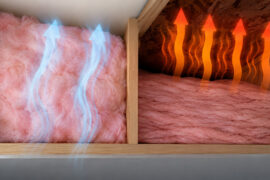
The insulation tax credit sits inside the federal tax code as a specific provision, not a general discount on home improvement. It covers a slice of the material cost for qualifying insulation and air sealing products, and the IRS administers it under Section 25C.
Eligibility came down to ownership and occupancy. An existing home, in the United States, used as the taxpayer’s principal residence.
For tax year 2023 alone, 669,440 returns claimed the insulation portion (Internal Revenue Service, 2024).
What Is an Insulation Tax Credit?

The formal name is the Energy Efficient Home Improvement Credit, defined in Internal Revenue Code Section 25C. “Insulation tax credit” is just shorthand for the insulation and air sealing piece of it.
It comes off tax owed. Not a rebate check, and not a deduction against taxable income.
Congress rewrote the rate and the rules in the Inflation Reduction Act of 2022, effective for improvements made from January 1, 2023.
Under that version, the IRS pays back a share of what a taxpayer spends on the materials that make up home insulation and air sealing systems. The labor to install them was never part of the calculation.
Where people go wrong is usually on what the credit isn’t.
- It isn’t a rebate paid at the time of purchase
- Landlords and rental property owners can’t claim it
- It isn’t a deduction that lowers taxable income before tax gets calculated
It was popular while it lasted. Insulation upgrades appeared on 30% of Energy Efficient Home Improvement Credit returns in 2023, tied with windows and skylights as the most claimed item (Congressional Research Service, 2024).
How It Differs From the Residential Clean Energy Credit
Section 25D, the Residential Clean Energy Credit, gets confused with 25C constantly. Both expired on the same date, which doesn’t help anyone keep them straight.
Section 25C is the building itself: insulation, air sealing, windows, doors, heat pumps, efficient HVAC equipment. Section 25D went to generation and storage instead, meaning solar panels, solar water heating, battery storage, geothermal systems.
How Much Is the Insulation Tax Credit Worth?
Thirty percent of material cost, and then the caps kick in. The caps are shared, which is the part that catches people out.
Figures below come from the Internal Revenue Service.
- Credit rate of 30% on qualifying materials
- Annual cap of $1,200 split across insulation, windows, doors, skylights, and electrical panel upgrades
- $3,200 total once the separate heat pump and biomass stove category is counted
- Home energy audits worth $150, drawn from that same $1,200 pool
Windows carry their own $600 sub-cap and doors stop at $500 total. Insulation and air sealing have no sub-cap at all, which means a big insulation job can swallow most of the $1,200 on its own.
The same pool funds a qualifying home energy audit. That $150 audit credit counts against the total, so anything else claimed on the building envelope in the same year has less room to work with.
The average claim across the whole credit came to $882 per return in 2023 (IRS, 2024).
Why the Credit Is Nonrefundable
Owe no tax, get nothing. A nonrefundable credit can only cancel out tax actually due for the year.
Anything above that is simply gone. It doesn’t get paid out, and it doesn’t carry forward.
- A taxpayer who owes $400 in tax can use $400 of credit that year, at most
- The unused portion above that doesn’t roll into a future return
What Insulation Materials Qualify for the Credit?
ENERGY STAR’s list of qualifying bulk materials is fairly generous. Batts, rolls, blown-in fiber, rigid boards, expanding spray foam, pour-in-place products. All of it counts under Section 25C.
Air sealing products qualify too, though only when they ship with a Manufacturer Certification Statement confirming eligibility.
There’s one bureaucratic break here worth knowing about. Insulation and air sealing are the only Section 25C category exempt from the qualified manufacturer registration and product identification number lookup that other items now require.
A broader rundown of types of insulation materials covers how each performs by climate and application.
Material cost is all that counts. Installation labor for building envelope components gets stripped out before anything else happens.
| Material | Works Well For | Watch Out For |
|---|---|---|
| Batt insulation | Standard stud-bay walls and attic floors | Gaps around wiring and outlets reduce performance |
| Blown-in fiber | Irregular attic spaces and older homes | Settles over time, thinning coverage |
| Spray foam | Air sealing and hard-to-reach cavities | Higher material cost per square foot |
| Rigid board | Basement walls and exterior sheathing | Needs a fire-rated cover in living spaces |
The IECC Efficiency Standard Insulation Must Meet
Qualifying insulation has to meet the International Energy Conservation Code standard in effect two years before the year of installation, per IRS guidance. That lag trips people up more than anything else in this section.
Material placed in service in 2025 had to meet the IECC edition in effect on January 1, 2023, not whatever the current edition says.
The code sets minimum insulation levels for attics, walls, and floors by climate zone. It also governs air leakage rates across the building envelope, and it dictates how insulation sits around recessed lighting and ductwork.
Those minimums show up as an R-value rating. A product can hit the number printed on its label and still fail the credit, because it went in under the wrong code cycle.
Who Is Eligible to Claim the Insulation Tax Credit?

Owner-occupants of an existing home, and nobody else. For insulation and other building envelope work, the credit follows the taxpayer’s principal residence. A second home doesn’t count. An investment property definitely doesn’t.
The house also has to be in the United States and already standing before the improvement, since new construction never qualified under Section 25C.
- You own the home where the insulation is installed
- That home is your principal residence, not a second home or a rental you own
- Single-family homes, townhouses, condos, and mobile homes all pass the ownership test
- Co-owners of the same home can usually split the credit by their share of the cost
Someone who splits the year between two homes they own has to pick one. Insulation and other envelope work only qualifies at the principal residence. Other Section 25C categories are looser: heat pumps, for instance, can extend to a second home used as a residence. Insulation cannot.
When Does the Insulation Tax Credit Not Apply?
The credit fails in more situations than most guides bother to mention. Knowing them before you buy anything saves a rejected claim later.
Situations That Never Qualify
Some of these have nothing to do with the insulation product itself.
- Rental property, even when the landlord pays for the insulation directly
- New construction, regardless of how efficient the finished home is
- Installation labor, which is stripped out before the 30% rate is applied
- Insulation added to a home that is not a residence you live in
None of these are edge cases. They account for a large share of the claims the IRS denies on review.
Reasons a Claim Gets Rejected
An air sealing product filed without its Manufacturer Certification Statement fails. So does a purchase claimed in the year it was bought instead of the year it was installed.
Then there’s the claim filed with no itemized receipts, nothing separating material cost from labor. That one is self-inflicted.
Most rejections trace back to paperwork rather than to the insulation. A properly documented air sealing project rarely gets challenged once the certification statement is attached.
Is the Insulation Tax Credit Still Available in 2026?
No. Section 25C expired for insulation placed in service after December 31, 2025.
The One Big Beautiful Bill Act, Public Law 119-21, signed July 4, 2025, pulled that expiration date forward. The Inflation Reduction Act had originally set it at 2032.
Section 25D went out on the same date under the same law, taking the solar and battery storage credit with it.
| Installation Year | Credit Status |
|---|---|
| 2023 to 2025 | Claimable on that year’s federal return |
| 2026 and later | No longer eligible under current law |
If you bought and installed insulation in 2025, you keep the right to claim it. The filing just happens in 2026.
How Do You Claim the Insulation Tax Credit?
For a 2025 installation, the paperwork trail looks like any other federal tax credit.
- Collect itemized receipts that separate material cost from labor
- Get the manufacturer certification statement for any air sealing product used
- Complete IRS Form 5695, using the building envelope worksheet in Publication 5979
- Carry the credit total to Schedule 3 of Form 1040
- File by the standard deadline for the tax year the insulation was installed
Filing for a 2025 Installation
A 2025 project goes on the 2025 federal return, the one filed in early 2026.
What matters is the placed-in-service date, not the purchase date. The IRS ties the credit to when insulation was installed and ready for use.
So a deposit paid in December 2025 for work finished in January 2026 generally lands on the wrong side of the cutoff.
Amending a Return With Form 1040-X
Finished a qualifying project in 2023, 2024, or 2025 and never claimed it? You’re not automatically out of luck.
The IRS generally allows a refund claim within three years of the original filing date. You’ll need a copy of the return you originally filed for that tax year, plus an updated Form 5695 showing the insulation expense.
Form 1040-X carries the correction. Use the version that matches the tax year being amended rather than the current year’s form.
Documentation to Keep
Paperwork proves a claim. It doesn’t create one.
Hold onto the records after the return is filed and accepted, since insulation claims can be reviewed years later.
- Manufacturer certification statement for the specific product installed
- Itemized contractor invoice or store receipt showing material cost separate from labor
- A copy of the filed Form 5695 for that tax year
Three years after filing is the floor, matching the window the IRS uses for amended return claims.
What Replaces the Insulation Tax Credit in 2026?
The federal credit is gone. Money for insulation work hasn’t disappeared, it just moved. None of what’s left runs through the IRS, and none of it uses Form 5695.
| Program | Administrator | Income Requirement | 2026 Status |
|---|---|---|---|
| Insulation tax credit (Section 25C) | Internal Revenue Service | None | Expired after Dec 31, 2025 |
| HOMES | State energy offices, DOE funded | None, performance-based | Live in some states, pending in others |
| HEEHR | State energy offices, DOE funded | Income-qualified | Live in some states, pending in others |
| Weatherization Assistance Program | Local weatherization agencies, DOE funded | Income-qualified | Ongoing nationwide |
Rollout has been slow. Only thirteen states had fully launched their HOMES and HEEHR programs as of June 2026, even though every state and territory had already received its full award (Building Performance Association, 2026).
Home Owner Managing Energy Savings (HOMES)
HOMES pays for whole-home efficiency work based on modeled or measured energy savings. Rebates scale with the percentage of savings a project delivers, not with a flat cut of the purchase price.
- Funded through the Inflation Reduction Act of 2022, administered by the U.S. Department of Energy
- Insulation and air sealing sit in the same project scope as HVAC and duct sealing
- No income cap on the base program, though larger rebates go to lower-income households
The naming has been a mess. DOE’s June 2026 guidance standardized the public name as Home Owner Managing Energy Savings, which is what the HOMES acronym has stood for since the program was created under the 2022 Inflation Reduction Act. Plenty of state agencies had been calling it “Home Efficiency Rebates” instead.
Vermont’s Public Service Department told state lawmakers in January 2026 that its HOMES rollout was nearly ready to launch, after more than two years of coordination with the DOE.
High-Efficiency Electric Home Rebate (HEEHR)
HEEHR pays at the register instead of making you wait for a tax return the following year.
Insulation, air sealing, and ventilation work draw up to $1,600, based on state program guides tracking DOE rules. Household income has to fall at or below 150% of the area median income for any rebate at all.
Earlier state guidance called it HEAR (Home Electrification and Appliance Rebates). Under 2026 DOE guidance the standardized name is High-Efficiency Electric Home Rebate (HEEHR), which is the name used in the underlying 2022 statute.
Stacking works. Virginia’s HEEHR program pairs its insulation figure with up to $8,000 for a heat pump swap, so a household can run both in one project.
Rules tightened through Notice 26-2, effective May 29, 2026, which removed a fuel-switching allowance that had let some households qualify more easily. These performance-linked weatherization rebate programs are what replaced the flat 30 percent the federal credit used to offer.
Weatherization Assistance Program and State Incentive Trackers
The Weatherization Assistance Program has helped more than 7 million households since 1976, weatherizing around 35,000 homes a year (U.S. Department of Energy).
It works differently from HOMES or HEEHR. WAP covers the full cost, so qualifying households are generally entitled to free home insulation and air sealing rather than a partial rebate.
- Income at or below 200% of the federal poverty line typically qualifies a household
- Renters can apply, not only homeowners
- Priority goes to households with an elderly or disabled member, or with young children
For everything outside those three, DSIRE tracks the state, utility, and manufacturer incentives filling the gap the federal credit left behind. The N.C. Clean Energy Technology Center at N.C. State University has maintained it since 1995.
FAQ on What Is An Insulation Tax Credit
Is the insulation tax credit the same thing as a rebate?
No. A rebate returns cash at the point of purchase. An insulation tax credit reduces tax owed on the return filed later, so the homeowner pays full price upfront and recovers the cost only through tax filing, not at checkout.
Does the insulation tax credit cover HVAC or windows too?
Insulation tax credit is the informal name for one slice of the Energy Efficient Home Improvement Credit. The same Section 25C statute also funds windows, doors, skylights, heat pumps, and efficient air conditioners, each under its own separate rules.
Can I claim the credit on a vacation home?
Not for insulation, no. Building envelope work like insulation and air sealing has to go to the taxpayer’s principal residence. Equipment categories such as heat pumps extend to a second home used as a residence. Insulation doesn’t.
Is there an income limit for the insulation tax credit?
No income limit applies to the federal insulation tax credit itself. Any taxpayer with enough tax liability can claim it, whatever they earn. Replacement state programs such as HEEHR do require income qualification, a different structure entirely.
Will the insulation tax credit come back after 2026?
Current law sets no return date. Section 25C ended through statute rather than a temporary pause, so bringing it back takes new legislation from Congress, not a scheduled renewal or an automatic extension.
Do I need a contractor, or can I install insulation myself?
Labor cost is excluded regardless of who does the work, so installing it yourself does not reduce the benefit. Material receipts still count on a DIY project, though a contractor invoice makes the documentation easier to defend.
What is the difference between HOMES and HEEHR?
HOMES pays based on measured or modeled energy savings, with no income cap on the base program. HEEHR pays at the point of sale and requires income qualification. Both run through state energy offices, not the IRS.
What Comes First After the Insulation Tax Credit Expires?
If you missed the credit before it expired on December 31, 2025, start with an amended return. Then look at the state replacement rebates. After that it’s a straight comparison between unsubsidized insulation cost and long-term savings.
- Check whether a 2023, 2024, or 2025 insulation purchase still qualifies for an amended claim
- Apply to HOMES or HEEHR in states where the rollout has launched
- Compare unsubsidized material cost against the utility savings insulation delivers over time
Paying full price without the 30 percent offset changes the math, obviously. It doesn’t erase the case for insulating. The Environmental Protection Agency attributes an average 15 percent cut in heating and cooling costs to combined air sealing and insulation work, and that return keeps accruing whether or not a federal discount exists.
Weighing that ongoing saving against today’s unsubsidized material prices is exactly what a payback period for insulation calculation answers.