Summarize this article with:

Cold floors in winter and high energy bills often point to the same problem: your crawl space. Crawl space insulation creates a thermal barrier between your living space and the ground below, stopping heat loss and moisture problems that cost homeowners thousands.

Most houses built on crawl spaces lose 15-25% of their heating and cooling energy through poorly insulated or uninsulated foundations. That’s money disappearing into thin air while your floors stay uncomfortably cold.

This guide explains what crawl space insulation is, which materials work best, and how to install it correctly. You’ll learn where to insulate, how to control moisture, and whether vented or sealed designs make sense for your climate.

What Is Crawl Space Insulation?

Crawl space insulation is the process of insulating the area beneath a home to improve energy efficiency and prevent moisture buildup. It helps maintain indoor temperature, reduces energy costs, and prevents issues like mold or frozen pipes. Common materials include foam board, spray foam, or fiberglass batts, depending on climate and design.

Understanding Crawl Space Insulation Basics

What Crawl Spaces Are and Why They Need Insulation

YouTube player

A crawl space sits between your home’s floor and the ground, typically 18 to 48 inches high. Research from Crawl Space Medic shows about 10% of U.S. homes have crawl spaces as of 2022.

Without proper insulation, 10% of your home’s heat escapes through flooring. The stack effect pulls cold crawl space air up through floor gaps while warm air escapes through your home’s top.

Ground moisture is relentless. Data from Contracting Business shows bare ground in a 1,000 sq ft crawl space can evaporate up to 12 gallons of water daily with a 3-foot water table. This moisture condenses on cold surfaces, soaking wood framing and insulation.

Types of Crawl Spaces and Their Insulation Requirements

Vented crawl spaces have open foundation vents. The old theory: ventilation dries things out. Reality: it makes moisture worse. You insulate between floor joists above, treating the crawl space as outdoor space.

Unvented crawl spaces seal all foundation vents permanently. You insulate foundation walls instead of floors, treating the space as part of your conditioned home.

Building Science Corporation research shows the difference: vented crawl spaces in the Southeast average 75% humidity versus 48% for sealed spaces.

What Crawl Space Insulation Actually Does

Key benefits:

  • Stops heat loss through floors during winter
  • Controls moisture with vapor barriers (bare earth releases 12-15 gallons of water vapor daily)
  • Prevents frozen pipes and costly burst damage
  • Makes floors feel warmer
  • Reduces energy costs by 15-20% according to EPA data

Common Insulation Materials for Crawl Spaces

YouTube player

Fiberglass Batts and Blankets

Fiberglass insulation comes in pre-cut batts for standard 16-inch or 24-inch joist spacing. Building codes typically require R-19 or R-30 for crawl space floors.

The moisture problem:

Wet fiberglass loses insulating ability. Water compresses glass fibers and destroys air pockets that provide thermal resistance. Research from Acculevel shows humidity alone (without active water problems) makes insulation damp.

Sagging happens within a few years. Gravity plus moisture weight pulls batts down, creating heat-loss gaps between insulation and subfloor.

Rigid Foam Board Insulation

YouTube player

Rigid foam board panels come in 4×8 foot sheets, various thicknesses. Perfect for foundation walls.

Three main types:

  • Extruded polystyrene (XPS): Pink or blue foam, R-5 per inch, good moisture resistance
  • Expanded polystyrene (EPS): White beadboard, R-4 per inch, costs less than XPS
  • Polyisocyanurate: Highest R-value at R-6 to R-6.5 per inch, more expensive but thinner

Foam boards create effective air barriers when seams get sealed. They don’t absorb water like fiberglass and maintain thermal performance in damp conditions.

Spray Foam Insulation Options

YouTube player

Spray foam insulation gets applied as liquid that expands and hardens. Professional installers use specialized equipment.

Closed-cell foam expands 30x its liquid volume, creating rigid, impermeable barrier. Delivers R-6 to R-7 per inch and acts as both insulation and vapor barrier. Perfect for sealing rim joists and foundation walls in one step. No separate vapor barrier needed.

According to 2025 industry data, spray foam costs $2-5 per square foot installed. Average crawl space project runs $2,000-3,100. Closed-cell insulation costs more upfront but eliminates moisture problems.

Open-cell foam expands up to 100x with softer, sponge-like texture. Offers R-3.5 per inch, costs less than closed-cell. Allows some moisture vapor transmission, requiring separate vapor barrier.

DIY foam kits exist but need practice. Most crawl spaces benefit from professional installation guaranteeing proper coverage and thickness.

Other Insulation Materials Worth Considering

Rock wool insulation resists fire better than other materials. Made from melted volcanic rock or steel slag, it won’t burn and protects wooden framing. Handles moisture better than fiberglass while maintaining shape. Water drains through without destroying insulating properties.

Reflective insulation uses shiny foil layers to reflect radiant heat. Works best in hot climates where keeping summer heat out matters more than winter warmth retention.

Insulated crawl space doors and access hatches prevent air leakage at entry points. Even perfectly insulated walls and floors lose efficiency if the access door leaks.

Where to Insulate in Your Crawl Space

Floor Joist Insulation (Traditional Method)

Installing batt insulation between floor joists from below is the old-school approach. You push batts up against the subfloor and secure them.

Installation methods:

  • Vapor barrier facing points upward toward warm living space (backwards traps moisture)
  • Friction-fit batts cut slightly wider than joist spacing to wedge themselves up
  • Wire supports (lightning bolt shaped) hold batts without compression
  • Plastic straps or chicken wire stapled across joists

The inevitable problem: Everything sags. Gravity wins after a few years, creating gaps where heat escapes.

Crawl Space Wall Insulation

YouTube player

Insulating foundation walls instead of floor joists creates better results. This method treats your crawl space as conditioned space.

Install insulation directly against concrete or block foundation walls. Foam boards work best since they resist moisture and attach easily to masonry. Run insulation from sill plate down to footing or ground level (some stop at frost line but full coverage performs better).

Benefits over ceiling insulation:

  • Eliminates cold floors (entire crawl space stays warmer)
  • Protects plumbing and ductwork from freezing
  • Living space floor becomes interior surface, not thermal boundary

Rim Joist and Band Joist Areas

Rim joists sit at the perimeter where floor joists rest on foundation walls. Research from Sprayman shows rim joists can account for 15-25% of a home’s total heat loss. Data from InSoFast indicates rim joist areas can cause more air leakage than all windows combined.

The Department of Energy estimates that air leakage accounts for about 40% of heat lost in typical buildings. According to HandiFoam case study data, spray foam insulation in rim joist areas showed 11.4% reduction in annual infiltration rate, translating to approximately 19.3% cost savings for heating and cooling.

Thermal bridging occurs where wooden rim joists connect to foundation walls. Wood conducts heat faster than insulated areas around it.

Two installation approaches:

Cut rigid foam to fit each rim joist cavity (every space has different dimensions). Press foam pieces in snugly, then seal edges with expanding spray foam. The foam fills irregular gaps rigid boards can’t match.

Spray foam the entire rim joist area in one shot. Creates perfect air sealing and insulation without cutting individual pieces.

Crawl Space Ceiling Versus Perimeter Approach

Attribute Crawl Space Ceiling Insulation Perimeter Insulation Approach
Installation Location Insulation installed between floor joists on the crawl space ceiling, directly beneath the living space floor. Insulation applied to crawl space foundation walls and perimeter, extending from the rim joist down to the ground level.
Thermal Boundary Position Creates a thermal barrier at the floor level, separating conditioned living space from unconditioned crawl space. Establishes thermal boundary at foundation walls, enclosing the crawl space within the building envelope.
Crawl Space Climate Crawl space remains vented and unconditioned, exposed to outdoor temperature fluctuations and moisture variations. Creates a semi-conditioned or conditioned crawl space environment with controlled temperature and humidity levels.
Moisture Management Relies on ventilation to control crawl space moisture; insulation susceptible to moisture damage if ventilation is inadequate. Requires vapor barrier installation and sealed vents to prevent ground moisture infiltration and condensation issues.
Energy Efficiency Moderate energy savings; heated or cooled air loss through floor reduced, but HVAC ductwork in crawl space remains in unconditioned environment. Superior energy performance when properly sealed; ductwork operates in conditioned space, minimizing thermal losses and improving system efficiency.
Installation Complexity Simpler installation process; fiberglass batts inserted between joists with minimal preparation required. More comprehensive approach requiring vent sealing, vapor barrier placement, and proper insulation attachment to foundation walls.
Cost Considerations Lower upfront material and labor costs due to straightforward installation technique and fewer supplementary components. Higher initial investment covering insulation materials, vapor barriers, vent sealing, and potentially dehumidification equipment.
Plumbing Protection Water pipes in crawl space remain exposed to freezing temperatures during winter months, requiring supplemental pipe insulation. Plumbing systems benefit from warmer crawl space temperatures, significantly reducing freeze risk without additional pipe wrapping.
Long-Term Durability Fiberglass batts may sag over time due to gravity and moisture absorption, reducing insulation effectiveness and requiring replacement. Rigid foam or spray foam insulation on walls provides durable, long-lasting performance with minimal degradation when properly installed.
Building Code Compliance Traditional method meeting older building code requirements in most jurisdictions for vented crawl space configurations. Increasingly preferred method aligning with modern building science principles and updated IRC codes for unvented crawl space construction.
Best Application Scenario Suitable for dry climates with well-drained soil, minimal groundwater issues, and budget-constrained projects seeking basic thermal improvement. Optimal for humid climates, homes with existing moisture problems, properties with ductwork in crawl space, and comprehensive energy efficiency upgrades.

Ceiling insulation means insulating between floor joists above crawl space. You treat the crawl space as outside and protect your floor from it. Creates cold floors and moisture problems in many areas. Pipes and ducts remain exposed to freezing.

Perimeter insulation means insulating foundation walls around crawl space. The crawl space becomes part of your conditioned home.

Building codes allow both but specify different requirements for each. The perimeter approach generally performs better and solves more problems. Costs more upfront but saves money long-term through better energy efficiency and fewer moisture issues.

Climate matters when choosing methods. Cold climates benefit most from perimeter insulation while some mild climates work with ceiling insulation.

Preparing Your Crawl Space Before Insulation

Moisture Assessment and Water Problems

Standing water means drainage issues need fixing first. No point insulating until water problems get solved.

Check for puddles after heavy rain. Walk the entire space and look in corners where water collects.

Foundation cracks let water seep through. Small hairline cracks might be fine, but anything wider than 1/8 inch needs attention.

Gutters and downspouts cause most crawl space water problems. Clogged gutters overflow and dump thousands of gallons right next to your foundation.

Critical drainage requirement: Building America Solution Center recommends extending downspouts at least 5 feet from foundation, with 10 feet optimal for maximum protection. Research from Spectra Pro Select shows proper downspout extensions prevent 85% of basement water problems. Those short splash blocks don’t cut it because water soaks back toward foundation.

For homes with basement walls, extend downspouts at least 6 feet away. The ground should slope down 6 inches for every 6 feet moving away from the house.

Vapor Barrier Installation on Ground

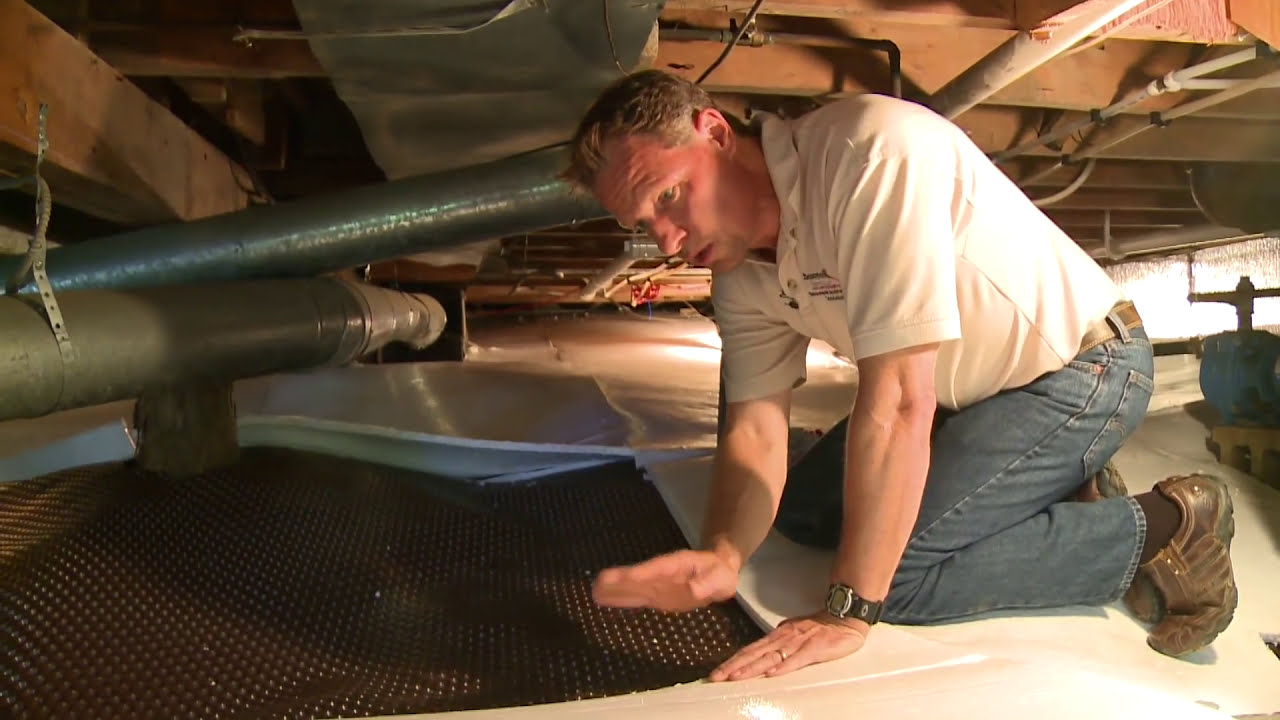
polyethylene vapor barrier stops moisture from evaporating into your crawl space. Research from Contracting Business shows installing 6-mil plastic with overlapped seams reduces ground evaporation from 12 gallons per day down to less than 1 gallon in a 1,000 sq ft crawl space.

Installation specs:

  • Use 6-mil minimum, but 10-mil or 12-mil lasts longer and resists tears
  • Roll sheets across entire floor
  • Overlap seams by at least 12 inches
  • Seal all seams with quality vapor barrier tape (not regular duct tape)
  • Run barrier up foundation walls about 6 inches and tape it there

This creates a continuous moisture barrier from ground to walls.

Dealing With Existing Mold and Mildew

Mold grows on wood framing when moisture stays high. Look for black, green, or white fuzzy growth on floor joists and rim joists.

Surface mold on wood can usually be cleaned. Mix water and detergent, scrub affected areas, then let everything dry completely.

Some people use bleach but it doesn’t kill mold roots in porous materials like wood. Detergent removes surface growth just as well.

EPA guidelines for professional help: Mold covering more than 10 square feet needs professional remediation. For areas less than 10 square feet, you can handle removal yourself using proper gear (N-95 respirator, goggles, gloves). No containment necessary for small areas.

According to PuroClean industry data, crawl space mold remediation costs $1,500-4,000 depending on size and extent. Small infestations under 10 square feet cost $150-300 for DIY supplies and materials.

Never insulate over active mold. Fix moisture source, clean or replace affected materials, then insulate once everything’s dry and clean.

Ventilation Decisions for Your Space

Sealing foundation vents makes sense when converting to a conditioned crawl space. You’re changing from vented to unvented approach.

Remove vent covers and fill openings with cut rigid foam pieces. Seal around foam with expanding spray foam or caulk.

Traditional vented crawl spaces keep vents open year-round. The theory was fresh air would dry things out, but this makes moisture worse in most climates.

Optimal humidity control: Industry experts recommend maintaining 50-60% relative humidity in sealed crawl spaces. According to Crawl Space Medic, this range creates dry, sustainable environment with wood moisture levels around 8-12%. RH levels above 60% increase likelihood of wood moisture rising, creating conditions for fungal growth.

Crawl Space Ninja research shows keeping RH between 45-55% solves most issues with germs, bacteria, and other indoor pollution that thrive in extremely low humidity or RH over 60%.

Adding a dehumidifier controls humidity better than vents. Typical capacity ranges from 50-100 pints per day depending on crawl space size and moisture levels. Set dehumidifier to maintain target humidity range.

Some sealed crawl spaces get conditioned with small HVAC supply duct. This adds a tiny bit of heated or cooled air to keep temperatures stable.

Tools and Materials You’ll Need

Safety Equipment

A respirator mask rated N95 or better protects your lungs from insulation fibers. Those cheap dust masks don’t cut it for this work.

Fiberglass particles irritate skin like crazy. Wear long sleeves, long pants, and gloves even when it’s hot down there.

Safety glasses or goggles keep fibers out of your eyes. Regular glasses don’t provide enough coverage around the sides.

Disposable coveralls make cleanup easier. Toss them when you’re done instead of washing fiberglass into your laundry.

Knee pads save your knees on concrete or gravel. You’ll be crawling around for hours so protect yourself.

Cutting and Installation Tools

Utility knives with fresh blades slice through batt insulation cleanly. Dull blades compress and tear instead of cutting.

Buy a pack of extra blades. You’ll go through several during a full crawl space job.

A measuring tape and straight edge help cut batts to exact dimensions. Compressed fiberglass springs back after cutting so measure carefully.

Heavy-duty staple guns secure insulation to wood framing. Manual staplers work but electric or pneumatic versions save your hand from cramping.

Wire insulation supports hold batts up without compressing them. You can also use rigid wire cut to length.

Sealing and Finishing Materials

Cans of expanding spray foam fill gaps around pipes, wires, and irregular spaces. Get the low-expansion type so it doesn’t push framing apart.

Vapor barrier insulation materials include plastic sheeting and specialized tapes. The vapor barrier controls moisture movement through your building envelope.

Foil tape seals seams in faced insulation better than regular tape. It sticks to the paper or foil facing and doesn’t peel off over time.

Acoustic sealant works for sealing between wood members. This stuff stays flexible and doesn’t crack like regular caulk.

Lighting and Access Equipment

Portable LED work lights make a huge difference in dark crawl spaces. Hang them from floor joists as you work.

Battery-powered lights beat corded ones since you won’t have outlets down there. Bring backup batteries or a second light.

A crawling board or piece of plywood helps distribute your weight on vapor barriers. You’ll tear holes in the plastic if you crawl directly on it.

Keep a headlamp handy for tight spots where work lights don’t reach. You need both hands free while cutting and installing.

Step-by-Step Installation for Fiberglass Batts

Measuring and Cutting Batts to Size

Measure the distance between each pair of floor joists. Most are 16 inches on center, but older homes vary all over the place.

Standard batts come 15 or 15.5 inches wide for 16-inch joist spacing. They compress slightly to friction-fit between joists.

Cut batts about an inch longer than the joist span. This extra length lets you compress the ends slightly against the rim joist and band joist for a tighter fit.

Use a straight board as a cutting guide. Compress the insulation against the board and slice through with a sharp utility knife.

Don’t compress insulation more than necessary when cutting. Squeezed fiberglass loses its R-value permanently if you crush the air pockets too much.

Installing Batts Between Floor Joists

Push each batt up against the subfloor above. The insulation should contact the floor sheathing across its entire surface.

Face the vapor barrier toward the heated space. For floor insulation, that means the facing points up toward your living area.

Paper or foil facing on batts acts as a vapor retarder. Installing it backwards traps moisture inside the insulation where it destroys thermal performance.

Work methodically from one end of the crawl space to the other. Complete each joist bay before moving on so you don’t miss any.

Cut around pipes and wiring instead of compressing insulation around them. Split batts lengthwise and tuck pieces on both sides of obstacles.

Securing Batts So They Stay in Place

Wire insulation supports spring between joists every 18 to 24 inches. These metal rods hold insulation up without crushing it.

Push the pointed ends into the wood on both sides. The wire flexes to fit and springs back to hold tension.

Some batts have flanges designed for stapling. Staple the flanges to the bottom edge or side of joists, not the face.

Plastic netting or mesh works too. Staple it across the bottom of joists to create a hammock that supports the insulation.

Check your work after installing several bays. Make sure nothing’s sagging or falling down already.

Common Mistakes That Reduce Effectiveness

Compressing insulation destroys its ability to resist heat flow. Stuffing R-19 batts into spaces meant for R-13 gives you maybe R-12 performance.

Gaps around pipes, wires, and ductwork let air bypass the insulation completely. A small gap creates major heat loss because air moves through it freely.

Installing batts with the vapor barrier facing the wrong direction causes condensation inside the insulation. Moisture gets trapped and soaks the fiberglass.

Forgetting to insulate rim joists leaves huge heat loss areas. These perimeter areas matter just as much as the main floor bays.

Leaving batts loose without proper supports means they’ll sag within months. Gravity always wins if you don’t secure things properly.

Step-by-Step Installation for Rigid Foam Boards

Insulating Foundation Walls With Foam

Clean the foundation walls before installing anything. Brush off loose dirt, old paint, and cobwebs so adhesive sticks properly.

Concrete block walls need extra attention. Fill major voids in the blocks with spray foam or mortar so your boards sit flat.

Measure wall height from the sill plate down to where you want insulation to stop. Most installations run all the way to the footing or ground level.

Cut boards with a utility knife or fine-tooth saw. Score the surface deeply with a knife, then snap the board along the line.

Leave a small gap at the top for termite inspection. Building codes in many areas require a visible band of foundation so inspectors can spot mud tubes.

Attaching Foam Boards to Concrete or Block

Construction adhesive made for foam comes in tubes for caulk guns. Apply beads in a zigzag pattern across the back of each board.

Press boards firmly against the wall and hold for 30 seconds. The adhesive grabs fast but needs pressure to bond properly.

Mechanical fasteners add extra security. Plastic cap nails or concrete screws with large washers keep boards from pulling away.

Drive fasteners into concrete or block, not just mortar joints. Mortar crumbles over time and won’t hold fasteners securely.

Stagger vertical seams between rows of boards. Don’t line up seams because that creates a thermal bridge where heat escapes.

Sealing All Seams and Penetrations

Foil tape designed for insulation seals seams between foam boards. Regular duct tape fails within months in crawl space conditions.

Press tape down firmly and smooth out air bubbles. The tape needs full contact to create an air barrier.

Spray foam fills gaps around pipes, electrical conduit, and other penetrations. Use low-expansion foam so it doesn’t push boards away from walls.

Seal the top edge where foam meets the rim joist and sill plate. This connection matters because air leaks here bypass your entire insulation job.

Seal the bottom edge too if boards don’t extend to the ground. Tuck vapor barrier sheeting up behind the foam and tape it in place.

Insulating Rim Joists With Cut Foam Pieces

Measure each rim joist cavity individually. Dimensions vary even in new construction, and old houses are all over the place.

Cut pieces about 1/4 inch larger than the opening. Slightly oversized pieces wedge in tight and reduce air gaps.

Push foam into each cavity until it sits flush with the inside face of the rim joist. Don’t leave gaps behind the foam.

Seal the perimeter of each piece with expanding spray foam. Run a bead around all four edges to stop air movement completely.

This rim joist detail eliminates one of the biggest heat loss areas in the entire house. Take your time and do it right.

Spray Foam Application for Crawl Spaces

When Spray Foam Makes the Most Sense

Converting a vented crawl space to unvented works best with spray foam. You get insulation and air sealing in one application.

Irregular foundation walls with lots of bumps and offsets are perfect for foam. Rigid boards leave gaps on uneven surfaces but foam fills everything.

Crawl spaces with utilities benefit from spray foam on walls. Pipes and ducts stay inside the conditioned space instead of exposed to freezing temperatures.

The cost runs higher than other materials but you’re paying for combined insulation and air barrier. Compare spray foam to the total cost of rigid foam plus separate air sealing.

Rim joist areas almost always justify spray foam expense. The time saved and superior air sealing beat cutting dozens of individual foam pieces.

DIY Spray Foam Kits Versus Professional Installation

Small two-component kits from home centers work for rim joists and small areas. These contain enough foam for maybe 200 square feet.

The foam comes in two pressurized tanks that mix at the spray gun. You get about 30 minutes of working time before the tanks clog.

Practice on cardboard or scrap wood first. Foam application takes coordination and the right technique to get even coverage without waste.

Professional installation makes sense for entire crawl spaces. Contractors have better equipment, more experience, and can finish in hours instead of days.

Pros carry insurance too. If something goes wrong with a DIY application, you eat the cost of fixing it.

Preparing Surfaces for Spray Foam

Everything needs to be dry before spraying. Foam won’t stick to wet surfaces and moisture trapped behind foam causes rot.

Sweep away loose dirt and debris. The foam sticks to concrete, block, and wood but not to dust and grime.

Cover areas you don’t want foamed. Plastic sheeting and tape protect pipes, electrical boxes, and equipment from overspray.

Ventilate the space during application. Open any crawl space vents or doors and set up fans to move air.

Temperature matters for foam application. Most products need surfaces above 50 degrees and work best between 60-80 degrees.

Application Technique and Thickness

Spray in multiple passes rather than trying to build full thickness at once. Foam generates heat as it cures and too much at once can scorch.

Start at the top of walls and work downward. Gravity helps foam stick instead of fighting it.

Build thickness gradually with 1-2 inch passes. Let each pass cure for a few minutes before adding the next layer.

Different climate zones require different R-values. Check local building codes for minimum requirements in your area.

Closed-cell foam at R-6 per inch needs about 3 inches for R-19. That meets code in most moderate climates.

Trim excess foam after it fully cures. A serrated knife or old handsaw cuts through cured foam easily.

Vented Versus Unvented Crawl Space Strategies

Attribute Vented Crawl Space Unvented Crawl Space
Ventilation Method Exterior foundation vents allow outdoor air circulation through crawl space perimeter Sealed foundation with no exterior vents, creating a conditioned or semi-conditioned space
Moisture Control Strategy Relies on passive air exchange to remove moisture from soil and foundation walls Uses vapor barrier, dehumidification systems, and sealed environment to prevent moisture intrusion
Energy Efficiency Impact Lower initial cost but higher ongoing energy costs due to unconditioned air entering home envelope Higher upfront investment with reduced heating and cooling costs through thermal boundary integration
Climate Suitability Traditional approach for dry climates with low humidity levels and minimal groundwater Recommended for humid climates, areas with high water tables, or moisture-prone regions
Air Quality Effect Potential for mold spores, radon gas, and outdoor pollutants to enter living areas through floor assembly Controlled environment reduces mold growth risk and limits contaminant migration with proper mechanical ventilation
Installation Requirements Foundation vents, ground cover vapor barrier (optional), adequate cross-ventilation spacing Complete vapor barrier system, foundation wall insulation, vent sealing, dehumidification equipment
Building Code Status Historically standard practice, still permitted with 1 square foot ventilation per 150 square feet floor area Approved by International Residential Code since 2009 with specific requirements for encapsulation
Maintenance Considerations Requires seasonal vent management, regular inspection for pest entry, monitoring for condensation issues Dehumidifier maintenance, vapor barrier inspection, mechanical system monitoring, sealed perimeter checks

Traditional Vented Crawl Space Approach

Foundation vents stay open year-round in traditional designs. The theory was outside air would dry moisture and prevent rot.

This approach worked okay in dry climates. But in humid areas, vents bring in moisture-laden air that condenses on cool surfaces.

Floor joist insulation makes sense with vented crawl spaces. You’re treating the crawl space as outside and protecting your floor from it.

Cold floors in winter are common with this method. The crawl space stays at outdoor temperatures and your floor acts as the thermal boundary.

Pipes and ductwork in vented crawl spaces need their own insulation. Everything down there faces freezing temperatures in winter.

Converting to Unvented Conditioned Space

Sealing foundation vents permanently changes how your crawl space functions. You’re bringing it inside your home’s thermal envelope.

Remove vent covers and fill openings with cut pieces of rigid foam. Seal around the foam with spray foam or high-quality caulk.

Insulate foundation walls instead of the floor above. The entire crawl space becomes conditioned space that stays at moderate temperatures.

Add a small amount of conditioned air from your HVAC system. A single supply duct sized for about 1% of your system’s capacity works.

Dehumidifiers control moisture better than vents ever could. Set one to maintain 50-55% relative humidity year-round.

This approach eliminates cold floors because your floor becomes an interior surface. No more temperature difference between crawl space and living area.

Building Code Requirements in Your Area

Check local codes before choosing vented or unvented. Some jurisdictions still require vents while others have updated to allow sealed crawl spaces.

The International Residential Code permits both approaches. Vented crawl spaces need 1 square foot of vent area per 150 square feet of space.

Unvented crawl spaces must meet specific requirements. You need a ground vapor barrier, insulated foundation walls, and conditioned air or mechanical ventilation.

Some areas require engineer approval for unvented designs. Check with your building department before starting work.

Permits may be required for crawl space work. Converting vented to unvented definitely needs a permit in most jurisdictions.

Which Method Works Better in Different Climates

Hot humid climates benefit most from sealed, conditioned crawl spaces. Vents bring in moisture that condenses on cool surfaces and causes mold.

Southern states see dramatic improvements with unvented designs. Humidity control and energy savings both improve compared to traditional vented spaces.

Cold climates need frost protection more than moisture control. Both methods can work but sealed crawl spaces protect pipes and reduce heating costs.

Mixed climates with hot summers and cold winters usually favor sealed designs. You get benefits in both seasons instead of compromising.

Dry climates like the Southwest can work with either approach. Moisture rarely causes problems so choose based on energy efficiency and floor warmth goals.

Dealing With Pipes, Ducts, and Utilities

Insulating Around Plumbing Pipes

Keep water pipes on the warm side of your insulation. Pipes outside the thermal envelope freeze and burst during cold snaps.

In floor joist installations, pipes should sit between the insulation and your subfloor. Don’t let them hang below the insulation in cold air.

Pipe insulation adds extra freeze protection. Foam tubes that slip over pipes cost a few bucks and prevent thousands in damage.

Split insulation batts lengthwise to fit around pipes. Tuck one piece behind the pipe and another in front for complete coverage.

Never compress insulation tightly around pipes. You’ll reduce the R-value and the compression creates cold spots where pipes can freeze.

HVAC Ducts in Crawl Spaces

Leaky ductwork wastes massive amounts of energy. Seal all joints with mastic before adding insulation around them.

Foil tape works for small gaps but mastic handles larger ones better. The sticky paste seals connections permanently.

Uninsulated ducts lose 25-40% of heated or cooled air before it reaches rooms. Wrap them with duct insulation or replace with pre-insulated flex duct.

Don’t compress duct insulation when installing crawl space insulation around it. Leave air space so both layers work properly.

Support ducts properly after insulation work. Metal straps every 4-6 feet prevent sagging that restricts airflow.

Electrical Wiring Considerations

Building codes prohibit covering junction boxes and electrical panels with insulation. Leave them accessible for future work.

Split batts around wiring instead of stuffing wire into compressed insulation. Electrical current generates heat that needs to dissipate.

Don’t compress insulation around electrical cables. The National Electrical Code requires clearance so wires don’t overheat.

Recessed lights in floors above crawl spaces need special attention. IC-rated fixtures can contact insulation but older ones need 3-inch clearance.

Mark electrical boxes with wire or flags before insulating. You need to find them later without tearing everything apart.

Access to Shutoff Valves and Equipment

Leave water shutoff valves accessible. Don’t bury them behind insulation where you can’t reach them during emergencies.

Create removable insulation panels around service areas. Cut rigid foam to fit and secure with clips or Velcro instead of adhesive.

Label important shutoffs clearly. Future homeowners and service people need to locate these quickly.

HVAC equipment, water heaters, and other utilities need maintenance access. Don’t block pathways to this equipment.

Consider insulating access doors separately. A well-insulated door maintains efficiency while allowing easy entry when needed.

Moisture Control and Vapor Barriers

Understanding Vapor Barriers and Where They Go

YouTube player

Vapor barriers slow moisture movement through building assemblies. The 6-mil or thicker polyethylene sheeting stops ground moisture from entering your crawl space.

Permeance ratings measure how much moisture passes through materials. Lower numbers mean better moisture blocking.

Warm-side installation is the general rule. Vapor barriers go on the side that’s warm in winter to prevent condensation inside assemblies.

For floor insulation, that means vapor barrier facing up toward heated rooms. For wall insulation in sealed crawl spaces, the barrier faces inward toward the space.

Getting this backwards traps moisture where it causes rot and mold. The vapor barrier should always face the space with higher humidity and temperature.

Ground Vapor Barrier Installation Details

Roll out polyethylene sheeting across the entire crawl space floor. Start at one end and work toward the other systematically.

Overlap seams by at least 12 inches. Some builders use 18-24 inches for extra insurance against moisture penetration.

Seal every seam with quality vapor barrier tape. The tape needs to stick permanently in humid conditions and not peel off.

Run the barrier up foundation walls 6-12 inches. Tape or seal it to the wall so moisture can’t sneak around the edges.

Seal around pier supports and other obstacles. Cut slits to fit around these, then tape the cuts closed.

Crawl Space Dehumidification

Dehumidifiers remove moisture from sealed crawl spaces better than vents ever could. They run automatically when humidity rises above your setpoint.

Size the unit for your space. Most crawl spaces need 50-70 pint capacity depending on square footage and moisture levels.

Set the target humidity between 50-55%. Lower than 50% wastes energy and higher than 60% allows mold growth.

Run condensate to a drain or pump it out. Most units have continuous drain options so you don’t empty buckets constantly.

Place the dehumidifier centrally if possible. Good air circulation throughout the space helps it work efficiently.

Managing Groundwater and Surface Water

Interior drain systems collect water that seeps through foundation walls. These perforated pipes run along the perimeter and slope to a collection point.

Sump pumps remove collected water when drains can’t gravity-feed to daylight. The pump activates automatically when water reaches a certain level.

Exterior drainage works better than interior but costs more. French drains around the foundation intercept water before it reaches walls.

Grade soil away from the house at least 6 inches over 10 feet. This simple fix prevents tons of water from reaching your foundation.

Downspout extensions matter more than most people think. That’s usually where water problems start.

Air Sealing for Maximum Effectiveness

Why Air Sealing Matters as Much as Insulation

Air leaks bypass insulation completely. Heated or cooled air flows through gaps and carries energy with it.

A hole the size of a quarter leaks as much air as 1 square foot of poorly insulated wall. Small gaps cause huge problems.

Understanding how insulation works helps explain why air sealing matters. Insulation stops conductive heat transfer but does nothing for air movement.

The stack effect pulls air up through your house and out the top. This creates negative pressure that sucks cold air up from crawl spaces through every crack.

Combine thorough air sealing with proper insulation. You need both working together to get maximum energy efficiency.

Finding and Sealing Common Air Leak Points

Gaps where pipes and wires penetrate through rim joists leak badly. These holes go straight from outside to inside your home.

Seal penetrations with spray foam before installing insulation. Fill the gap completely so no air can pass through.

Rim joist connections to foundation walls often have large gaps. The wood rarely sits perfectly flat against concrete or block.

Cracks in foundation walls let outside air in. Fill these with polyurethane caulk or hydraulic cement depending on size.

The connection between sill plate and foundation needs gasket material or caulk. Most older homes have nothing here and air pours through.

Choosing the Right Sealants

Expanding spray foam fills large irregular gaps perfectly. Low-expansion types work for most applications without pushing framing apart.

Great Stuff and similar products come in cans for small jobs. Two-component foam kits handle bigger projects more economically.

Caulk seals small cracks and static joints. Use polyurethane or acrylic latex caulk rated for exterior use and temperature extremes.

Acoustic sealant stays flexible forever. This works great between wood members that expand and contract with humidity changes.

Weatherstripping seals crawl space access doors. Adhesive-backed foam or rubber strips create compression seals when doors close.

Sealing Between Crawl Space and House

Subfloor penetrations for plumbing and ductwork need sealing from both sides. Foam or caulk from below, then seal from above if accessible.

Gaps around crawl space access doors let conditioned air escape. Add weatherstripping and make sure doors close tightly.

The connection between your foundation and floor framing leaks more than you’d think. Seal this entire perimeter with foam or caulk.

Create a continuous air barrier from the ground vapor barrier up through your walls. Every connection matters because air finds the path of least resistance.

Pay extra attention to corners and complex details. These areas get overlooked but they leak just as much as obvious gaps.

Insulating Crawl Space Access Doors and Vents

Making Insulated Access Door Covers

Access doors leak huge amounts of air if left uninsulated. The opening acts like a giant hole in your thermal envelope.

Build a sandwich panel from two pieces of rigid foam with plywood faces. Glue everything together with construction adhesive for a solid, insulated unit.

Cut the panel slightly larger than the opening. It should overlap the frame by an inch or so on all sides.

Add weatherstripping around the perimeter where the door contacts the frame. Adhesive-backed foam or rubber strips create a compression seal.

Latches or clips hold the door tight against weatherstripping. Simple barrel bolts work, or use cam latches that pull the door snug.

Sealing or Insulating Foundation Vents

Installing vent covers for sealed crawl spaces stops air leakage completely. Cut rigid foam to fit inside the vent opening from the interior side.

Seal around the foam with spray foam or caulk. You want zero air movement through these former vents.

Foundation vent covers from outside add a finished look. Magnetic or snap-on covers designed for crawl space conversions work great.

Some areas still require vented crawl spaces by code. If so, insulate behind the vents with rigid foam that doesn’t block airflow.

Automatic vents open and close based on temperature. These work in areas where seasonal venting makes sense, though sealed designs usually perform better.

Exterior Access Door Improvements

Old wood doors rot and warp over time. Replace them with insulated metal or composite doors designed for crawl space use.

Seal gaps around door frames with expanding foam. The gap between rough opening and frame leaks as much as the door itself.

Add a sloped cover or awning above exterior doors. This keeps rain from pooling against the door and eventually leaking through.

Install a threshold with good drainage. Water should run away from the door, not collect where it can seep inside.

Check the door seal annually. Weatherstripping wears out and needs replacement every few years.

Cost Breakdown and Budgeting

Material Costs for Different Insulation Types

Fiberglass batts run about $0.50 to $1.50 per square foot depending on thickness and R-value. R-19 costs more than R-13 but the difference isn’t huge.

Budget around $200-400 in materials for a typical 1,000 square foot crawl space using fiberglass. That includes insulation, supports, and sealing materials.

Rigid foam boards cost $1.50 to $3.00 per square foot. XPS runs slightly more than EPS, and polyiso costs the most.

A 1,000 square foot crawl space needs maybe 600 square feet of wall insulation. Figure $900-1,800 in foam board materials plus adhesive, fasteners, and tape.

Spray foam pricing varies wildly. Professional closed-cell installation runs $2.50 to $4.50 per square foot installed, so $1,500-2,700 for 600 square feet of wall coverage.

DIY foam kits cost less but cover limited areas. A two-component kit with 600 board feet costs around $600-800 and covers roughly 200 square feet at 3 inches thick.

Tool and Supply Expenses

One-time tool purchases add up if you don’t own them already. A quality utility knife, measuring tape, and staple gun run about $100 total.

Safety equipment costs another $75-100. Respirator masks, safety glasses, coveralls, and gloves aren’t optional when working with insulation.

Vapor barrier materials for 1,000 square feet need two or three rolls of 6-mil poly at $50-75 each. Add tape, spray foam cans, and caulk for another $100-150.

Work lights, extension cords, and basic supplies add maybe $100. You can rent equipment like pneumatic staplers for $30-50 per day if needed.

Budget at least $400-500 for supplies beyond the insulation itself. Cutting corners on air sealing materials defeats the purpose of insulating.

DIY Labor Investment

Plan on 20-40 hours for a typical crawl space if you’re working alone. Experience and space complexity affect this significantly.

Physical difficulty ranks pretty high. You’re crawling, reaching overhead, and working in cramped conditions for extended periods.

Bring a helper if possible. Having someone pass materials and assist with awkward installations cuts time substantially.

The learning curve costs time on your first project. Expect things to go slower initially as you figure out techniques and fix mistakes.

Professional Installation Pricing

Contractors typically charge $1,500 to $4,000 for complete crawl space insulation. Price depends on square footage, material choice, and regional labor rates.

Professional spray foam installation costs more upfront but includes labor and equipment. Getting quotes from three contractors helps establish fair pricing in your area.

Many contractors offer crawl space encapsulation packages. These include vapor barrier, insulation, dehumidifier, and vent sealing for $5,000-15,000.

Warranties and guaranteed results add value to professional work. If something goes wrong, they fix it rather than you eating the cost.

Energy audits can identify whether crawl space work provides the best return on investment. Some utility companies offer subsidized audits or rebates for insulation projects.

Safety Considerations While Working

Crawl Space Hazards to Watch For

Sharp objects lurk everywhere in crawl spaces. Protruding nails, metal straps, and broken glass hide in dirt and shadows.

Low headroom causes constant head bumps. Wear a hard hat or bump cap to protect yourself from joists and ductwork.

Spiders, mice, and other pests make crawl spaces home. Disturbing their habitat during work means encountering them frequently.

Check for wasp or hornet nests before starting. These insects get aggressive when disturbed and crawl spaces offer limited escape routes.

Loose or deteriorated flooring above can collapse. Test the subfloor before putting your full weight anywhere questionable.

Insulation Material Safety

Fiberglass irritates skin like nothing else. The tiny glass fibers embed in skin and itch for days if you don’t protect yourself.

Wear long sleeves, pants, and gloves even in hot weather. Disposable coveralls over regular clothes work best because you throw them away after.

Respirator masks prevent inhaling insulation particles. N95 masks provide minimum protection but P100 filters work better for extended exposure.

Spray foam off-gassing requires serious ventilation during application. The chemical smell indicates harmful vapors that damage lungs.

Wait at least 24 hours after spray foam application before re-entering without respiratory protection. The curing process releases chemicals you don’t want to breathe.

Electrical and Plumbing Safety

Identify live wires before working around them. Assume all wiring is hot unless you’ve verified it’s off at the breaker.

Don’t cut or damage wiring while installing insulation. Nicked insulation on wires creates fire hazards even if the wire still works.

Gas lines need extreme caution. If you smell gas or suspect a leak, leave immediately and call the utility company.

Shut off water to pipes if you’ll be working around them extensively. A broken pipe floods the crawl space and creates a mess.

Know where your main water shutoff is located. In emergencies, seconds count and fumbling around wastes time.

Working in Confined Spaces

Never work alone in crawl spaces. Someone should know you’re down there and check on you periodically.

Have an escape plan and keep it clear. Don’t block your exit route with materials or tools.

Recognize signs of poor air quality. Headaches, dizziness, or unusual odors mean you need fresh air immediately.

Take frequent breaks in fresh air. Crawl spaces trap heat, humidity, and dust that exhaust you faster than normal work.

Keep a phone or walkie-talkie with you. Being able to call for help matters if something goes wrong.

Maintenance and Long-Term Performance

Inspecting Insulation After Installation

Check your work within the first month after installation. Early problems are easier to fix than issues discovered years later.

Look for sagging or settling in batt insulation between floor joists. Gravity pulls on poorly secured insulation constantly.

Walk the entire crawl space and examine every section. Don’t assume everything’s fine because one area looks good.

Foam board installations need seam checks. Look for gaps where boards have separated or tape has peeled off.

Moisture damage shows up as darkened or compressed insulation. Water destroys thermal performance and indicates bigger problems.

Checking for Settling or Sagging

Fiberglass batts start sagging within months if supports fail. Wire rods can slip out of place or staples can pull loose from wood.

Push up on batts to test if they’re still contacting the subfloor. Gaps between insulation and floor let heat escape freely.

Add extra supports where sagging occurs. It’s easier to add a few wire rods now than re-insulate later.

Foam insulation doesn’t sag but can separate from walls if adhesive fails. Press on boards to verify they’re still bonded firmly.

Spray foam stays in place permanently once cured. This material needs no maintenance for sagging or settling issues.

Looking for Moisture Damage or Mold

Inspect for water stains on insulation and wood framing. Brown or dark patches indicate moisture problems that need addressing.

Mold appears as fuzzy growth in various colors. Black, green, or white patches on wood or insulation mean moisture levels are too high.

Check the vapor barrier for tears or holes. Damaged sheeting lets ground moisture enter your crawl space freely.

Look at rim joists and sill plates carefully. These areas collect condensation when air sealing fails.

Dehumidifier operation matters for sealed crawl spaces. Verify it’s running and maintaining proper humidity levels between 50-55%.

Verifying Air Sealing Held Up

Gaps can open as buildings settle and materials expand or contract. Check seals around penetrations and at rim joists annually.

Feel for air movement on cold days. Your hand detects air leaks better than your eyes can spot small gaps.

Spray foam at penetrations sometimes cracks as wood moves. Add fresh foam to gaps that have opened up.

Tape on foam board seams can peel over time. Re-tape any loose seams to maintain the air barrier.

Access door weatherstripping wears out from use. Replace it when doors don’t seal tightly anymore.

Seasonal Maintenance Tasks

Checking Vapor Barrier Condition

Walk the ground vapor barrier twice a year. Spring and fall inspections catch problems before they worsen.

Look for tears from foot traffic or stored items. Patch holes immediately with vapor barrier tape.

Seams can separate where tape has failed. Re-tape any gaps between sheets of polyethylene.

Water pooling on the barrier indicates drainage problems. Fix grading or add interior drains before moisture damages insulation.

Verify the barrier still extends up walls and remains taped in place. Edges that pull away let moisture bypass the system.

Monitoring Humidity Levels

Buy a hygrometer to measure crawl space humidity. These cost $20-30 and provide accurate readings.

Keep humidity between 50-60% year-round. Lower wastes energy on dehumidification while higher allows mold growth.

Check readings monthly during humid summer months. This is when moisture problems develop fastest.

Dehumidifier settings may need seasonal adjustment. Winter air holds less moisture so the unit runs less frequently.

Record humidity readings in a notebook. Trends help identify developing problems before damage occurs.

Inspecting for Pest Damage

Rodents destroy insulation by nesting in it and compressing the material. Check for tunnels, droppings, or chewed areas.

Termites eat wood but also tunnel through foam insulation. Look for mud tubes on foundation walls and damaged areas.

Insects sometimes nest in the space between insulation and foundation walls. Remove nests and seal entry points.

Set traps or bait stations if you notice pest activity. Address infestations quickly before extensive damage occurs.

Seal any new entry points you discover. Mice only need a hole the size of a dime to enter crawl spaces.

When to Add More Insulation

Signs That Insulation Is Underperforming

Cold floors in winter mean heat is escaping through your crawl space. Well-insulated floors feel comfortable even in cold weather.

Higher than normal utility bills suggest insulation problems. Compare current bills to previous years adjusted for weather differences.

Ice dams forming on roof edges can indicate air leaks from crawl spaces. Warm air escaping through the building envelope melts snow unevenly.

Drafts felt near floors point to air leakage through crawl spaces. Seal gaps and add insulation where needed.

Condensation on windows near the floor often relates to cold surfaces caused by inadequate crawl space insulation.

Upgrading to Meet New Energy Codes

Building codes get updated periodically with higher R-value requirements. Older insulation may no longer meet current standards.

Check your local code when considering home improvements. Adding insulation during other work often makes economic sense.

Energy efficiency standards improve over time as materials and techniques advance. What worked 20 years ago might be substandard now.

Tax credits and utility rebates sometimes incentivize upgrades. These programs offset costs and improve return on investment.

Compare your current R-value to code requirements. Adding a layer of foam board over existing insulation is often easier than starting over.

Adding Insulation During Other Repairs

Plumbing or electrical work in crawl spaces offers chances to improve insulation. You’re already paying someone to access the space.

Foundation repairs that require removing insulation give opportunities to upgrade. Install better materials when reinstalling.

HVAC duct replacement projects should include crawl space insulation assessment. Poor insulation wastes the benefits of new efficient equipment.

Moisture remediation work pairs perfectly with insulation upgrades. Fix water problems and improve thermal performance simultaneously.

Budget extra for insulation improvements when planning other crawl space projects. The incremental cost is small compared to doing separate jobs later.

Troubleshooting Common Problems

Cold Floors Despite Insulation

Air leaks bypass insulation and cause cold floors. Check rim joists, penetrations, and access doors for gaps.

Insufficient R-value for your climate zone means the insulation can’t keep up. Check if your installation meets code requirements.

Sagging insulation creates gaps where heat escapes. Reinstall with proper supports to maintain contact with the subfloor.

Compressed insulation loses thermal performance. Don’t stuff high R-value batts into spaces designed for lower ratings.

Missing insulation at edges and corners causes localized cold spots. These forgotten areas need just as much attention as main sections.

Musty Smells Coming From Crawl Space

Persistent musty odors indicate mold or mildew growth somewhere. High humidity creates conditions where fungi thrive.

Check humidity levels first. Readings above 60% need dehumidification or better moisture control.

Ground vapor barrier damage lets moisture evaporate into the space. Inspect and repair any tears or gaps in the sheeting.

Standing water anywhere means drainage problems need fixing. No amount of insulation helps if water stays in the space.

Poor ventilation in sealed crawl spaces causes odor buildup. Make sure dehumidifiers or HVAC supply air is working properly.

Ice Dams or Icicles Appearing on Roof

Ice dams form when warm air escapes and melts snow unevenly. Heat loss often starts in crawl spaces and travels up through walls.

The stack effect pulls warm air up through the house. Seal crawl space air leaks to reduce this driving force.

Attic insulation matters too but don’t ignore crawl spaces. Heat loss from below contributes to the overall problem.

Inadequate attic ventilation combines with crawl space issues. Address both areas for complete ice dam prevention.

Consider an energy audit to identify all heat loss points. Crawl space insulation might be just one piece of a larger problem.

FAQ on Crawl Space Insulation

What is crawl space insulation?

Crawl space insulation is material installed in the area between your home’s floor and the ground to stop heat loss and control moisture. It creates a thermal barrier that keeps living spaces comfortable while reducing energy costs.

Should I insulate my crawl space walls or ceiling?

Insulate walls when converting to a sealed, conditioned crawl space. Insulate the ceiling (floor joists) for traditional vented designs. Wall insulation generally performs better and solves more problems.

What R-value do I need for crawl space insulation?

Most building codes require R-19 to R-30 for floor insulation depending on climate zone. Wall insulation typically needs R-10 to R-15. Check local codes for specific requirements in your area.

What is the best insulation for crawl spaces?

Closed-cell spray foam works best for walls, providing insulation and vapor barrier combined. Rigid foam boards offer good performance at lower cost. Fiberglass batts work for ceiling insulation when kept dry.

How much does crawl space insulation cost?

DIY fiberglass installation costs $200-400 for materials in a 1,000 square foot space. Rigid foam runs $900-1,800. Professional spray foam installation ranges from $1,500-4,000 depending on coverage area.

Can I insulate my crawl space myself?

Yes, fiberglass batts and rigid foam boards are DIY-friendly projects. Spray foam requires more skill and equipment. Expect 20-40 hours of labor for a typical crawl space if working alone.

Do I need a vapor barrier in my crawl space?

Absolutely. A 6-mil or thicker polyethylene vapor barrier on the ground stops moisture from evaporating into your crawl space. This prevents mold, wood rot, and insulation damage from ground moisture.

Should crawl space vents be open or closed?

Close and seal all vents when converting to a conditioned crawl space with wall insulation. Keep vents open only for traditional vented designs with ceiling insulation between floor joists.

How do I prevent mold in an insulated crawl space?

Install a complete ground vapor barrier, seal all vents, and maintain 50-55% humidity with a dehumidifier. Fix drainage problems and ensure proper air sealing to prevent condensation on surfaces.

Does crawl space insulation really save money?

Yes, proper insulation reduces heating and cooling costs by 10-20% on average. You’ll also see benefits from warmer floors, protected pipes, and fewer moisture problems that damage your home.

Conclusion

Understanding what is crawl space insulation and how to install it properly transforms your home’s comfort and energy efficiency. The right approach depends on your climate, building codes, and whether you choose vented or sealed designs.

Wall insulation with rigid foam or spray foam creates the best long-term performance in most situations. Floor joist insulation works but requires careful attention to prevent sagging and moisture damage.

Don’t skip the vapor barrier, air sealing, or moisture control steps. These details matter just as much as the insulation material itself for preventing mold and maintaining thermal performance.

Start by fixing drainage problems and sealing foundation vents if converting to conditioned space. Then install insulation, seal all gaps, and add dehumidification to keep humidity levels between 50-55%.

The upfront investment pays back through lower utility bills, warmer floors, and protected plumbing. Your crawl space becomes part of your home’s building envelope instead of a source of energy loss.

Author

My name is Bogdan Sandu, and I’ve dedicated my life to helping homeowners transform their spaces through practical guidance, expert advice, and proven techniques.

Write A Comment