Part 6 of the California Code of Regulations is what people mean when they say Title 24. It sets mandatory energy performance standards for new construction, additions, and alterations across the state.
The California Energy Commission administers it. Updates land every three years, and local building permits are where compliance actually gets enforced. Location changes the math too, since California is split into 16 climate zones, each with its own minimum insulation, window, and equipment targets.
Field verification changed hands for the current cycle. It now runs through the California Energy Commission’s Energy Code Compliance Program, which replaced the long-standing HERS Program on January 1, 2026.
What Is Title 24?

Part 6 of the California Code of Regulations carries the mandatory energy performance rules for buildings across the state. That single part is what almost everyone means by the name.
The Warren-Alquist Act put it in place in 1978. The California Energy Commission has updated it on a fixed schedule ever since.
You will also see it called the California Energy Code, or the Building Energy Efficiency Standards. Same thing, different paperwork.
The full California Code of Regulations runs to 28 separate titles covering everything from housing to agriculture, so the shorthand is doing a lot of work.
Plenty of states adopt a national model code such as ASHRAE Standard 90.1 and leave it at that. California writes, tests, and rewrites its own rules through the California Energy Commission every cycle.
What Are the Different Parts of Title 24?

Calling it a document oversells it. The California Building Standards Code holds 12 parts under the Title 24 umbrella, and each one covers a different slice of construction.
| Part | Covers |
|---|---|
| Part 1 | Administrative regulations for the whole code |
| Part 6 | Energy efficiency standards, the Energy Code |
| Part 9 | Fire and life safety requirements |
| Part 11 | CALGreen, the state’s green building standards |
Part 6 is the one builders, architects, and homeowners are talking about when they say Title 24 in conversation.
Public schools and state-owned buildings answer to the Division of the State Architect as well, which enforces the same energy rules alongside local building departments.
Part 11, CALGreen, gets confused with the energy code often enough that it earns its own comparison further down.
What Is the Purpose of Title 24?
The code exists to cut how much energy California buildings use, without pricing people out of building them.
Every update gets built around one question. Does the efficiency gain pay for itself over the life of the building?
That same test feeds the state’s longer-range zero net energy goals for new construction, where a building is meant to generate as much energy as it consumes over a year.
Fifty years of numbers sit behind the standards.
- Energy efficiency standards have saved Californians more than $100 billion in avoided costs over the past 50 years (California Energy Commission)
- The 2025 Energy Code is projected to save $4.8 billion in energy costs over 30 years (California Energy Commission, September 2024)
- The same update is expected to cut greenhouse gas emissions by about 4 million metric tons
- Its benefit-to-cost ratio works out to 7, meaning every dollar spent on compliance returns roughly seven dollars in savings
That cost-benefit math is also why the code touches nearly every part of a building rather than picking one system to regulate.
How Does Title 24 Compliance Work?
Two routes exist. A project goes prescriptive or it goes performance, and both end in the same signed compliance document.
| Criteria | Prescriptive Method | Performance Method |
|---|---|---|
| Flexibility | Low, fixed minimums | High, tradeoffs allowed |
| Documentation | Simple checklist | Full energy model |
| Best for | Small, standard-shaped projects | Larger or unusual designs |
| Review speed | Faster plan check | Longer review cycle |
Prescriptive Method
Every component of the building meets its own prescribed requirement. No swapping a better window for weaker wall insulation.
When a design already fits the numbers, this is the fastest way through plan check. It is the simplest method on paper and the least forgiving once a design steps outside a standard layout.
Performance Method
The performance method runs a full energy model of the proposed building and compares it against a standard design of the same size and shape.
Prescriptive is easy to document and moves quickly, though it caps window area and boxes in the design.
Performance buys back that flexibility. A bigger window wall becomes possible if the envelope tightens somewhere else. The price is energy modeling software and a longer review.
Most architects default to the performance path the moment a design breaks from a standard box shape.
What Metric Does Title 24 Use to Measure Energy Performance?
The performance path scores a design against an energy budget rather than a simple kilowatt-hour count.
How that budget gets calculated has shifted as the code evolved.
| Metric | Used | What It Measures |
|---|---|---|
| Time Dependent Valuation | 2005 through the 2022 code | Cost of energy by hour, season, and climate zone |
| Hourly Source Energy | Added in the 2022 code, alongside TDV | Emissions tied to how electricity is generated |
| Long-Term System Cost | 2025 code onward | Replaces Time Dependent Valuation as the primary metric |
The switch to Long-Term System Cost is one of the bigger technical changes in the 2025 cycle, even though most homeowners will never see the term on a permit.
Compliance Software Used to Calculate It
CBECC is the state’s own public domain modeling program, and it sits on the approved list next to EnergyPro from EnergySoft LLC. Right-Energy and IES VE are approved for specific building types.
EnergySoft’s EnergyPro has been on the state’s approved list since the earliest Title 24 performance cycles, and it picked up its 2025 code update, version 10.0, in December 2025.
A design has to run through one of these approved programs before a performance-path project can move to plan check.
What Building Systems Does Title 24 Regulate?

The code sets minimums across the whole building rather than singling out one system.
Envelope and Insulation
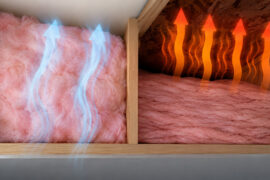
The building envelope carries the heaviest prescriptive weight, because a leaky envelope undercuts every other efficiency measure behind it.
Opaque assemblies like attics, walls, and floors get a minimum R-value that climbs in colder climate zones.
Windows and doors get their own cap, expressed as a maximum U-value, along with a solar heat gain coefficient limit for west-facing glass.
Cool roof requirements apply in several climate zones too, cutting how much heat a roof absorbs before it ever reaches the attic.
Nothing in the code names a product. Fiberglass batts, blown or dense-pack cellulose, closed-cell spray foam, open-cell spray foam, any of them can hit the same target once the numbers check out. That material neutrality is one of the more sensible things about Part 6.
Mechanical and Lighting Systems
Equipment efficiency is the obvious piece, but this section reaches further than that.
- Heating and cooling equipment efficiency
- Duct sealing and testing on new systems
- Lighting power allowances and required controls
- Water heating equipment type and efficiency
The 2025 code is expected to lead to more than 500,000 heat pump installations over three years, according to the California Energy Commission.
PulteGroup used a Rinnai tankless water heater in an earlier zero-net-energy prototype home built in Northern California to demonstrate compliance with Title 24’s water heating and efficiency requirements.
Solar and Battery Storage
New low-rise residential buildings have carried a rooftop solar requirement since the 2019 code cycle.
Meeting it does not always mean panels on that specific roof.
- Rooftop photovoltaic array sized to the home’s electrical load
- Community solar subscription, where rooftop panels are not workable
- Battery storage paired with a smaller array to earn compliance credit
The 2022 code cycle, effective 2023, extended photovoltaic and battery-storage standards to high-rise multifamily and nonresidential buildings. The 2025 update tightened those requirements further and added coverage for additional building types, such as assembly occupancies.
How Often Is Title 24 Updated?
Every three years, on a fixed cycle.
The California Energy Commission adopts each update, then sends it to the California Building Standards Commission for approval before it becomes enforceable.
Dates for the 2025 cycle are worth knowing if a project sits anywhere near the cutoff.
- The California Energy Commission adopted it on September 11, 2024
- The California Building Standards Commission approved it on December 17, 2024
- It applies to permits filed on or after January 1, 2026
That gap between adoption and enforcement is deliberate. Architects, energy consultants, and building departments get a runway to switch over software and paperwork before the deadline hits.
A project permitted the day before the effective date can still finish out under the old code, so the filing date on the permit application is what decides which version applies.
Who Verifies Title 24 Compliance?

Verification splits between a paperwork review at the local building department and a physical inspection by a certified rater.
The building department checks the submitted compliance documents against the plans before issuing a permit.
The physical inspection happens later, once the measures are actually installed.
Names changed with the 2025 code, which trips up anyone who learned the old ones.
| Role | Before the 2025 code | 2025 code onward |
|---|---|---|
| Program | HERS Program | Energy Code Compliance (ECC) Program |
| Organization | HERS Provider | ECC-Provider |
| Field verifier | HERS Rater | ECC-Rater |
The California Energy Commission moved field verification and diagnostic testing out of the old HERS regulations and into Title 24 itself, effective January 1, 2026.
The HERS name did not disappear, it just narrowed. It now covers whole-house ratings and home energy audits, not Title 24 compliance sign-off.
California Home Energy Efficiency Rating Services, known as CHEERS, became the first organization approved as an ECC-Provider, cleared by the California Energy Commission on November 12, 2025.
CHEERS alone registers more than 220,000 projects a year from over 70,000 building industry users, which gives a rough sense of how much verification volume runs through the system annually.
Which Buildings and Projects Must Comply With Title 24?
Any building project that needs a permit in California needs to address Title 24, residential or nonresidential.
That covers new construction, plus most additions and alterations once they touch the building envelope, lighting, or mechanical systems.
Covered occupancy types run wide.
- Single-family homes, duplexes, and townhomes
- Multifamily and mixed-use buildings
- Offices, retail, and other commercial space
- Hotels, motels, and most institutional buildings
Requirements are not identical everywhere in the state.
The California Energy Commission divides California into 16 climate zones, each with its own energy budget and its own minimum requirements for insulation, windows, and equipment.
A design that clears the numbers in coastal San Diego will not automatically clear them in the high desert around Palmdale.
When Does Title 24 Not Apply?
The exceptions list is short and specific rather than broad.
Most projects that trigger a building permit will still have to comply in some form.
| Exception | What It Covers |
|---|---|
| Qualified historic buildings | Regulated instead under the California Historic Building Code, Part 8 |
| Temporary structures | Left to the local building department’s discretion, including disaster-response structures |
| Occupancy Groups I-3 and I-4 | Covers jails and prisons (I-3) and licensed daycare facilities (I-4) |
None of these exceptions are automatic.
A historic building still has to follow its own separate code, and a local building department has to actually grant a temporary-structure exemption rather than assume one applies.
Unconditioned space causes its own share of confusion. A space with no heating or cooling still has to meet the lighting requirements in Part 6.
Builders sometimes read no HVAC as no Title 24 exposure at all, and that assumption is wrong often enough to cause permit delays.
How Is Title 24 Different From CALGreen?
Part 6 is about operational energy, meaning how much a building burns through once people are using it.
CALGreen, which is Part 11, reaches wider. It regulates a broader set of environmental measures, including the carbon locked into the materials before the building ever opens.
| Criteria | Part 6, Energy Code | Part 11, CALGreen |
|---|---|---|
| Focus | Operational energy use | Broader environmental impact |
| Status | Fully mandatory | Mostly mandatory, some voluntary tiers |
| Recent change | 2025 code, effective 2026 | Embodied carbon rule added 2024 |
That embodied carbon rule is the clearest split between the two parts.
Up to 50 percent of a new building’s total emissions over a 30-year lifespan come from embodied carbon rather than operational energy, according to the California Energy Commission’s 2021 Integrated Energy Policy Report.
CALGreen’s embodied carbon measure currently applies to nonresidential projects over 100,000 square feet and schools over 50,000 square feet.
That threshold drops to 50,000 square feet for all covered projects starting January 1, 2026, pulling many more mid-size buildings into scope.
A project can be fully compliant with the energy code and still have CALGreen obligations left to satisfy, since the two parts answer different questions.
How Do You Show Compliance With Title 24?

The sequence is the same whether the job is a kitchen remodel or a distribution warehouse.
- Choose prescriptive or performance and run the energy model if performance applies
- Generate compliance documents through CEC-approved software
- Submit those documents with the building permit application
- Build to the documented design
- Complete ECC field verification and diagnostic testing where required
- File the final signed documents to close out the permit
Skipping or reordering a step is usually what turns a routine permit into a delayed one.
Compliance Forms and Documents
Certificates of Compliance document the design at permit application, filed as CF1R for residential work and NRCC for nonresidential.
Certificates of Installation and Verification come later and confirm what actually got built. The installer or the ECC-Rater files those.
Small residential additions get a shortcut. Projects under 1,000 square feet can use a shorter prescriptive form instead of the full compliance package.
Installers file a separate certificate for insulation specifically, confirming the home insulation went in at the thickness and coverage the design called for.
Common Compliance Mistakes
Duct leakage testing fails more often than any other single field test, usually from connections that were never fully sealed before drywall went up.
A few other problems show up repeatedly on real projects.
- Compliance software version does not match the code cycle the permit was filed under
- Insulation installed before the ECC-Rater inspects it, forcing a rework
- Window schedules on the plans not matching what actually gets ordered
Most of these are coordination failures between the design team and the field crew, not gaps in the code itself.
FAQ on What Is Title 24
Why Is It Called Title 24?
The California Code of Regulations splits state rules into 28 titles, each assigned to a specific agency or subject.
Building standards landed at number 24 through that administrative sequence, not because of anything unique to energy or construction.
What Happens If a Building Does Not Comply With Title 24?
A project that fails to meet Title 24 cannot close out its building permit.
The local building department withholds final inspection and the certificate of occupancy until the design or installed measures are corrected to meet the energy budget.
What Should You Upgrade First in What Is Title 24?
Under Title 24, the building envelope earns the first construction dollar on any project, since insulation and window upgrades relax the energy budget more heavily than mechanical equipment or solar arrays added later in the same design.
That order follows the performance method’s own logic. A tighter envelope earns more room to trade against weaker mechanical or renewable numbers under the same standard design comparison.
The trade-off is upfront cost. Better windows and continuous insulation cost more at framing than a slightly larger heat pump added near the end of a project.
- Building envelope, meaning insulation, air sealing, and windows
- Mechanical systems for heating, cooling, and water heating
- Renewables, solar and battery storage
The next practical question is which types of insulation materials clear that target most affordably, since material choice closes the gap between a prescriptive minimum and a performance-path credit.