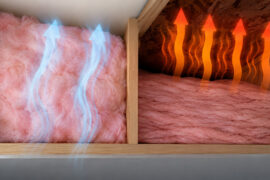
The whole thing comes down to one number: how much air a house leaks when you hold it at a set pressure difference. A blower door test gets that number with a calibrated fan mounted in an exterior door frame, which is a lot more useful than walking around with the back of your hand out, feeling for drafts.
RESNET certified raters and BPI certified analysts run the test during new construction inspections and home energy audits. Passive House certification reviews use it too, with a far tighter target than code. Whatever the setting, the result gets compared against a code or program threshold, like the International Energy Conservation Code’s air leakage limit.
This happens more often than most homeowners realize. RESNET has HERS Index rated more than 4.4 million homes nationwide since the program’s founding in 1995, and the blower door reading anchors every one of those scores (RESNET, 2025).
What Is a Blower Door Test?

The fan moves a known volume of air through the house while a gauge watches the pressure. What comes back is a single, comparable number rather than an impression.
People mix it up with a duct blaster test constantly. Different animal. The duct blaster isolates ductwork; the blower door measures the whole envelope, walls and windows and attic hatch and that gap behind the dryer vent included.
The same procedure goes by a few other names in the field.
- air leakage test
- building airtightness test
- envelope depressurization test
Contractors usually run it as one piece of a broader home energy audit, alongside insulation checks and combustion safety review.
How Does a Blower Door Test Work?

A fan sits inside a panel that temporarily replaces an actual exterior door. It pushes or pulls air until the house holds a fixed pressure difference against the outside, usually 50 pascals.
A digital manometer tracks that gap in real time and calculates how much air the fan has to move to keep it there. That airflow number is where CFM50 and ACH50 come from.
Equipment Used in a Blower Door Test
Two brands cover most of what you’ll see on a job site.
- Minneapolis Blower Door, made by The Energy Conservatory
- Retrotec fan systems, the common competing rig
- DG-1000 or DM32 digital manometer for the pressure reading
TECTITE software logs the readings and converts them into the final CFM50 and ACH50 figures automatically.
Plenty of techs pair the fan with a thermal imaging camera right after, since a cold patch on a wall usually lines up with wherever the pressure test found a leak.
Pressurization and Depressurization Methods
Depressurization is the default across most of North America.
Pulling air out of the house recreates a worst-case, wind-driven leakage condition. It also lets the tech walk the interior with a smoke pencil and trace exactly where outside air is sneaking in, which is the part homeowners actually find useful.
Pressurization comes out when backdrafting is a real risk, so a home with a fuel-burning fireplace or a naturally vented water heater often gets tested that direction instead. European protocols also call for it. EN13829 averages a pressurized run with a depressurized one and reports the mean.
Either direction still aims at the same reference point of 50 pascals, roughly what a 20 mile per hour wind does to every side of the house at once.
What Do Blower Door Test Results Mean?

Results come back as CFM50 and ACH50, and the two are connected.
CFM50 is the raw airflow the fan moves at 50 pascals, measured in cubic feet per minute. ACH50 takes that same airflow and divides it by the interior volume of the house, which is why a big leaky house and a small leaky house can post very different CFM50 numbers and land in the same ACH50 neighborhood.
Lower is tighter. Higher means more uncontrolled infiltration, bigger stack effect losses in winter, and more wind washing through wall and attic insulation.
Neither figure works like a school grade. It states how much conditioned air the house loses to the outside every hour, which also ties into indoor air quality and moisture risk over time.
What Standards Govern Blower Door Testing?
ASTM E779 is the base test method most technicians in the United States follow, with ASTM E1827 accepted as an alternate practice.
ISO 9972 covers the equivalent procedure internationally. European testers know the same protocol under the name EN13829.
| Standard | Governing Body | Role |
|---|---|---|
| ASTM E779 | ASTM International | Primary US test method |
| ASTM E1827 | ASTM International | Alternate US test practice |
| ISO 9972 | International Organization for Standardization | International equivalent procedure |
None of these standards set a pass or fail line on their own. That job belongs to whatever energy code or certification program sits on top, which is why RESNET ties its HERS Index scoring to the applicable ASTM method, and the International Code Council folds the same test into the IECC’s mandatory compliance path.
What Counts as a Passing Blower Door Test Score?
There’s no universal cutoff. A passing score depends entirely on which code or certification applies to the house.
New construction under the 2021 IECC tops out at 3 ACH50 across most climate zones, with a looser allowance in the hot ones. The 2024 IECC tightens things further, and the exact number still moves by climate zone rather than settling on one figure.
- The 2021 IECC caps new construction at 3 ACH50 in climate zones 3 through 8, with 5 ACH50 allowed in zones 1 and 2 (2021 IECC)
- The 2024 IECC moves to 4.0 ACH50 in climate zones 0 through 2, 3.0 ACH50 in zones 3 through 5, and 2.5 ACH50 in zones 6 through 8 (2024 IECC)
- Passive House Institute sets its limit at 0.6 ACH50 for new certified construction (Passive House Institute)
- An untreated older home often lands at 20 to 25 ACH50, against roughly 5 to 10 ACH50 for a typical new home built without a specific airtightness target (Pro Clima building airtightness data)
Land above the target and the fix usually comes down to air sealing the specific gaps the test just found. Nobody tears the house apart over a failed number.
Field results back this up. Ecocor, the Maine-based Passive House building firm founded by Chris Corson, reports blower door results on its panelized homes ranging from 0.17 to 0.42 ACH50 in the field, comfortably under the 0.6 ACH50 Passive House limit (Passive House Accelerator).
Homes chasing net zero energy performance push for similarly low numbers. Worth knowing the tradeoff: seal a house that tight and it needs a dedicated whole-house ventilation system, because fresh air no longer wanders in on its own.
Who Needs a Blower Door Test?
Anyone building new residential construction in a jurisdiction that adopted the 2015 IECC or later needs one before the certificate of occupancy gets issued.
Beyond that mandate, the test shows up in a handful of situations.
- New construction, where it’s a required final inspection step
- Weatherization Assistance Program retrofits, where DOE-funded crews verify the before and after numbers
- Passive House and other voluntary certifications, with a bar sitting well below code minimum
- Real estate transactions, where a buyer occasionally orders one with no code trigger at all
RESNET’s own tally puts HERS-rated homes at 436,798 in 2024, up from 362,265 in 2023, and the blower door reading sits at the center of that scoring process (RESNET, 2025).
New York, Florida, Michigan, and Georgia already require the test on new single-family construction, and more states keep adding the mandate as they adopt newer code cycles. Wherever code or a program calls for third-party verification, a RESNET-certified HERS rater or a BPI-certified analyst typically runs it.
How Much Does a Blower Door Test Cost?
A standalone test typically runs a few hundred dollars. Home size and the number of zones needing separate testing drive most of the variation.
Bundling it into a full home energy audit costs more upfront but saves a separate trip, since the same crew handles insulation checks and combustion safety review in one visit.
- Outsourcing a single test runs around $300 per house, based on one contractor’s own pricing (Fine Homebuilding, 2021)
- Buying the equipment makes sense at volume. A Minneapolis Blower Door system listed near $3,755 pays for itself after roughly 13 tests at that rate (Fine Homebuilding, 2021)
Households going through DOE-backed retrofits can often get part of that expense offset through a weatherization rebate tied to the improvement work.
How Long Does a Blower Door Test Take?
A single-family home usually wraps up in under an hour once the crew arrives. Most of that is setup, not testing.
- 10 to 20 minutes mounting the fan panel in the door frame
- 10 to 15 minutes prepping the house, which means closing windows, opening interior doors, isolating combustion appliances
- About 15 minutes to run the test and record the reading
Add a pressure pan test or a thermal imaging pass on top and the visit stretches closer to two hours.
Who Is Qualified to Perform a Blower Door Test?

Two credentials cover most of the testing done in the United States, one from BPI and one from RESNET.
BPI restructured its Building Analyst credential on May 31, 2023, splitting the old single certification into two (BPI).
The Building Analyst Technician, or BA-T, is the field credential. It’s earned through a proctored field exam and covers hands-on diagnostic work, blower door and combustion safety included. The Building Analyst Professional, or BA-P, sits on the modeling side. That one is a 60 question written exam with a 2.5 hour limit and a 70% passing score, covering energy modeling and scope of work development.
So when someone says “BPI-certified analyst” in the context of an actual test, they mean the BA-T. That’s the credential BPI kept for field work.
RESNET runs a longer path for its HERS raters.
- Pass the RESNET National Rater Exam
- Pass the RESNET Rater Simulation Practical Test
- Pass the RESNET Combustion Appliance Simulation Test
- Complete five probationary ratings overseen by a RESNET Candidate Field Assessor before certification is issued (RESNET)
Certified raters don’t get to coast afterward. RESNET requires a file review on 10% of a rater’s rated homes and a field review on 1% every year, plus 18 hours of approved training every three years to keep the credential active (RESNET).
PEG, LLC, one of RESNET’s largest accredited rating providers, crossed 250,000 HERS-rated homes in January 2025, a volume only possible because its raters work under that same annual quality assurance structure (RESNET, 2025).
Blower Door Test vs Duct Blaster Test vs Pressure Pan Test
These get confused constantly, mostly because the same crew often runs all three back to back on one visit. Each isolates a different part of the house and reports in different units.
| Test | Target Pressure | What It Isolates |
|---|---|---|
| Blower door test | 50 Pa | Whole building envelope |
| Duct blaster test | 25 Pa | Ductwork only, registers taped off |
| Pressure pan test | Reads relative to house pressure | Individual registers, one at a time |
The duct blaster connects straight to the air handler or a return grille and pressurizes the taped-off duct system on its own, separate from the blower door fan. Under the 2021 IECC, post-construction duct leakage has to stay under 4.0 CFM per 100 square feet of conditioned floor area when the air handler is installed, loosening to 8.0 CFM per 100 square feet if the ducts sit entirely inside the conditioned envelope (DOE Building Science Education Solution Center).
California leans on the same duct blaster procedure to check compliance with its own Title 24 energy code, separate from whatever the IECC requires elsewhere.
The pressure pan works differently. It sits over one register at a time while the blower door depressurizes the house. A near-zero reading means that duct run is tight. A reading several pascals off zero flags a leak at that specific boot or connection (Southface Energy Institute).
Where each one falls short is the part worth remembering. The blower door covers the whole envelope and is what the energy code actually mandates, but it can’t tell you which duct run is leaking. The duct blaster pinpoints duct leakage and satisfies the IECC’s separate duct rule, though it needs every register taped and won’t catch a leaky window or rim joist. Pressure pan testing is quick and cheap to bolt onto the same visit, and it gives a relative pressure reading instead of a calibrated CFM number. It points at problems. It doesn’t quantify them.
When Does a Blower Door Test Not Apply?
The test stops being reliable under a few specific conditions, and a good tech flags them before the fan ever runs.
Wind is the biggest one.
- ASTM E779 doesn’t hard-code a numeric wind cutoff into the standard itself, but blower door manufacturers and standard field practice treat 5 mph or less as the threshold for a reliable single-point reading
- Above roughly 5 mph, techs typically switch to a multi-point test rather than stopping outright, since averaging several pressure readings helps cancel out wind noise
- Once wind climbs into the 15 to 20 mph range, most protocols call for postponing the test entirely, since gusts overwhelm the fan’s ability to hold a steady reference pressure
Past that, gusts push air through the envelope on their own and the fan can’t tell its own airflow apart from the wind’s.
Combustion appliances create the second failure point. Depressurizing a house with an open fireplace, a naturally vented water heater, or an unsealed furnace running can pull exhaust gas back into the living space instead of sending it up the flue. That equipment gets isolated or shut down before the fan turns on, no exceptions.
Attached and multifamily units complicate the math in a different way. Under the 2021 IECC, individual dwelling units in attached buildings, or any unit at 1,500 square feet or smaller, get an alternate compliance path using 0.30 CFM per square foot of dwelling unit enclosure area instead of the standard whole-house ACH50 metric. Shared walls make a single clean test boundary hard to define.
And a house that isn’t finished isn’t worth testing. Running the fan before insulation, drywall, and trim are done measures a building that doesn’t exist yet.
How Is a Blower Door Test Performed, Step by Step?
Setup and prep matter as much as the fan does.
- Walk the house first. The tech notes fireplaces, combustion appliances, and any obvious gaps before touching the equipment.
- Isolate combustion equipment. Pilot lights get extinguished, dampers get closed, and any open flame gets dealt with for safety.
- Set interior conditions. Interior doors get opened, exterior windows and doors get closed, and HVAC registers stay in their normal position unless the protocol says otherwise.
- Mount the fan panel. The door panel goes into the exterior door frame in place of the actual door, sealed at the edges.
- Connect the manometer. A tube runs from inside to outside so the gauge reads the true pressure difference across the envelope.
- Run the fan to 50 pascals. The technician ramps the fan up until the house holds that reference pressure, then lets the software calculate CFM50.
- Convert and record ACH50. The software divides CFM50 by house volume and logs the final number against the applicable code or program target.
- Walk the leaks while the fan runs. With the house still depressurized, the tech uses a smoke pencil or a thermal imaging pass to physically locate the worst leak points for the report.
Miss a step, like leaving a bathroom exhaust fan running or forgetting an interior closet door, and the reading comes back wrong in a way nobody catches until the crew has packed up and left.
FAQ on What Is A Blower Door Test
What Is a Blower Door Test Not, and How Is It Different From a Home Energy Audit?
One thing gets measured here, and that’s the air leakage rate.
A home energy audit is the larger inspection built around it, covering insulation levels, duct leakage, HVAC efficiency, and combustion safety. The test supplies one data point inside that audit.
Can a Homeowner Run a DIY Blower Door Test?
Rental kits and manometers exist, and a motivated homeowner can absolutely rig a fan in a doorway and find obvious drafts with it. Useful weekend project, honestly.
What that setup cannot produce is a calibrated CFM50 reading that satisfies ASTM E779 or counts toward code compliance or certification.
Is a Blower Door Test Worth Doing on an Older, Existing Home?
Older homes usually post the highest ACH50 numbers on the block, and that gap is exactly where air sealing pays back fastest.
Testing first tells a homeowner which leaks matter before the money gets spent, instead of after.
What Happens After a Blower Door Test?
The technician delivers a written report with the ACH50 or CFM50 result plus the leak locations found with a smoke pencil or thermal camera.
Contractors use that list to prioritize sealing work, then schedule a retest to confirm the house clears the target.
Is a Blower Door Test Safe, or Can It Damage the House?
The test is safe when a technician follows protocol. Fifty pascals is a mild, momentary load next to what a house takes in an ordinary storm.
The risk sits with combustion appliances left running during depressurization, not with the fan or the structure.
What Should You Fix First After a Blower Door Test?
The report points toward the leaks worth sealing first, and the biggest ACH50 gains come from attacking the largest, highest-volume gaps before anything else. Usually that means the attic plane, the rim joists, and any unsealed penetration through the top plate.
- Attic plane and top plate penetrations, for the largest leakage-to-area ratio
- Rim joists and foundation sill, where stack effect pulls hardest
- Window and door weatherstripping, which delivers the smallest ACH50 gain per dollar
Sealing the big stuff first cuts the number fastest per dollar spent. Every point after that costs more, because the easy leaks are already gone.
Once the biggest ones are closed, the question changes from finding air paths to controlling heat flow, which is where understanding how insulation works becomes the next practical step.