The difference between a rebate and a tax credit tends to surface at tax time, which is the worst possible moment to learn it. One arrives as a discount while the work is happening. The other shows up months later on a return, assuming it shows up at all.
Weatherization rebates sit in the first category. Government-backed or utility-backed, they cut the cost of efficiency work at the point of installation.
The U.S. Department of Energy runs the biggest one, the Weatherization Assistance Program. State energy offices handle the newer tracks created under the Inflation Reduction Act.
WAP has been operating since 1976 and has upgraded more than 7.2 million homes nationwide, according to Department of Energy figures published in 2025. This is not a pilot program.
What Is a Weatherization Rebate?

The mechanics are simple enough. Money comes off the price before or during the project, funded by a federal or utility pot, and there is no repayment and no waiting for a filing season.
The model goes back to the Weatherization Assistance Program, still the largest source of weatherization rebate money in the country.
WAP has pushed federal formula grants out to state energy offices and local agencies since 1976, and most of the state and utility programs running today are built on the same bones.
Rebates, grants, and loans get used interchangeably in conversation, which causes problems later.
A rebate either knocks the price down at the point of sale or pays part of the cost back after installation, with nothing owed. A grant is a lump sum tied to a defined project scope, usually run through a state or nonprofit agency. A loan is borrowed money, sometimes at a reduced rate through a state energy program, but it still gets repaid.
What separates weatherization rebates from the wider pool of efficiency incentives is the income test. These are aimed at income-eligible households specifically, not at any homeowner who wants a new furnace.
What Does a Weatherization Rebate Cover?
Envelope work comes first in almost every program, with mechanical systems funded after that if there is budget left.
Cosmetic work does not qualify. Painting, flooring, that sort of thing. Every measure has to tie back to a measurable energy outcome, which is the basis for the funding in the first place.
Building Envelope Measures
Most of the rebate money lands here. The envelope decides how much conditioned air escapes a house, so it is the cheapest place to get real savings.
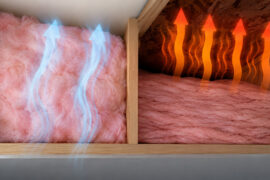
Attic and wall home insulation upgrades are the most commonly funded measure across WAP and the state HOMES programs. Weatherstripping and window replacement usually fill out the rest of the envelope scope.
- Attic insulation
- Wall insulation
- Weatherstripping
- Window replacement
Insulation almost always gets paired with air sealing. Insulating a leaky house is close to pointless, since the air keeps moving through the gaps regardless of what is in the walls.
Mechanical System Measures
- Duct sealing
- Furnace or boiler replacement
- Heat pump installation
Per unit, mechanical work costs considerably more than envelope work, so plenty of programs put a hard dollar cap on HVAC replacement.
HEAR exists partly to fill that gap. It is one of the two IRA-created rebate tracks, and it was built around heat pump and electrification upgrades that WAP budgets often cannot stretch to cover.
Where Does Weatherization Rebate Funding Come From?
There is no single pot. Federal, state, and utility money stacks up, and which layers a household can actually reach depends on where they live.
Underneath it all sits the Department of Energy’s Weatherization Assistance Program, funded through annual congressional appropriations.
On top of that are the Inflation Reduction Act’s Home Energy Rebates, split between HOMES and the Home Electrification and Appliance Rebate. That second one goes by HEAR in some states and HEEHRA in others, which is a needless source of confusion for anyone reading across state lines.
The Department of Energy authorized $8.8 billion across the two IRA rebate tracks, distributed to state energy offices and tribes through formula grants (Department of Energy, 2023).
States apply for their share, then write their own rules inside DOE’s guardrails. That is why rebate amounts and covered measures look different the moment you cross a border.
Funding Windows and Renewal Cycles
WAP renews annually through the federal budget process, so a pause in one fiscal year does not mean the program has ended. The IRA rebates work the opposite way. HOMES and HEAR received fixed allocations, and once a state’s share is spent, it is spent.
California’s HEEHRA program for single-family homes reached its full allocation and closed to new reservations in February 2026. Other states are expected to follow as their funds run down.
Who Administers Weatherization Rebate Programs?

At the federal level, oversight sits with the Department of Energy’s Office of State and Community Energy Programs.
The money then moves to state energy offices, which write program rules and set income limits inside federal guidelines. Community action agencies handle everything at the household level, from intake through scheduling and contractor coordination.
- DOE’s Office of State and Community Energy Programs sets policy and releases the formula grant funding
- State energy offices write program rules and manage the rebate budget
- Community action agencies process applications and schedule the work
- BPI-certified installers complete the measures and trigger final payment
That last link matters more than people expect. A contractor’s certification status is often tied directly to whether a household’s rebate gets disbursed at all.
Speed varies a lot between states. Each energy office runs its own application queue and inspection schedule, and some are simply better staffed than others.
Who Qualifies for a Weatherization Rebate?
Which program a household applies through changes the answer, because WAP and the IRA tracks measure income differently.
WAP benchmarks against the federal poverty guideline. HEAR and HOMES use area median income instead, usually written as AMI.
For WAP, the line sits at or below 200 percent of the federal poverty guideline.
HEAR covers up to 100 percent of project costs for households at or below 80 percent of area median income, and phases out completely above 150 percent of AMI (Department of Energy, 2023).
Household size moves the dollar figure under both tests. A family of five qualifies at a higher income than a single-person household.
Homeowners are eligible under WAP and under both IRA tracks, with proof of ownership required during the application. Renters can get many of the same measures, though the landlord has to sign off before anything starts.
For proof of eligibility, agencies usually want recent tax returns, pay stubs, or a benefit award letter such as SNAP or SSI documentation.
Nebraska moved its state weatherization ceiling to 200 percent of the federal poverty guideline back in 2010. That threshold has since become close to a national norm for WAP-funded work.
How Much Is a Weatherization Rebate Worth?
It depends on the program, on measured or modeled energy savings, and on which income tier a household lands in.
Anyone quoting a single figure is generalizing. The numbers below come from one federal grant program and two separate IRA rebate tracks, and they are not measuring the same thing.
HOMES pays up to $8,000 per household, tied to a minimum modeled energy savings of 20 percent (Department of Energy, 2023). HEAR, or HEEHRA depending on the state, goes up to $14,000, with real amounts landing anywhere from $840 to the full cap based on income and project scope. WAP is not a fixed-amount program at all, and its average expenditure runs $7,669 per household (Pennsylvania Department of Community and Economic Development, 2026).
Bigger rebates generally follow deeper modeled savings or lower household income. Square footage on its own does not move the number much.
Stacking is where totals get interesting. A household that gets envelope work through WAP and then uses a HOMES rebate for HVAC replacement can end up with a combined project value well above either program’s individual cap.
Iowa’s Economic Development Authority built its HOMES rebate to scale directly with modeled savings instead of paying a flat amount per household.
Weatherization Rebate vs Tax Credit: How Do They Differ?
Both lower the cost of home energy upgrades. Timing is what separates them, and timing is what people get wrong.
A rebate cuts the price before or shortly after installation. A tax credit returns money the following spring, once a return has been filed.
| Feature | Weatherization Rebate | 25C Tax Credit |
|---|---|---|
| When you get the money | Point of sale or shortly after work is done | Following year, when you file taxes |
| Income limit | Yes, tied to poverty guideline or AMI | None |
| Maximum value | Up to $14,000 (HEAR) or $8,000 (HOMES) | $1,200 a year for insulation and air sealing |
| Current status | Active, funded through state allocations | Ended for installations after December 31, 2025 |
The insulation tax credit under Section 25C paid out 30 percent of project cost, capped at $1,200 a year for building envelope work. Congress let it expire for installations completed after December 31, 2025 (IRS, 2024).
New work can no longer be filed against it. For anyone still inside an eligible income tier, that makes the weatherization rebate the more dependable option by default.
Stacking the two used to make sense, since the rebate and the credit applied through different mechanisms. That option went away with the credit.
How Do You Apply for a Weatherization Rebate?

The sequence is fairly consistent from state to state, even though the forms and the wait times are not.
- Contact the state energy office or the community action agency that covers your county
- Submit income and property documentation, meaning tax returns, pay stubs or a benefit letter, plus proof you own or rent the home
- Wait for placement on the service list, which moves according to funding and priority scoring
- Complete a home energy audit, where a certified auditor inspects the house and writes up the work order
- Let a BPI-certified crew install the approved measures and close out the file
The home energy audit is the step that decides everything downstream. It determines which measures a household qualifies for, and most agencies will not schedule installation without one on file.
North Carolina’s Community Action Opportunities reports that the audit visit runs two to three hours and includes a blower door test to measure air leakage (Community Action Opportunities, 2026).
Past that stage, some programs move quickly. Washington DC’s Department of Energy and Environment assigns a nonprofit that arranges contractor work within 21 days, funding and contractor capacity permitting (DC Department of Energy and Environment, 2026).
Documents Needed Before Approval
Worth having ready before the first phone call:
- Proof of income, such as a recent tax return, pay stubs, or a benefit award letter
- Proof of residency, usually a utility bill or lease agreement
- Photo identification for the applicant
- Landlord authorization if the applicant rents
Missing paperwork is the most common reason an application stalls before it ever reaches the audit stage. Not eligibility. Paperwork.
What Are the Pros and Cons of a Weatherization Rebate?
This is not free money for everyone, and there are households who would be better off paying out of pocket and getting the work done this month. It comes down to income, timing, and patience.
The upside
- The cost drops upfront, since the rebate applies before or right after the work
- Nothing gets repaid, which is not true of loan-based efficiency programs
- Measures come bundled, so insulation, air sealing and mechanical work usually happen in a single visit
- Utility bills stay lower long after the project closes out
The drawbacks
- Income eligibility shuts out moderate and higher earners completely
- Processing can drag on for months, occasionally years, before any work begins
- Contractor availability is thin in rural counties
- Funding caps mean a larger retrofit rarely gets covered in full
Waitlists are not first-come, first-served everywhere either. The West Virginia Development Office scores its queue on points, giving priority to households with a high energy burden, elderly residents, or children in the home. Two similar applicants can wait very different lengths of time depending on circumstances rather than application date (West Virginia Development Office, 2026).
The return side is solid, though. A national evaluation of WAP-funded homes found average annual energy cost reductions of $372, and those savings repeat every year after the initial investment (Department of Energy, 2025).
That recurring number is why a lot of households decide the wait is worth sitting through.
When Does a Weatherization Rebate Not Apply?
Some households never clear the first screen, and it saves time to know which category you fall into before filling anything out.
- Income above the ceiling disqualifies a household no matter how old or inefficient the house is
- Work outside the covered measures list, meaning roofing, cosmetic remodeling, solar panels and general repairs, falls outside WAP, HOMES and HEAR
- Once a state’s allocation runs out for the fiscal year, new applications stop moving until the next funding cycle
- A renter cannot receive weatherization work without written permission from the property owner
- A home already weatherized under a federal cycle typically cannot reapply until a required waiting period passes
Funding exhaustion is not theoretical. Clackamas County, Oregon reports a waitlist running two to four years for its DOE and LIHEAP-funded program, driven by demand that consistently outpaces annual funding.
The same county will not re-weatherize a home for 15 years after the first round of work, a restriction set by its federal and state funders (Clackamas County, 2026).
Restrictions like that exist because weatherization is funded as a one-time investment per household, not as a recurring subsidy.
FAQ on What Is A Weatherization Rebate
What role does a home energy audit play in the rebate process?
A home energy audit measures how a home currently uses energy and flags the most cost-effective upgrades before any rebate gets approved. HOMES rebate amounts are calculated from audit results, so the audit effectively sets the ceiling on what a household can recover.
Can renters get a weatherization rebate?
Yes, and that includes HEAR-funded electrification upgrades, though landlord authorization has to come first. Multifamily buildings can qualify as a whole property as well, provided a set share of units house income-eligible tenants.
What commonly goes wrong during a weatherization rebate application?
Most stalls trace back to incomplete income documentation, a missing landlord signature on rental units, or a home that fails the pre-audit safety check over things like knob-and-tube wiring or an active roof leak. Any one of those freezes the file until it is resolved.
How long does it take to receive a weatherization rebate after applying?
Timelines vary sharply by state and funding cycle. Some households go from application to finished work in a few weeks. Others sit on a waitlist for a year or more before an auditor is even scheduled.
Is a weatherization rebate taxable?
A weatherization rebate is not typically treated as taxable income, since it functions as a price reduction rather than a payment received. A tax credit is a different animal and does have to be reported on a federal return.
What is the weatherization rebate funding status right now?
Status differs by state and shifts as fiscal years turn over. Some states still have active HOMES and HEAR allocations, others have paused new applications after hitting their cap, and WAP funding rides on the current federal appropriation.
What Should You Check First Before Pursuing a Weatherization Rebate?
Before spending time on an application, confirm where you stand on income eligibility against the relevant program’s threshold, what shape the house is actually in, and which measures your local administering agency is funding this cycle. That last one changes more often than people expect.
- Check income against the federal poverty guideline or the area median income test
- Look at the home’s age, ownership status, and whether it has been weatherized before
- Match the work you need against your state’s current covered measures list
There is a real gap for households sitting above every rebate ceiling. The 25C tax credit that used to cover insulation and air sealing stopped applying to installations completed after December 31, 2025, which leaves no federal incentive at all for that income band.
Households that do clear the income test often qualify for free home insulation under the same guidelines, where the specific rules go further than the general rebate threshold.