Pull down the hatch on an average American attic and you will find one of about five things up there. Fiberglass, cellulose, mineral wool, spray foam, or rigid foam board. Each resists heat flow at a different rate, measured as R-value per inch, and that number drives most of the decision.
Weatherization contractors and HERS raters sort through the options the same way a homeowner should. Climate zone first. Then how easy the attic is to get into, and how much moisture it sees.
Codes are indifferent to which material you pick. What gets checked is whether the finished depth hits the Department of Energy’s zone-based R-value target, which is the line between insulated and adequately insulated.
The number printed on the bag comes out of a lab. ASTM International revised the heat flow meter method behind it, ASTM C518, in 2021, and manufacturers run that procedure to substantiate what they put on the label.
What Are the Types of Attic Insulation?
Material and installation method both count as a “type,” which is why the categories blur at the edges. Fiberglass shows up as batts and as blown-in loose fill, and those two behave very differently on a real attic floor even though the glass itself is identical.
Fiberglass, cellulose, mineral wool, spray foam and rigid foam board cover almost every attic in the country. Reflective barriers get listed alongside them, though they work as a supplemental layer rather than a stand-alone system.
The payoff here is not marketing fluff. Sealing an attic and bringing it up to the right level, instead of leaving gaps and thin spots, saves homeowners an average of 15 percent on heating and cooling costs, according to the U.S. Environmental Protection Agency and ENERGY STAR.
Installation method separates these categories as much as the raw material does. It also decides whether you can do the work yourself with a rented blower or need to call a crew.
| Type | R-Value per Inch | Installation Method | Fire Resistance |
|---|---|---|---|
| Fiberglass | R-2.2 to R-3.8 | Batts, rolls, or blown-in loose-fill | Noncombustible fibers, facings can burn |
| Cellulose | R-3.2 to R-3.8 | Loose-fill or dense-pack, blown in | Borate-treated for flame resistance |
| Mineral Wool | R-2.8 to R-4.0 | Batts, rolls, or loose-fill | Withstands direct flame without igniting |
| Spray Foam | R-3.5 to R-7.0 | Sprayed liquid, professionally applied | Needs a thermal barrier indoors |
| Rigid Foam Board | R-4.0 to R-7.0 | Cut boards, taped and sealed seams | Flammable, must be covered per code |
The attic is one piece of a bigger picture. These same products belong to the wider family of insulation materials used across the rest of a house, from walls down to crawlspaces, and the physics doesn’t change from one to the next.
If the whole R-value concept is fuzzy, a plain-language grounding in what R-value actually measures is worth ten minutes before you start comparing brands or price tags.
Fiberglass Insulation for Attics

Molten glass, spun into fine strands, bonded with resin and packed loose enough to trap still air. That’s the whole product.
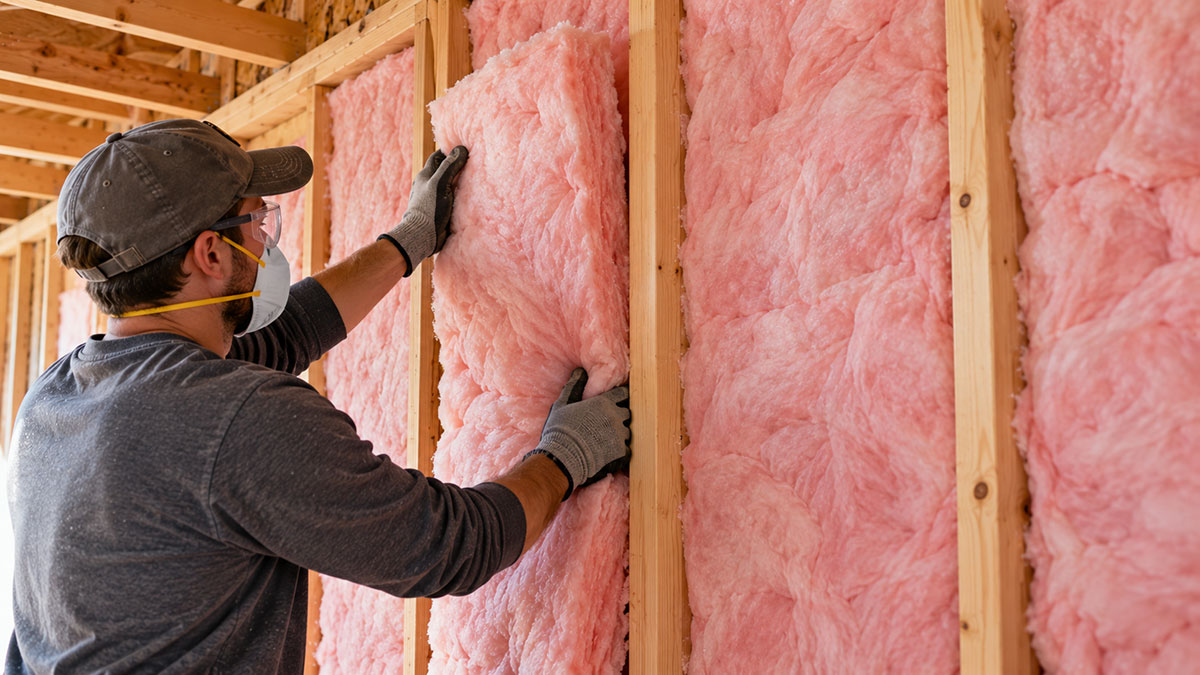
Owens Corning markets its fiberglass under a trademarked pink color, one of the most recognized branding moves in the building materials industry, and the company remains one of the largest fiberglass manufacturers in North America.
Fiberglass Batts and Rolls
Spun glass fibers, sold faced or unfaced, rated between 2.9 and 3.8 per inch depending on density. Material alone runs roughly $0.30 to $0.60 per square foot, and it arrives pre-cut to drop between joists.
For an attic floor, specify unfaced batt insulation so the material can breathe and release trapped moisture instead of holding it against the drywall below.
Here’s the mistake that costs the most: squeezing a batt into a narrower joist bay than it was made for. The air pockets do the insulating, and compressing them out takes a meaningful chunk of the rated R-value with them.
Blown-In Loose-Fill Fiberglass
Loose-fill gets blown in with a machine instead of laid down in sheets, so it settles around wiring, pipes and whatever irregular framing the original builder left behind. It suits a large open floor with few obstructions and nothing already up there to work around.
Loose-fill insulation applied this way reaches corners that batts cannot follow without a lot of cutting and piecing.
Two caveats worth knowing before you rent the equipment.
- It still loses R-value when wet or compacted
- Depth accuracy depends on a properly calibrated blower, not on eyeballing it
Fiberglass batts are still the most common attic insulation in the country. Cheap, sold everywhere, and forgiving enough for a weekend.
Cellulose Insulation for Attics

Recycled paper, mostly old newsprint, shredded and treated with borate compounds for fire and pest resistance.
Greenfiber, formed from the merger of Applegate and Greenfiber, is the largest manufacturer of cellulose insulation in North America and sells its product under the Sanctuary brand.
R-value lands around 3.2 to 3.8 per inch, close enough to fiberglass that the number isn’t the deciding factor. What happens after it’s on the floor is.
Loose-Fill vs Dense-Pack Cellulose
Loose-fill goes into open attic floors at lower density, which is the version most homeowners encounter. Dense-pack is the same material compressed into enclosed cavities at much higher density, and it lives mostly in walls rather than attics.
Loose-fill cellulose insulation settles by roughly 20 percent over the years. A decade or two after the original install, a top-up layer is usually due.
That gradual loss of depth is insulation settlement, and it’s why cellulose depth should get checked periodically instead of assumed permanent.
Water is the bigger issue. Cellulose that gets soaked by a roof leak or condensation loses R-value fast and can support mold, so moisture control matters more here than it does with mineral wool.
Mineral Wool Insulation for Attics
Spun from basalt rock and recycled furnace slag, then bound into batts, rolls, or loose fibers.
Fire performance is the reason it exists in a market otherwise dominated by cheaper products. Mineral wool withstands direct flame without igniting, which neither fiberglass facings nor foam products can claim.
It runs 2.8 to 4.0 per inch, denser than most fiberglass batts, and it holds its thermal resistance even after getting wet. Cost per square foot sits above fiberglass, roughly level with cellulose.
The North American Insulation Manufacturers Association represents producers of both fiberglass and mineral wool, and treats mineral wool’s moisture tolerance as one of its defining selling points.
A product’s insulation fire rating is the main reason contractors reach for mineral wool in attics near chimneys, flues, or recessed lighting.
Other points in its favor: it handles direct flame without producing toxic smoke, and it resists pests without any added chemical treatment.
What you’re paying for, and putting up with:
- Higher upfront cost than fiberglass batts
- Thinner stock at general home centers, so you may be ordering
- Real weight, which makes a full attic a genuinely tiring install
Manufacturers such as Rockwool, one of the largest stone wool producers worldwide, cite the rock wool insulation category as their core residential attic product line.
Spray Foam Insulation for Attics

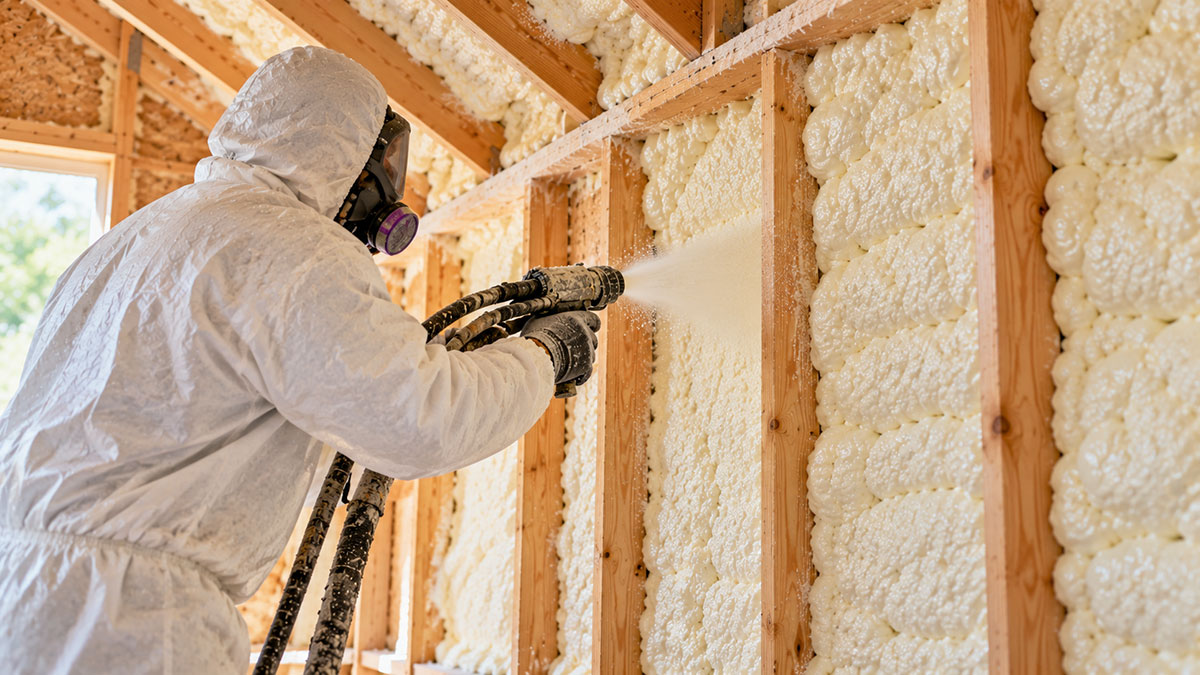
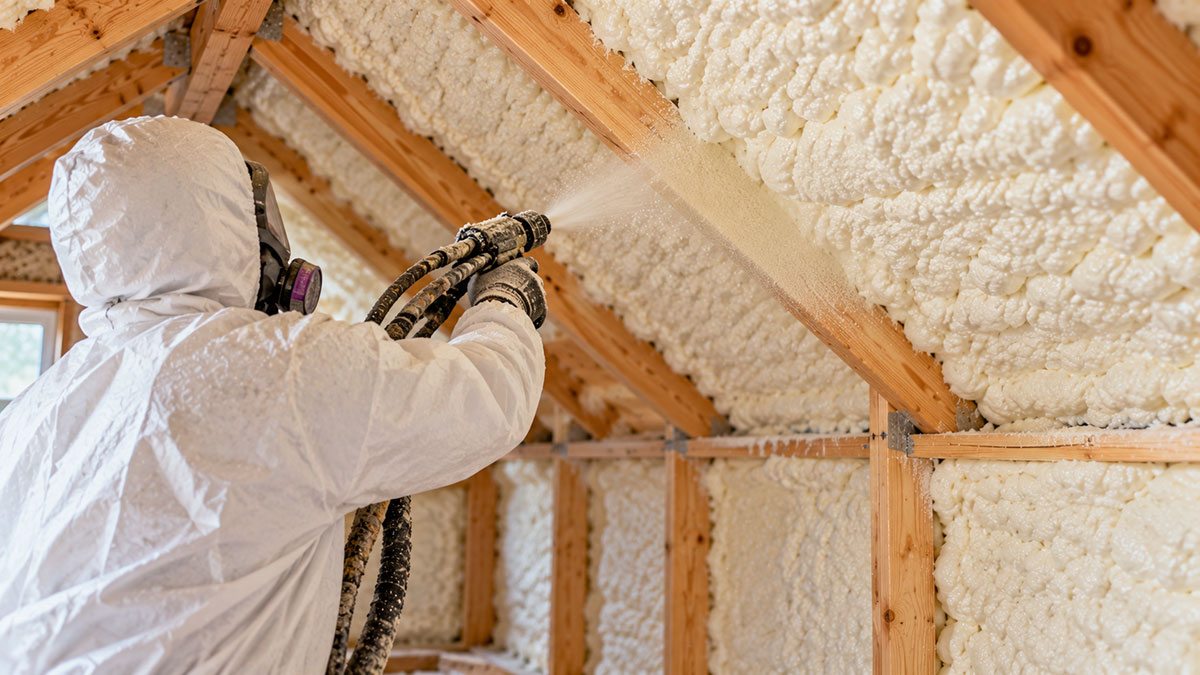
A two-part polyurethane liquid that expands on contact and cures into rigid or semi-rigid foam.
Icynene, now part of Huntsman Building Solutions after a 2020 acquisition, was among the earliest brands to bring open-cell spray foam into mainstream North American residential attics.
Open-Cell Spray Foam
Open-cell expands to roughly 100 times its liquid volume and stays soft and flexible once cured. R-value runs about 3.5 to 3.6 per inch, lighter than closed-cell but still well past what the same thickness of fiberglass delivers.
It’s vapor-permeable, which means cold climates need a separate moisture control strategy on top of it. Closed-cell doesn’t have that problem.
Closed-Cell Spray Foam
Tighter cell structure pushes R-value to roughly 6.0 to 7.0 per inch and gives the cured foam real rigidity.
Spray foam is the only common attic material that insulates and acts as an air sealing layer in one pass, closing the gaps that fiberglass and loose cellulose just drape over.
What you get for the money:
- Air sealing and insulation from one application
- Highest R-value per inch in the group
- Good behavior around irregular framing and penetrations
And the money is the problem. It’s the most expensive option per square foot by a wide margin, requires licensed professional application, and needs a code-compliant thermal barrier anywhere it faces an occupied space.
Fully cured closed-cell insulation is rigid enough to add minor structural bracing to roof framing. Fiberglass and cellulose do nothing of the kind.
Rigid Foam Board and Radiant Barrier Insulation
These two fill the gaps where batts or blown-in material are simply the wrong tool.
Johns Manville produces AP Foil-Faced Polyiso boards rated up to R-28, a common pick where roof deck space is tight and every inch of R-value counts.
Rigid Foam Board
Three chemistries, three price points. Expanded polystyrene sits around R-4.0 per inch. Extruded polystyrene runs R-4.8 to R-5.0. Polyisocyanurate tops the group at roughly R-5.9 to R-7.0 per inch.
Rigid foam board insulation shows up at the roof deck and on knee walls far more often than across an open attic floor, where blown-in material is faster and cheaper.
Boards only hit their rated value when every seam is taped and sealed. An unsealed joint creates the same thermal bridging as a gap between batts.
Radiant Barrier
A thin reflective layer, usually foil-faced, that blocks radiant heat rather than slowing conductive heat flow the way mass insulation does. It carries no R-value rating at all.
Best use is stapled to the underside of rafters in hot climates, where attic roof temperatures climb far above the living space below.
- Cuts radiant heat gain, not conductive heat loss
- Goes in addition to floor insulation, never instead of it
- Needs an air gap facing it, so pressing it flat defeats the point
Reflective insulation pairs well with fiberglass or cellulose on the attic floor, since the two are attacking different heat transfer mechanisms.
Which Attic Insulation Type Fits Your Climate Zone?
Climate zone sets the R-value target. Material choice comes after that, not before.
The U.S. Department of Energy splits the country into eight zones, and ENERGY STAR’s recommendations, built on the 2021 International Energy Conservation Code, assign a specific attic target to each.
- Zone 1, hot climates such as Miami: R-30 for an uninsulated attic
- Zones 2 and 3, including Houston and Atlanta: R-49 for an uninsulated attic
- Zones 4A, 4B, 5, and 6, including Chicago and Seattle: R-60 for an uninsulated attic
- Zones 7 and 8, including northern Minnesota: R-60 uninsulated, dropping to R-49 once 3 to 4 inches already exists
Cold zones push you toward denser materials like mineral wool or closed-cell foam, because reaching R-60 with low-density fiberglass batts means stacking a genuinely impractical amount of thickness over the joists.
Hot, humid zones flip the priority toward moisture resistance. That’s why mineral wool and borate-treated cellulose often outperform standard fiberglass along the Gulf Coast despite similar R-values.
One assumption hides inside every one of those targets. Hitting your number with ENERGY STAR insulation guidance presumes a properly air-sealed attic underneath, because no amount of added R-value fixes a leaky ceiling plane.
A contractor running a home energy audit will confirm the zone target and measure what’s already there before recommending a top-up material.
How Much Does Attic Insulation Cost, and How Fast Does It Pay Back?
Attic insulation runs an average of $1,700 to $2,500 installed, or roughly $1 to $3 per square foot, according to HomeAdvisor’s 2025 national pricing data. That range swings with attic size, access, and whether old material has to come out first.
Timing on the tax side just got worse. The federal Section 25C credit, which covered 30 percent of insulation costs up to $1,200 a year, expired for any project placed in service after December 31, 2025, under the One Big Beautiful Bill Act.
If you missed that window, check state and utility programs before you assume the whole cost is yours.
| Type | Installed Cost per Sq Ft | Relative Payback Speed |
|---|---|---|
| Fiberglass batts | $0.80 to $2.50 | Fastest, lowest upfront cost |
| Blown-in cellulose | $1.20 to $3.00 | Fast, close behind fiberglass |
| Mineral wool | $1.50 to $3.00 | Moderate, higher material cost |
| Spray foam | $1.50 to $5.00 | Slowest, highest upfront cost |
Those per-square-foot ranges come from 2025 and 2026 contractor pricing guides, and they hold up across most regions with normal attic access.
Rebates rewrite this math completely. Massachusetts runs the largest example: the Mass Save program covered 75 to 100 percent of approved insulation costs and weatherized more than 55,000 homes in 2024 alone.
A program like that drops real out-of-pocket cost far below sticker price, and out-of-pocket is the number that actually sets a payback period for insulation.
Even without a rebate, cold climates recover the money faster. Bigger indoor-outdoor temperature gap, more energy saved per heating season.
Before writing this off at tax time, check current insulation tax credit rules in your state. Several kept their own version running after the federal credit ended.
How Is Attic Insulation Installed?

Patrick Kiker, vice president of NAIMA, put the scale of it plainly in a 2025 interview: 89 percent of U.S. homes are underinsulated.
So most attics in the country need this work at some point, whether that’s a first install or a top-up over old, thin material.
Air sealing comes first, always. Gaps around wiring, plumbing stacks and the attic hatch waste more energy than a thin insulation layer ever will.
Home Depot rents its insulation blower free for 24 hours with a purchase of 10 or more bags, a policy posted directly on the retailer’s own product pages.
The sequence for a professional-grade attic insulation installation is the same regardless of who ends up holding the hose.
- Seal air leaks first: caulk penetrations, foam the attic hatch, and box off recessed lights before adding any material
- Check existing depth and condition, noting any dark, matted, or damp spots
- Install baffles at every soffit so airflow from the eaves to the ridge stays open
- Pick the material and calculate coverage based on target R-value and square footage
- Lay or blow insulation to a level, consistent depth, checking ruler markers set on the joists
- Walk the perimeter last to catch gaps around the chimney, plumbing stacks, and access panel
DIY-Friendly vs Professional-Only Installation
Two jobs are reasonable to take on alone. Fiberglass batts in an open, accessible attic floor, and a rented blower loaded with bagged loose-fill fiberglass or cellulose.
Leave these to a crew:
- Spray foam, which needs licensed application and serious safety gear
- Dense-pack cellulose in closed wall cavities
- Anything that turns up knob-and-tube wiring or attic mold
If you’re going the fiberglass route solo, read a step-by-step how to install fiberglass insulation guide before renting equipment. Batt sizing mistakes are the number one reason people end up redoing the job.
The errors that quietly eat real-world R-value:
- Compressing batts into a shallower cavity than they are rated for
- Leaving gaps around the attic hatch or top plate
- Covering soffit vents with loose-fill, which blocks airflow
- Skipping baffles, letting insulation drift toward the eaves
Where Does Attic Insulation Fail or Not Apply?
No insulation type fixes a wet attic.
A roof leak, or a bathroom fan venting into the attic instead of outside, soaks the material from above or below. R-value drops the moment fibers or cellulose take on water, and piling extra depth over the top just buries the problem under a thicker, equally wet layer.
Over-insulating past the soffit-to-ridge airflow path fails a different way. Blocked ventilation traps warm, moist air against the roof deck, which raises the odds of ice dams and winter condensation.
The compression problem has real numbers behind it. The Insulation Institute’s own formula shows an R-19 batt squeezed into a cavity 12 percent too shallow loses roughly six percent of its rated value, landing near R-18 once the compressed insulation is accounted for.
Then there are the jobs code stops before they begin.
- Foam board and spray foam need a code-approved thermal barrier in any occupied space, not just bare framing
- Concealed knob-and-tube wiring cannot be buried under loose, rolled, or foamed-in-place material under NEC 394.12
- Non-IC recessed light fixtures need a box or clearance gap, while IC-rated fixtures can be covered directly
Homes built before the early 1990s carry one more risk that has nothing to do with R-value.
Vermiculite insulation from that era can contain asbestos, and it resembles some loose-fill products closely enough that anyone working in an old attic should confirm how to tell the difference between cellulose and asbestos insulation before disturbing a thing.
Attic insulation solves a heat-flow problem. It is not a moisture fix, a wiring fix, or a hazardous-material fix, and treating it as all four is where most of these projects go sideways.
FAQ on Attic Insulation Types
Is spray foam insulation worth the extra cost over fiberglass?
Spray foam costs two to three times more per square foot than fiberglass, and it doubles as an air sealing layer fiberglass cannot provide.
That premium pays off fastest in older, leaky attics, less so in a tight, newly built one.
Can you mix two different attic insulation types in the same attic?
Yes, layering a new material over an existing layer is standard practice if the bottom layer is dry, unfaced, and uncompressed.
Fiberglass and cellulose layer well together. Spray foam is the exception, since it seals rather than stacks.
How do you remove old or contaminated attic insulation?
A licensed contractor vacuums loose-fill material through a hose system and bags it for disposal, keeping dust out of the living space below.
Rodent droppings, mold, and suspected vermiculite all call for professional removal rather than a DIY weekend project.
How do you measure how much insulation you already have?
Push a tape measure down to the attic floor at three or four joist bays and record the depth.
Multiply that depth by the material’s R-value per inch to estimate the current total, then compare it against your zone’s target.
Does attic ventilation affect how insulation performs?
Yes, the International Residential Code sets a minimum net free ventilation area of 1/150 of the attic floor, cut to 1/300 with balanced vents.
Blocked airflow traps moisture against the roof deck no matter how deep the insulation runs underneath it.
Are there tax credits or rebates for attic insulation?
The federal Section 25C credit ended for projects placed in service after 2025, but state and utility programs did not disappear with it.
DSIRE, the Database of State Incentives for Renewables and Efficiency, tracks current insulation rebates by ZIP code.
Where Should You Start With Attic Insulation Types?
Order matters more than material here. Fix moisture and air leaks, bring the attic up to its climate-zone R-value target with one consistent material, and only then consider whether a costlier upgrade earns its price. Skip a step and everything after it underperforms.
- Seal moisture sources and air leaks before adding any depth
- Hit the climate-zone R-value target with a single material
- Recheck depth after the first heating season
Going with the cheapest material at step two means giving up the air-sealing bonus spray foam brings. That trade is worth making only when the attic floor is already reasonably tight.
The same air-sealing-first logic applies one floor down, where insulating basement walls handles the other end of the same heat-loss path through the house.