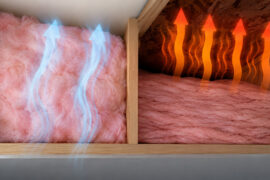
At the supply house, foil-faced rolls sit on the same rack as fiberglass and foam board, which is probably part of why they get installed wrong so often. They do not do the same job. A reflective product lives or dies on one thing: a low emittance surface looking across an enclosed air space. Take the air space away and you have a very thin sheet of nothing.
It gets used in attics, wall cavities, and around duct runs, mostly where thickness is the constraint. Performance shows up as a surface emittance plus an air space R-value instead of one number printed on the bag, which trips people up when they try to compare it against a batt.
Oak Ridge National Laboratory put a number on the summer case. Foil stapled to the rafters cut attic heat flow by 49.8% against an identical attic with no barrier, a 2013 finding.
What Is Reflective Insulation?
Strip the product down and you have a low emittance surface, almost always aluminum foil, bonded to something, positioned so the foil faces an open air gap.
Mass materials slow conductive heat flow. This does something else. It bounces radiant energy back before that energy reaches the surface it would otherwise warm and re-radiate into the room.
It sits alongside fiberglass, cellulose, and rigid foam among the broader types of insulation materials used in residential and commercial construction.
- A low emittance facing bonded to a substrate
- Works only when that facing looks across an open air gap
- ASTM C1224 is the specification that defines the category
Foil laid flat against drywall with no gap behind it is not reflective insulation in any functional sense. The label can say whatever it wants.
What Is Reflective Insulation Made Of?

Peel a sample apart and you get a facing, a substrate, and a backing.
- The outer facing is aluminum foil or a metallized film
- Under it sits a substrate, usually a polyethylene bubble core, kraft paper, or a thin foam layer
- Double sided products add a second foil layer on the back; single sided ones just get a plain film
Single sheet products a few hundredths of an inch thick carry almost no material R-value on their own. Thicker substrates like bubble pack or foam add roughly 1 to 3 to the total, according to RIMA International.
Reflectix builds a double bubble line with two foil layers over a polyethylene bubble core, sold for attic, wall, and duct work.
Does Reflective Insulation Act as a Vapor Barrier?
Foil is close to impermeable, so in most assemblies it behaves like a vapor barrier whether you wanted one or not. Side effect of the material, not a rated function.
Which is why perforated facings exist. They are sold specifically to let some vapor move through. Solid facings on both sides can trap moisture inside a wall or roof assembly when the vapor drive runs the wrong direction.
Get the orientation wrong and you have built yourself a condensation problem in exchange for solving a heat problem.
How Does Reflective Insulation Work?

Fiberglass and foam are aimed at conduction, heat crawling through solid material. They also cut convection by trapping air in place. Radiation is the mode they mostly ignore, and it is the only one a reflective product is built to interrupt.
Conduction is heat passing straight through a solid. Convection is heat carried along by air currents moving through a cavity. Radiation travels as electromagnetic waves across open space, gets absorbed by whatever surface it hits, and then that surface re-emits it into the room behind.
Our broader guide on how insulation works walks through all of this in more depth.
A low emittance foil surface sends most of that radiant energy back toward where it came from instead of soaking it up.
Mass insulation resists thermal conductivity. It reflects nothing.
That difference is the whole reason stacking foil tight against drywall accomplishes almost nothing.
What Is Emittance and Why Does It Matter?
Every surface releases radiant energy at some rate, and emittance is the number that describes it, scaled from 0 to 1. Lower emittance means more reflection and less emission. It is also the number that decides whether a product counts as reflective insulation at all.
- ASTM C1224, most recently updated in 2022, sets the qualifying threshold at an emittance of 0.1 or less
- California’s Title 24 energy code (2022 compliance manual) requires 0.05 or less for radiant barrier compliance credit, tested under ASTM C1371 or ASTM E408
- Testing under ASTM C1371 uses a portable differential thermopile emissometer
New foil comes in well under both thresholds. That number does not stay put.
Dust settles. Aluminum oxidizes. Both push effective emittance up over the years, which is why every published rating describes a clean, new surface rather than one that has been sitting in an attic since 2014.
Products carrying the ASTM International and RIMA-I Verification Program mark have passed independent lab testing overseen by the Safety Equipment Institute.
Why Does Reflective Insulation Need an Air Space?
Go back to that Oak Ridge result. Foil stapled to rafters cut summer heat flow through the attic floor by 49.8% in 2013 testing, measured against an identical attic with no radiant barrier.
That only happened because the foil was facing an open gap. Radiant reflection has nothing to intercept if the reflective surface is already touching the thing it was supposed to block.
The Tennessee Valley Authority and the Department of Energy were running field tests on this same principle through the 1980s, well before the current ASTM specifications existed.
ROAM Roof and Solar, a roofing contractor in Belton, Texas, reported attic temperature drops after installing foil with that same rafter stapled method in 2026.
The air space gets destroyed in a handful of ordinary ways. Direct contact with a solid surface on both faces kills it. So does compressing the material flat against a joist or rafter, or leaving a gap narrower than the minimum the installation practice calls for.
And none of it helps where wood framing touches both faces of an assembly. Heat conducts straight around the barrier there, a version of thermal bridging that no amount of air gap somewhere else can undo.
What R-Value Does Reflective Insulation Provide?
There is no single R-value on this product the way there is on a fiberglass batt.
The figure moves with the size of the air space beside it and the direction heat is traveling through that space. An R-value calculated for downward heat flow, summer conditions in an attic floor, comes out higher than the same assembly rated for upward or horizontal flow.
Manufacturers and specifiers outside North America often express the same resistance as U-value, which is just the inverse.
A 2023 peer reviewed study published by MDPI modeled five heat flow directions with effective emittances from 0 to 0.82 and found that simplified surface assumptions shift calculated R-values by less than 3%. Separately, the FTC R-value Rule, 16 CFR Part 460, has required tested R-value disclosure for home insulation sellers since 1980.
That regulation is also why you will never see a reflective product legally advertise a flat R-value per inch the way some foam boards do.
How Does Reflective Insulation Compare to Radiant Barriers and Mass Insulation?
Online the three terms get swapped around like they mean the same thing. They do not. Thickness and layer count separate them more than the marketing copy usually admits.
| Product | Primary mechanism | Typical R-value contribution | Moisture behavior |
|---|---|---|---|
| Reflective insulation | Radiant reflection across a formed air space | 1 to 3 from substrate, plus air space R-value | Facing acts as a de facto vapor barrier |
| Radiant barrier | Radiant reflection, single foil layer | Negligible on its own | Usually perforated to allow some drying |
| Foil faced batt | Conduction resistance plus a reflective facing | Set by the batt material, foil adds little | Facing can trap moisture if misoriented |
| Fiberglass batt | Conduction resistance through trapped air | Set by thickness and density | Absorbs and holds moisture if wetted |
Set against fiberglass insulation, reflective products win in radiant dominant climates and tight cavities. They lose anywhere code minimums are written around thick mass R-values, and there is no arguing with a code table.
The tradeoff against mass alternatives like spray foam or cellulose insulation runs the same direction. Strong on summer radiant gain, weak as the only layer in a cold climate roof.
NAIMA, the trade association for fiberglass and mineral wool manufacturers, has pushed back hard on claims that a thin foil layer matches thick batt R-values. For conduction dominated assemblies, the ASHRAE air space tables that both industries cite generally back up that skepticism.
Where Is Reflective Insulation Installed?
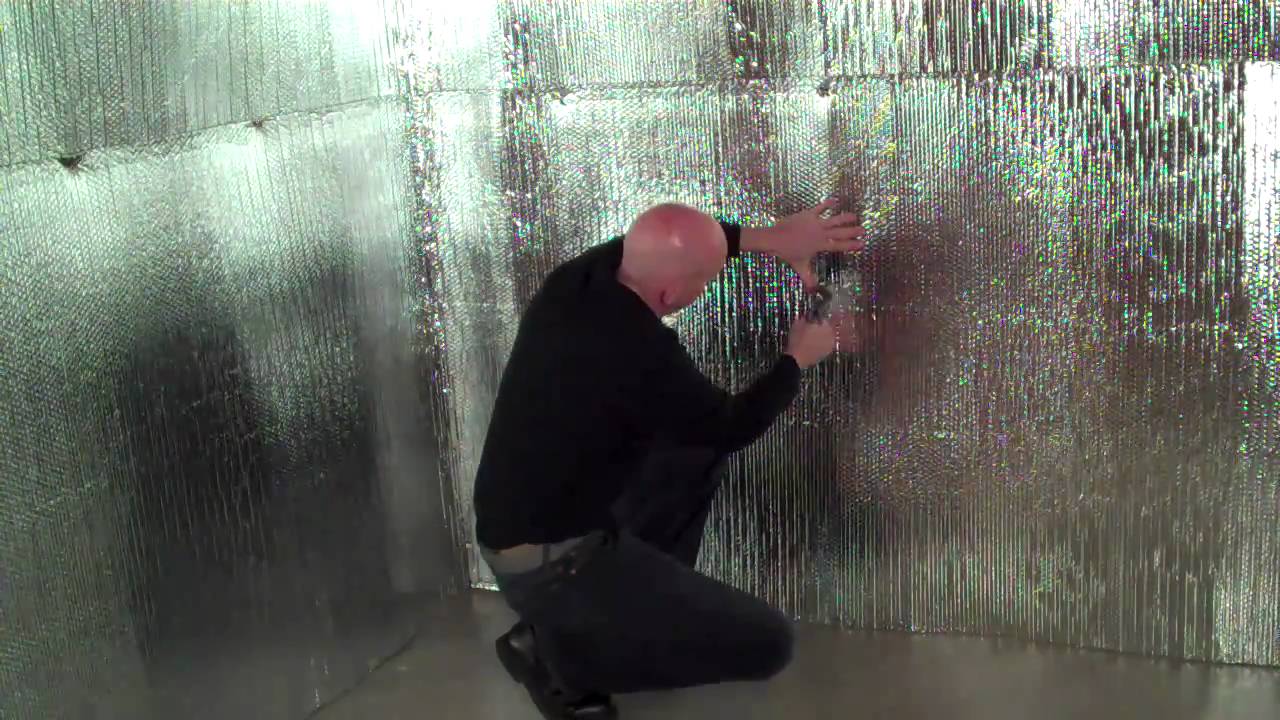
It turns up wherever a builder needs low profile heat control more than raw thermal mass. Attics most of all, either stapled under the rafters or laid across the floor joists.
| Location | Typical Method | Main Reason |
|---|---|---|
| Attic rafters | Stapled or draped across trusses | Blocks roof deck radiant heat before it reaches living space |
| Wall cavity | Installed with facing toward the interior air gap | Thin profile where wall depth is limited |
| Crawl space or under slab | Laid flat or draped over framing | Controls moisture and radiant loss from the ground |
| Duct wrap | Wrapped around supply and return lines | Cuts radiant and conductive loss along duct runs |
Wall cavity work borrows most of its logic from cavity wall insulation, except the point is a thin profile where wall depth is limited rather than a thick fill.
Below grade, the same principle shows up in guides on insulating basement walls. A foil facing does not care whether the framing sits above or below ground.
Gibraltar Building Products makes a point worth remembering here. Rafter mounted foil picks up dust more slowly than the same material lying across the attic floor, even though the floor position blocks more heat while it is still new.
What Standards Govern Reflective Insulation?
Beyond the C1224 specification and the C1371 emittance test already mentioned, several other ASTM documents fill in the gaps.
- ASTM C727 is the standard practice for installing reflective insulation in building construction
- ASTM C1158 handles installation of radiant barrier systems specifically
- ASTM C1313 specifies sheet radiant barriers as their own product class
- ASTM C168 is the terminology standard that keeps definitions consistent across everything above
RIMA International, the trade group behind that verification program, was founded in 1978 for the specific purpose of getting reflective products recognized in building codes.
State and federal rules stack on top. California’s Title 24 sets its own eligibility criteria for radiant barrier compliance credit, and the FTC R-value Rule governs how the resulting numbers get advertised. Both covered above.
What Are the Pros and Cons of Reflective Insulation?
On the plus side, it fits places fiberglass and foam board cannot, and the facing shrugs off moisture far better than an absorbent mass material does. RIMA International puts the radiant performance of a single low emittance surface at roughly 90 to 97% of the radiant heat striking it.
It also sidesteps a problem loose fill materials deal with for decades. It does not suffer from insulation settlement once it is in place.
Now the other side. In conduction dominated assemblies it contributes very little on its own, and performance hangs entirely on installation quality plus a surface that stays reasonably clean. Cost per unit of thermal resistance often runs higher than thick mass insulation in conduction heavy climates.
Bubble and foam substrates raise insulation fire rating questions too, which manufacturers address through facing choice and code listing.
Neither list decides anything by itself. What decides it is which heat transfer mechanism actually dominates the assembly in front of you.
How Do You Install Reflective Insulation?
Order of operations matters more here than with mass insulation. One reversed step can wipe out the entire benefit, which is not something you can say about a batt.
- Figure out which side carries the low emittance surface before anything gets fastened
- Point the reflective side at the air space it is meant to protect, not at the framing behind it
- Hold the minimum gap. California’s Title 24 requires at least 1.5 inches of clearance at the center of the span between a stapled radiant barrier and the roof decking
- Seal seams and penetrations, since gaps between sheets let convective currents undercut whatever the foil was doing
- Wrap the ducts and fixtures too. Any metal running through the space counts, not just the framing
AtticFoil builds its product with a reflective layer on both sides for a fairly practical reason: if one surface gets dirty or scuffed during install, the other one picks up the slack.
Installation Mistakes That Cancel the Reflective Effect
Failures usually trace back to habits rather than to the material.
- Fastening the foil with the dull or painted side facing the air space
- Leaving it loose enough that wind or attic traffic collapses the gap within a season
- Squeezing the bubble core flat under a staple or a fastener
That last one does more damage than it looks like it should. Crushing the core destroys the trapped air pockets that gave the substrate its own material R-value, a version of insulation compression that quietly wipes out two numbers rather than one.
Avoiding any of this takes no special tools. It takes checking the facing direction before the staple gun comes out.
When Does Reflective Insulation Not Work?
When it fails, it usually fails for reasons anyone could have predicted. The material is fine. The physics it depends on just was not present in that assembly.
Oak Ridge National Laboratory and the Tennessee Valley Authority tested dusted horizontal radiant barriers in research houses and measured cooling loads rising by as much as 8.4% against a clean barrier. Worth noting that the dusted barrier still cut cooling loads by about 7% compared to a house with nothing at all.
The distance between those two numbers is the best evidence going that surface condition decides performance, not the mere presence of foil in the attic.
- No enclosed air space, meaning foil pressed against drywall, subfloor, or any other solid with nothing behind it
- Conduction dominated assemblies, where some other strategy is carrying the real load
- Facing installed backward, low emittance side pointed away from the space it should protect
- Sustained high humidity with no separate plan for vapor control
A cold climate wall built mostly around dense sheathing gets more out of thermal mass than out of a radiant focused layer, simply because there is not much radiant load for foil to catch.
In consistently humid conditions, relying on the facing rather than a purpose built vapor barrier insulation layer can hold moisture against sheathing long enough for mold to take hold.
None of that means the product is broken. It means the assembly around it was not built for what reflective insulation actually does.
FAQ on What Is Reflective Insulation
What is reflective insulation also called?
You will see it sold as foil insulation, and it gets confused with radiant barrier constantly. Thickness and layer count are the difference. Multi-layer reflective insulation puts a bubble or foam core between two foil facings; a radiant barrier is one foil sheet.
How much does reflective insulation cost?
Price tracks layer count rather than any flat rate. A single foil facing over a thin core sits at the bottom. Double-sided foil with a thicker bubble or foam core costs more per roll, since you are paying for both more material and more lamination steps.
Does reflective insulation work in cold climates as well as hot climates?
A low emittance surface reflects radiant energy whichever way it is traveling, so yes, year round. Summer, it turns solar heat away from the living space. Winter, an inward facing surface sends indoor heat back into the room rather than letting it go out through the assembly.
Is reflective insulation fire rated?
Aluminum foil does not burn. The bubble or foam core it is laminated to can. ASTM E84 covers the flame spread and smoke developed testing that building codes reference, and ASTM E2599 sets how the samples get mounted before that test runs.
Can reflective insulation go over existing insulation, or does old material need removal first?
Nothing needs to come out. You can layer it straight over existing mass insulation, as long as you use a perforated facing so moisture sitting in the material underneath can still escape into the attic air. That is RIMA International guidance.
What Should You Check Before Buying Reflective Insulation?
Start with the load. If conduction is what is genuinely moving heat through that assembly, nothing about emittance or gap depth matters yet, and you are about to solve the wrong problem.
Once radiant heat is established as the dominant path, the next question is how much depth the location gives you for an air space. Then, and only then, whether the product carries a verified emittance rating instead of a number printed on the wrapper.
Going with a product that carries the ASTM International and RIMA-I Verification Program mark over generic unverified foil means paying a premium for independently confirmed performance. Certainty instead of savings, basically.
After that it is a sizing question, covered in a guide on how much insulation your attic needs, because a verified and correctly placed layer only pays off when the coverage matches the space.