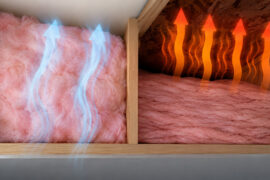
Melt basalt rock together with recycled slag from a steel furnace, spin the liquid into fiber, and what cools down is rock wool. Same family as the mineral wool sold under a dozen other names.
It goes in as batts between studs, as rigid board outside the sheathing, as loose fill blown into attics, and as pre-formed sleeves around pipe. Houses and commercial buildings both.
Arguments about which insulation to buy tend to circle the same few things: how much heat the material stops, what it does in a fire, how it handles sound, and what it costs. Rock wool sits somewhere different from fiberglass or cellulose on every one of those.
One figure from ROCKWOOL Group’s 2025 sustainability reporting stuck with me, because melting stone is not a cheap process energy-wise. Building insulation ROCKWOOL sold in 2025 will save almost 100 times the energy used to produce it over the product’s working life.
What Is Rock Wool Insulation
The furnace step is what defines the category. Basalt rock and recycled blast furnace slag go in together, come out molten, and get spun into fine fiber that sets into a dense mat.
That mat slows heat movement and dampens sound inside walls, attics, and mechanical systems.
Volcanic stone instead of sand is the part that matters. Cured basalt fiber holds together at temperatures that would turn glass-based insulation into a puddle.
It sits alongside fiberglass, cellulose, and spray foam among the common types of insulation materials, though its mineral origin puts it in a different performance class for fire and moisture.
Most jobs use one of two forms. Batts come precut and friction-fit between studs, joists, and rafters. Rigid board is pressed harder and goes on exterior sheathing, foundations, and curtain wall backpans.
Homeowners almost never touch the board. A batt, cut with a straightedge and pressed into a wall cavity, is what most people mean when they say batt insulation.
The naming is a mess, honestly. Stone wool, mineral wool, and ROCKWOOL (a brand name that got used generically for the whole category) all point at the same basalt-and-slag fiber.
What Is Rock Wool Insulation Made Of
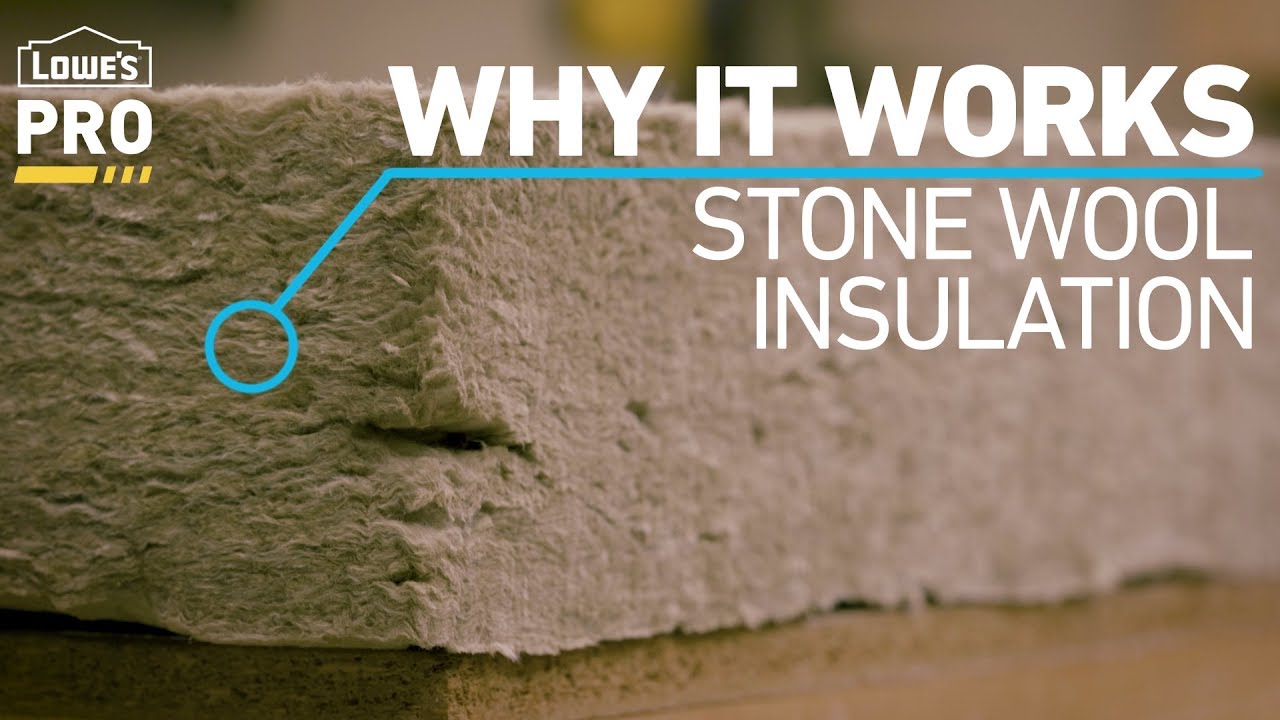
Basalt rock and recycled slag from steel blast furnaces go into the melt together, heated until the mixture runs closer to lava than to glass.
That molten stone then hits a cascade of spinning wheels. Roughly the same principle as a cotton candy machine, except what comes off the wheels is mineral fiber instead of sugar.
A resin binder holds the loose fiber mat together. Most major manufacturers moved to formaldehyde-free binder formulas over the past decade, which is a quieter change than it sounds, since it took away the main indoor air complaint people used to raise about the product.
So the sequence runs melt, spin, bind, press. Forming pressure at that last stage decides whether the line puts out a soft batt or a board you can stand on.
After that the physics is nothing special. Millions of trapped air pockets between the fibers slow heat movement, which is how insulation works no matter what the raw material is.
Density gets locked in during forming, not added later. That is why a rock wool board holds its shape under load and loose-fill products cannot.
What R-Value Does Rock Wool Insulation Have
Published figures land between roughly 3.7 and 4.3 per inch. ROCKWOOL’s own Comfortbatt line tests at approximately R-4.0 per inch under ASTM C518.
Per inch is the operative part. R-value measures how much a material resists heat flow, so the number only means something once you multiply it by the thickness the assembly can actually fit.
The spec sheet numbers worth keeping in front of you.
- R-value: approximately 4.0 per inch, tested to ASTM C518 (ROCKWOOL)
- Melting point: minimum 2,150 degrees Fahrenheit, ASTM E136 (ROCKWOOL)
- Sound absorption: NRC 0.95 to 1.09, STC 45 to 52 on 2-inch panels (GreenBuildingAdvisor, 2022)
- Density: roughly 2 to 14 pounds per cubic foot across batt, board, and roofing lines (ROCKWOOL guide specifications)
Thermal resistance is the inverse of a material’s thermal conductivity, so a fiber structure that conducts less heat is what pushes the per-inch number up in the first place.
Search around and you will find numbers anywhere from 3.0 to 4.3 per inch, mostly because older articles blend different densities and brands into one generic figure. Annoying, and it causes real spec errors.
Use the data sheet for the specific product, tested to ASTM C518. That is the value an energy code calculation or a project submittal actually relies on.
Rock wool holds its R-value under compression better than loose fiberglass does, since the fiber is stiff enough not to collapse. Cram an oversized batt into a tight cavity anyway and you still lose effective thickness.
Why Is Rock Wool Insulation Fire Resistant

A house fire runs hot, but not that hot. Basalt fiber carries a minimum melting point of 2,150 degrees Fahrenheit, and that gap is the whole story.
It earns a noncombustible classification under ASTM E136, the test standard separating materials that will not sustain combustion from the ones that will.
Manufacturer test data for stone wool batts and boards consistently reports a flame spread index and a smoke developed index of zero under ASTM E84. No fire carried across the surface, no smoke added to the room during the burn.
Firestopping around pipes, ducts, and floor penetrations is where the property gets worked hardest. Close behind:
- Fire-rated partition walls between apartment units
- Curtain wall backpans on high-rise buildings
- Mechanical rooms and boiler enclosures
Toronto’s Humber River Hospital specified rock wool board across its exterior wall system, chosen specifically for its fire performance and its contribution to the project’s LEED certification.
Fire behavior also feeds directly into a product’s insulation fire rating classification, which building codes reference when deciding what can go into a rated wall or floor.
None of which makes a wall fireproof. The rating always belongs to the tested assembly, insulation and framing and wall board together, never to the insulation sitting alone in its wrapper.
How Well Does Rock Wool Insulation Block Sound
Two-inch stone wool panels test at NRC ratings up to 1.09 and STC ratings between 45 and 52, which puts them above most fiberglass batts of the same thickness.
Those two ratings get confused constantly. NRC is absorption, how much sound energy the material soaks up instead of bouncing back, on a scale of 0 to 1 where anything near 1.0 is eating nearly everything that hits it.
STC is about blocking. How much sound a whole wall assembly stops from passing through, which depends on framing and drywall at least as much as on whatever is packed in the cavity.
Density does the work. More fiber surface area per cubic inch means more sound absorbed, which is why acoustic-specific rock wool products are made denser than standard thermal batts.
Interior partitions, home theaters, recording studio builds. Those are the spaces that need airborne noise control and low reverberation inside the room at the same time.
A cubicle divider packed with rock wool turns distracting office chatter into quieter background noise, part of why the material keeps showing up in the soundproof insulation category.
Honest limit though. If low-frequency noise is the problem, insulation alone will not fix it. A decoupled wall assembly or mass loaded vinyl does more down there than any batt can.
Does Rock Wool Insulation Resist Moisture
A hydrophobic treatment applied during manufacturing keeps water out. Splash a batt and the water beads and runs off the fiber instead of soaking in.
ROCKWOOL’s Comfortboard 110 specification lists moisture sorption at 0.28 percent maximum under ASTM C1104, a test measuring how much water vapor the material pulls from a high-humidity atmosphere.
That is a small fraction of what an untreated fiber would take on. It is also the reason the insulation dries out and recovers full R-value after getting wet, rather than staying compressed and degraded.
It earns its price in the damp spots.
- Basement and below-grade walls, where occasional dampness is normal
- Rim joists, a common spot for condensation
- Exterior continuous insulation, exposed to wind-driven rain during construction
A Vancouver apartment tower re-clad its exterior walls with stone wool board during a 2012 enclosure renewal, a retrofit credited with cutting the building’s annual heating costs from roughly $18,000 to about $2,000.
Not everyone counts water shedding as a pure win. Building science forums have pointed out that a material which sheds water cannot buffer moisture and release it slowly the way a hygroscopic product like cellulose does. Two different humidity strategies, not a clean victory for one.
And it is not a vapor barrier. Vapor permeance and bulk water resistance are separate properties, and the wall still needs its own vapor strategy based on climate and construction type.
Rock Wool vs Fiberglass Insulation, Which Performs Better
Both slow heat effectively. They split on fire behavior, on what happens after a leak, and on price.
Cellulose belongs in the same conversation, so the table below covers all three.
| Attribute | Rock Wool | Fiberglass | Cellulose |
|---|---|---|---|
| R-value per inch | 3.7 to 4.3 | 2.2 to 3.4 | 3.2 to 3.8 |
| Fire rating | Noncombustible, ASTM E136 | Noncombustible fiber, facing can burn | Fire-retardant treated |
| Material cost, blown-in, per sq ft | $1.30 to $2.20 | $0.45 to $1.10 | $0.60 to $2.80 |
| Moisture behavior | Sheds water, dries fully | Absorbs, R-value drops | Absorbs and holds moisture |
| Sound absorption, NRC | 0.95 to 1.09 | 0.70 to 0.90 | 0.80 to 0.90 |
Cost figures come from HomeGnome’s 2025 blown-in insulation pricing survey. Performance figures pull from manufacturer specification sheets cited earlier in this article.
Fiberglass still takes upfront cost and installer familiarity. Crews have been cutting and fitting it for decades, and the lower price per square foot compounds fast across a whole house.
Rock wool takes fire performance and sound control, plus how the material behaves after a leak or a flood. It also holds a stable R-value under the kind of compression that flattens a fiberglass batt over years of settling and sloppy pipe runs.
Owens Corning and Johns Manville anchor the fiberglass side in North America, the way ROCKWOOL International anchors stone wool.
Nobody sweeps every category. A cold-climate retrofit on a tight budget usually lands on fiberglass insulation. A fire-rated commercial wall or a serious soundproofing job usually lands on rock wool.
Cellulose insulation sits somewhere in between. Better moisture buffering than either mineral product, though it absorbs water instead of shedding it and can settle in open cavities over time.
Is Rock Wool Insulation Safe
Installed and covered up, it is fine. The handling stage is where people get itchy.
The International Agency for Research on Cancer classifies stone wool fiber as Group 3, not classifiable as to its carcinogenicity to humans. Same category coffee landed in when IARC moved coffee drinking out of the “possibly carcinogenic” group in 2016.
Biosolubility is the reason. The fiber dissolves in lung fluid rather than lodging there the way asbestos does, and that mechanism separates the two materials entirely.
What people actually report is coarse fiber fragments rubbing against bare skin while cutting and fitting. Airborne dust reaching the throat and nasal passages runs a close second, usually when somebody skipped the mask. Binder components can release if the material gets heated well above normal room temperature, which almost never happens inside a finished wall.
Formaldehyde-free binder formulas are standard now across major product lines, and GREENGUARD Gold certified rock wool products are recognized by more than 450 federal purchasers, retailers, and green building rating systems for low chemical emissions.
UL Environment re-audits that certification on a recurring basis. Not a one-time sticker.
Against fiberglass insulation safety data, the two materials land in the same IARC category, so the practical difference comes down to handling technique rather than long-term risk.
Gloves, long sleeves, eye protection, a cheap dust mask. That covers the actual exposure. Compared to cellulose insulation, which throws a different kind of dust during blowing, rock wool’s irritation risk sits almost entirely in the cutting and fitting stage.
Which Rock Wool Form Fits Which Job
Pick the form to match the cavity, not the other way around. Choosing wrong wastes material and money, usually both at once.
Batts go in stud bays. Board goes outside the sheathing. Loose-fill handles the attic nobody wants to crawl through twice, and pipe sections do exactly what the name suggests.
Batt Insulation
Standard stud and joist cavities in walls, floors, and attics. This is the default, and most residential work never needs anything else.
Precut to standard stud spacing, friction-fit, no adhesive and no mechanical fasteners.
Fastest install in regular framing, and the only tool required is a serrated knife. Stocked at lumber yards and big box stores alike, so nobody waits on a special order.
It struggles the moment framing gets irregular or a cavity fills up with obstructions. Cut a batt short, or squeeze one in to force a fit, and you have left a gap that will show up on a thermal camera later.
Rigid Board
Board carries enough compressive strength to sit under cladding, behind stucco, or on top of a foundation wall without crushing.
Comfortboard and similar product lines run denser than batt, which is where that load-bearing capacity comes from.
The reason to specify it is continuous exterior coverage. A board layer outside the studs breaks the thermal path that wood or steel framing creates, and no stud-cavity batt can do that.
Handling is worse. Board gets scored and snapped or cut with a fine-tooth saw rather than sliced with a bread knife, and fastening patterns start mattering once wind load enters the picture.
Loose-Fill
Blown into open attics, or dense-packed into finished wall cavities through drilled access holes.
Good for irregular joist bays, retrofit attics full of existing obstructions, and anywhere too tight to tuck a batt by hand.
Depth goes uneven if the installer does not rake the material level. And you are either renting a blowing machine or paying someone who owns one.
Unlike loose-fill insulation made from cellulose, rock wool fiber does not settle much over time once it is blown to the correct density.
Pipe Wrap
Pre-formed rigid cylinders, sized to slide over specific pipe diameters.
Mechanical rooms, boiler lines, HVAC ductwork. Batt and board have no role here.
- Cut to length with a hand saw
- Secured with wire, tape, or a factory jacket depending on the application
- Rated for higher service temperatures than standard batt or board products
Most homeowners never touch this form. Pipe insulation work almost always falls to a mechanical contractor rather than a weekend project.
What Does Rock Wool Insulation Cost
It costs more upfront than fiberglass. The gap narrows once labor and long-term performance enter the math, though it never fully closes.
Material and installation pricing both move with form, region, and whether the job is new construction or a retrofit.
Price Per Square Foot
For a standard 2×6 wall cavity, rock wool batt material runs about $1.06 per square foot, against roughly $0.57 to $0.72 for fiberglass batt of the same size (HomeTips).
That holds across most residential applications. Figure 40 to 80 percent higher than fiberglass on a cost per square foot basis for material alone.
The premium traces back to manufacturing. Melting stone at extreme heat burns more energy than forming glass fiber, production volume is nowhere near what the fiberglass supply chain moves, and the denser material means more raw feedstock goes into the same square foot of coverage.
Labor closes part of the percentage gap. Rock wool’s rigidity makes it quicker to fit tight on well-framed walls, while fiberglass batts need more fluffing and adjusting to sit right.
Environmental Certifications and Recycled Content
ROCKWOOL’s Milton, Ontario facility is certified for a minimum of 40 percent recycled content, verified through ICC-ES SAVE third-party certification.
Recycled slag from steel manufacturing makes up most of that figure, with post-industrial stone wool scrap fed back into the furnace covering the remainder.
- Environmental Product Declaration, third-party verified life cycle data
- GREENGUARD Gold, audited low chemical emissions
- LEED certification credit toward materials, energy, and indoor air quality categories
None of that changes the number on a receipt. It shows up on commercial submittals and green building scorecards, where a material’s origin gets picked over as closely as its R-value.
How to Install Rock Wool Insulation
Hand tools, nothing specialized, at least for standard batt work.
ROCKWOOL’s own installation guide breaks the wall cavity process into a short, repeatable sequence.
- Locate obstructions first. Mark plumbing, electrical boxes, and wiring in the cavity before cutting anything.
- Cut the batt to size with a serrated knife, sizing it slightly larger than the cavity for a snug fit.
- Insert the batt tight against the framing and top plate, compressing it briefly to slide it into place, then release.
- Notch around obstructions rather than compressing the batt over them, using a tape measure to keep cuts accurate.
- Fit additional batts flush against each other and flush with the interior face of the studs, leaving no visible gaps.
Board and loose-fill follow completely different logic. Board gets mechanically fastened or adhered to sheathing, and loose-fill gets blown to a target density with a machine, so neither one uses this sequence.
Common Installation Mistakes
Compressing a batt to force a fit is the most common error by a wide margin, and it costs R-value directly.
Squeeze a batt into a cavity narrower than its rated thickness and it loses insulating power roughly in proportion, because insulation compression kills the air pockets doing the thermal work.
Other things go wrong on site.
- Leaving gaps around electrical boxes instead of notching the batt to fit snugly
- Skipping the top plate and bottom plate, where short cuts are easy to overlook
- Stapling faced batts unevenly, creating pockets between the flange and the framing
- Cramming full-size batts into narrower retrofit cavities without resizing them first
None of these announce themselves. They turn up on the next energy bill, or on a blower door test.
When Rock Wool Insulation Does Not Work
It is the wrong choice often enough that the cases are worth naming. Pretending otherwise leads to callbacks.
Below-grade walls with a history of bulk water intrusion are the clearest one, and that is a different problem from the routine humidity rock wool handles fine in a normal basement.
Set batt directly against a damp foundation wall and air gaps form behind it. Humid air reaches cold concrete and condenses. Now there is a wet cavity nobody can see.
Building science guidance on insulating basement walls generally calls for a continuous rigid layer against the concrete first, with batt reserved for the framed wall in front of it. Batt is not a substitute for that rigid layer.
It also underperforms in a handful of situations even when the install is clean.
- Thin 2×4 stud walls, where wood framing creates enough thermal bridging to undercut the batt’s rated R-value
- Tight budgets where fiberglass or cellulose meets code at a lower material cost
- Spaces that need an air barrier, since the batt itself does not seal air leaks
- Odd angles and heavily obstructed cavities, where fiberglass’s greater flexibility fits faster
The thermal bridging point is not hypothetical. Building science contractors have measured a 2×4 wall cavity filled with R-15 rock wool performing at roughly R-9 to R-10 once the wood framing’s heat loss gets factored into the whole-wall value.
Not a defect in the insulation. Any batt product does this once real framing interrupts the fill, and a 2×4 wall shows it worse than a 2×6 simply because the framing fraction is higher.
Retrofit insulation adds one more wrinkle. Semi-rigid batts do not conform to protruding nails, sagging old framing, or oddly sized cavities the way a loose-fill or spray product does.
None of this rules rock wool out. It rules out treating it as a universal fix instead of what it is, a material with fit-for-purpose conditions, same as every other one.
FAQ on What Is Rock Wool Insulation
Is rock wool insulation the same thing as mineral wool or stone wool?
Stone wool and rock wool name the same basalt fiber. Mineral wool is the broader category, covering rock wool plus slag wool made from furnace byproduct.
Product labels mix the terms freely, so the raw material listed matters more than the name on the wrapper.
Does rock wool insulation need a vapor barrier?
On its own the material is vapor-permeable, rated around 30 to 35 perm under ASTM E96, so it is no barrier by default. Whether an assembly needs one depends on climate zone and wall construction, not on the insulation.
How long does rock wool insulation last?
Rock wool insulation lasts at least 65 years without measurable performance loss, according to ROCKWOOL Group testing of material recovered from Copenhagen Airport in 2023. Thermal, fire, and acoustic performance held steady, since mineral fiber does not rot or compress like organic insulation.
Can rock wool insulation be recycled at the end of its life?
It qualifies for upcycling at dedicated recycling plants, where offcuts and demolition waste get melted back into virgin stone fiber instead of landfilled. ROCKWOOL’s European facilities already run this closed loop, though residential curbside programs rarely accept the material.
What Replaces What Is Rock Wool Insulation When It Doesn’t Fit?
Spray foam takes over in cavities too irregular for a batt, in below-grade walls with active water intrusion, and in air-sealing-critical assemblies where a fibrous product cannot close every gap on its own.
Worth putting the two numbers side by side. A nominal 4 per inch against a measured R-9 to R-10 in a 2×4 cavity once framing intrudes. The per-inch edge over fiberglass mostly washes out in thin-wall construction, while it holds up in thicker 2×6 assemblies.
Choosing spray foam insulation over rock wool means giving up noncombustible fire performance and sound absorption in exchange for a continuous air seal. Worth the trade only when gaps, not thermal or fire behavior, are what actually fails.