Cavity wall insulation is already sitting inside a lot of British walls. Government figures put the installed rate at 71 percent of homes with a cavity wall, equal to 15.2 million properties in Great Britain by the end of 2024 (Department for Energy Security and Net Zero, 2025).
The work is retrofit, done by registered installers on homes built with a twin leaf wall, which mostly means properties from the 1920s onward. It cuts heat loss, and the finished wall gets judged against a U-value target set out in Building Regulations Part L.
What Is Cavity Wall Insulation?

It means filling the gap between the two brick layers of an external wall with an insulating material. That gap is the wall cavity, and it sits between an outer leaf and an inner leaf of masonry.
Left empty, the space lets warm air pass through the wall with very little resistance, which is why so many UK homes get it filled as a form of home insulation.
It counts as retrofit insulation, though a light kind. Nothing structural changes beyond a series of small drill holes in the brickwork, and the whole job happens from outside. It only deals with the air gap between the masonry leaves, so the loft and floor are a separate matter.
What Is a Cavity Wall?
Instead of one thick slab of masonry, a cavity wall uses two separate skins with an air gap between them.
The outer leaf is almost always brick. The inner leaf is brick or concrete block, and metal wall ties hold the two together across the gap, which typically runs 50mm to 75mm wide in older properties.
You can usually spot one from the brick pattern. Cavity walls show bricks laid end to end, called stretcher bond, rather than the alternating long and short pattern of a solid wall.
Properties built before the 1920s were almost always solid wall, with no cavity to fill at all.
How Does Cavity Wall Insulation Work?
Filling the cavity slows heat loss. The material replaces the moving air inside the gap with something that traps still air within its fibres or cells.
Around 33 percent of the heat lost from an uninsulated home escapes through the walls (Energy Saving Trust). Once the cavity is filled, a typical cavity wall U-value improves from about 1.5 W/m2K to about 0.5 W/m2K (The Open University, OpenLearn).
Approved Document L sets a target of 0.55 W/m2K for filling the cavity of an existing wall in England, under Building Regulations Part L.
A material’s thermal conductivity plays a big part in that result. Lower conductivity gives a better U-value at the same fill thickness.
How much of the improvement a property actually gets depends on whether the fill is full fill or partial fill, and on the condition of the masonry, including any residual cavity left unfilled. Cold air that still moves around drill holes or wall ties eats into it as well.
What Materials Are Used to Fill a Cavity Wall?
Mineral wool, EPS beads, polyurethane foam and urea-formaldehyde foam cover most of the cavity wall insulation found in UK homes.
Retrofit jobs almost always use full fill loose material or injected foam. Rigid board and batts can only be fitted while a wall is being built, so they rarely come into it.
Mineral Wool
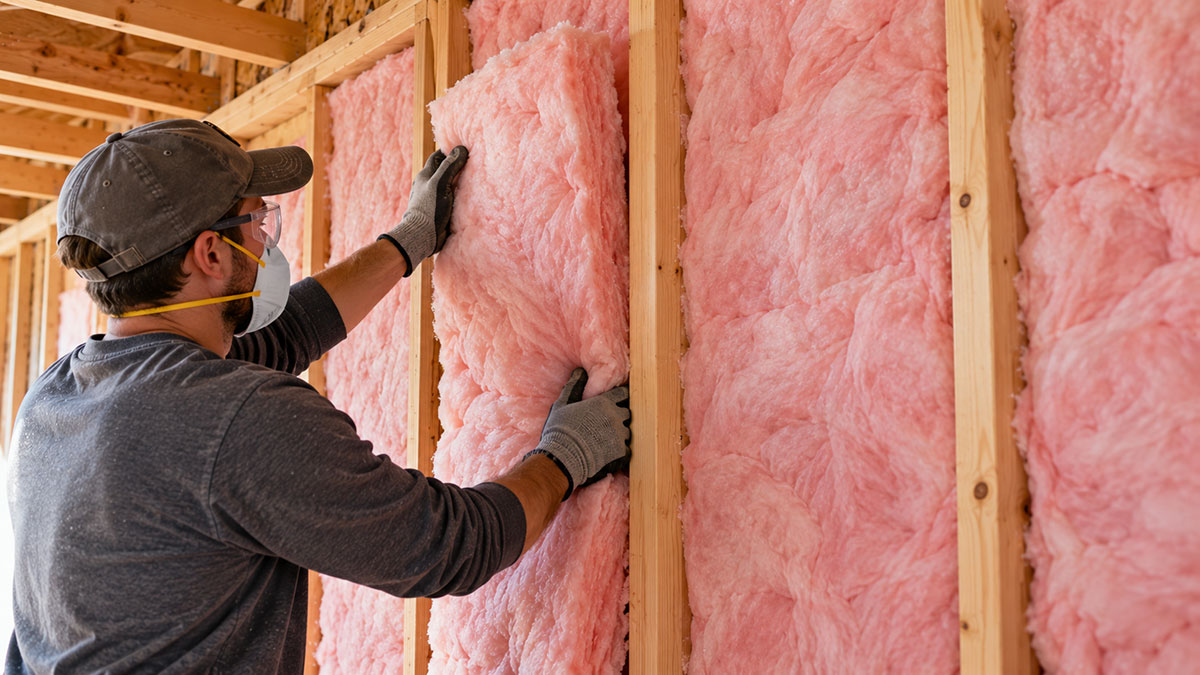
Mineral wool goes in as blown fibre. It settles loosely around the wall ties without leaving gaps.
You’ll also see it sold as rock wool insulation, and ROCKWOOL and Knauf Insulation both make it. It’s non combustible and widely available, and it performs well across most cavity widths. The blown fibre flows around wall ties and pipework too, so the fill stays consistent.
Moisture is the weak spot. If the outer leaf lets water through, the wool can absorb it. It also needs a wider cavity than foam to hit the same U-value.
EPS Beads
Expanded polystyrene beads are blown into the cavity together with a bonding agent, which locks them in place once it sets. They count as loose-fill insulation, and they flow into irregular cavities that rigid products cannot reach.
Any moisture that gets into the cavity drains out quickly, and the beads fill gaps around obstructions and pipework without much fuss. The bonding agent is the part to watch. Quality varies between installers, which affects how stable the fill stays over the long term.
Polyurethane Foam
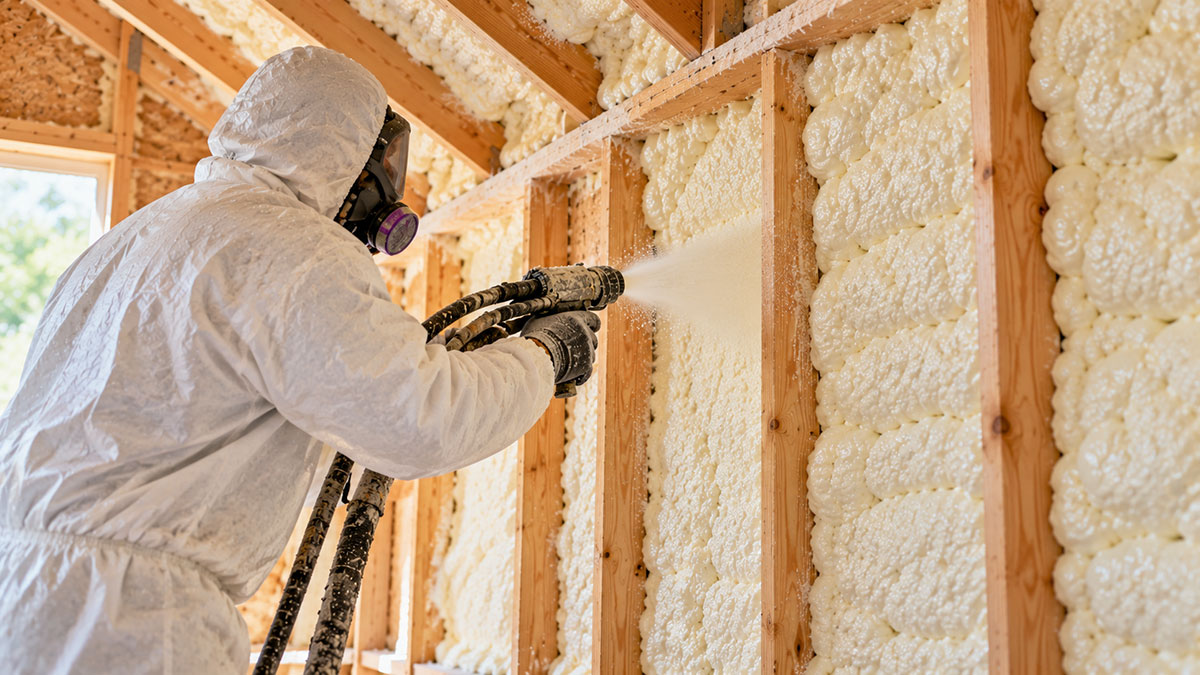
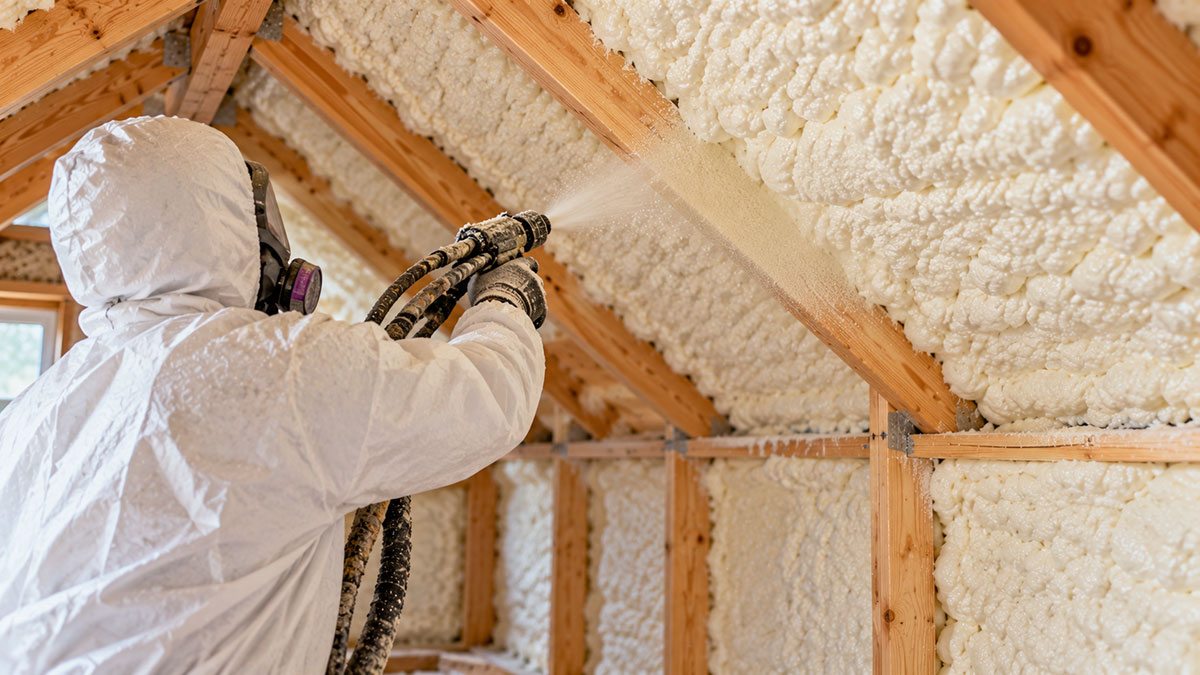
Installers inject polyurethane foam as a liquid. It expands and sets rigid inside the cavity within minutes, bonding straight to the masonry instead of settling loosely.
It reaches a comparable U-value at a lower thickness than mineral wool or beads, so it suits cavities narrower than 50mm. Once cured, it leaves little room for air movement.
The trade off shows up when the cavity wasn’t properly surveyed first. Trapped moisture then has fewer places to drain.
Urea-Formaldehyde Foam
This one is mostly history now. Urea-formaldehyde foam was widely used in the 1970s and 1980s before newer materials replaced it.
Early formulations released formaldehyde gas during curing, which led to tighter British Standards on how the foam is made and installed. Installers rarely specify it today, though older properties sometimes still carry it from a previous job.
Whatever material goes in, it should carry a current British Board of Agrément certificate. Scheme funded work under ECO4 requires PAS 2030 compliant products and installation.
Is Your Home Suitable for Cavity Wall Insulation?
Not every cavity wall qualifies, and a short building survey settles the question before any material goes in.
Width comes first. According to Centre for Sustainable Energy guidance, a standard fill needs a cavity at least 50mm wide. Narrower cavities count as hard to treat and suit only some systems after specialist assessment.
The surveyor then looks at the wall itself. Cracked brickwork and poor pointing get flagged before filling starts, along with any wall tie corrosion. Exposure matters as well, since walls facing heavy driving rain need extra checks for damp penetration. And any sign of condensation risk or rising damp usually rules a property out until it’s fixed.
Flats sitting above an unfilled cavity, or properties with a history of flooding, are typically excluded outright.
Older or listed properties sometimes also need a check against Historic England guidance before any drilling begins.
Cavity Wall Insulation vs External and Internal Wall Insulation
Which method applies depends on whether the wall has a cavity to fill in the first place. Solid wall properties, mostly built before the 1920s, need external wall insulation or an internal equivalent instead.
| Method | Applies To | Typical Cost | Disruption |
|---|---|---|---|
| Cavity wall insulation | Unfilled cavity walls | GBP 2,700 to GBP 4,600 per property (MoneySuperMarket) | Low, done from outside in hours |
| External wall insulation | Solid or cavity walls needing a facade upgrade | Around GBP 10,000 for a three-bed semi (FMB) | Moderate, scaffolding required |
| Internal wall insulation | Solid walls where the facade must stay unchanged | GBP 60 to GBP 100 per square metre (Eco Insulation) | High, rooms out of use during fitting |
Internal wall insulation also brings the wall in by several centimetres in every treated room, and a cavity fill never does that.
Poor detailing at floor and ceiling junctions on an internal job can introduce thermal bridging as well. A cavity fill rarely causes it, since the insulation sits fully enclosed within the wall.
How Much Does Cavity Wall Insulation Cost?
Property size sets most of the price. Installed cost typically runs from GBP 2,700 for a semi-detached home to GBP 4,600 for a detached property (MoneySuperMarket).
Material choice moves it a bit, since foam and beads price differently from mineral wool, and taller properties that need scaffolding cost more to reach.
Against that, annual savings on heating bills range from GBP 100 to GBP 370, depending on the property (MoneySuperMarket). Those savings are what decide the payback period for insulation, which for cavity fill usually lands well inside its expected lifespan.
The benefits of home insulation go past the energy bill too, including a stronger EPC rating and lower heating costs through the coldest months.
What Grants and Schemes Help Pay for Cavity Wall Insulation?
Who gets funding comes down to income and benefits, plus the property’s current EPC rating. Which material goes in the wall makes no difference.
The Energy Company Obligation (ECO4) is the main route open in 2026. Ofgem regulates it, and the larger energy suppliers deliver it.
Under ECO4, the installed measures must lift a property to at least EPC band C if it starts in band D or E, or to at least band D if it starts in band F or G. Earlier, measure-led phases of the scheme carried no such whole-house requirement.
That minimum uplift is why many households end up with cavity wall insulation paired with loft or heating upgrades in one free home insulation package, not a single measure on its own. It’s the awkward part of the scheme if all you wanted was a cavity fill.
| Scheme | Eligibility Basis | Status in 2026 |
|---|---|---|
| ECO4 | Qualifying benefit or LA Flex low income route, EPC D to G (private rented homes E to G) | Open, runs to 31 December 2026 |
| Great British Insulation Scheme | Council Tax band A to D (A to E in Scotland and Wales), EPC D or below | Closed. Referral service shut in October 2025 and the scheme ended on 31 March 2026 |
The Great British Insulation Scheme covered single measures such as loft and cavity fill without requiring a qualifying benefit, which made it the simpler of the two routes while it ran.
ECO4 takes a whole house view instead, so many suppliers now pitch cavity wall insulation as one part of a broader plan to improve home insulation across a property in one visit.
In practice that means households on a qualifying benefit such as Universal Credit or Pension Credit, or households below the local council’s LA Flex income threshold. The property also has to be currently rated EPC band D, E, F or G (private rented homes must be band E, F or G).
How Is Cavity Wall Insulation Installed?
Every job follows the same basic sequence, whatever material ends up in the cavity. Installers call the method drill-and-fill insulation.
- A registered installer surveys the property, checking cavity width, wall condition and exposure before confirming the job can proceed.
- Small holes, roughly 22mm to 26mm across, are drilled into the mortar joints rather than the brick itself.
- The chosen material is pumped or blown into the cavity through the holes until it reaches the required density.
- A borescope camera or similar check confirms the fill has reached every part of the cavity, with no voids left behind.
- The holes are patched with colour matched mortar, restoring the original look of the wall.
The survey in step one is essentially a small home energy audit, confirming the property qualifies before a single hole gets drilled.
A standard semi-detached property usually takes half a day or less from start to finish, and all of it happens outside.
What Guarantees and Certifications Should You Check?
A cavity wall insulation job is only as good as the paperwork that comes with it. Several bodies sit behind that paperwork, each covering a different part of the job.
| Body | Role |
|---|---|
| CIGA | Issues a 25 year guarantee on the installation itself |
| TrustMark | Government endorsed accreditation for the installer |
| British Board of Agrément (BBA) | Certifies the insulation product before it reaches the market |
| National Insulation Association (NIA) | Trade body membership for registered installers |
The Cavity Insulation Guarantee Agency (CIGA) offers an independent 25 year guarantee on installations carried out by its registered installers. It covers the material and workmanship rather than the property itself.
Before a product reaches that stage, the BBA puts it through its own certification scheme, which covers its insulation fire rating and thermal performance as well as durability.
PAS 2035 covers the retrofit assessment, which happens before any drilling starts. The installation work that follows is governed by PAS 2030. Both sit underneath TrustMark’s own scheme rules, which is why funded work always asks for proof of registration before a claim gets paid out.
What Problems Can Cavity Wall Insulation Cause?
Most jobs cause no issues at all. A poorly surveyed property, though, can end up worse off than before.
The industry has a well documented history here. An independent review led by Dr Peter Bonfield, published in December 2016, examined widespread mis-selling and poor practice across the retrofit sector. It led directly to the tightened PAS 2030:2017 standard the following year.
The usual failures are damp penetration, when insulation bridges a cavity that was never suitable for filling in the first place, and cold bridging around missed sections or voids left by an incomplete fill. Wall tie corrosion gets worse too once a dry cavity turns damp.
Loose fill can also be affected by insulation settlement over several decades, which leaves a thin gap at the top of the cavity.
Running a thermal imaging camera across the wall from inside usually confirms whether a cold patch traces back to a fill problem or a separate issue such as a leak.
CIGA’s guarantee covers damp linked to the insulation itself, not damp caused by a separate issue such as a roof leak or rising ground water.
When Does Cavity Wall Insulation Not Apply?
Some properties fail the suitability check for reasons that go beyond a narrow cavity or a bit of damp.
Exposure is one. Approved Document C and BS 8104 divide the UK into four wind driven rain zones, and full fill insulation is not permitted in zone 4, the most severe category, without extra protection such as render.
Construction rules others out. Timber, slate or tile clad outer leaves need a vented, unfilled cavity to work properly, which rules out a standard fill. A cavity that already holds an older or failed insulation type needs that material assessed or removed before anything new goes in. Timber framed portal structures, and cavities wider than a product’s tested range, fall outside what any current system covers.
None of this gets decided on-site by feel. It comes from the same pre-installation survey and product certification covered earlier, which is why skipping that step causes most of the failures on record.
FAQ on What Is Cavity Wall Insulation
Can Cavity Wall Insulation Be Removed or Replaced?
Yes. Installers use insulation vacuum removal to pull failed or damp loose fill out of the cavity. The wall is then dried and inspected, and it can be refilled with a correctly specified product once the underlying cause has been fixed.
How Long Does Cavity Wall Insulation Last?
Correctly installed and kept dry, it’s generally expected to last as long as the wall itself, and CIGA guarantees the installation for 25 years. Quoted working lifespans for mineral wool and EPS beads typically run from around 25 to 40 years. Foam systems can degrade faster if the cavity was damp or poorly surveyed before the fill went in.
How Can You Tell if a Home Already Has Cavity Wall Insulation?
Look along the brickwork for a grid of small, slightly different coloured mortar patches. Those are sealed drill holes from a previous fill. An EPC report, or a call to CIGA quoting the postcode, confirms whether a guarantee is registered.
Does Cavity Wall Insulation Affect EPC Rating or Property Value?
Filling the cavity typically adds around 5 to 10 EPC points, which can be enough to lift a property by one band, since wall performance carries real weight in the calculation. A stronger rating tends to support both valuations and mortgage affordability checks, particularly on older housing stock.
Do You Need Planning Permission for Cavity Wall Insulation?
Not usually. Planning permission is rarely required, since the work changes nothing about the wall’s external appearance beyond small patched holes, per Planning Portal guidance. Listed buildings and conservation areas are the main exception, so check with the local authority.
Is Cavity Wall Insulation a Legal Requirement in an Existing Home?
No. There is no legal obligation to insulate an existing cavity wall. Once work does start, though, it counts as notifiable building work and has to meet Building Regulations, which is usually satisfied through a competent person scheme rather than a council inspection.
What Does Cavity Wall Insulation Cost to Maintain?
Nothing, if it’s installed correctly. The fill sits sealed inside the cavity for the working life of the wall, with no servicing or cleaning, and no replacement expected under normal conditions.
The catch is that a failing fill gives no visible warning beyond a cold patch or a damp mark on the brickwork. Once the drill holes are patched, the material sits out of reach.
So keep the CIGA or equivalent guarantee certificate somewhere you’ll actually find it. If a cold patch or damp mark shows up on an outside wall, note it and book a professional check the first time it happens.
Batts, foil and loose fill, which get used outside the wall cavity, are covered in the breakdown of types of insulation materials.