Ask a couple of contractors about Icynene and you can come away thinking they’re describing different products. Sort of true, actually. The name covers a whole line of two-component spray polyurethane foam (SPF) that insulates and air seals a building envelope in one applied layer.
Huntsman Building Solutions makes it. It goes into walls, attics, rim joists and crawl spaces, and it gets measured against the same R-value and air barrier tests applied to fiberglass, cellulose and other spray foam.
The chemistry is where it pulls away from the pack. Icynene’s HFO closed-cell formulas use a blowing agent with a global warming potential of 1, about 99.9 percent lower than older blowing agents used across the industry, according to Huntsman Building Solutions’ 2024 product documentation.
What Is Icynene Spray Foam Insulation?

Not one product, for starters. The name belongs to a family of open-cell and closed-cell formulations sold under a single brand and applied to walls, attics, rim joists and crawl spaces.
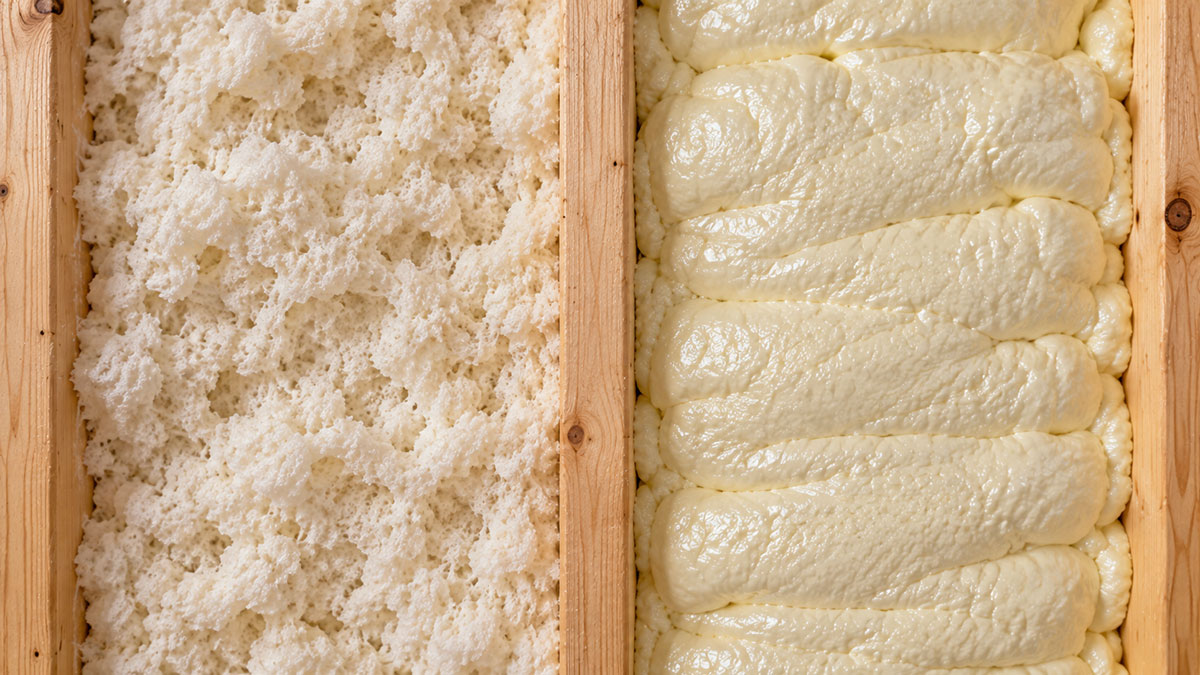
What you notice first is what happens on contact. Liquid open-cell foam expands to roughly 100 times its sprayed volume, fills the cavity and seals it in the same step. Closed-cell foam expands far less, on the order of 30 to 60 times.
The brand sits inside the broader spray foam insulation category, and that category is one branch of the wider field of home insulation, alongside fiberglass, cellulose and rigid board products.
Icynene Inc. started in Ontario in 1986 and merged with Lapolla Industries in 2017 to form Icynene-Lapolla. Huntsman acquired Icynene-Lapolla in February 2020, and the brand now operates under Huntsman Building Solutions, the manufacturer that also owns the Demilec spray foam brand.
Open-cell foam goes into interior cavities where flexibility and sound dampening matter. Closed-cell foam takes the exterior walls, rim joists and anywhere moisture resistance comes first.
What Makes Icynene’s Chemistry Different From Other Spray Foam?
The formula decides how a spray polyurethane foam performs and how it ages, not just the fact that it’s foam.
Icynene’s system reacts a polymeric isocyanate with a polyol resin on site. In the open-cell lines, water does most of the work of expanding the foam instead of a synthetic gas.
Water-Blown, Bio-Based Formulation
Water reacts with the isocyanate and releases carbon dioxide, and that gas is what expands the foam. So the open-cell line needs no synthetic HFC or HCFC blowing agent at all. Icynene’s renewable-based light-density formula, LD-R-50 (2009), went a step further and used castor oil to replace part of the petroleum-based polyol.
Icynene ProSeal Eco, launched in 2013, was the first 100 percent water-blown medium-density closed-cell spray foam on the market.
The newer HFO closed-cell formulations, HFO 200 and HFO MAX, use a hydrofluoroolefin blowing agent rather than water alone. Huntsman Building Solutions’ 2024 HFO-series documentation puts that blowing agent’s global warming potential at 1, about 99.9 percent lower than older blowing agents.
Open-Cell vs Closed-Cell Structure
Cell structure is what splits the line in half, and the table below shows how far apart the two sides land.
| Trait | Open-cell (Classic, Ultra, High-R, Xpress) | Closed-cell (HFO 200, HFO MAX) |
|---|---|---|
| Feel | Soft, flexible | Rigid, hard |
| Density | 0.5 to 0.8 lb per cubic foot | 1.8 to 2.3 lb per cubic foot |
| Vapor behavior | Vapor permeable | Vapor retarder at rated thickness |
Denser closed cells trap gas that conducts heat more slowly, which is why closed-cell tests lower on thermal conductivity per inch than open-cell foam.
Icynene Prime NM, a no-mix open-cell formula, was built to cut spray-tip mixing errors and widen the working temperature range for installers.
How Does Icynene Create an Air Barrier?
It fills a cavity so completely that air has no continuous path left to travel through.
Code officials don’t take that on faith, though. A material earns the label air barrier only after passing a specific test.
Air leakage accounts for 25 to 40 percent of the energy used to heat and cool a typical home, according to ENERGY STAR. Most of it escapes through top plates, wiring penetrations, rim joists, sill plates, duct chases and recessed lighting. Foam that fills those cavities closes the paths in one pass, instead of caulking each gap by hand.
Cutting that leakage is the whole reason air sealing gets treated as a performance category separate from R-value.
The test methods are ASTM E2178 and ASTM E283, both measuring air permeance at a pressure difference of 75 pascals. A material qualifies as air-impermeable at or below 0.02 liters per second per square meter under that pressure, a threshold written into the International Residential Code.
Closed-cell Icynene reaches that threshold at roughly 1 to 1.5 inches thick (HFO 200 is rated at 1 inch). Open-cell needs more mass to close off every path. ICC-ES reports rate Icynene Classic 75 at 2 inches, Classic 45 at 3 inches and High-R 80 at 3.5 inches, while the Spray Polyurethane Foam Alliance cites 3.5 to 5.5 inches for open-cell foam generally.
Joseph Lstiburek of Building Science Corporation helped set that 0.02 threshold, basing it on the airtightness of ordinary drywall.
Contractors confirm the finished assembly with a blower door test, which depressurizes the house and measures how much air gets pulled back in through whatever gaps remain.
What R-Value Does Icynene Spray Foam Deliver?

R-value per inch is the number most buyers compare first. Icynene publishes a separate figure for each formula rather than one blended brand-wide number.
If you want the formal definition and the math behind it, the R-value page covers it. The published figures look like this:
- Icynene HFO 200 (closed-cell) has an aged thermal resistance of 7.4 per inch (Huntsman Building Solutions, 2024)
- Icynene High-R 80 (open-cell) comes in at 4.0 per inch aged, at 0.75 lb per cubic foot density (Huntsman Building Solutions, 2024)
- Open-cell spray foam generally runs R-3.6 to R-4.5 per inch (Spray Polyurethane Foam Alliance)
- Closed-cell spray foam generally runs R-5.8 to R-6.9 per inch (Spray Polyurethane Foam Alliance)
All of those are aged values, tested after the blowing agent has stabilized, not the higher nominal number printed on day one.
R-value covers the material alone. A related figure, U-value, measures the whole assembly, studs and sheathing included.
Density tracks with R-value across both families. Heavier closed-cell foam packs more resistance into the same inch of cavity than lighter open-cell foam does.
Does Icynene Control Moisture and Vapor on Its Own?
Air sealing and vapor control are separate jobs, and the two formulas split them differently.
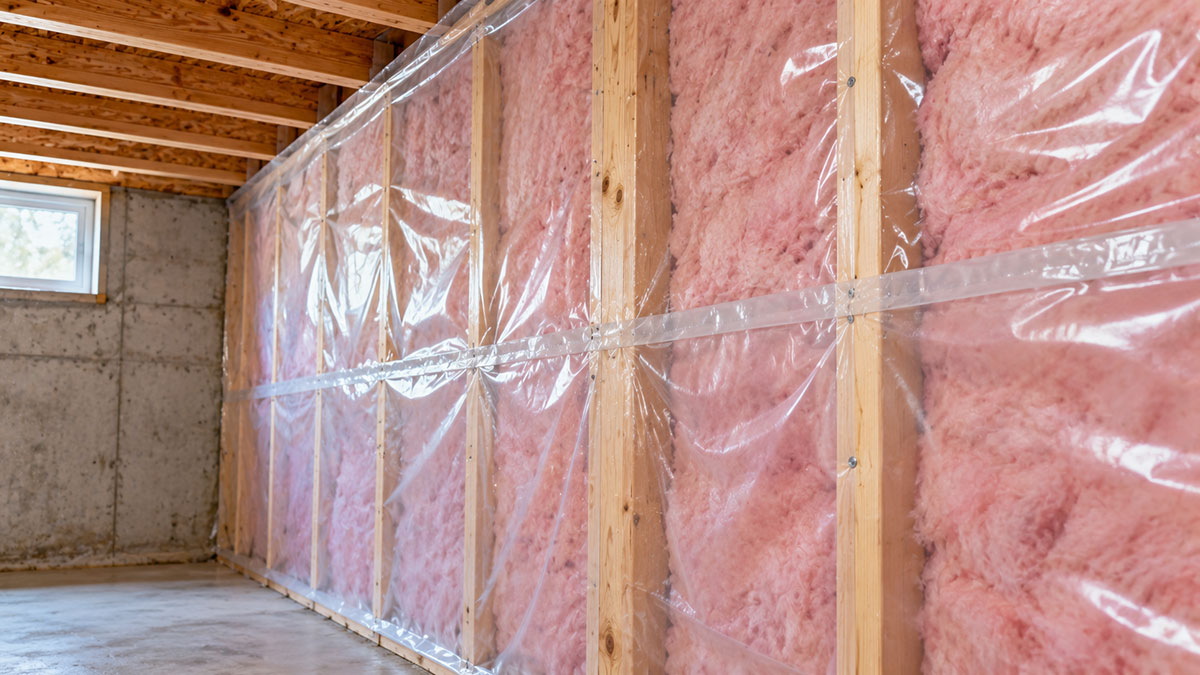
Open-cell foam is vapor permeable, much like fiberglass or cellulose, so cold climates often still need a separate vapor barrier.
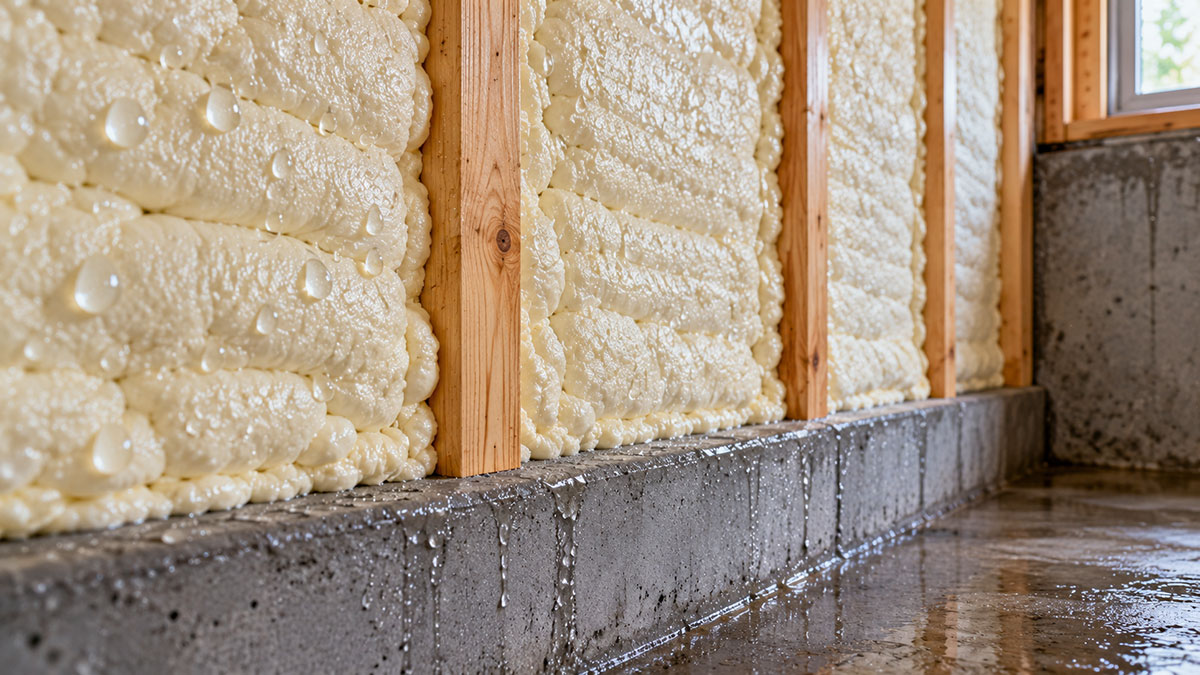
Closed-cell behaves differently once it reaches a minimum thickness. At roughly 1 to 1.5 inches it works as a recognized vapor retarder (HFO 200 is rated Class II at 1 inch). It also resists bulk water, which is why it’s the only spray foam rated for below-grade contact, and it cuts down the condensation that leads to mold and structural rot inside a wall cavity.
Icynene-Lapolla’s closed-cell Lapolla FOAM-LOK system did exactly that job on a River Rouge, Michigan manufacturing building, specified for both waterproofing and thermal insulation on a difficult saw-tooth roof (Roofing Contractor, 2020).
That same water resistance is why closed-cell is the formula specified for insulating basement walls below grade, where open-cell foam would simply soak up groundwater.
Icynene vs Fiberglass and Cellulose Insulation
All of these materials go after the same problem, and they trade off material cost, installed R-value and whether air sealing comes included or has to be added separately.
Fiberglass and cellulose work by trapping still air inside fibers. Icynene insulates and air seals through one continuous, adhered layer.
| Material | R-value per inch | Air barrier on its own | Vapor handling |
|---|---|---|---|
| Fiberglass batt | R-3.1 to R-3.8 | No | Permeable |
| Cellulose (blown) | R-3.2 to R-3.8 | Partial, dense-pack only | Permeable |
| Icynene open-cell | R-3.6 to R-4.5 | Yes, at roughly 2 to 5.5 inches depending on formula | Permeable |
| Icynene closed-cell | R-5.8 to R-6.9 | Yes, at 1 to 1.5 inches | Retarder at rated thickness |
Figures per the U.S. Department of Energy and the Spray Polyurethane Foam Alliance.
Fiberglass wins on raw material cost and speed of installation, which keeps it the default for standard stud-bay walls. Cellulose closes more gaps than fiberglass once it’s dense-packed, but it still isn’t a certified air barrier material.
Anyone weighing spray foam or cellulose insulation for an attic retrofit is really choosing between air sealing performance and upfront cost.
Fiberglass insulation and cellulose both settle over time when installed loose, quietly losing R-value at the top of a wall cavity. Icynene’s cured foam doesn’t sag or settle once it sets. That’s what the higher material cost is buying.
Which Icynene Formula Fits Which Part of the House?
The cell structure covered above translates directly into where each formula gets specified on a job.
Attics and Unvented Rooflines
Open-cell formulas dominate here. Attics rarely see standing water, and the lower material cost per board foot adds up over a big roof deck.
Icynene Classic 75 targets R-20 in standard roof decks and walls. Icynene Xpress 55 is built for unventilated attics and crawl spaces, and High-R 80 delivers a higher R-value per inch (R-4.0 aged) for tighter cavities.
Xpress 55 complies with AC377 Appendix X fire testing, which means it can skip a separate ignition barrier in attics entered only for utility service (Huntsman Building Solutions, 2024).
Open-cell foam sits among several attic insulation types a builder can pick from, but it’s the only one on that list that air seals as it insulates.
Exterior Walls and Rim Joists
Bray Architects specified closed-cell Icynene as continuous insulation on the Prescott High School project in Wisconsin, chosen specifically to interrupt heat flow across the wall studs (Building Design + Construction).
Closed-cell earns its higher cost at rim joists, where air leakage and moisture both pile up. It also makes sense for exterior walls in cold climates that need a built-in vapor retarder, and for any assembly that sees occasional water contact.
Continuous closed-cell layers cut thermal bridging through framing members in a way cavity-only insulation can’t.
Crawl Spaces
Crawl spaces bring ground moisture and hard-to-reach framing together in one spot, which is why closed-cell fits so well. It adheres directly to rim joists and foundation walls without furring strips, holds up against moisture rising from exposed soil, and seals the space in one pass instead of layering a vapor barrier plus batts.
Open-cell shows up far less often down there, since its vapor permeability works against a space that’s already damp.
Open-cell costs less per board foot and does a better job dampening sound between rooms. The catches are that it isn’t rated for direct water contact and needs more thickness to qualify as an air barrier.
Closed-cell packs more R-value into less cavity depth and doubles as both air barrier and vapor retarder. You pay more per board foot for that, and it’s less forgiving of ambient temperature while it’s being sprayed.
Is Icynene Spray Foam Worth the Extra Cost?
It costs more per board foot than fiberglass or cellulose. The return shows up in the utility bill, not on the invoice.
Homeowners who air seal and add insulation save an average of 15 percent on heating and cooling costs, according to the EPA and ENERGY STAR. That figure covers any air sealing and insulation combination, not spray foam specifically, but it isolates the same mechanism Icynene relies on.
Payback speeds up at rim joists and attics, the leakiest parts of most homes. It also speeds up in homes with high heating or cooling loads, where every percent of savings compounds, and in new construction, where ductwork and equipment can be sized around a tighter envelope from day one.
Whether spray foam insulation is worth it depends more on the leaks it replaces than on the material itself.
Broader weatherization research backs the direction, if not the exact figure. Department of Energy evaluations of the federal Weatherization Assistance Program, run by Oak Ridge National Laboratory, found energy savings exceeded program costs by a factor of 1.4.
That program mixed several measures rather than foam alone, but it’s the same math buyers run when they weigh ROI on insulation against a higher sticker price.
Paybacks slow down in already-tight new builds, where there’s less air leakage left to recover.
Is Icynene Spray Foam Safe Indoors?
Cured Icynene foam is chemically inert. The question that matters is what happens in the hours right after it’s sprayed.
Cure Time and Re-Entry
Isocyanate and resin react on contact, releasing heat and off-gassing briefly as they cure. Occupants, pets and unprotected workers stay out of the area during that window, and active ventilation shortens the wait before normal use resumes.
Icynene’s ProSeal closed-cell formula, reformulated as an ultra-low-VOC product, brought its re-entry window down to one hour for trades and two hours for full re-occupancy with ventilation running (Icynene technical data sheet, U.S. only). Huntsman Building Solutions’ current homeowner guidance is more conservative, recommending 24 hours before occupants return when appropriate ventilation is used.
Older or thicker applications, and jobs without active ventilation, take longer to clear. So whether spray foam insulation is safe after it cures really has two separate answers, one for during the cure and one for after it.
Emissions Testing
Icynene ProSeal and Icynene Classic Max both hold UL GREENGUARD Gold certification, the strictest tier of UL Environment’s chemical emissions program (UL Environment, 2016). Classic Max was believed to be the first open-cell spray foam insulation in the United States to reach that level.
GREENGUARD Gold testing screens for more than 360 individual VOCs, with formaldehyde held to its own tighter limit. That’s a certification, not a marketing line, and it’s why Icynene shows up in school and healthcare specifications where indoor air quality requirements are strict and non-negotiable.
How Is Icynene Spray Foam Installed?
Only through Huntsman Building Solutions’ network of licensed dealers. It isn’t sold as a retail DIY kit.
The sequence stays fixed no matter which formula is going in.
- Prep and mask the work area, covering surfaces that shouldn’t get overspray.
- Check the temperature of the substrate and ambient air against the formula’s rated spray range.
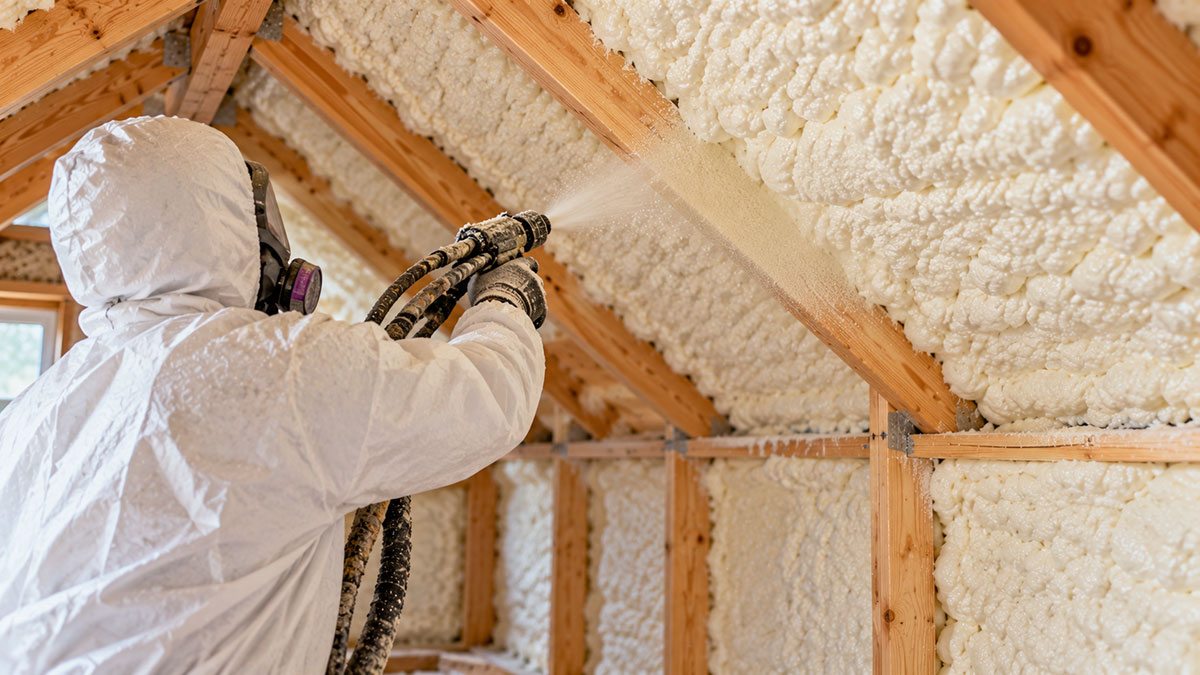
- Feed both components through a heated proportioning rig at a fixed mix ratio.
- Apply in passes, respecting the formula’s maximum lift per pass.
- Trim cured foam flush with the framing before drywall or sheathing goes on.
- Inspect coverage and thickness against the job’s design R-value.
Both components meet for the first time inside the gun, fed by heated spray rig equipment that holds pressure and temperature in a narrow working window.
Lift per pass and cure speed vary by formula. Icynene HFO MAX allows up to 6.5 inches of lift in a single pass, while lighter open-cell formulas go on in thinner layers (Huntsman Building Solutions, 2024).
Icynene’s ProSeal formula was engineered to spray reliably down to 23°F, letting crews keep working through cold months that would otherwise halt a job (Icynene product documentation).
A single set of ProSeal yields an average of 4,750 board feet of coverage, the figure estimators use to price a job before spraying starts (Icynene product documentation).
What Codes and Fire Tests Does Icynene Meet?
Foam plastic insulation can’t go into a code-regulated building until it has passed a defined set of fire tests.
| Test or document | What it measures | Issued by |
|---|---|---|
| ASTM E84 / UL 723 | Flame spread and smoke development | ASTM International / UL |
| AC377 | Acceptance criteria for foam plastic insulation | ICC Evaluation Service |
| ESR report | Code-compliance approval for a specific product | ICC Evaluation Service |
Fire and Ignition-Barrier Requirements
Icynene Classic 75 posted a flame spread index of 25 or less when tested at 4 inches thick and 0.7 pounds per cubic foot under ASTM E84 and UL 723 (ICC Evaluation Service, ESR-5495).
That flame spread rating is what lets the foam be used behind a standard 15-minute thermal barrier. Skipping a separate ignition barrier in specific attic and crawl space uses is a separate approval. It comes from AC377 Appendix X testing (as with Xpress 55 and HFO 200) or from a listed intumescent coating, and it’s covered under insulation fire rating classifications.
That exemption is conditional, not automatic. It applies only to the specific formulas, thicknesses and uses named in each product’s evaluation report.
Whether spray foam insulation is flammable comes down to which formula, at what thickness, behind what barrier.
Evaluation Reports and Approvals
Huntsman Building Solutions developed W-Wall, a load-bearing partition assembly that became the first two-hour fire-rated system tested and approved for use with open-cell spray foam (Huntsman Building Solutions, 2022).
An ESR report pins down the exact formula and density that was tested, not a generic product category. It lists which building codes the product satisfies, typically the current International Residential Code and International Building Code cycles, and it carries an expiration date, since reports get renewed on a set schedule rather than issued permanently.
Building inspectors check the ESR number against the product on site, not the brand name alone.
When Does Icynene Spray Foam Not Make Sense?
It isn’t the right call everywhere, and a fair comparison should say so.
On a tight budget for new construction, fiberglass or cellulose can often hit the code-required R-value for less money. Finished walls with no access are another problem, since spraying needs an open cavity and a finished interior usually means demolition first. And in an already-sealed, well-insulated home there’s little air leakage left to fix, which slows the payback.
Once a cavity is filled, taking the foam back out is slow and expensive. Anyone comparing options should read up on how to remove spray foam insulation before spraying, not after.
Open-cell foam specifically doesn’t belong anywhere it will sit in standing water, a crawl space with a high water table, or an uncontrolled below-grade wall.
Spraying also fails outside its rated temperature window. Substrate or ambient conditions colder than a formula’s minimum spray temperature risk an incomplete cure, whichever formula is going in.
Projects planned as retrofit insulation in a home with finished, undisturbed walls are usually better served by drill-and-fill cellulose or dense-pack methods that skip opening the cavity at all.
FAQ on Why Icynene Spray Foam Insulation Stands Out
Is Icynene the same as generic spray polyurethane foam?
No. Icynene names a specific spray polyurethane foam brand manufactured by Huntsman Building Solutions, covering open-cell and closed-cell formulations.
The broader spray polyurethane foam category includes other Huntsman brands such as Demilec, as well as independent manufacturers such as Gaco and Carlisle.
Does Icynene reduce sound transmission between rooms?
Open-cell Icynene fills stud cavities completely, which cuts airborne sound transmission between rooms more than fiberglass batts with gaps.
It isn’t a dedicated soundproofing product, and dense assemblies still need mass-loaded drywall or resilient channel for real acoustic control.
Does installing Icynene increase a home’s resale value?
No independent study ties Icynene specifically to a resale premium.
Appraisers and buyers generally value lower documented utility costs and permanent air sealing, but insulation upgrades rarely appear as a separate line item on a home appraisal report.
What warranty coverage comes with Icynene insulation?
Warranty terms come from the installing dealer, not from one Icynene-wide policy.
Coverage typically separates material defects from workmanship, and length varies by dealer and region. Buyers should request the specific warranty document in writing before signing a spray foam contract.
What problems actually show up on real Icynene jobs?
Reported issues cluster around installation error rather than the material itself.
Overexpansion can push out drywall or studs when installers overfill a cavity, and lingering odor after cure usually points to inadequate ventilation or an under-cured mix ratio.
Can Icynene be removed or added to an already-built home?
Cured Icynene doesn’t dissolve or peel away. Removal means cutting and grinding it out by hand.
That’s why most retrofit jobs add foam through small access openings in attics or crawl spaces instead of stripping finished walls first.
What Should You Check First With Icynene Spray Foam Insulation?
Moisture exposure and cavity access, before R-value or price. Those two conditions decide whether open-cell or closed-cell even qualifies, and that has to be settled before any cost comparison starts.
Moisture and water contact rule closed-cell in or open-cell out. Cavity access matters because a finished wall changes the whole approach. After that, the ambient and substrate temperature on spray day sets the install window.
A single pass of Icynene HFO MAX can qualify as an air barrier at 1.5 inches and still leave five inches of spare lift capacity before hitting its 6.5-inch maximum for one pass. Other closed-cell formulas, such as HFO 200, have lower pass limits.
That headroom is a trade-off, not a bonus. It only pays off where the formula’s higher material cost is already justified by moisture risk or a tight cavity.
A home energy audit shows exactly where those leaks concentrate before a crew loads the rig.