Aerogel insulation usually enters the conversation because something doesn’t fit. The wall cavity is too shallow for fiberglass, or a pipe run has almost no clearance, and the thickness needed to reach the target R-value simply isn’t available.
Manufacturers such as Aspen Aerogels and Cabot Corporation sell it as flexible blankets and rigid panels, plus loose particles. It ends up in energy infrastructure and building retrofits, and in aerospace hardware too. Performance is rated in watts per meter-kelvin, so it can be compared straight against fiberglass, mineral wool and spray foam.
The internal structure is where it gets strange. Peer-reviewed research published in Advances in Materials Science and Engineering documents a specific surface area near 1,000 square meters per gram for silica aerogel (Bheekhun et al., 2013). That’s a lot of internal surface for something that is mostly air.
What Is Aerogel Insulation?

Aerogel starts as a silica gel and ends up as a synthetic, nanoporous solid full of pores measured in nanometers, each one holding still air. That structure is what separates it from foam or fiber insulation, and from reflective products.
Most aerogel is silica, although carbon and biopolymer versions exist. It ranks among the lowest-density solids ever produced (graphene-based aerogels now hold the outright record). It’s nearly transparent to translucent, which is where the nickname frozen smoke comes from, and for its thickness the thermal conductivity is extremely low.
Aspen Aerogels notes the material is composed of up to 99.8% air by volume. In its standard silica aerogel, the intertwined silica skeleton makes up roughly 3% of that volume, with air filling the remaining 97% (Aspen Aerogels, 2026).
Of all the types of insulation materials sold today, aerogel sits at the extreme end for packing thermal resistance into minimal thickness.
Who Invented Aerogel and How Did It Reach Insulation Use?
Chemist Samuel Kistler first described a workable aerogel in a paper published in Nature in 1931, according to the American Physical Society (2021). He got there by swapping the liquid inside a jelly-like silica gel for gas without letting the structure collapse. The story goes that it started as a wager with a colleague, Charles Learned.
Then not much happened. From the 1930s into the 1960s it stayed a lab curiosity, too slow and too costly to make at any scale.
The 1990s changed that. NASA-funded engineers at Aspen Systems, working under a Kennedy Space Center SBIR contract that began in 1993, developed flexible, fiber-reinforced aerogel blankets for spaceflight hardware. Aspen Aerogels spun off from Aspen Systems in 2001 to sell the technology commercially.
NASA’s Spinoff program covered the Aspen Systems product in a piece titled Frozen Smoke. It described an aerogel-based superinsulation, a new kind of flexible cryogenic insulation with extremely low thermal conductivity (NASA Spinoff, 1998).
The same report noted that aerogel protected the Sojourner rover from the cold of Martian nights on the 1997 Mars Pathfinder mission, and that it was set to fly again as the particle-capture medium on the Stardust comet-sampling mission.
How Is Aerogel Insulation Made?
Manufacturing starts with a silica precursor, either liquid water glass or an alkoxysilane compound such as TEOS.
- Mix the precursor into a sol.
- Cast the sol into a mold and let it gel into a solid three-dimensional network that’s still saturated with liquid.
- Age the gel so the pore walls get stronger before drying.
- Exchange the solvent and apply a hydrophobic surface treatment.
- Dry the gel, either by supercritical extraction or by ambient-pressure evaporation.
Drying is where the routes split. Supercritical drying removes the solvent above its critical temperature and pressure, so it never crosses the liquid-to-gas boundary that would collapse the pores. Ambient-pressure drying is cheaper and faster, but it leans on that earlier hydrophobic treatment to keep the network from shrinking as it dries.
Drying is also the costliest step in the whole process, which is a big part of why aerogel trades at a premium over ordinary insulation.
Why Does Aerogel Insulation Block Heat So Effectively?
Mostly it comes down to pore size, plus how little solid there is to carry heat. Conduction has almost nothing to work with, because the silica skeleton is so sparse that solid-to-solid transfer barely has a path.
Convection gets shut down by the pores themselves. They’re smaller than the mean free path of air, so gas molecules end up trapped (this is the Knudsen effect) and can’t circulate heat. Radiation is the one that needs extra help, and higher-temperature grades add fine opacifier particles that scatter infrared before it crosses the material.
NASA’s Spinoff program put the effect in plain terms. A one-inch-thick aerogel window matched the insulation value of fifteen panes of glass with trapped air between them (NASA Spinoff, 1998).
That result comes from the same physics behind how insulation works generally, just pushed further by the nanoscale pore size.
A continuous aerogel layer also has no seams or framing running through it, so there are fewer weak points prone to thermal bridging than some layered assemblies develop.
What Forms Does Aerogel Insulation Come In?
Which form makes sense depends mostly on whether the job needs something that bends or something that holds its shape. Loose particles are their own thing.
Blanket
Glass or polyester fiber gets embedded in the aerogel while it gels, which is why the finished sheet bends and rolls up instead of crumbling. Rolls are typically 5 to 10 mm thick. They wrap around pipes and tanks, or any equipment with an awkward shape, without needing to be cut to a rigid form. Aspen Aerogels sells them under the Spaceloft and Pyrogel names.
It works as blanket insulation for retrofits, particularly where a wall or floor cavity is too shallow for anything thicker.
Panel
Panels are rigid or semi-rigid boards with the aerogel bonded to a facing layer, most often for daylighting or wall systems. Cabot Corporation markets a translucent version under the Lumira aerogel brand for skylights and glazing systems.
You give up some flexibility and get dimensional stability in return, so panels install more like conventional board insulation than a wrapped blanket.
Particle and granule
Cabot’s particle lines, Enova and Entera aerogel, package the material as loose grains that run from microns to millimeters across. One use is mixing them into insulating plasters and renders for solid walls. They also go into coatings and battery thermal barriers, and some daylighting systems use them to diffuse light rather than keep it clear.
Because loose particles pack with more air gaps between grains, they generally conduct slightly more heat than an intact blanket of the same material.
What R-Value and Thermal Conductivity Does Aerogel Insulation Deliver?
Aspen Aerogels rates its Spaceloft blanket at 14 mW/m-K (0.014 W/mK), about two and a half times more insulating than Styrofoam (Aspen Aerogels product data). Per inch, that works out to roughly R-10, which is more than double a same-thickness layer of standard fiberglass batt. Density sits around 0.15 g/cm³, among the lightest solids sold as a building material.
Datasheets lead with thermal conductivity because it describes the raw material. The lower the thermal conductivity, the less heat moves through a fixed thickness. R-value works the other direction. It states how much resistance to heat flow a specific thickness provides, and it’s the figure most building codes reference directly.
Independent testing backs up the manufacturer numbers. A Thermtest heat flow meter test measured 0.014 W/mK at 23°C on an Aspen Aerogels blanket, within 3% of the manufacturer’s stated value (Thermtest, 2024). Labs run figures like these through ASTM C518 heat flow meter testing or the ASTM C177 guarded hot plate method, the two standards most manufacturer datasheets cite.
How Does Aerogel Insulation Compare to Fiberglass, Mineral Wool, and Spray Foam?
Posting the lowest thermal conductivity on paper doesn’t make aerogel the automatic winner. Installed cost and available thickness shift the comparison a lot.
| Material | Thermal conductivity | R-value per inch | Typical cost tier |
|---|---|---|---|
| Aerogel blanket | 0.013-0.020 W/mK | Around R-10 | Highest |
| Fiberglass batt | Around 0.040 W/mK | R-3 to R-4 | Lowest |
| Mineral wool | 0.035-0.040 W/mK | R-3 to R-4.3 | Low to mid |
| Closed-cell spray foam | 0.023-0.026 W/mK | R-6 to R-7 | Mid to high |
Standard fiberglass insulation stays the default for most stud-bay retrofits because it delivers acceptable R-value at a fraction of aerogel’s material cost.
Closed-cell spray foam insulation lands in the middle. It beats fiberglass and mineral wool per inch, but it still needs noticeably more thickness than aerogel to reach the same R-value.
Aerogel really only wins when thickness, not price, is the problem being solved.
What Are the Pros and Cons of Aerogel Insulation?
Aerogel hasn’t replaced cheaper materials, and the tradeoffs explain why.
Thickness is the headline benefit. Aerogel has the thinnest profile available for a given R-value. Treated aerogel is hydrophobic by design, so it resists water absorption. The core is non-combustible, unlike foam-based alternatives, and it holds its thermal performance across a wide temperature range.
The downsides are more practical.
- It has the highest material cost per square foot among common insulation types.
- It’s brittle under point loads or sharp bending.
- Cutting it throws off fine dust, so protective gear is a must on site.
- You won’t find much of it in big-box retail, so sourcing usually means a specialty supplier.
General Insulation, a national mechanical insulation distributor, stocks aerogel blankets specifically because most contractors can’t find the material at a typical lumber yard.
None of that changes the basic math behind the benefits of home insulation. Less heat lost or gained still means lower utility bills, and aerogel just delivers that in far less space.
What Does Aerogel Insulation Cost?
The U.S. Department of Energy’s Building Technologies Office (2023) noted that a new low-cost aerogel formulation under development was targeting no more than a dollar per square foot per inch, three to five times cheaper than standard silica aerogel composites.
That target says a lot about today’s pricing. Current silica aerogel products still carry a premium that most homeowners notice right away next to a roll of fiberglass.
Blankets generally cost less than rigid panels of the same thickness, and higher-density, high-temperature grades cost more than standard building-grade blankets. The drying method matters too. Supercritical-dried material, covered earlier, carries a higher price than ambient-pressure-dried alternatives.
Working out the cost per square foot for insulation only tells half the story, since aerogel needs less material thickness to hit the same target than bulkier options.
Whether the premium pencils out depends on the ROI on insulation for the specific project, weighing space and energy savings against the higher sticker price.
Is Aerogel Insulation Fire Resistant?
Mostly yes. Silica aerogel’s inorganic backbone doesn’t burn, which is a real difference from foam-based insulation that can melt or ignite.
Aspen Aerogels’ Pyrogel XTF datasheet reports a Flame Spread Index of 5 or less and a Smoke Developed Index of 10 or less under ASTM E84 testing (Aspen Aerogels, 2025). The same product is evaluated to UL 1709 rapid rise fire testing, and Aspen Aerogels’ datasheets put the tested protection at up to 3 to 4 hours (180 to 240 minutes) depending on the configuration.
The catch is everything bonded to the core. Facings and adhesives can still burn even when the aerogel doesn’t, and the same goes for any fiber reinforcement.
That distinction matters for anyone checking insulation fire rating requirements, since a product’s overall rating reflects the full assembly, not just the aerogel layer.
On the broader question of is home insulation flammable, the answer for this material is split. The core resists ignition, but installers still treat facings and tapes as combustible components.
Where Is Aerogel Insulation Used?
| Industry | Typical use | Example |
|---|---|---|
| Oil and gas | Subsea pipeline and platform insulation | Aspen Aerogels Spaceloft Subsea |
| Building construction | Wall, floor, and roof retrofits | Historic buildings with shallow cavities |
| Electric vehicles | Battery pack thermal barriers | Aspen Aerogels PyroThin |
| Aerospace | Spacecraft and rover insulation | NASA Mars missions |
Energy infrastructure is still the largest market for the material, mostly because pipe and equipment insulation has to fit inside tight annulus spacing.
Aspen Aerogels reports an installed base of more than 1,921 km (1,194 miles) of subsea pipeline insulation worldwide (Aspen Aerogels, 2026).
The thin profile is also why aerogel gets specified on pipe insulation jobs where a thick fiberglass jacket won’t fit inside the available clearance.
In buildings it’s mostly a retrofit insulation choice, brought in when a wall or floor cavity is too shallow for standard batts to hit code.
How Do You Install Aerogel Insulation?
The order stays fairly consistent whether the job is a pipe run or a wall retrofit.
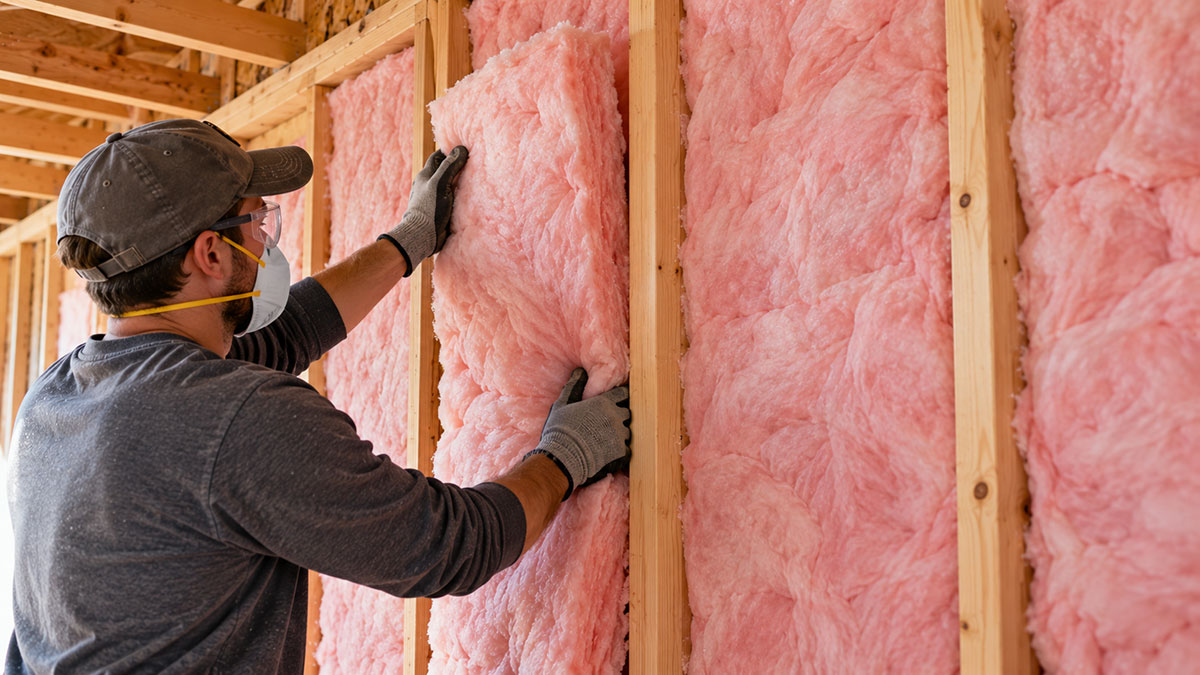
- Put on gloves, eye protection, and a dust mask before opening the roll.
- Measure and dry-fit the blanket against the surface before cutting anything.
- Cut with a sharp utility knife or shears on a clean, flat surface.
- Fit each piece snugly. Don’t force or crush it into the cavity.
- Overlap the seams and tape them so there are no gaps between pieces.
- Close up the wall, jacket, or cladding once the layer is continuous.
Overfilling a cavity is the most common mistake. Squeezing the blanket in to make it fit causes insulation compression, which thins the trapped air layer and lowers the effective R-value.
Crews typically pair the blanket with separate air sealing around outlets, plates and other penetrations, since the blanket itself isn’t designed to stop air movement on its own.
When Does Aerogel Insulation Not Make Sense?
A lot of jobs don’t need it, and paying the premium anyway is just wasted budget.
Anything that has to carry weight is the clearest no. Aspen Aerogels rates Pyrogel XTF for compressive resistance of at least 3 psi (20.7 kPa) at 10% deformation (Aspen Aerogels, 2025), well below what a load-bearing application would demand. Projects with genuine structural loads usually do better with closed-cell insulation, which is built to carry weight without crushing. Rigid foam board insulation is another common substitute when compressive strength matters more than raw R-value per inch.
Budget is the other obvious one. When a wall or floor already has room for standard-depth batts, fiberglass or mineral wool reaches the same code-required R-value for a fraction of the price, and aerogel’s main advantage, thinness, simply isn’t needed.
Constant saturation is a poor fit too. The material resists surface water, but prolonged submersion in standing water isn’t a scenario any manufacturer datasheet rates it for.
FAQ on What Is Aerogel Insulation
What Is Aerogel Called, and How Does It Differ From Silica Gel or Foam Insulation?
Frozen smoke, going by its hazy look.
Silica gel is a dense desiccant, while aerogel keeps its gas-filled pore structure intact. Foam insulation traps larger gas bubbles in a polymer matrix, which gives it higher thermal conductivity than silica aerogel.
What Is the Difference Between Aerogel Insulation and Vacuum Insulation Panels?
A puncture is the big difference. Vacuum insulation panels rely on a sealed core under vacuum, and they reach very low conductivity but fail outright once that seal is broken.
Aerogel depends only on its nanoporous structure, so damage lowers performance gradually instead of wiping out the panel’s insulating value.
Is Aerogel Insulation Waterproof?
Not fully. Aerogel insulation is hydrophobic and repels surface water during normal use, but prolonged submersion or standing water can still reach the structure. That’s why manufacturers rate it wet-resistant rather than submersible.
Is Aerogel Insulation Environmentally Friendly?
Cabot Corporation describes its Lumira aerogel as safe, non-hazardous and environmentally friendly, and says it has been confirmed consistent with the “Cradle to Cradle” design philosophy.
The stronger argument is about operation. Less heat lost through walls, roofs and pipes offsets the material’s manufacturing footprint over a building’s lifetime.
Where Can You Buy Aerogel Insulation?
Not at most home-improvement chains.
Buyers usually order directly from manufacturers like Aspen Aerogels and Cabot Corporation, or go through specialty insulation distributors and online retailers that carry Spaceloft and Pyrogel, plus Lumira aerogel, in cut-to-size rolls or sheets.
Is Aerogel Insulation Safe to Handle?
Cutting or compressing aerogel blankets releases fine silica dust, so gloves, eye protection, and a dust mask are standard practice.
Manufacturer safety data sheets classify aerogel blankets as synthetic amorphous silica that is not regulated as hazardous waste and can go to an approved landfill. The real risk during installation is irritation from dust exposure, not hazardous content.
What Thickness of Aerogel Insulation Do You Need for a Target R-Value?
Standard aerogel blankets deliver roughly R-10 per inch, so hitting R-20 needs about two inches and R-30 needs about three.
Manufacturer datasheets list exact thickness options per product line, since density and grade shift the R-value per inch slightly.
What Should You Check First Before Committing to Aerogel Insulation?
Start with the load. If it goes past aerogel’s roughly 3 psi compressive rating, the decision is already made. Then measure the cavity and see whether it genuinely lacks room for a thicker batt. If it doesn’t, fiberglass wins on price and there’s nothing left to weigh.
Only after that does the cost comparison matter, meaning installed cost against the space an R-10-per-inch material saves.
The compressive rating and the R-10-per-inch figure are tied together. Compression well past roughly 3 psi flattens the same pore structure responsible for the R-value, so a crushed blanket loses thermal performance and mechanical margin at the same moment.
Accepting that ceiling means giving up load-bearing duty entirely, since aerogel insulates without supporting weight above the cavity.
The first step is a home energy audit, which confirms which cavities need a thin, high-R material before you price aerogel against alternatives.