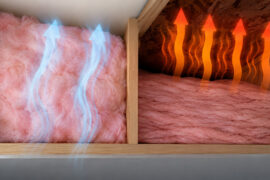
Shredded newspaper and a two-part plastic resin end up fighting over the same stud bay. That is the strange part of this comparison.
Code does not take sides. Attic and wall R-value targets are identical either way. What changes is where each material physically works, and contractors have settled into a pattern: foam in tight cavities, cellulose across open attic runs.
Closed-cell spray foam reaches R-6.0 to R-7.0 per inch, roughly double the R-3.5 to R-3.8 per inch that dense-pack cellulose delivers, according to ArmorThane’s 2026 spray foam technical guide.
What Is the Difference Between Spray Foam and Cellulose Insulation

One material shows up as a liquid and hardens where it lands. The other shows up shredded and stays loose forever.
That is the surface difference. The one that actually matters is mechanical: foam air-seals and insulates in a single pass, while cellulose only insulates and leans on the rest of the building to control airflow.
- Spray foam starts as polyol resin, mixed on site with isocyanate, sprayed wet, then expanded into a rigid or semi-rigid plastic that bonds to framing and sheathing.
- Cellulose is shredded newsprint, mostly post-consumer, treated with a borate compound and blown or packed into open cavities.
Neither one behaves identically job to job. Foam sets into whatever shape it was sprayed into and stays there. Cellulose takes the shape of the cavity, then keeps reacting to gravity and vibration for years.
Homeowners researching how spray foam insulation is formulated often assume it’s one product. Open-cell and closed-cell versions differ enough to change every attribute below.
Cellulose has the same problem. What cellulose insulation actually contains shifts with density and treatment method, not brand name.
Icynene remains one of the longer-established open-cell foam brands, and Greenfiber is generally recognized as the largest cellulose insulation manufacturer in North America.
Spray Foam vs Cellulose Insulation: Side-by-Side Comparison
Thermal resistance, installed cost, air sealing, fire code obligations, recycled content, service life. Those are what the table tracks, and they’re what most quotes end up hinging on.
Spray foam and cellulose are two of several types of insulation materials builders choose between. The gap between these two specifically runs wider than most side-by-side charts admit.
| Attribute | Spray Foam | Cellulose | Notes |
|---|---|---|---|
| R-value per inch | R-3.5 to R-7.0 | R-3.5 to R-3.8 | Closed-cell foam leads; open-cell and cellulose overlap |
| Installed cost per sq ft | $1.70 to $5.00 | $1.10 to $1.80 | Closed-cell foam is the most expensive option |
| Air sealing | Built into the material | Requires a separate air barrier | Foam bonds to framing; cellulose does not |
| Fire code requirement | Thermal or ignition barrier required | No foam-plastic barrier required | Foam is classified as foam plastic under code |
| Recycled content | Low, unless a soy-based blend is used | 75 to 85 percent | Cellulose is made mostly from recycled newsprint |
| Typical lifespan | Long service life, minimal settling | Multiple decades, gradual settling possible | Foam cures rigid; cellulose can compress |
Look at installed cost and the gap stops being academic. Closed-cell foam can run close to three times the price of blown cellulose over the same square footage.
Demilec and Lapolla supply much of the closed-cell chemical systems residential contractors run, while Applegate and Greenfiber lead the cellulose side.
How R-Value and Air Sealing Compare Between Spray Foam and Cellulose
R-value per inch is where these two separate hardest. Closed-cell foam delivers roughly double the thermal resistance of open-cell foam or cellulose, inch for inch.
Contractors size the whole project off that number, since R-value is the baseline metric building departments check against local code minimums.
R-Value Per Inch
Closed-cell spray foam rates between R-6.0 and R-7.0 per inch, the highest of any common insulation material (ArmorThane, 2026).
Open-cell foam falls to R-3.5 to R-3.7 per inch. At that point it’s sitting right on top of cellulose.
- Closed-cell spray foam: R-6.0 to R-7.0 per inch
- Open-cell spray foam: R-3.5 to R-3.7 per inch
- Dense-pack cellulose: R-3.8 per inch (Cellulose Insulation Manufacturers Association)
- Loose-fill cellulose: R-3.5 to R-3.8 per inch
Packing cellulose tighter buys air sealing, not R-value. Past roughly 3.5 pounds per cubic foot the number barely moves, based on field interviews compiled by GreenBuildingAdvisor.
Applegate Insulation markets its dense-pack product for blower-door performance on retrofit jobs. Not for an R-value jump over standard blown cellulose.
Air Sealing and Blower Door Results
The EPA and ENERGY STAR estimate that combined insulation and air sealing work can save homeowners up to 20 percent on heating and cooling costs, or roughly 10 to 20 percent of total energy costs. Spray foam captures more of that range than cellulose manages alone.
Foam bonds directly to framing and sheathing, which closes the small gaps loose material never reaches. Cellulose insulates but does not seal, so it depends on drywall, sheathing and tape doing their part. Most jurisdictions now require a blower door test at project completion, which is the part that catches the difference. Insulation on paper and insulation that actually performs are not the same submission.
A wall insulated with foam and a wall insulated with cellulose can carry identical R-value and still test differently, because air sealing and R-value measure two separate things.
What Spray Foam and Cellulose Insulation Cost
Closed-cell foam is the expensive end. Cellulose is the cheap end. Open-cell sits between them and moves around by region and job complexity.
Every quote eventually collapses into a cost per square foot figure once labor, material and site access are folded in.
Spray Foam Insulation Cost
- Open-cell foam: $1.70 to $2.90 per square foot installed
- Closed-cell foam: $3.00 to $5.00 per square foot installed
Board foot pricing shows the same gap at finer resolution. Open-cell runs $0.35 to $0.55 per board foot, closed-cell runs $1.00 to $2.50 (InsulationRValues.com, 2026).
RetroFoam of Michigan, a national franchise installer, prices closed-cell jobs well above open-cell for identical square footage. Most contractors confirm the same spread on their own quotes.
A full breakdown of how much spray foam insulation costs by project type shows the closed-cell premium holding across attics, walls and crawl spaces.
Cellulose Insulation Cost
Cellulose stays cheaper in almost every region of the United States.
Installed, it runs $1.10 to $1.80 per square foot in 2026. Roughly a third of closed-cell foam for the same coverage (Bhumicalculator, 2026).
- Attic top-ups price lower than wall retrofits
- Dense-pack wall installation costs more than open attic blowing, purely on labor
- Pulling out old insulation first adds $1.50 to $2.00 per square foot on top of the base price
National averages for 2026, all installed:
- Closed-cell spray foam: $3.00 to $5.00 per square foot
- Open-cell spray foam: $1.70 to $2.90 per square foot
- Cellulose insulation: $1.10 to $1.80 per square foot
- Old-material removal premium: adds $1.50 to $2.00 per square foot
How Each Material Handles Moisture and Mold Risk
Closed-cell foam blocks moisture almost completely. Open-cell lets some vapor through. Cellulose absorbs and releases water on its own without falling apart structurally, as long as it eventually gets to dry.
Moisture Behavior in Spray Foam
Closed-cell foam carries a low permeability rating and becomes its own vapor barrier at roughly two inches of thickness.
- Closed-cell foam: low permeability, and it can trap moisture behind the foam layer if water reaches the sheathing from outside
- Open-cell foam: higher permeability, partial vapor movement, faster drying after a leak
Neither foam absorbs water the way a fiber does. That’s why foam manufacturers rarely issue the attic humidity warnings cellulose installers hand out routinely.
Moisture Behavior in Cellulose
A Cold Climate Housing Research Center field study found that wall assemblies stay below the 80 percent relative humidity mold threshold when cellulose is paired with a functioning vapor retarder, and spend most of a winter above that threshold without one (Cold Climate Housing Research Center, 2013).
Sustained exposure above that line is the problem. A brief damp spell is not what rots framing.
Most of the time, cellulose gets wet because a vapor barrier is missing or was installed badly. The insulation itself is rarely the flaw.
- Cellulose absorbs and releases moisture instead of pinning it flat against framing
- Tight packing and thorough air sealing at install time lower the odds of ever hitting that humidity threshold
Nu-Wool tests its cellulose to ASTM C739 and ASTM C1338, the moisture-absorption and fungal-resistance standards insurers tend to ask about after a water claim.
Fire Safety and Building Code Requirements for Spray Foam and Cellulose
Foam is a combustible plastic and always needs a code-approved barrier between it and living space. Cellulose gets treated with a fire retardant, which is not the same as being fireproof, and nobody in the industry claims otherwise.
Fire Code Requirements for Spray Foam
Exposed foam fails inspection in almost every occupied room.
- Thermal barrier: required under IRC Section R316.4, typically half-inch gypsum board rated for 15 minutes of fire resistance
- Ignition barrier: a lighter-duty alternative allowed in attics and crawl spaces with limited access, quarter-inch plywood or particleboard for example
The Spray Polyurethane Foam Alliance publishes the field guidance most inspectors reference when they check barrier compliance.
Most residential jobs just hang standard gypsum board instead of pursuing alternative fire testing. It settles the question of how flammable spray foam insulation is cheaply and in one step.
Fire Code Requirements for Cellulose
No thermal barrier is required here, since cellulose is not classified as foam plastic under the building code.
Its fire rating comes from a borate treatment mixed in during manufacturing, not from anything installed over the material afterward.
That treatment is tested against National Fire Protection Association combustion standards for flame spread and smolder resistance. It is not tested against open flame from a structure fire already burning.
- Borate concentration typically runs 10 to 20 percent of the finished product by weight
- The treatment targets flame spread and smoldering combustion specifically
- Cellulose still follows the same general fire-separation rules as any insulation in an occupied wall or ceiling assembly
Environmental Impact and Recycled Content of Spray Foam vs Cellulose
Cellulose wins on recycled content, and it isn’t close. Foam remains a petrochemical product, though plant-based formulations have narrowed things somewhat.
- Cellulose: 75 to 85 percent recycled paper fiber, mostly post-consumer newsprint and cardboard, treated with 10 to 20 percent borate (Cellulose Insulation Manufacturers Association)
- Spray foam: built primarily from petroleum-derived polyol and isocyanate, with soy-based polyol blends available as a partial substitute
Embodied carbon follows the raw material gap. Making a pound of polyurethane foam burns more processing energy than shredding and treating a pound of old newsprint.
Some installers chase LEED certification credit for high-recycled-content insulation, which favors cellulose on paper even on projects where foam clearly wins on air sealing.
Low-emission certification is a separate question. GREENGUARD Certification evaluates chemical emissions after installation, not the percentage of recycled material that went into the product.
Greenfiber states that roughly 85 percent of its raw material comes from recycled newsprint and cardboard collected through municipal recycling programs.
How Spray Foam and Cellulose Insulation Are Installed
Foam goes on wet and cures in place. Cellulose gets blown in dry through a hose.
Different equipment, different crew size, different site prep. Watch both jobs back to back and they barely look like the same trade.
Installing Spray Foam Insulation
A two-person crew mixes and sprays on site using a heated hose and a plural-component proportioner that meters resin and isocyanate at a fixed ratio.
- Prep the substrate. Surfaces must be clean, dry and within the manufacturer’s temperature range, typically around 20 degrees Fahrenheit minimum for closed-cell systems.
- Spray in passes. Foam goes on in lifts rather than one thick coat, since an oversized single pass can overheat and scorch.
- Trim excess. Cured foam gets cut flush with the framing once it hardens.
- Ventilate and vacate. The crew clears the space while curing finishes.
Graco builds much of the plural-component rig equipment contractors run on residential jobs, feeding both chemical components through a single heated hose.
EPA guidance calls for building occupants to stay out for at least 24 hours after a two-component, high-pressure spray foam job. Individual manufacturers often extend that window for closed-cell products, sometimes to 48 hours or more, since closed-cell’s density slows how fast off-gassing clears.
A homeowner asking whether spray foam insulation is safe after it cures is really asking about that window. Once curing finishes, the material stops reacting and stops releasing anything.
Installing Cellulose Insulation
Cellulose arrives compressed in bales and gets fluffed through a blowing machine before it ever reaches the hose.
Same machine for attics and walls, different settings. A wall cavity needs pressure behind it. An open attic floor does not.
- Load the machine. Bales are broken apart and fed into the hopper.
- Set the density. Loose-fill for open attics, dense-pack for enclosed walls.
- Blow through the hose. Material travels through a flexible hose into the cavity or attic space.
- Check depth or fill. Attic depth gets measured against the target R-value; wall cavities get checked through inspection holes.
Retrofit crews usually drill small holes through existing siding or drywall instead of opening the whole wall, then patch each hole once the cavity fills.
A step-by-step look at how insulation gets installed in an attic covers depth markers and coverage charts in more detail than fits here.
Lifespan and Settling: Which Insulation Lasts Longer
Foam cures into a rigid or semi-rigid structure and stops moving.
Cellulose is loose fiber, so gravity, vibration and moisture cycles all keep working on it.
Modern cellulose can settle up to 20 percent over time in wall cavities that were not packed to a settled density from the start, according to industry data reported by RetroFoam.
That kind of insulation settlement opens a void at the top of the cavity. It does not thin evenly across the wall, which is what makes it annoying.
- Attics settle too, but evenly, so the R-value loss is predictable and usually already baked into coverage charts
- Walls settle unevenly, which is why voids at the top of a stud bay drive most complaints
Dense-pack installation is the standard fix, since material packed tight at install time has less room to move later.
International Cellulose Corporation, maker of the Celbar line, publishes a settled-density coverage chart to account for this. Most cellulose manufacturers do the same.
Foam sidesteps the settling question entirely. The tradeoff shows up later: cured foam cannot be added to or adjusted, while cellulose can be topped up in an afternoon.
Which Insulation Is Better for Your Climate and Building Type
Cold climates reward foam’s air sealing at the rim joist and sill plate. Hot, humid climates care far more about how each material handles vapor.
Building type carries just as much weight as climate. An attic, a finished wall and a crawl space each ask something different of the same two materials.
| DOE Climate Zone | Attic R-value | Wall R-value |
|---|---|---|
| Zone 1-2 (hot) | R-30 to R-38 | R-13 |
| Zone 3-4 (mixed) | R-38 to R-49 | R-13, plus R-5 continuous in zone 4 |
| Zone 6-7 (cold, very cold) | R-60 | R-13, plus R-10 continuous |
ENERGY STAR guidance lines up with that chart: roughly R-30 to R-49 for the warmest zones, up to R-60 once a house sits in a cold or very cold zone.
Those continuous R-5 and R-10 figures in the wall column point to exterior insulation added outside the cavity fill. Neither foam nor cellulose provides that on its own inside a standard stud bay.
Cold Climate Applications
Foam earns its price here. Closed-cell seals the irregular gaps around a sill plate better than any batt or blown material, and it adds vapor control at the exact spot where cold outdoor air meets warm indoor framing. One application handles both jobs in a space nobody wants to crawl into twice.
Meritage Homes, a national production builder, standardizes open-cell foam rather than closed-cell across both its cold and hot climate developments. Which suggests that even builders working cold regions sometimes rate spray foam’s air-sealing performance above the closed-cell vapor control described above.
Hot and Humid Climate Applications
- Open-cell foam and cellulose: both allow partial inward drying toward the interior, which helps when humidity is the bigger enemy
- Closed-cell foam: needs a deliberate drying path designed into the assembly, or it will pin humidity against the sheathing
Coastal and Gulf Coast builders lean toward open-cell foam or cellulose in wall cavities for exactly that reason, saving closed-cell for spots like rim joists where drying paths matter less.
Humidity control down here is less about which material insulates better and more about which one lets the wall dry in the direction it needs to.
Older Homes and Retrofits
Irregular framing and finished walls change the math.
Cellulose fits retrofit insulation work more easily, since it can be blown through small drilled holes without opening a wall.
- Spray foam retrofits usually require opening the wall or ceiling, which adds demolition and patching cost
- Cellulose retrofits work through drilled access holes, patched afterward
- Older homes with knob-and-tube wiring or masonry construction need a contractor who knows both the material and the structure before anything gets installed
Pros and Cons of Spray Foam Insulation vs Cellulose Insulation
Every attribute above turns into a tradeoff the moment somebody actually has to choose.
Pros and Cons of Spray Foam Insulation
What foam does well:
- Highest R-value per inch of any common insulation material
- Air seal and insulation in one application
- Real structural rigidity added to the wall assembly, closed-cell especially
- No settling once cured
Where it costs you:
- Highest installed cost of the two
- Off-gasses during curing, so re-entry has to wait
- Always needs a code-approved barrier in occupied space
Removing spray foam insulation once cured is slow, physical work. Nothing like pulling loose fill out by hand.
Huntsman Corporation, a global polyurethane systems supplier, markets closed-cell foam’s structural contribution as a selling point in hurricane-prone regions, not just its thermal numbers.
Pros and Cons of Cellulose Insulation
Cost and material sourcing are the strongest arguments for cellulose, both covered above.
Whether cellulose insulation is safe to handle and live around comes up constantly, and the borate treatment answers most of that on its own.
What cellulose does well:
- Lowest installed cost of the two
- Highest recycled content, by a wide margin
- Can be topped up or repaired without specialized equipment
- No off-gassing wait after installation
Where it costs you:
- Settles over time in wall cavities if it wasn’t properly dense-packed
- No air seal on its own, so it still depends on the rest of the envelope
- Lower R-value per inch than closed-cell foam, which bites in tight cavities
When Spray Foam or Cellulose Insulation Does Not Make Sense
Neither material belongs in every assembly. The failure modes are specific enough to plan around instead of discovering them two winters later.
When Spray Foam Does Not Make Sense
Trapped moisture causes nearly all of it. The foam itself is rarely the problem.
- Damp masonry or green concrete does not take spray foam well, since the moisture gets sealed in rather than given a way out
- Unvented roof decks with no plan for where moisture goes can trap condensation between the foam and the sheathing
- Budget-limited retrofits where only part of a house gets foamed often leave the untreated sections working against the sealed ones
Oak Ridge National Laboratory’s guidance on spray foam retrofits puts it bluntly: fix every moisture problem in the assembly before the foam goes in, never after.
Spray over a hidden moisture problem and the same seal that makes foam effective is what keeps the problem from drying out.
When Cellulose Does Not Make Sense
Cellulose depends on the rest of the building to keep it dry. That dependency is the whole failure mode.
Crawl spaces with standing water or uncontrolled humidity will saturate it faster than it can dry, especially with no functioning vapor barrier insulation layer underneath.
- Gaps in the air barrier let moist indoor air reach the cellulose, which is a slower and sneakier problem than a bulk water leak
- Older homes sometimes still hold vermiculite insulation, which can carry asbestos, and that has to be identified before new cellulose goes in near it
- Poorly ventilated attics trap the same humidity cellulose is trying to manage, which undermines the material before it gets a fair test
Before blowing new cellulose into a very old wall, telling cellulose and asbestos insulation apart matters more than any performance comparison in this article.
FAQ on Spray Foam Vs Cellulose Insulation
Is Spray Foam Insulation Worth The Higher Cost?
Worth it depends on the cavity and the climate more than the upfront number. Closed-cell foam pays back fastest in tight, cold-climate assemblies where air sealing kills the most heat loss, which is what decides whether spray foam insulation is worth it for a given house.
Does Spray Foam Affect Home Resale Value?
Spray foam rarely shows up as a line item buyers price separately, though inspectors do flag undocumented foam jobs during a sale. Cellulose draws no such attention. A signed installation receipt matters more to resale than which material is in the walls.
Can Spray Foam And Cellulose Be Combined In One House?
Yes, and it happens often. Contractors spray foam at rim joists and sill plates for the air seal, then blow cellulose into the open attic above. Mixing them within a single wall cavity gets avoided, since it muddies both moisture management and inspection.
Can A Homeowner Install Cellulose Or Spray Foam Without A Contractor?
Cellulose is the realistic DIY option. Rental blowing machines and bags of loose-fill insulation are easy to find for attic top-ups. Spray foam requires licensed chemical handling and calibrated equipment, which puts professional installation well ahead of any DIY attempt.
Is Cellulose Irritating To Handle Without Protective Gear?
Yes. Loose fiber and borate dust irritate skin, eyes and airways during installation. Installers wear a dust mask, goggles and long sleeves. Once it settles inside a closed cavity, cellulose poses no ongoing airborne irritation risk to occupants.
How Do You Remove Old Spray Foam Or Cellulose Insulation?
Cured foam has no shortcut. It gets cut, scraped, or ground off the framing by hand, because it will not vacuum out. Cellulose is far easier: an insulation vacuum pulls it through a hose in one pass.
What Should You Check First in Spray Foam Vs Cellulose Insulation?
Check the cavity’s moisture exposure before anything else. That single condition rules out one material before cost, R-value or climate zone ever enter the conversation.
After that, the order goes: climate zone, to set the R-value target, then cavity depth and budget, to pick between whichever options survived the moisture check.
Closed-cell foam still delivers roughly double the R-value per inch of dense-pack cellulose at close to three times the installed price. That inch-for-inch premium only earns its money back in cavities too shallow for cellulose to reach the same target.
The same moisture-first logic carries over when the project moves to insulating basement walls, where below-grade humidity changes both the material choice and the vapor strategy.